Within Recovery Teams
Where Field Exploitation Should Stop
Rapid field answers are useful, but deep disassembly can damage electronics, software and trace evidence.
On this page
- What field teams can safely learn quickly
- Why software and electronics are fragile evidence
- When items should move to exploitation centres
Page outline Jump by section
Introduction
Field exploitation teams are expected to answer urgent battlefield questions quickly: What system was captured? Is it new? What threat does it pose? Yet one of the most important technical-intelligence decisions is knowing when to stop. In the reverse engineering of foreign military technology, excessive field disassembly can destroy precisely the evidence that makes a captured system valuable. Modern weapons increasingly combine software, encrypted storage, sensors, communications modules and complex electronics that may be altered, corrupted or rendered useless by inexperienced handling. Military technical-intelligence doctrine therefore treats field exploitation as a triage activity rather than a full reverse-engineering effort, with deeper analysis transferred to specialised exploitation centres and laboratories.[Bits]bits.defm2 22.401(06TECHINTJuly 27, 2006 — 9 Jun 2006 — TECHINT includes the identification, assessment, collection, exploitation, and evacuation of capt…
The practical challenge is balancing immediate operational needs against long-term intelligence value. A field team may need rapid answers within hours, but a national-level exploitation programme may need the same system preserved intact for months of laboratory examination. The point at which disassembly should stop is therefore governed less by curiosity than by evidence preservation, safety and the limits of field expertise.
What Field Teams Can Safely Learn Quickly
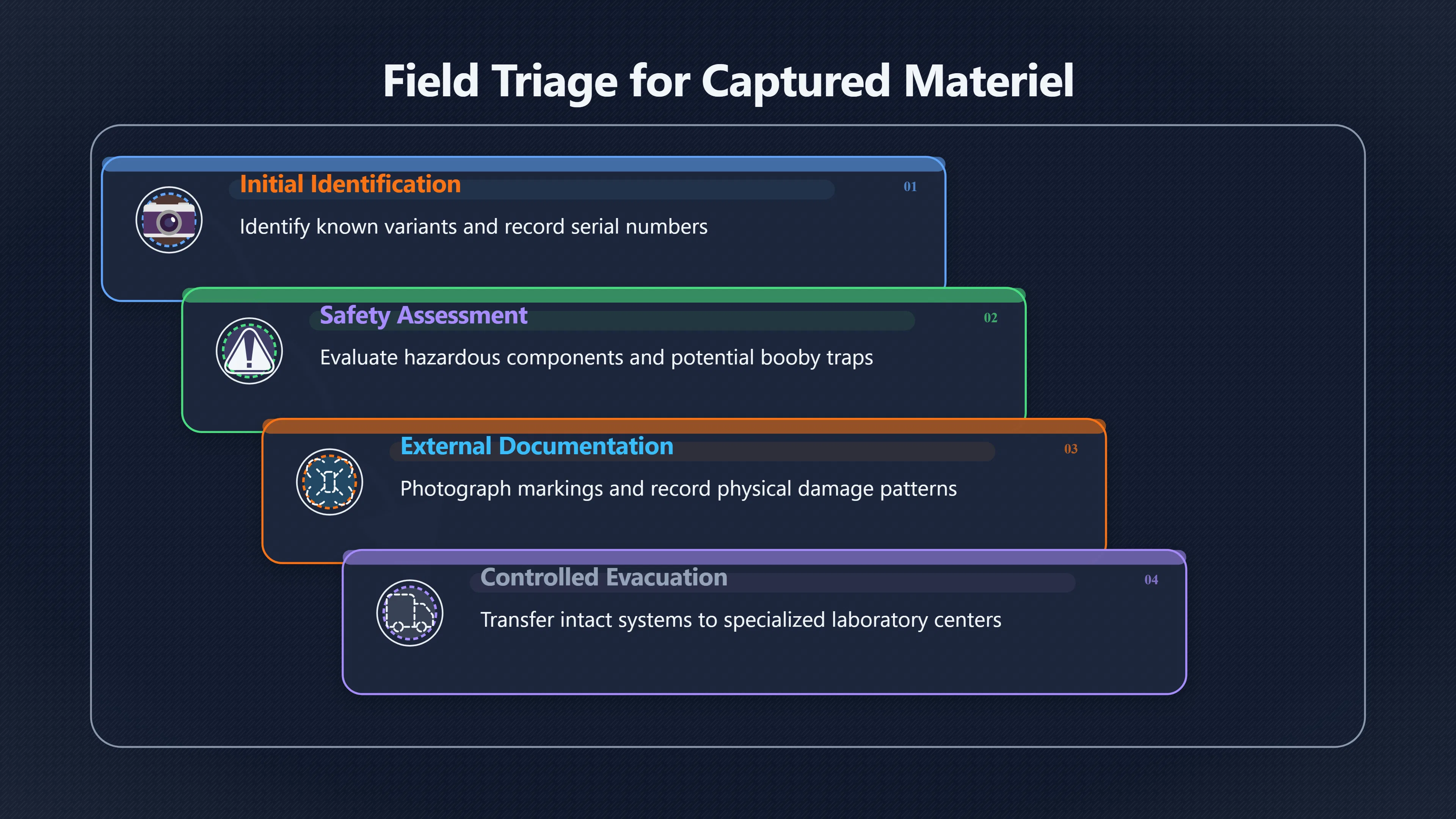
Most technical-intelligence doctrine supports a staged approach. Initial teams focus on identification, documentation, safety assessment and limited examination rather than comprehensive teardown. Captured equipment can often yield useful intelligence through external inspection, photography, serial-number recording, markings analysis, component identification and comparison with known systems. Technical-intelligence guidance has long emphasised identification, assessment, collection and evacuation as distinct activities rather than assuming that every captured item should be fully dismantled where it is found.[Bits]bits.defm2 22.401(06TECHINTJuly 27, 2006 — 9 Jun 2006 — TECHINT includes the identification, assessment, collection, exploitation, and evacuation of capt…
In practice, field teams can often answer several high-priority questions without opening major assemblies:
- Whether the item represents a known or previously unseen variant.
- Manufacturer, production batch or likely date of manufacture.
- Visible modifications indicating local adaptation.
- Obvious sensor, guidance or communications features.
- Physical damage patterns that reveal how the system was employed.
This form of rapid exploitation supports operational reporting while preserving the option for deeper examination later. It mirrors broader exploitation-intelligence practices that separate battlefield triage from specialist exploitation.[Australian Army Research Centre]researchcentre.army.gov.auAustralian Army Research CentreExploitation Intelligence: A New Intelligence Discipline?Exploitation Intelligence (EXINT): the process by…
A useful rule is that every additional step beyond identification should have a specific intelligence requirement attached to it. If removing a cover, disconnecting a module or opening a sealed compartment does not answer an urgent operational question, the burden shifts towards preservation rather than further disassembly.
Why Software and Electronics Are Fragile Evidence
The traditional image of reverse engineering often involves mechanically dismantling hardware. Modern military systems make this increasingly risky.
Many captured systems now contain embedded processors, non-volatile memory, encrypted communications hardware and digital storage. Electronic evidence specialists consistently emphasise that digital evidence is unusually vulnerable to alteration, corruption and loss through seemingly minor handling errors. First responders are trained to avoid unnecessary interaction with digital devices because powering equipment on, disconnecting components or improperly handling storage media can change data or destroy evidential value.[interpol.int]interpol.intGUIDELINES FOR DIGITAL FORENSICS FIRST…April 8, 2021 — In the case of electronic evidence collection, the aim is to avoid the…
For battlefield exploitation teams, several risks arise:
- Data alteration: System logs, mission records and configuration files may change automatically when power states change.
- Memory loss: Volatile information may disappear if power is interrupted incorrectly.
- Component damage: Static discharge, moisture and improvised handling can destroy sensitive electronics.
- Chain-of-custody problems: Unrecorded manipulation can make later technical conclusions less reliable.
- Loss of hidden evidence: Firmware, software configurations and stored operational histories may be more valuable than the visible hardware itself.
The intelligence value of a captured drone, missile seeker or communications device may therefore reside less in its physical construction than in the information stored inside it. Digital-forensics guidance repeatedly stresses preserving original states wherever possible and involving specialists before significant intervention occurs.[interpol.int]interpol.intGUIDELINES FOR DIGITAL FORENSICS FIRST…April 8, 2021 — In the case of electronic evidence collection, the aim is to avoid the…
The Warning Signs That Disassembly Should Stop
The transition point from field exploitation to specialist exploitation is usually reached when further examination risks causing irreversible loss.
Several indicators commonly justify stopping field disassembly:
Encountering sealed electronic modules. Once exploitation reaches integrated electronics packages, encrypted communications hardware or protected storage devices, specialist laboratories generally possess better tools and environmental controls than forward teams.
Presence of software-dependent systems. If useful intelligence may reside in firmware, memory or network configurations rather than hardware structure, preserving the device state becomes more important than exposing additional components.[Interpol]interpol.intGUIDELINES FOR DIGITAL FORENSICS FIRST…April 8, 2021 — In the case of electronic evidence collection, the aim is to avoid the…
Uncertainty about consequences. If technicians cannot confidently predict what opening, disconnecting or powering a subsystem will do, preservation normally becomes the safer intelligence choice.
Potential booby traps or hazardous components. Technical-intelligence doctrine frequently overlaps with explosive ordnance disposal responsibilities because captured systems may contain dangerous mechanisms, energetic materials or anti-tamper features.[Bits]bits.defm2 22.401(06TECHINTJuly 27, 2006 — 9 Jun 2006 — TECHINT includes the identification, assessment, collection, exploitation, and evacuation of capt…
Diminishing intelligence returns. Once external inspection has answered immediate battlefield questions, additional field disassembly may produce little operational benefit while increasing the chance of evidence loss.
The principle resembles crime-scene handling: the first responder’s role is often to preserve opportunities for later specialists rather than exhaust every possible line of inquiry immediately.[interpol.int]interpol.intGUIDELINES FOR DIGITAL FORENSICS FIRST…April 8, 2021 — In the case of electronic evidence collection, the aim is to avoid the…
Why Exploitation Centres Exist
Captured-materiel exploitation centres were created partly to solve this exact problem. They concentrate specialist expertise, laboratory equipment and technical disciplines that field units cannot reasonably maintain close to the front. US and allied doctrine describes captured-materiel exploitation centres as hubs for coordinating battlefield technical intelligence and bringing together experts from engineering, ordnance, electronics and other specialities.[Intelligence Resource Program]irp.fas.orgThe theater's TECHINT unit forms a CMEC from its own assets to conduct and coordinate the command's battlefield TECHINT…Read more…
The historical logic is straightforward. A component damaged during hurried field examination can never be restored to its original state. By contrast, a carefully preserved system can always be examined later.
Cold War exploitation efforts frequently moved important captured systems rapidly to dedicated facilities for detailed analysis. Captured aircraft, missile components and other high-value technologies were often transported largely intact so that specialists could reconstruct design decisions, manufacturing methods and performance characteristics under controlled conditions.[National Security Archive]nsarchive.gwu.eduNational Security Archive The U.SGovernment's Secret Search for Foreign Objects…31 Jan 2018 — From Captured MiGs to Space “Junk” – Military and Intelligence Agents Sco…
Modern systems make this logic even stronger because laboratories can combine hardware analysis, software extraction, materials science, electromagnetic testing and digital forensics in ways impossible for small forward teams.
When Items Should Move to Exploitation Centres
The handoff threshold is generally reached when the expected intelligence gain from laboratory analysis exceeds the expected intelligence gain from continued field work.
Items are strong candidates for immediate transfer when they include:
- Novel guidance, sensing or communications technology.
- Advanced processors, memory devices or software-driven functions.
- Anti-tamper mechanisms or indications of encryption.
- Rare or previously unseen variants.
- Systems likely to support strategic rather than purely tactical intelligence requirements.
- Components whose evidential value depends on preserving original condition.
At that point, the most valuable contribution a field team can make is often meticulous documentation rather than deeper disassembly. Photographs, location data, markings, serial numbers, packaging records and handling logs preserve context while allowing specialist teams to begin work with confidence. Technical-intelligence and exploitation doctrine repeatedly emphasise documentation, collection and controlled evacuation as core functions because intelligence value depends not only on the object itself but also on preserving how it was found and handled.[bits.de]bits.defm2 22.401(06TECHINTJuly 27, 2006 — 9 Jun 2006 — TECHINT includes the identification, assessment, collection, exploitation, and evacuation of capt…
The Governance Principle Behind Stopping Early
The decision to stop disassembly is fundamentally a governance choice rather than a technical failure. It reflects the recognition that intelligence exploitation occurs across multiple levels, from battlefield collection to national laboratories.
Field teams are optimised for speed, access and immediate operational relevance. Exploitation centres are optimised for preservation, specialist analysis and long-term intelligence extraction. Effective technical-intelligence systems therefore establish boundaries between the two. The most successful recovery programmes are not those that dismantle everything at the point of capture, but those that know exactly when to preserve, document and transfer a system before irreversible damage occurs.[bits.de]bits.defm2 22.401(06TECHINTJuly 27, 2006 — 9 Jun 2006 — TECHINT includes the identification, assessment, collection, exploitation, and evacuation of capt…
Amazon book picks
Further Reading
Books and field guides related to Where Field Exploitation Should Stop. Use these as the next step if you want deeper reading beyond the article.

The Pentagon's Brain: An Uncensored History of DARPA, America...
Connects field collection to laboratory exploitation.
Practical Reverse Engineering
Shows why disciplined analysis beats uncontrolled disassembly.
eBay marketplace picks
Marketplace Samples
Live-tested eBay searches with available results related to this page.


Endnotes
1.
Source: bits.de
Title: fm2 22.401(06)
Link:https://www.bits.de/NRANEU/others/amd-us-archive/fm2-22.401%2806%29.pdf
Source snippet
TECHINTJuly 27, 2006 — 9 Jun 2006 — TECHINT includes the identification, assessment, collection, exploitation, and evacuation of capt...
Published: July 27, 2006
2.
Source: interpol.int
Link:https://www.interpol.int/content/download/16243/file/Guidelines_to_Digital_Forensics_First_Responders_V7.pdf
Source snippet
GUIDELINES FOR DIGITAL FORENSICS FIRST...April 8, 2021 — In the case of electronic evidence collection, the aim is to avoid the...
Published: April 8, 2021
3.
Source: irp.fas.org
Link:https://irp.fas.org/doddir/army/fm34-37/Ch8.htm
Source snippet
The theater's TECHINT unit forms a CMEC from its own assets to conduct and coordinate the command's battlefield TECHINT...Read more...
4.
Source: researchcentre.army.gov.au
Link:https://researchcentre.army.gov.au/library/australian-army-journal-aaj/volume-9-number-1-autumn/exploitation-intelligence-new-intelligence-discipline
Source snippet
Australian Army Research CentreExploitation Intelligence: A New Intelligence Discipline?Exploitation Intelligence (EXINT): the process by...
5.
Source: forensicsciencesimplified.org
Link:https://www.forensicsciencesimplified.org/digital/DigitalEvidence.pdf
Source snippet
A Simplified Guide To Digital EvidenceSeizing Stand Alone Computers and Equipment: To prevent the alteration of digital evidence during c...
6.
Source: ojp.gov
Link:https://www.ojp.gov/pdffiles1/nij/219941.pdf
Source snippet
Office of Justice ProgramsElectronic Crime Scene Investigation: A Guide for First...3 Apr 2008 — First responders must use caution when...
7.
Source: nsarchive.gwu.edu
Title: National Security Archive The U.S
Link:https://nsarchive.gwu.edu/briefing-book/intelligence/2018-01-31/scavenging-intelligence-us-governments-secret-search-foreign-objects-during-cold-war
Source snippet
Government's Secret Search for Foreign Objects...31 Jan 2018 — From Captured MiGs to Space “Junk” – Military and Intelligence Agents Sco...
8.
Source: info.publicintelligence.net
Link:https://info.publicintelligence.net/USArmy-DOMEX.pdf
Source snippet
and Media Exploitation TacticsPhotograph the detainee together with [captured material]({{ 'material-ledger/' | relative_url }}). 567. ○ Proximity (establishes relation between ind...
9.
Source: info.publicintelligence.net
Title: USArmy Document Media Exploitation
Link:https://info.publicintelligence.net/USArmy-DocumentMediaExploitation.pdf
Source snippet
1-5. Captured materials are [documents]({{ 'documents/' | relative_url }}), items of equipment, or materiel in the possession of enemy forces that...Read more...
10.
Source: assets.publishing.service.gov.uk
Title: doctrine uk captured persons jdp 1 10
Link:https://assets.publishing.service.gov.uk/media/5f71e2c9e90e0747bfbf9c3a/doctrine_uk_captured_persons_jdp_1_10.pdf
Source snippet
Adverse incidents and allegations on a regular basis, detention...
11.
Source: nsarchive2.gwu.edu
Title: Tactical Site Exploitation
Link:https://nsarchive2.gwu.edu/NSAEBB/NSAEBB410/docs/Tactical%20Site%20Exploitation.pdf
Source snippet
Site Exploitation.pdfPhotograph the location where the detainees were captured. If in a unique hiding place, photograph someone in the hi...
Additional References
12.
Source: cia.gov
Link:https://www.cia.gov/readingroom/docs/CIA-RDP75-00662R000100130077-6.pdf
Source snippet
MILITARY SECURITY CAPTURED ENEMY MATERIALRecognizing the value of intelligence, which can be derived from captured enemy matériel the Joi...
13.
Source: mca-marines.org
Link:https://www.mca-marines.org/wp-content/uploads/35-Why-Site-Exploitation.pdf
Source snippet
Marine Corps AssociationWhy Site ExploitationThe exploitation also provided political effects proving the Soviet involve- ment as capture...
14.
Source: un.org
Link:https://www.un.org/counterterrorism/sites/default/files/guide-first_responders-digital_devices_in_battlefield.pdf
Source snippet
guide-first_responders-digital_devices_in_battlefield.pdfThe document outlines the actions that first responders need to take in the batt...
15.
Source: nllp.jallc.nato.int
Link:https://nllp.jallc.nato.int/cmnt/ciedcoi/CIED%20PUBLICATIONS/Handbooks%20and%20Doctrines/AJP%202.5%28A%29%20Captured%20Persons%2C%20Material%20and%20Documents%20dated%20aug07.pdf
Source snippet
nato.intAJP-2.5(A) CAPTURED PERSONS, MATERIEL AND...Within the operational environment, the amount of time CPERs stay at collecting poin...
16.
Source: esd.whs.mil
Link:https://www.esd.whs.mil/Portals/54/Documents/FOID/Reading%20Room/Detainne_Related/07-F-2406_doc_10.pdf
Source snippet
INTERROGATIONCaptured Materiel Exploitation. The JCh4EC liaison team assists in exploiting sources who have knowledge of captured enemy w...
17.
Source: ecteg.eu
Link:https://www.ecteg.eu/tcf/co/P_FirstResponders.html
18.
Source: scribd.com
Link:https://www.scribd.com/doc/115212321/ATTP
19.
Source: ndupress.ndu.edu
Title: understanding the enemy the enduring value of technical and forensic exploitati
Link:https://ndupress.ndu.edu/Media/News/Article/577571/understanding-the-enemy-the-enduring-value-of-technical-and-forensic-exploitati/
Source snippet
NDU PressUnderstanding the Enemy: The Enduring Value of Technical...30 Sept 2014 — The Joint Captured Material Exploitation Center is on...
20.
Source: s3-eu-west-1.amazonaws.com
Title: Joint Doctrine Publication 1-10
Link:https://s3-eu-west-1.amazonaws.com/s3-euw1-ap-pe-ws4-cws-documents.ri-prod/9781444167320/docs/MOD_Joint_Doctrine_on_Captured_Persons.pdf
Source snippet
Captured Persons (CPERS)Our Armed Forces may capture and detain individuals during an international arm...
21.
Source: bluevoyant.com
Link:https://www.bluevoyant.com/knowledge-center/understanding-digital-forensics-process-techniques-and-tools
Source snippet
Understanding Digital Forensics: Process, Techniques...Digital forensics is the practice of identifying, acquiring, and analyzing elect...
Topic Tree
Follow this branch
Parent topic
Recovery Teams How Captured Hardware Reaches the LabRelated pages 5
- Capture Tags Why the Tag Can Matter as Much as the Weapon
- EOD Safety Making Captured Weapons Safe Without Ruining the Clues
- Photologs The Photos That Save a Wreck's Original Story
- Stop Stripping When Souvenirs Destroy the Intelligence Story
- Vietnam CMEC How Vietnam Turned Captured Gear Into a System