What Captured Weapons Really Reveal
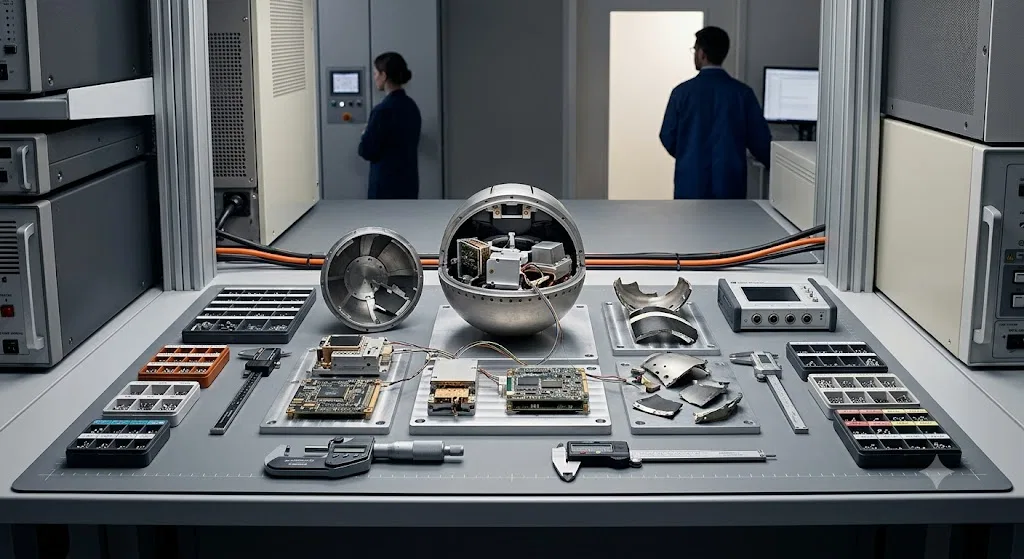
Reverse engineering foreign military technology is the organised study of captured, bought, recovered or otherwise obtained weapons and systems to understand how an adversary’s equipment works, how it can be countered, and what lessons can be absorbed into one’s own defence industry. It is not simply copying.
Page outline Jump by section
Introduction
The subject matters because modern military advantage often depends on knowing the enemy’s equipment more precisely than public specifications allow. A brochure may say a radar can track a target at a certain range; exploitation work asks what it actually sees, what confuses it, how reliable it is, how it is repaired, and whether it contains design shortcuts. The United States, Soviet Union, Russia, China, Ukraine and many others have all treated foreign materiel as a source of intelligence, countermeasures and industrial learning. Official US descriptions of foreign materiel exploitation show that this remains a standing intelligence mission, not merely a Cold War curiosity.[Nasic]nasic.af.milNasic Acquire, Assess, ExploitAcquire, Assess, ExploitNovember 21, 2016 — 21 Nov 2016 — The Department of Defense's foreign materiel acquisition and exploitation…
What “reverse engineering” really means in a military setting
In civilian technology, reverse engineering often means taking apart a product to understand or reproduce it. In military intelligence, the term is broader. Analysts may want to copy a component, but they may also want to build a simulator, design a countermeasure, train pilots against a realistic threat, identify supply-chain dependencies, or brief commanders on the limits of a weapon system.
A useful distinction is between exploitation and replication. Exploitation means extracting intelligence from foreign equipment: what it does, how it is built, what frequencies it uses, how it fails, and what tactics it implies. Replication means making a copy or derivative. The two overlap, but they are not the same. The US National Air and Space Intelligence Center, for example, describes foreign materiel exploitation as work on air, space and cyberspace-related military systems to improve understanding of potential adversary capabilities; a 2017 facility expansion was explicitly intended to strengthen that mission.[Nasic]nasic.af.milnasic opens new fme facilityNASIC opens new FME facility27 Oct 2017 — FME analysts exploit air, space and cyberspace-related military systems that helps provide…
The practical outputs can be very different:
- Operational intelligence: pilots, air-defence crews or electronic warfare teams learn what an adversary system can and cannot do.
- Countermeasures: engineers design jammers, decoys, armour changes, radar modes or missile-warning logic based on real measurements.
- Training realism: captured or replicated threat systems make exercises more faithful than paper estimates.
- Industrial learning: a state may copy a whole system, imitate a subsystem, or learn manufacturing methods.
- Supply-chain intelligence: investigators identify foreign chips, sensors, engines or materials inside weapons and trace how they reached the user.
This is why military reverse engineering is usually multidisciplinary. A tank, aircraft or missile is not just a mechanical object. It is a bundle of metallurgy, electronics, software, optics, radio-frequency behaviour, production tolerances, logistics assumptions and doctrine.
Why states take foreign equipment apart
The basic motive is uncertainty reduction. States rarely know exactly how a rival’s newest weapons perform. Intelligence can come from satellites, defectors, export brochures, combat observation and signals collection, but physical access to the hardware is uniquely valuable because it turns estimates into measurements.
The US Army’s budget justification for “Exploitation of Foreign Items” states the aim plainly: acquiring and exploiting foreign ground materiel reduces uncertainty about threats, supports research and development, provides material for realistic testing and training, and aids countermeasure development. It also notes that captured threat materiel may require immediate exploitation to develop force-protection measures.[Army Financial Management]asafm.army.milFinancial Management RDTEFinancial Management RDTE
There are four recurring reasons states value this work.
First, performance claims are often misleading. Adversaries exaggerate, misunderstand or conceal capabilities. A famous example is the Soviet MiG-25. Before the aircraft was examined closely after Viktor Belenko’s 1976 defection to Japan, Western observers had feared an extremely advanced “superfighter”. The subsequent US-Japanese exploitation showed a formidable interceptor, but also one whose design made trade-offs in avionics, structure and manoeuvrability. A Defense Intelligence Agency exploitation report on the MiG-25 covered materials, structures, aerodynamics, avionics, radar, flight control and related implications.[fordlibrarymuseum.gov]fordlibrarymuseum.govOpen source on fordlibrarymuseum.gov.
Second, countermeasures require exactness. Electronic warfare and air defence are unforgiving domains. Knowing that an enemy radar exists is less useful than knowing its operating modes, antenna behaviour, signal patterns and vulnerability to deception or jamming. The same applies to missile seekers, datalinks and drone navigation systems.
Third, foreign equipment reveals industrial capacity. A weapon’s internal construction can show whether a state has advanced domestic electronics, depends on imported components, uses rugged but old-fashioned designs, or has solved difficult manufacturing problems. Investigations into weapons used in Ukraine, for instance, have traced components in Russian, Iranian and North Korean missile and UAV debris, linking technical analysis to supply-chain enforcement and sanctions policy.[IISS]iiss.orgTracking the Components of Missiles and UAVs Used byTracking the Components of Missiles and UAVs Used by
Fourth, reverse engineering can shorten development cycles. Copying an entire system is difficult, but copying a good idea, seeker layout, aerodynamic feature, fuse concept or manufacturing trick can save years. That is why military organisations have historically raced to secure enemy aircraft, missiles, radars and documents at the end of wars or after defections.
The Cold War made captured technology unusually valuable
The Second World War and early Cold War created some of the clearest examples of organised foreign technology exploitation. At the end of the war in Europe, the United States launched Operation LUSTY, short for “Luftwaffe Secret Technology”, to capture and evaluate German aircraft, documents, research facilities and weapons. The National Museum of the US Air Force describes the operation as an effort to exploit German scientific documents, research facilities and aircraft, with one team collecting enemy aircraft and weapons for examination in the United States.[Air Force Museum]nationalmuseum.af.milAir Force Museum Operation LUSTYAir Force Museum Operation LUSTY
This was not only about curiosity. Germany had fielded jet aircraft, advanced rockets, guided weapons and sophisticated aeronautical research. Allied forces wanted to know what had been achieved, what could be used, and what must not fall exclusively into Soviet hands. NASIC’s own heritage account says that captured German and Japanese aircraft began arriving at Wright Field in 1943, and that after the war captured documents and German technical specialists became part of the wider exploitation effort.[Nasic]nasic.af.milOpen source on af.mil.
Project Paperclip, often discussed alongside captured hardware programmes, brought German and Austrian scientists, engineers and technicians to the United States after the Second World War. The Smithsonian’s National Air and Space Museum notes that the programme was first called Project Overcast and was intended to bring experts to the US for a limited period to help the war against Japan, although it later became tied to American rocketry and the early space age.[National Air and Space Museum]airandspace.si.eduproject paperclip and american rocketry after world war iiproject paperclip and american rocketry after world war ii
The Soviet Union pursued similar gains. The post-war Soviet R-1 rocket drew on captured German V-2 technology and personnel, while the Tupolev Tu-4 bomber became one of the most striking examples of aircraft replication. After several US B-29 Superfortresses landed in Soviet territory during the war, Stalin ordered Tupolev to duplicate the aircraft rapidly rather than merely design a similar bomber. The resulting Tu-4 first flew in 1947 and entered service in 1949, after a large industrial reverse-engineering effort that had to translate US materials, dimensions and components into Soviet production reality.[Wikipedia]WikipediaTupolev Tu-4Tupolev Tu-4
These cases show a central truth: reverse engineering is easiest when a state already has a strong industrial base. Capturing a sophisticated system is not the same as being able to reproduce it. The Soviet Tu-4 was possible because the USSR could mobilise design bureaus, factories, metallurgists and state authority on a huge scale. Even then, copying involved redesigning around different measurement systems, materials and engines.[Wikipedia]WikipediaTupolev Tu-4Tupolev Tu-4
Case study: the Sidewinder and the limits of “copying”
The AIM-9 Sidewinder story is often used as the neatest example of military reverse engineering. In 1958, an AIM-9B fired by a Taiwanese aircraft reportedly lodged in a Chinese MiG-17 without exploding. The missile was then transferred to the Soviet Union, where it informed the K-13 or R-3S missile, known in NATO reporting as the AA-2 “Atoll”. The broad claim that the Soviet K-13 was a reverse-engineered copy of the AIM-9B is widely repeated in aviation histories and technical summaries.[Wikipedia]WikipediaAIM-9 SidewinderAIM-9 Sidewinder
The episode is memorable because it shows how valuable even one intact weapon can be. An air-to-air missile contains far more than a warhead and motor. It includes a seeker, control surfaces, gyros, fusing, cooling arrangements, electronics, materials and manufacturing choices. For a state trying to master compact infrared-guided missiles, the internal architecture of a working example can reveal a design logic that is hard to infer from photographs.
Yet the Sidewinder case also illustrates why “copying” is not magic. A successful reverse-engineered weapon still has to be manufactured at scale, integrated onto aircraft, tested, maintained and improved. The copied object may solve one design problem while creating others. In missile technology especially, production quality and seeker reliability matter as much as external resemblance.
A better way to read the Sidewinder case is not “one missile changed everything”, but “one missile gave engineers a working reference design”. That reference could accelerate a programme, but it did not remove the need for a supporting industrial system, test infrastructure and operational doctrine.
Case study: the MiG-25 showed why direct access beats speculation
Viktor Belenko’s 1976 flight of a Soviet MiG-25P to Hakodate, Japan, created one of the most consequential aircraft exploitation opportunities of the Cold War. Japan did not permit the United States to fly the aircraft away, but Japanese and American specialists disassembled and studied it before it was returned to the Soviet Union. The DIA’s special equipment exploitation reporting covered major aircraft systems and explicitly stated that the data came from Japanese Self-Defense Forces and a US exploitation team.[fordlibrarymuseum.gov]fordlibrarymuseum.govOpen source on fordlibrarymuseum.gov.
The most important result was not that the MiG-25 was “bad”. It was that the aircraft was understood more accurately. It was extremely fast and dangerous in its intended high-speed interception role, but the examination reduced inflated Western fears about its technology level. Its design reflected Soviet priorities: speed, altitude, powerful radar and robust construction rather than the kind of manoeuvring performance and avionics sophistication Western observers had sometimes imagined.[fordlibrarymuseum.gov]fordlibrarymuseum.govOpen source on fordlibrarymuseum.gov.
For readers, the lesson is that reverse engineering often corrects both overestimation and underestimation. Militaries can be just as vulnerable to fear-driven analysis as to complacency. Physical exploitation gives analysts a firmer basis for procurement, tactics and threat modelling.
The political consequences also mattered. The defection strained Japan-Soviet relations and generated pressure over returning the aircraft. Captured or defected equipment is never just a technical object; it is a diplomatic incident, an intelligence prize and a propaganda symbol at the same time.
Foreign materiel exploitation today is faster and more digital
Modern foreign technology exploitation still includes aircraft, tanks, missiles and radars, but the centre of gravity has shifted towards electronics, software, radio-frequency behaviour and supply chains. A captured drone, missile or electronic warfare device may be valuable less because of its metal body than because of its navigation unit, camera module, modem, processor, antenna design or firmware.
Ukraine has made this visible. Since Russia’s full-scale invasion in 2022, Ukrainian forces and partner organisations have examined large quantities of Russian equipment, missile debris, drones and electronic systems. Conflict Armament Research has documented weapons and ammunition in Ukraine and has also traced components inside Russian systems, while later IISS research drawing partly on CAR field investigations examined the technological make-up and procurement routes of components in Russian, Iranian and North Korean missiles and UAVs used in Ukraine.[conflictarm.com]conflictarm.comOpen source on conflictarm.com.
This kind of exploitation has several purposes at once. It helps defenders understand how weapons navigate, communicate and resist jamming. It helps governments identify sanctions evasion routes. It also helps industry build counter-drone and electronic warfare systems that respond to what is actually appearing on the battlefield, not just what intelligence assessments predicted.
The cycle is quickening. A 2025 Royal United Services Institute report on competitive electronic warfare in land operations argued that rapidly exploiting captured equipment could allow electronic warfare payloads to be generated closer to the front and faster, creating a more responsive cycle of adaptation.[RUSI]static.rusi.orgCompetitive Electronic Warfare in Modern Land OperationsCompetitive Electronic Warfare in Modern Land Operations
Russia also tries to exploit captured Western equipment. Reuters reported in July 2024 that Russian state media said specialists were studying an intact guidance system from a US-made ATACMS missile, with Russian commentary framing the work as a way to identify weaknesses and adjust air defence and electronic warfare responses. Such claims from state media should be treated carefully, but they fit the long-standing pattern: battlefield debris and captured systems are used to improve countermeasures as well as propaganda.[Reuters]reuters.comOpen source on reuters.com.
What can be learned from captured systems
A captured weapon rarely yields a single secret. Instead, it produces layers of understanding.
Physical construction reveals materials, tolerances, corrosion protection, armour layout, heat treatment, modularity and manufacturing quality. Analysts can infer whether a system is designed for long service life, rapid mass production, harsh storage, easy repair or one-way expendability.
Electronics and software reveal processors, sensors, memory, navigation aids, encryption habits, circuit-board workmanship and dependencies on foreign components. In modern missiles and drones, these details can be more strategically important than the airframe.
Signatures matter because many military contests are contests of detection. Aircraft, ships, radars, datalinks and missiles all emit or reflect energy in patterns. Measuring those patterns helps build warning receivers, decoys, electronic attack tools and realistic simulators.
Human factors reveal how crews actually use the equipment. Cockpit layout, maintenance access, diagnostic systems and field repair practices all show assumptions about training, logistics and doctrine.
Industrial clues reveal whether a state is innovating, improvising or compensating for shortages. A weapon may show elegant design in one area and crude substitution in another. That unevenness is often more informative than a simple ranking of “advanced” or “backward”.
This is why public fascination with “copying” can miss the greater value. Often the prize is not a blueprint but a map of strengths, weaknesses and assumptions.
Why reverse engineering often fails to produce a clean copy
The popular image of reverse engineering suggests that once a weapon is taken apart, it can be rebuilt. In reality, copying foreign military technology is constrained by tacit knowledge: the undocumented know-how embedded in workers, suppliers, test engineers and production cultures.
A state may measure every part of a missile and still struggle to reproduce the propellant, seeker reliability, sensor cooling, software integration or quality-control process. It may understand a radar’s architecture but lack the semiconductor base to produce equivalent components. It may copy an airframe but not the engine life, coatings, datalinks or maintenance system that make it effective.
The Tu-4 example shows both the power and pain of replication. Soviet engineers could copy the B-29 closely, but only by mobilising hundreds of factories and research institutes, translating measurements, replacing unavailable materials and making bureaucratically controlled decisions about every deviation from the original.[Wikipedia]WikipediaTupolev Tu-4Tupolev Tu-4
There are also strategic reasons not to copy exactly. A captured system may reflect the enemy’s doctrine rather than one’s own. It may be too expensive, too maintenance-heavy, too dependent on imported components, or already obsolete by the time replication is complete. In many cases, the best outcome is selective learning: copy the idea, not the object.
The legal and ethical boundaries are messy
Foreign materiel exploitation is not automatically unlawful. Capturing enemy equipment during armed conflict and studying it has long been part of war. The harder questions arise around espionage, export controls, intellectual property, post-conflict transfers, and the use of scientists or prisoners.
Export-control regimes exist partly because states understand that technology transfer is not limited to finished weapons. The Wassenaar Arrangement, established to promote transparency and responsibility in transfers of conventional arms and dual-use goods and technologies, explicitly covers sensitive technologies as well as physical goods. Its best-practice documents include controls on intangible transfers of technology, such as technical data and know-how passed without a physical shipment.[wassenaar.org]wassenaar.orgWA DOC 15 SEC 001 Basic Documents 2015 JanuaryWA DOC 15 SEC 001 Basic Documents 2015 January
That matters because reverse engineering sits in the same ecosystem as procurement, espionage and industrial policy. A state may legally study captured battlefield debris, but the spread of technical data, manufacturing instructions or controlled components can raise separate export-control and proliferation concerns. Research on intangible technology transfer has also warned that controls are difficult to apply because the capability to manufacture strategic technologies depends heavily on tacit knowledge as well as physical items.[Strategic Trade Research Institute]strategictraderesearch.orgOpen source on strategictraderesearch.org.
Ethically, the Second World War cases remain uncomfortable. Operation Paperclip advanced American aerospace and missile work, but it also involved bringing German specialists into US programmes after a war in which Nazi Germany had used forced labour and committed mass atrocities. The Smithsonian account notes the programme’s role in bringing German and Austrian experts to the United States, while broader historical debate centres on the moral cost of using enemy expertise after catastrophic war.[National Air and Space Museum]airandspace.si.eduproject paperclip and american rocketry after world war iiproject paperclip and american rocketry after world war ii

Myths that distort the topic
The first myth is that capturing a weapon instantly transfers its capability. Hardware helps, but the harder parts are production, testing, integration, training and doctrine. A single missile can reveal design logic; it does not automatically create an industrial base.
The second myth is that reverse engineering is always about inferior states copying superior ones. In reality, every major military power studies foreign technology. The United States exploited German and Japanese equipment during the Second World War, Soviet MiGs during the Cold War, and current adversary systems through standing intelligence organisations. NASIC’s public history explicitly ties today’s foreign materiel exploitation mission to earlier captured-aircraft work.[Nasic]nasic.af.milnasic opens new fme facilityNASIC opens new FME facility27 Oct 2017 — FME analysts exploit air, space and cyberspace-related military systems that helps provide…
The third myth is that the value is always in the most advanced component. Sometimes the most useful discovery is a weakness, a cheap substitute, a supply-chain dependency, or a maintenance burden. In sanctions enforcement, identifying ordinary commercial components inside weapons can be more useful than admiring a sophisticated subsystem.
The fourth myth is that public claims of reverse-engineering success should be accepted at face value. States have incentives to exaggerate what they learned from captured enemy systems. Claims about studying a missile, tank or drone may be true in a narrow sense while overstating the practical result. Serious assessment asks what was captured, how intact it was, whether the captor has the industrial base to exploit it, and whether any operational change followed.
Why the topic still matters
Reverse engineering foreign military technology remains important because wars are now adaptation contests. A weapon introduced in January may face countermeasures by March. A drone navigation method, radio link, missile seeker or jammer waveform can become a battlefield advantage only until the other side captures enough evidence to understand and blunt it.
The Russia-Ukraine war has made this especially clear. Both sides adapt drones, jammers, navigation methods, armour and air-defence tactics at speed. Technical exploitation is no longer only a rear-area intelligence function feeding long-term procurement. It is increasingly part of a live feedback loop between the battlefield, laboratories, software teams, manufacturers and commanders. RUSI’s discussion of faster exploitation cycles in electronic warfare captures this shift: the side that learns from captured equipment fastest may gain temporary but real tactical advantages.[RUSI]static.rusi.orgCompetitive Electronic Warfare in Modern Land OperationsCompetitive Electronic Warfare in Modern Land Operations
The enduring lesson is sober rather than sensational. Foreign military technology is rarely a magic secret waiting to be stolen. It is evidence. When handled well, that evidence can correct threat assessments, reveal vulnerabilities, guide countermeasures, expose supply chains and accelerate domestic learning. When misunderstood, it can lead to exaggerated fears, false confidence or expensive attempts to copy systems that do not fit one’s own military needs.
Amazon book picks
Further Reading
Books and field guides related to What Captured Weapons Really Reveal. Use these as the next step if you want deeper reading beyond the article.
Skunk Works
Explains how advanced aerospace systems are evaluated, developed and understood in competitive military environments.

The Pentagon's Brain: An Uncensored History of DARPA, America...
Provides context on how governments exploit technology and intelligence for defense purposes.
The Craft of Intelligence
Helps readers understand how intelligence organizations turn information into actionable knowledge.
eBay marketplace picks
Marketplace Samples
Live-tested eBay searches with available results related to this page.


Endnotes
1.
Source: asafm.army.mil
Title: Financial Management RDTE
Link:https://www.asafm.army.mil/Portals/72/Documents/BudgetMaterial/2027/Discretionary%20Budget/rdte/RDTE%20-%20Vol%204%20-%20Budget%20Activity%206.pdf
2.
Source: fordlibrarymuseum.gov
Link:https://www.fordlibrarymuseum.gov/library/document/0324/1553704.pdf
3.
Source: Wikipedia
Title: Defection of Viktor Belenko
Link:https://en.wikipedia.org/wiki/Defection_of_Viktor_Belenko
4.
Source: iiss.org
Title: Tracking the Components of Missiles and UAVs Used by
Link:https://www.iiss.org/globalassets/media-library—content–migration/files/research-papers/2025/09/pub25-094-tracking-the-components-of-missiles-and-uavs-used-by-russia-in-ukraine.pdf
5.
Source: Wikipedia
Title: Tupolev Tu-4
Link:https://en.wikipedia.org/wiki/Tupolev_Tu-4
6.
Source: Wikipedia
Title: AIM-9 Sidewinder
Link:https://en.wikipedia.org/wiki/AIM-9_Sidewinder
7.
Source: conflictarm.com
Link:https://www.conflictarm.com/reports/weapons-of-the-war-in-ukraine/
8.
Source: static.rusi.org
Title: Competitive Electronic Warfare in Modern Land Operations
Link:https://static.rusi.org/competitive-electronic-warfare-in-land-operations_1.pdf
9.
Source: reuters.com
Link:https://www.reuters.com/world/europe/russia-is-studying-an-intact-us-atacms-missile-guidance-system-says-ria-2024-07-01/
10.
Source: wassenaar.org
Title: WA DOC 15 SEC 001 Basic Documents 2015 January
Link:https://www.wassenaar.org/app/uploads/2015/07/WA-DOC-15-SEC-001-Basic-Documents-2015-January.pdf
11.
Source: wassenaar.org
Link:https://www.wassenaar.org/best-practices/
12.
Source: wassenaar.org
Link:https://www.wassenaar.org/app/uploads/2019/consolidated/ITT_Best_Practices_for_public_statement_2006.pdf
13.
Source: Wikipedia
Title: Reverse engineering
Link:https://en.wikipedia.org/wiki/Reverse_engineering
14.
Source: Wikipedia
Link:https://en.wikipedia.org/wiki/Defense
15.
Source: Wikipedia
Title: Operation LUSTY
Link:https://en.wikipedia.org/wiki/Operation_LUSTY
16.
Source: Wikipedia
Title: Operation Paperclip
Link:https://en.wikipedia.org/wiki/Operation_Paperclip
17.
Source: armysbir.army.mil
Link:https://armysbir.army.mil/topics/reverse-engineering-equipment/
18.
Source: usainscom.army.mil
Link:https://www.usainscom.army.mil/MSCs/NGIC/
19.
Source: mipb.ikn.army.mil
Link:https://mipb.ikn.army.mil/media/kibjbqed/2020-01-03-building-the-base-using-the-armys-intelligence-program-of-analysis-to-drive-foundational-intelligence.pdf
20.
Source: army.mil
Title: reserve mi battalion conducts training exercise
Link:https://www.army.mil/article/56806/reserve_mi_battalion_conducts_training_exercise
21.
Source: home.army.mil
Title: ATP 2 01.3 Intelligence Preparation of the Battlefield
Link:https://home.army.mil/wood/application/files/8915/5751/8365/ATP_2-01.3_Intelligence_Preparation_of_the_Battlefield.pdf
22.
Source: odin.t2com.army.mil
Title: Chapter 3: Operational Environment Enterprise Support
Link:https://odin.t2com.army.mil/TC/Chapter_3%3A_Operational_Environment_Enterprise_Support
23.
Source: api.army.mil
Title: theater intelligence primer oct 18 public
Link:https://api.army.mil/e2/c/downloads/2023/01/31/99eea2fd/theater-intelligence-primer-oct-18-public.pdf
24.
Source: mipb.ikn.army.mil
Title: mil The Army Intelligence Program of Analysis
Link:https://mipb.ikn.army.mil/media/hxgjry4o/mipb-2018-07-09-full-issue.pdf
25.
Source: cpeisw.army.mil
Title: mil Pd M TENCAP
26.
Source: cpeisw.army.mil
Title: mil P M IS&A
Link:https://cpeisw.army.mil/pm-isa/
27.
Source: fordlibrarymuseum.gov
Link:https://www.fordlibrarymuseum.gov/library/document/0324/1553702.pdf
28.
Source: wassenaar.org
Link:https://www.wassenaar.org/app/uploads/2019/12/WA-DOC-19-PUB-005-Public-Docs-Vol-III-Comp.-of-Best-Practice-Documents-Dec.-2019.pdf
29.
Source: conflictarm.com
Link:https://www.conflictarm.com/wp-content/uploads/2021/11/Weapons-of-the-war-in-Ukraine-low.pdf
30.
Source: mindef.gov.sg
Link:https://www.mindef.gov.sg/
31.
Source: defense.com
Link:https://www.defense.com/
32.
Source: nasic.af.mil
Title: Nasic Acquire, Assess, Exploit
Link:https://www.nasic.af.mil/News/Article-Display/Article/1010245/acquire-assess-exploit/
Source snippet
Acquire, Assess, ExploitNovember 21, 2016 — 21 Nov 2016 — The Department of Defense's foreign materiel acquisition and exploitation...
Published: November 21, 2016
33.
Source: nasic.af.mil
Title: nasic opens new fme facility
Link:https://www.nasic.af.mil/News/Article-Display/Article/1356030/nasic-opens-new-fme-facility/
Source snippet
NASIC opens new FME facility27 Oct 2017 — FME analysts exploit air, space and cyberspace-related military systems that helps provide...
34.
Source: nationalmuseum.af.mil
Title: Air Force Museum Operation LUSTY
Link:https://www.nationalmuseum.af.mil/Visit/Museum-Exhibits/Fact-Sheets/Display/Article/196144/operation-lusty/
35.
Source: nasic.af.mil
Link:https://www.nasic.af.mil/About-Us/Fact-Sheets/Article/611728/national-air-and-space-intelligence-center-heritage/
36.
Source: airandspace.si.edu
Title: project paperclip and american rocketry after world war ii
Link:https://airandspace.si.edu/stories/editorial/project-paperclip-and-american-rocketry-after-world-war-ii
37.
Source: strategictraderesearch.org
Link:https://strategictraderesearch.org/wp-content/uploads/2017/09/4_The_Contribution_of_Intangible_Technology_Controls_in_Controlling_the_Spread-of-Strategic-Technologies.pdf
38.
Source: nationalmuseum.af.mil
Title: mil American Raiders
Link:https://www.nationalmuseum.af.mil/Portals/7/documents/transcripts/american_raiders_transcript.pdf
39.
Source: nasic.af.mil
Link:https://www.nasic.af.mil/News/Photos/igphoto/2001670881/
40.
Source: nasic.af.mil
Title: mil Photos
Link:https://www.nasic.af.mil/News/Photos/?igpage=31
41.
Source: nasic.af.mil
Title: mil Photos
Link:https://www.nasic.af.mil/News/Photos/igpage/6/igsort/Title/
42.
Source: dictionary.cambridge.org
Link:https://dictionary.cambridge.org/dictionary/english/defense
43.
Source: indianamilitary.org
Link:https://www.indianamilitary.org/FreemanAAF/OperationLusty/OPERATION-LUSTY.pdf
44.
Source: nationalww2museum.org
Link:https://www.nationalww2museum.org/watch/project-paperclip-wwii-2
Additional References
45.
Source: youtube.com
Title: Analyzing Military Technology
Link:https://www.youtube.com/watch?v=c0uvhG29aeM
Source snippet
[Ukraine TrophyLab]({{ 'trophy-lab/' | relative_url }}) shares captured Russian weapons with friendly nations Reverse Engineering Goldmine...
46.
Source: youtube.com
Link:https://www.youtube.com/watch?v=Gszsxp8omZc
Source snippet
Reverse engineering Iran's air defense tracking system...
47.
Source: youtube.com
Title: Aviation Historian Peter Merlin talks about the Russian Mi Gs at AREA 51
Link:https://www.youtube.com/watch?v=t79ndKspdvQ
Source snippet
Russia & Iran Are Rebuilding Western Weapons Cheaper...
48.
Source: cia.gov
Link:https://www.cia.gov/readingroom/docs/CIA-RDP90-00806R000100140073-5.pdf
49.
Source: youtube.com
Title: Russia & Iran Are Rebuilding Western Weapons Cheaper
Link:https://www.youtube.com/watch?v=9-St-2ySqsM
Source snippet
Analyzing Military Technology - Javelin and Maverick Missiles...
50.
Source: microsoft.com
Link:https://www.microsoft.com/en-us/microsoft-365-life-hacks/writing/defence-vs-defense-whats-the-difference
51.
Source: airandspaceforces.com
Link:https://www.airandspaceforces.com/article/0609bomber/
52.
Source: storymaps.arcgis.com
Link:https://storymaps.arcgis.com/stories/00594bef40bc4148b16dc7267172d033
53.
Source: reddit.com
Link:https://www.reddit.com/r/WarCollege/comments/yamwfx/are_there_any_notable_or_suspected_examples_of/
54.
Source: linkedin.com
Link:https://www.linkedin.com/posts/brunogiussani_ukraine-open-sources-russian-weapons-weapons-activity-7478021826900824064-ZRYp
Topic Tree
Follow this branch
More on this topic 30
- Battlefield Intel What Captured Weapons Tell Commanders
- Cold War Race Why the Cold War Prized Captured Machines
- Countermeasures Why Countermeasures Need Real Hardware
- Defections When Defectors Bring the Hardware
- Docs vs Hardware Paper Plans or Real Machines?
- Drone Debris What Crashed Drones Can Reveal
- Ethics Where Captured Technology Gets Complicated
- Exploit vs Copy Is Reverse Engineering Just Copying?
- +22 more in sidebar