Within Radar Signatures
When a Radar Becomes a Real Threat
Search, acquisition, tracking and guidance modes can emit differently, giving crews earlier clues that a radar is becoming lethal.
On this page
- Search mode versus track mode
- Weapon support signatures and escalation
- Why mode timing matters to countermeasures
Page outline Jump by section
Introduction
A radar does not become dangerous simply because it is transmitting. What matters is how it is transmitting at a given moment. One of the most valuable insights gained from radar exploitation is that many military radars change their emission patterns as they move from searching for targets to preparing a weapon engagement. Those changes can provide the earliest warning that a situation is escalating from surveillance to attack. By studying captured systems and correlating their emissions with operational modes, analysts can teach radar warning receivers (RWRs) and electronic-support systems to recognise not just a radar’s identity, but its intent.[Wikipedia]WikipediaFire-control radarFire-control radar
Within the broader field of radar exploitation and electronic signatures, mode changes are important because they reveal a transition in the kill chain. A wide-area search radar may represent awareness. A dedicated tracking or guidance mode may indicate that a weapon system is actively preparing to engage. Understanding where those transitions occur allows crews to react before a missile is launched.[Wikipedia]WikipediaFire-control radarFire-control radar
Search Mode Versus Track Mode
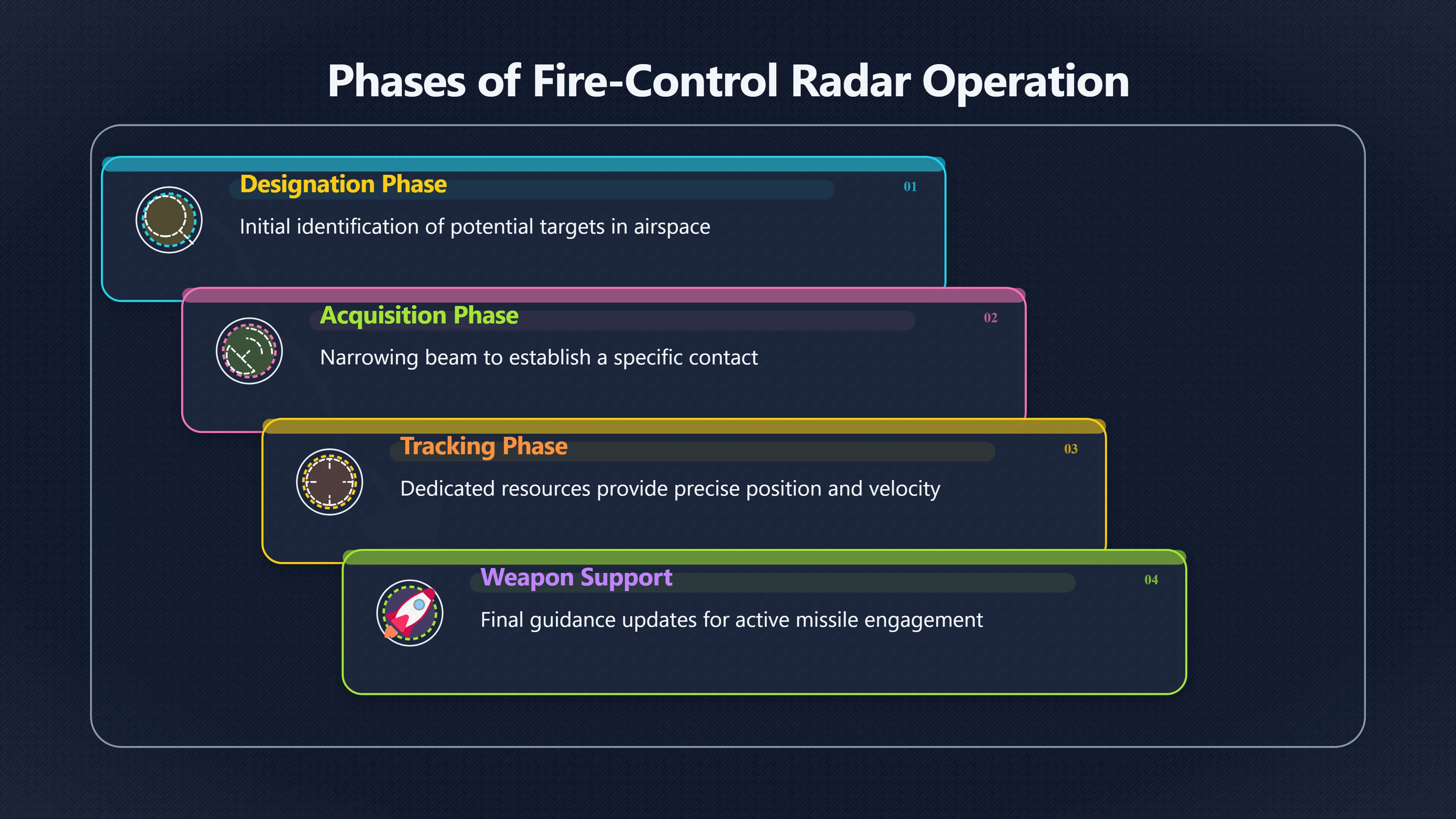
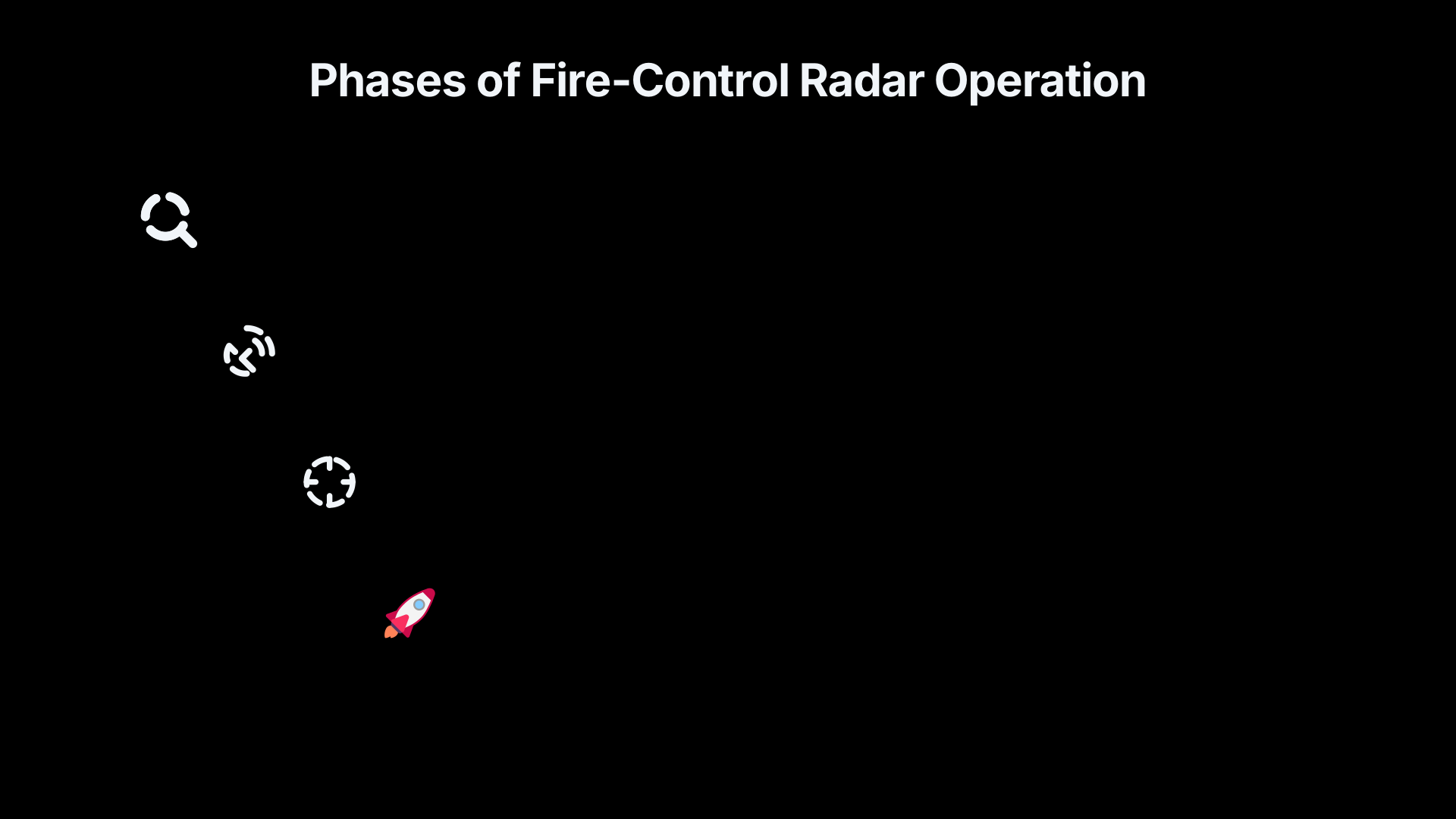
Most military fire-control radars operate through a sequence of modes rather than a single continuous behaviour. Typical phases include designation, acquisition and tracking, each with different emission characteristics and tactical meaning.[firecontrolman.tpub.com]firecontrolman.tpub.comPHASE S OF RADAR OPERATIONPHASES OF RADAR OPERATION - Fire ControlmanThe three sequential phases of radar operation (designation, acquisition, and track) are often…
In a search mode, a radar is trying to detect potential targets across a wide volume of airspace. To do this efficiently, it generally scans large sectors using moving beams and accepts lower update rates on any individual target. Search emissions are therefore spread across space and time. To an RWR, this often appears as periodic illumination from a known radar type without evidence of concentrated attention.[Radartutorial]radartutorial.euIn rapid succession it also uses alternately a special tracking mode. In search mode, the antenna…Read more…
The situation changes when a radar enters acquisition or tracking mode. Instead of distributing energy broadly, the radar begins dedicating more resources to a specific contact. Fire-control radars commonly narrow their beam, revisit the target more frequently and generate more precise tracking data. Because the radar’s emissions become more focused and repetitive from the target’s perspective, electronic-support systems can often recognise that the radar is no longer merely searching.[Wikipedia]WikipediaFire-control radarFire-control radar
This distinction explains why many warning systems classify threats by behaviour rather than simply by emitter type. The same radar may produce a low-priority warning while searching and a high-priority warning once it begins tracking. Modern RWRs are designed specifically to analyse waveform details and emission characteristics in order to estimate the threat posed by a radar at a particular moment.[Wikipedia]WikipediaRadar warning receiverRadar warning receiver
Weapon-Support Signatures and Escalation
The most important mode transition is often the shift from target tracking to weapon support. Not every radar engagement requires the same level of radar involvement, but many missile systems demand additional tracking accuracy, guidance updates or target illumination after launch. Those requirements frequently create distinctive electromagnetic signatures.[Wikipedia]WikipediaFire-control radarFire-control radar
Several mechanisms can reveal that escalation:
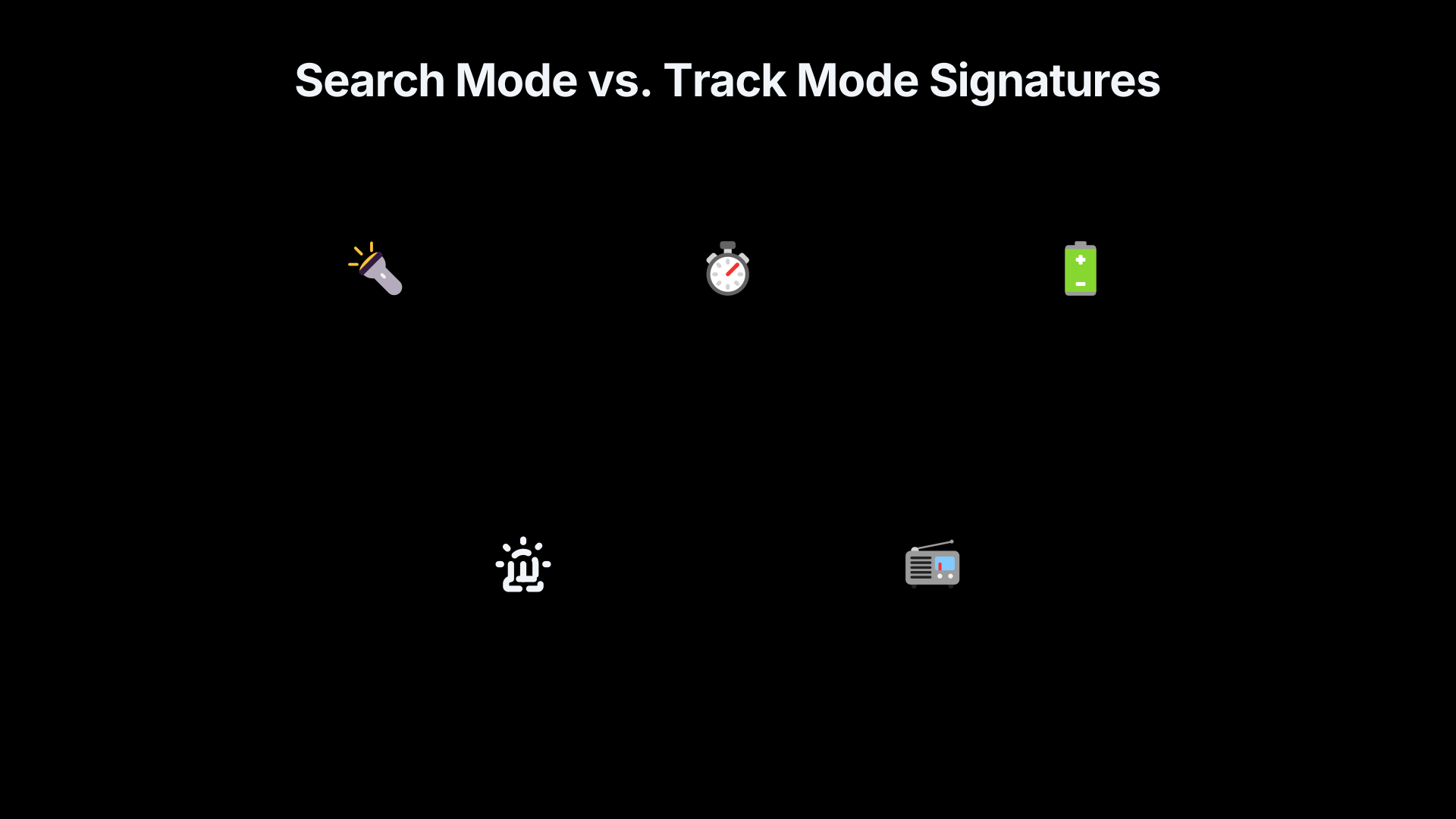
- Higher track update rates. A radar may revisit a tracked target more often to refine position and velocity estimates.
- Narrower beam concentration. Energy becomes focused on a single target rather than distributed across a search sector.
- Different pulse patterns. Pulse repetition frequency, pulse width or timing behaviour may change to support fire-control functions.
- Continuous illumination. Some semi-active missile systems require the target to be continuously illuminated, creating a highly distinctive signature.[Wikipedia]WikipediaFire-control radarFire-control radar
Historically, radar warning receivers were designed around precisely these transitions. During the Cold War, aircrews learned to distinguish between surveillance radars and fire-control radars because the latter often produced recognisable engagement signatures. The unique characteristics of many fire-control radars made them identifiable through parameters such as frequency, pulse duration and pulse repetition patterns.[Wikipedia]WikipediaFire-control radarFire-control radar
A particularly significant example involves semi-active radar-guided weapons. These missiles depend on reflected energy from a radar that continues illuminating the target after launch. Because the radar must maintain a stable lock and provide guidance support, the emission pattern becomes markedly different from broad-area search activity. To a defending aircraft, that change can be more meaningful than the mere detection of the radar itself.[Wikipedia]WikipediaTrack while scanTrack while scan
Why Captured Systems Matter
External interception can reveal that a mode change exists, but exploitation of a captured radar can reveal exactly how and when it occurs.
Analysts can place a recovered radar into controlled test conditions and observe transitions between search, acquisition, track and guidance states. Rather than waiting for those transitions to occur in combat, they can deliberately trigger them and record the resulting signatures. This produces a far richer library of emitter behaviour. The value lies not merely in knowing that a radar tracks targets, but in understanding the precise electronic clues that accompany the transition.[Wikipedia]WikipediaFire-control radarFire-control radar
Captured systems are also useful because some modern radars blur traditional boundaries. Multifunction and phased-array systems may search, track and manage engagements simultaneously. Instead of obvious switches between modes, they allocate radar resources dynamically. Exploitation helps analysts determine which subtle waveform changes still correlate with threat escalation and which are simply routine resource-management behaviour.[Wikipedia]WikipediaTrack while scanTrack while scan
This is one reason why electronic-intelligence databases focus on detailed parametric information rather than simple radar names. The goal is to recognise behavioural states that indicate growing danger, even when the underlying radar remains the same system.
Why Mode Timing Matters to Countermeasures
For pilots and air-defence operators, timing is often more important than identification. A warning received during a search sweep may require observation. A warning received when a radar enters a dedicated tracking or guidance mode may require immediate defensive action.
Electronic countermeasures, manoeuvring decisions, decoy deployment and threat prioritisation all depend on understanding where an adversary sits in the engagement sequence. If a radar has just transitioned from broad surveillance to target-specific tracking, the available reaction window may be shrinking rapidly.[Wikipedia]WikipediaRadar warning receiverRadar warning receiver
The practical value of radar exploitation is therefore not limited to recognising emitters. It allows forces to infer intent from behaviour. A radar that changes mode is revealing that its operator has moved from looking for targets to acting on one. In electronic warfare, that transition is often the clearest indication that a radar has become a real threat.[Wikipedia]WikipediaFire-control radarFire-control radar

Amazon book picks
Further Reading
Books and field guides related to When a Radar Becomes a Real Threat. Use these as the next step if you want deeper reading beyond the article.
Electronic Warfare in the Information Age
Covers threat identification and escalation indicators.
Introduction to Electronic Warfare Modeling
EW 101 has been a popular column in the Journal of Electronic Defense for a number of years. This compilation of tutorial articles from J...
eBay marketplace picks
Marketplace Samples
Live-tested eBay searches with available results related to this page.
Endnotes
1.
Source: Wikipedia
Title: Fire-control radar
Link:https://en.wikipedia.org/wiki/Fire-control_radar
2.
Source: Wikipedia
Title: Radar warning receiver
Link:https://en.wikipedia.org/wiki/Radar_warning_receiver
3.
Source: firecontrolman.tpub.com
Title: PHASE S OF RADAR OPERATION
Link:https://firecontrolman.tpub.com/14099/css/Phases-Of-Radar-Operation-28.htm
Source snippet
PHASES OF RADAR OPERATION - Fire ControlmanThe three sequential phases of radar operation (designation, acquisition, and track) are often...
4.
Source: radartutorial.eu
Link:https://www.radartutorial.eu/20.airborne/ab04.en.html
Source snippet
In rapid succession it also uses alternately a special tracking mode. In search mode, the antenna...Read more...
5.
Source: Wikipedia
Title: Track while scan
Link:https://en.wikipedia.org/wiki/Track_while_scan
6.
Source: radartutorial.eu
Link:https://www.radartutorial.eu/02.basics/Fire-control%20radar.en.html
Source snippet
Fire-control Radar or Tracking RadarTrack-while-scan is a method of combining search and track functions. This radar can track multiple t...
7.
Source: Wikipedia
Link:https://en.wikipedia.org/wiki/Radar
Source snippet
RadarRadar is a system that uses radio waves to determine the distance (ranging), direction (azimuth and elevation angles), and radial...
8.
Source: radar.com
Link:https://radar.com/
Source snippet
Location Infrastructure and IntelligenceRadar helps teams fight fraud, optimize operations, and engage customers, powered by the...
9.
Source: cwa.gov.tw
Link:https://www.cwa.gov.tw/V8/E/W/OBS_Radar.html
Source snippet
Radar | Central Weather AdministrationColorbar(Topography Not Displayed). Colorbar(Topography Not Displayed). Weather Graphs. Notes. 1. S...
Additional References
10.
Source: reddit.com
Link:https://www.reddit.com/r/explainlikeimfive/comments/1fuy1ue/eli5_how_does_a_radarwarningsystem_rwr_identify/
Source snippet
ELI5: How does a Radar-Warning-System (RWR) identify...I understand how you'd detect lasing but not radar lock, especially at the distan...
11.
Source: weather.metoffice.gov.uk
Link:https://weather.metoffice.gov.uk/maps-and-charts/rainfall-radar-forecast-map
Source snippet
rainfall radar mapOur rainfall radar map shows precipitation and rainfall rates across the UK. Includes forecasts up to 5 days and observ...
12.
Source: forum.dcs.world
Title: 112129 what is the difference between scan and tws radar modes
Link:https://forum.dcs.world/topic/112129-what-is-the-difference-between-scan-and-tws-radar-modes/
Source snippet
is the difference between Scan and TWS radar modes?17 Nov 2014 — The main distinction from SCAN mode is that the radar retains target par...
13.
Source: kureansiklopedi.com
Link:https://kureansiklopedi.com/en/detay/tws-and-rws-radar-tracking-in-modern-systems-b2f48
Source snippet
TWS and RWS: Radar Tracking in Modern Systems5 Dec 2025 — Track While Scan (TWS) is a search and track mode used in modern radar systems...
14.
Source: weather.gov.sg
Link:https://www.weather.gov.sg/mobile/home/
Source snippet
t Panjang Road · SW 46.3 km/h. Semakau Island. 4.07 am.Read more...
15.
Source: facebook.com
Link:https://www.facebook.com/DhakaTribune/posts/fighter-jets-use-radars-for-search-operations-or-fire-control-ahead-of-a-missile/1306178888217498/
Source snippet
er (RWR), which tells the pilot the direction, distance, and type of the...Read more...
16.
Source: ausairpower.net
Link:https://www.ausairpower.net/APA-Engagement-Fire-Control.html
Source snippet
Air Power AustraliaEngagement and Fire Control Radars (S-Band, X-band)by C Kopp · 2009 · Cited by 1 — Like the Fan Song, the Low Blow pro...
17.
Source: f4.manuals.heatblur.se
Title: se Radar Warning Receiver
Link:https://f4.manuals.heatblur.se/systems/defensive_systems/radar_warning_receiver.html
Source snippet
Warning Receiver - Heatblur F-4E Phantom IIThe ALR-46 Radar Warning Receiver (subsequently RWR) is the F-4E's passive situational awarene...
18.
Source: sat24.com
Title: Cloud radar Singapore
Link:https://www.sat24.com/en-gb/country/sg
Source snippet
View live satellite imagesView live satellite images of Singapore on the cloud radar at SAT24 and see where the sun is shining or the rai...
19.
Source: en.weather.com.cn
Title: weather.com.cn Radar
Link:https://en.weather.com.cn/radar/
Source snippet
Weather China - Meteorological Service for Public...Weather radar, also called weather surveillance radar (WSR) and Doppler weather rada...
Topic Tree