Within Countermeasures
When fake aircraft tested real radars
Project Palladium shows how controlled false targets helped engineers learn what hostile radars would actually accept or reject.
On this page
- How phantom radar targets were generated
- What Soviet radar reactions could reveal
- Why deception data mattered for countermeasures
Page outline Jump by section
Introduction
Project Palladium was one of the Cold War’s most unusual electronic intelligence programmes: instead of merely listening to Soviet radars, it deliberately fed them convincing false aircraft targets and then studied how the radar network reacted. Developed in the early 1960s to support concerns about the survivability of high-altitude reconnaissance aircraft such as the A-12 Oxcart, Palladium allowed US intelligence specialists to create “ghost aircraft” that appeared on hostile radar screens even though no corresponding aircraft existed. By observing what Soviet operators tracked, reported, or ignored, engineers could measure the practical limits of enemy radar systems and turn those measurements into requirements for stealth, electronic warfare, and future countermeasures.[gwu.edu]nsarchive2.gwu.eduNational Security ArchiveScience, Technology and the CIAThe program allowed the CIA to insert "ghost aircraft" with different radar cross…
Within the broader history of reverse engineering foreign military technology, Palladium stands out because it used deception as a measurement tool. The goal was not simply to fool Soviet radars but to learn exactly what kinds of targets those radars would accept as real.
How Phantom Radar Targets Were Generated
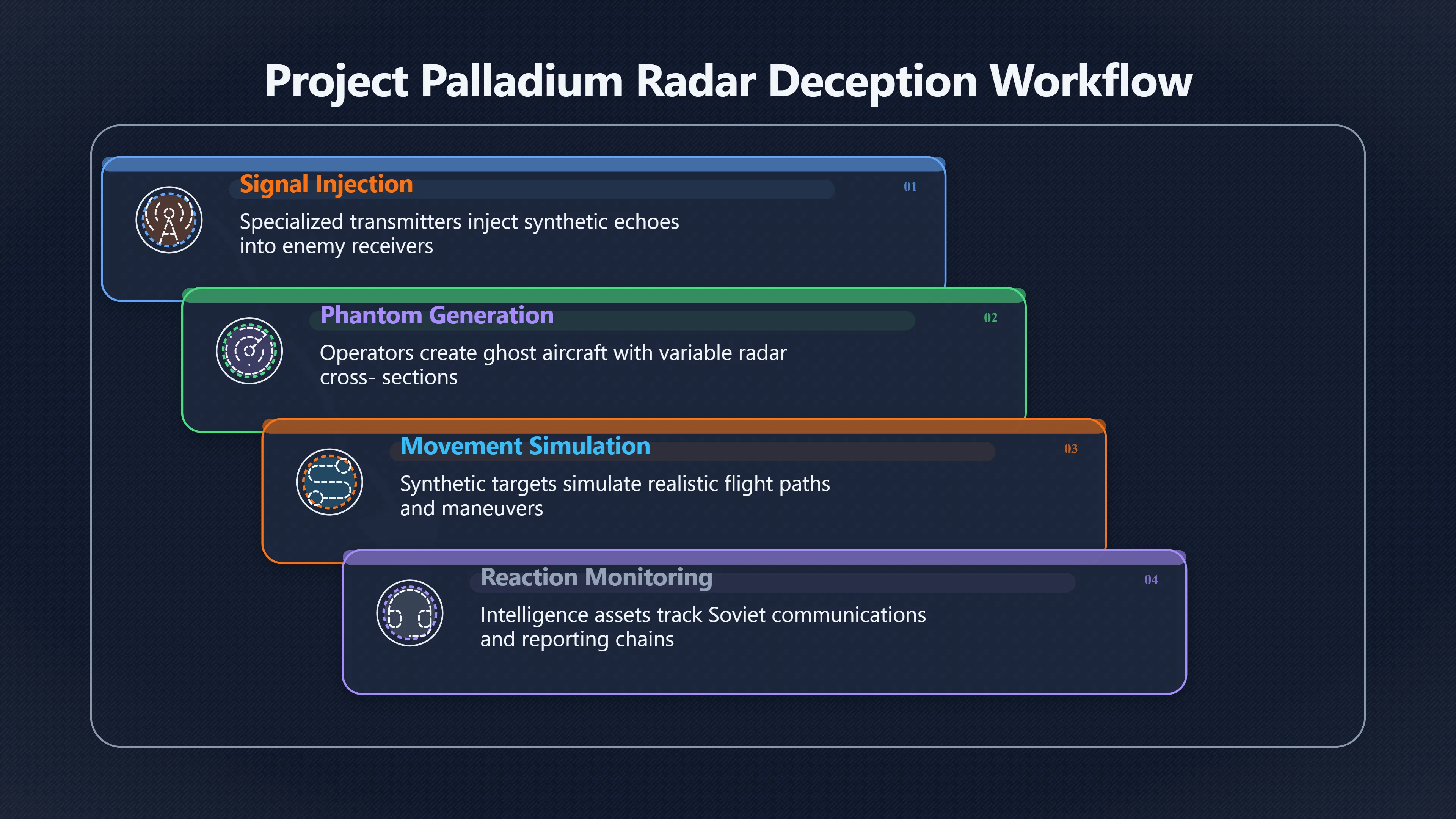
Palladium exploited a basic fact of radar operation: radar operators see processed radio-frequency returns, not physical objects. If an adversary can inject a believable return into the radar’s receiver, the system may display a target that does not actually exist.
The programme used specialised transmitters that interacted with Soviet radar emissions and generated synthetic echoes designed to resemble those of real aircraft. According to declassified accounts, operators could vary the apparent radar cross-section of the false aircraft, effectively making the phantom target appear larger or smaller to the radar network. This enabled intelligence teams to test detection thresholds rather than merely determine whether a radar was operating.[gwu.edu]nsarchive2.gwu.eduNational Security ArchiveScience, Technology and the CIAThe program allowed the CIA to insert "ghost aircraft" with different radar cross…
The technique went beyond creating a static blip. Operators could simulate aircraft movement, causing the ghost target to appear to approach, recede, or cross defended airspace. In some operations the false aircraft was presented as a realistic intruder approaching Soviet-controlled territory, compelling radar crews to react as though a genuine penetration attempt was underway.[National Security Archive]nsarchive2.gwu.eduNational Security ArchiveStealth, Countermeasures, and ELINT, 1960-1975 (U)Every PALLADIUM operation consisted of a CIA ream with its gho…
From a modern electronic-warfare perspective, Palladium was an early form of radar deception. Rather than jamming a radar with noise, it supplied information the radar was expected to believe. This distinction remains central to electronic warfare today: noise hides reality, while deception reshapes it.[U.S. Naval Institute]usni.orgelectronic combatNaval InstituteElectronic Combat | Proceedings - January 1984 Vol. 110/1…Deception jamming creates false targets that can deceive the…
What Soviet Radar Reactions Could Reveal
The most valuable intelligence came not from the phantom target itself but from the response it triggered.
Palladium operations were often paired with signals intelligence collection. While Soviet radar sites tracked the apparent aircraft, US intelligence assets monitored associated communications and reporting channels. Analysts could determine whether operators detected the target, how confidently they tracked it, and whether the contact was escalated through the air-defence network.[National Security Archive]nsarchive2.gwu.eduNational Security ArchiveScience, Technology and the CIAThe program allowed the CIA to insert "ghost aircraft" with different radar cross…
This approach transformed radar deception into a measurement instrument. By gradually changing the apparent characteristics of the ghost aircraft, intelligence officers could estimate:
- The smallest radar cross-section that could still be detected.
- Differences between theoretical radar performance and real operational performance.
- Variations in operator skill and reporting discipline.
- The range at which specific radar systems acquired or lost targets.
- Whether multiple radar stations interpreted the same contact consistently.[National Security Archive]nsarchive2.gwu.eduNational Security ArchiveScience, Technology and the CIAThe program allowed the CIA to insert "ghost aircraft" with different radar cross…
A frequently cited example involved operations against Soviet air-defence systems in Cuba. One mission combined Palladium-generated phantom aircraft with carefully timed releases of calibrated radar-reflective objects. By comparing Soviet reporting on the various returns, intelligence officers could infer detection sensitivity and tracking capability under realistic operational conditions.[Reddit]reddit.comCIA Project Palladium and the similarities to the Nimitz tic…February 25, 2021 — Once operational, Jack flew his black ghost in…
The crucial insight was that engineers no longer had to guess what Soviet radars could theoretically see. They could observe what Soviet crews actually saw and acted upon.
When Fake Aircraft Tested Real Radars
The programme emerged during a period when Soviet radar technology posed a growing threat to American reconnaissance operations. The 1960 shootdown of a U-2 over the Soviet Union had demonstrated that assumptions about radar limitations could be dangerously wrong.
As intelligence planners evaluated the future A-12 Oxcart, they needed more than estimates of radar coverage. They needed evidence about the practical detection limits of specific Soviet systems, including large early-warning radars such as Tall King and Spoon Rest. Palladium was developed to provide that evidence.[theaviationgeekclub.com]theaviationgeekclub.comThe Aviation Geek Club How the U.Ssecretly tested the A-12 RCS during…Palladium was a special electronic transmitter that could project a false target into the “Tall Ki…
Declassified accounts describe teams deploying specialised equipment near areas monitored by Soviet radar networks. Operations required careful coordination among intelligence, communications, and military personnel. Each mission effectively became a controlled experiment conducted against a real adversary’s air-defence system.[National Security Archive]nsarchive2.gwu.eduNational Security ArchiveStealth, Countermeasures, and ELINT, 1960-1975 (U)Every PALLADIUM operation consisted of a CIA ream with its gho…
Unlike laboratory testing, these experiments measured performance under authentic conditions: real equipment, real operators, real reporting chains, and real operational pressures. That realism gave Palladium a value that conventional intelligence collection alone could not provide.
Why Deception Data Mattered for Countermeasures
The ultimate purpose of Palladium was not deception for its own sake. It was to generate engineering data that could improve aircraft survivability.
If analysts learned that Soviet operators consistently detected targets above a certain apparent radar cross-section but failed to detect smaller ones, designers gained a concrete objective for radar-signature reduction. If operators ignored certain types of returns or reacted slowly under particular conditions, electronic warfare planners gained clues about where deception techniques might succeed.[National Security Archive]nsarchive2.gwu.eduNational Security ArchiveScience, Technology and the CIAThe program allowed the CIA to insert "ghost aircraft" with different radar cross…
This was especially important during the formative years of stealth development. Aircraft designers needed to know not simply whether radar reduction was desirable but how much reduction was necessary to defeat specific threat systems. Palladium helped convert intelligence questions into measurable design requirements.[tbp.org]tbp.organswer to the Oxcart's stealth — and…Read more…
The programme also highlighted an enduring lesson in countermeasure development: enemy systems must be studied as operational systems rather than as isolated pieces of hardware. A radar’s antenna, receiver, software logic, communications network, and human operators collectively determine whether a target is detected. Palladium gathered information about that entire chain.[National Security Archive]nsarchive2.gwu.eduNational Security ArchiveScience, Technology and the CIAThe program allowed the CIA to insert "ghost aircraft" with different radar cross…
The Lasting Significance of Palladium
Project Palladium occupies an unusual place in Cold War intelligence history because it blurred the line between collection and experimentation. Instead of waiting for Soviet systems to reveal themselves, intelligence officers actively created situations that forced those systems to respond.
The programme demonstrated that deception could be used not only to protect aircraft but also to discover how an adversary’s sensors actually worked. By generating phantom radar targets and measuring Soviet reactions, Palladium provided some of the most direct evidence available about the real-world performance of hostile radar networks. Those findings fed directly into the development of reconnaissance tactics, electronic countermeasures, and the broader effort to design aircraft that hostile radars would struggle to detect in the first place.[gwu.edu]nsarchive2.gwu.eduNational Security ArchiveScience, Technology and the CIAThe program allowed the CIA to insert "ghost aircraft" with different radar cross…
Amazon book picks
Further Reading
Books and field guides related to When fake aircraft tested real radars. Use these as the next step if you want deeper reading beyond the article.
The Puzzle Palace
Provides background on signals intelligence and Cold War collection methods.
eBay marketplace picks
Marketplace Samples
Live-tested eBay searches with available results related to this page.

Endnotes
1.
Source: tbp.org
Link:https://www.tbp.org/static/docs/features/F99Poteat.pdf
Source snippet
answer to the Oxcart's stealth — and...Read more...
2.
Source: usni.org
Title: electronic combat
Link:https://www.usni.org/magazines/proceedings/1984/january/electronic-combat
Source snippet
Naval InstituteElectronic Combat | Proceedings - January 1984 Vol. 110/1...Deception jamming creates false targets that can deceive the...
Published: January 1984
3.
Source: reddit.com
Link:https://www.reddit.com/r/UFOs/comments/lsgl0u/cia_project_palladium_and_the_similarities_to_the/
Source snippet
CIA Project Palladium and the similarities to the Nimitz tic...February 25, 2021 — Once operational, Jack flew his black ghost in...
Published: February 25, 2021
4.
Source: disclosdex.com
Title: 1962 project palladium
Link:https://disclosdex.com/programs/1962-project-palladium
Source snippet
Project Palladium | DisclosdexThe CIA developed Project Palladium in 1962 to evaluate Soviet radar detection capabilities, particularly t...
5.
Source: reddit.com
Link:https://www.reddit.com/r/UFOscience/comments/lqk677/cia_radar_games_and_ghost_aircraft/
Source snippet
CIA Radar Games and Ghost Aircraft: r/UFOscienceThe operation successfully projected a ghost aircraft flying out of Key West over soviet...
6.
Source: nsarchive2.gwu.edu
Link:https://nsarchive2.gwu.edu/NSAEBB/NSAEBB438/
Source snippet
National Security ArchiveScience, Technology and the CIAThe program allowed the CIA to insert "ghost aircraft" with different radar cross...
7.
Source: theaviationgeekclub.com
Title: The Aviation Geek Club How the U.S
Link:https://theaviationgeekclub.com/how-u-s-secretly-tested-the-a-12-rcs-during-the-cuban-missile-crisis/
Source snippet
secretly tested the A-12 RCS during...Palladium was a special electronic transmitter that could project a false target into the “Tall Ki...
8.
Source: nsarchive2.gwu.edu
Link:https://nsarchive2.gwu.edu/NSAEBB/NSAEBB54/st08.pdf
Source snippet
National Security ArchiveStealth, Countermeasures, and ELINT, 1960-1975 (U)Every PALLADIUM operation consisted of a CIA ream with its gho...
Additional References
9.
Source: cia.gov
Link:https://www.cia.gov/readingroom/docs/CIA-RDP84B00049R001503710006-4.pdf
Source snippet
ASSESSMENTS OF SOVIET STRATEGIC AIR DEFENSES--Soviet air defense forces today could perform well against aircraft at medium and high alti...
10.
Source: spyscape.com
Link:https://spyscape.com/article/false-flags-operation-northwoods-other-deadly-spy-ops
Source snippet
False Flags: Operation Northwoods & Other Sneaky Spy OpsFalse flags are sneaky political, intelligence, or military operations designed t...
11.
Source: cept.org
Link:https://cept.org/[documents
Source snippet
JAMMING & SPOOFING IN THE CONTEXT OF...In electronic warfare, creation of false radar targets primarily used for deception. Cyber- und I...
12.
Source: man.fas.org
Link:https://man.fas.org/dod-101/navy/docs/fun/part11.htm
Source snippet
11 COUNTERMEASURESThen the deception pulse will arrive at the radar before the real echo pulse, producing a false target at a closer rang...
13.
Source: imdb.com
Link:https://www.imdb.com/title/tt43276436/
Source snippet
PROJECT PALLADIUM (THE WEATHER STATION SPIES)CIA Declassified: PROJECT PALLADIUM (THE WEATHER STATION SPIES) Podcast. Release date Novemb...
14.
Source: twz.com
Link:https://www.twz.com/31151/area-51-veteran-and-cia-electronic-warfare-pioneer-weigh-in-on-navy-ufo-encounters
Source snippet
Area 51 Veteran And CIA Electronic Warfare Pioneer...25 Nov 2019 — In 1960, when the Soviet Union moved a Tall King radar system to C...
15.
Source: twz.com
Title: could some of the ufos navy pilots are encountering be airborne radar reflectors
Link:https://www.twz.com/28640/could-some-of-the-ufos-navy-pilots-are-encountering-be-airborne-radar-reflectors
Source snippet
Are Some Of The UFOs Navy Pilots Are Encountering...Dec 1, 2019 — Submarine-launched, radar reflector-toting balloons used to stimulate...
16.
Source: thedebrief.org
Title: devices of unknown origin part ii interlopers over the atlantic ryan graves
Link:https://thedebrief.org/devices-of-unknown-origin-part-ii-interlopers-over-the-atlantic-ryan-graves/
Source snippet
Devices of Unknown Origin Part II: Interlopers Over...Jun 24, 2021 — Something similar to what Gene Poteat and the CIA were doing with P...
17.
Source: cia.gov
Link:https://www.cia.gov/readingroom/docs/DOC_0000261292.pdf
Source snippet
would also create a hostile physical environment for the operation of both.Read more...
18.
Source: foxnews.com
Title: viral cia file about aliens attacking soldiers takes off ufo intrigue
Link:https://www.foxnews.com/us/viral-cia-file-about-aliens-attacking-soldiers-takes-off-ufo-intrigue
Source snippet
Viral CIA file about aliens attacking soldiers takes off with...Apr 13, 2025 — A Soviet-era document published on the CIA's website deta...
Topic Tree