Within Foreign Materiel
When Reverse Engineering Needed Engineers
Project Paperclip shows how people, documents and hardware all became part of postwar technology transfer.
On this page
- From Overcast to Paperclip
- Rocketry and aviation expertise
- Ethical and strategic tensions
Page outline Jump by section
Introduction
Project Paperclip shows a form of reverse engineering that went beyond captured parts, blueprints and test ranges. The United States did not merely take German rockets and aircraft apart after the Second World War; it imported many of the people who knew why those systems had been designed that way, how they had failed, and how they might be adapted for future weapons. The programme began as Project Overcast and became Project Paperclip, with the Joint Intelligence Objectives Agency responsible for operating the foreign scientist programme. Its purpose was explicitly framed as exploiting selected German and Austrian specialists in science and technology for United States national security.[National Archives]archives.govOpen source on archives.gov.
That made Paperclip a governance intervention inside the broader machinery of foreign military technology exploitation. It converted enemy expertise into a managed strategic asset: screened, contracted, housed, questioned, moved between laboratories and eventually absorbed into military, industrial and space institutions. The result was technically valuable, especially in missiles, aviation and aerospace medicine, but ethically compromised by the Nazi records of some recruits and by the deliberate willingness of United States officials to treat expertise as a reason to soften, obscure or postpone accountability.[National Air and Space Museum]airandspace.si.eduOpen source on si.edu.
From Overcast to Paperclip
The programme’s early logic was urgent and practical. In August 1946, Acting Secretary of State Dean Acheson sent President Harry Truman a memorandum explaining that the War Department had operated “Paperclip” since shortly after Victory in Europe Day, bringing selected German scientists to the United States under military custody for short-term exploitation. The same memorandum argued that specialists still in the American zones of Germany and Austria could be used to advance United States technology, and that their services might be lost unless action was taken quickly.[Office of the Historian]history.state.govOffice of the Historian Historical DocumentsOffice of the HistorianHistorical Documents - Office of the Historian…
The proposed policy expanded Paperclip to between 800 and 1,000 specialists at any one time. It also shows how the programme shifted from temporary interrogation towards managed immigration: families could be brought over, strict custody could be relaxed, contracts were to provide suitable salary and working conditions, and selected people might later receive regular immigration status. In other words, the United States was not only collecting intelligence from experts; it was building a pathway by which enemy technical labour could become part of its own research base.[Office of the Historian]history.state.govOffice of the Historian Historical DocumentsOffice of the HistorianHistorical Documents - Office of the Historian…
The Joint Intelligence Objectives Agency sat at the centre of that system. The National Archives describes the JIOA as the body with direct responsibility for operating the foreign scientist programme, first code-named Overcast and later Paperclip. Its work included administering policy, compiling dossiers, liaising with British intelligence officers running a similar project, and collecting, declassifying and distributing technical intelligence reports on German science and industry.[National Archives]archives.govOpen source on archives.gov.
This mattered because reverse engineering is often imagined as a purely material act: remove screws, measure alloys, translate manuals, test circuits. Paperclip added a human layer. The imported specialist could explain design intent, production shortcuts, unresolved defects and future possibilities that might not be obvious from hardware alone. The programme therefore blurred the line between exploitation and recruitment: the expert was treated as both an intelligence source and a productive engineer.[Office of the Historian]history.state.govOffice of the Historian Historical DocumentsOffice of the HistorianHistorical Documents - Office of the Historian…
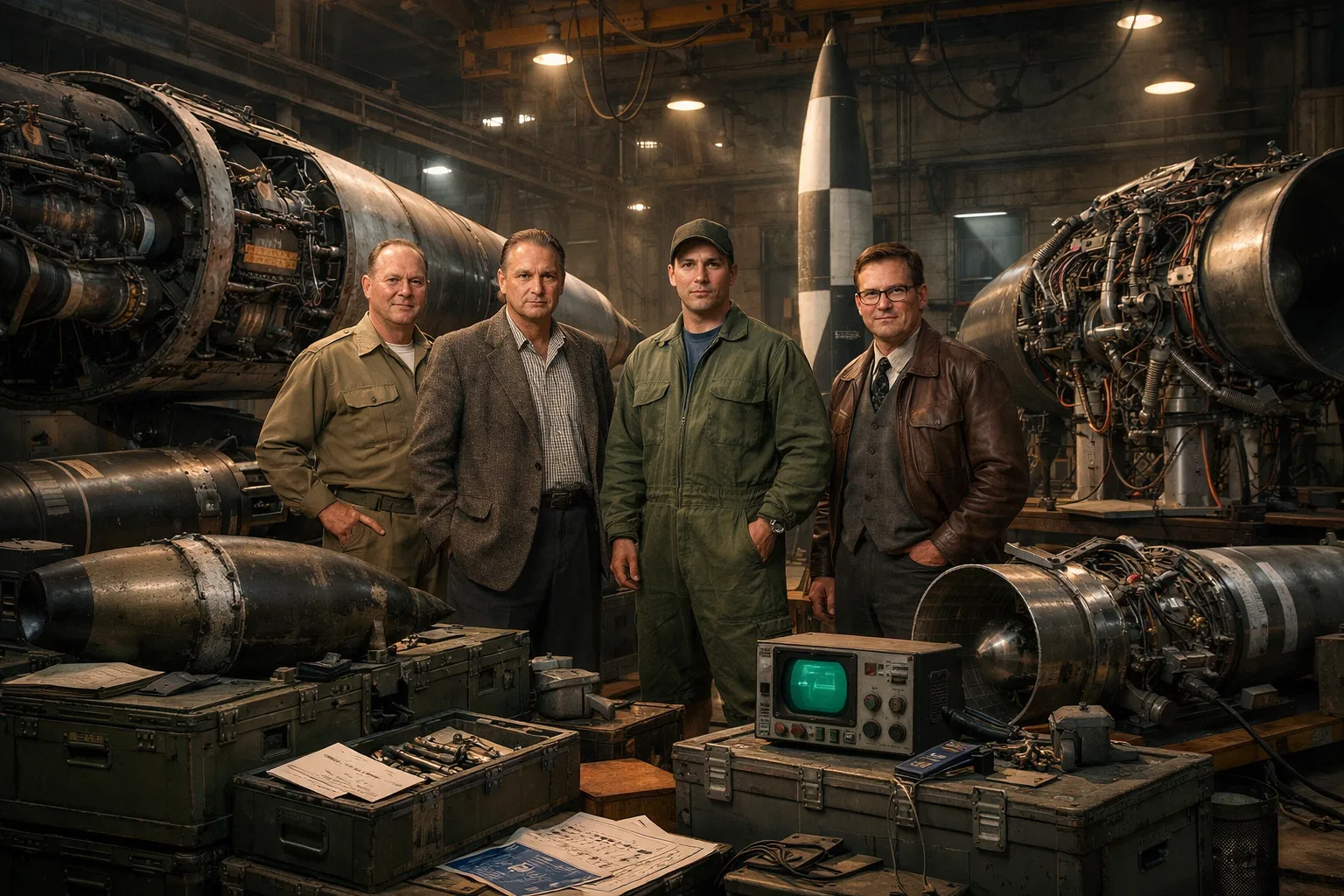
Why engineers mattered as much as captured hardware
The American postwar exploitation effort already involved machines, documents and field collection. Wright Field’s technical intelligence mission, for example, received captured German and Japanese aircraft for study, while officers and civilian scientists followed Allied forces to exploit enemy materiel and documents. After the war in Europe, Colonel Harold Watson’s group gathered German aircraft and sent or flew them to Wright Field and Freeman Field, Indiana, for assessment. Paperclip then brought more than 200 German scientists and technicians to Wright Field to work with American counterparts.[NASIC]nasic.af.milNational Air and Space Intelligence Center Heritage > National Air and Space Intelligence Center > Display…
The scale of document exploitation also shows why people were useful. By the end of 1947, Wright Field personnel had processed more than 1,500 tons of captured documents and added more than 100,000 new technical terms to English-language usage in the field. That was an enormous translation and interpretation challenge. Specialists who had worked inside German research systems could help connect documents, experimental facilities, components and design practices into a usable body of knowledge.[NASIC]nasic.af.milNational Air and Space Intelligence Center Heritage > National Air and Space Intelligence Center > Display…
The same pattern appeared in missile work. American forces moved large quantities of German missile hardware and documentation west before occupation zones hardened. Army historical accounts describe more than 360 metric tons of German missile parts going to New Mexico, and later describe Project Hermes as an effort to reconstruct and improve V-2 rockets using hundreds of rail cars of parts and more than 100 German experts based at Fort Bliss.[Army University Press]armyupress.army.milUniversity PressThe Army’s Current Multidomain Inflection Point and Potential Lessons from the Early Space Race…
That did not make German knowledge magical or self-sufficient. The V-2 programme in the United States still faced serious engineering limits: early assembly was difficult, the V-2 had unresolved aerodynamic instability and quality-control problems, and testing revealed high failure rates. The value of imported expertise lay not in instant copying, but in accelerating a learning cycle that combined German hardware, American test infrastructure, domestic rocket groups, universities, contractors and military requirements.[Army University Press]armyupress.army.milUniversity PressThe Army’s Current Multidomain Inflection Point and Potential Lessons from the Early Space Race…
Rocketry and aviation expertise
The most famous Paperclip case was the V-2 missile group led by Wernher von Braun. The Smithsonian’s National Air and Space Museum notes that von Braun had been a Nazi Party member and SS officer, and that the United States Army kept information about his record classified while bringing him and about 125 colleagues to Fort Bliss, Texas. There, the German team helped Americans launch V-2s and worked on missile-related projects before moving in 1950 to Redstone Arsenal in Huntsville, Alabama.[National Air and Space Museum]airandspace.si.eduOpen source on si.edu.
At Fort Bliss and White Sands, the imported specialists helped turn captured German rocketry into an American test programme. Project Hermes reconstructed and improved V-2s; a V-2 Upper Atmospheric Research Panel brought together military services, the Naval Research Laboratory, universities, civilian research institutions and General Electric; and payloads gathered atmospheric, photographic and radiation data. These tests were not yet a civilian space programme. They were part of a weapons and upper-atmosphere research environment shaped by the emerging Cold War.[Army University Press]armyupress.army.milUniversity PressThe Army’s Current Multidomain Inflection Point and Potential Lessons from the Early Space Race…
The later trajectory of the von Braun group explains why Paperclip became so strongly associated with spaceflight. After the move to Redstone Arsenal, the group became central to Army ballistic missile development, including Redstone and Jupiter work. After Sputnik, von Braun’s organisation helped launch Explorer I, the first United States satellite, and in 1960 his Army Ballistic Missile Agency division was transferred to NASA, where the Huntsville group later helped develop the Saturn rockets used for Apollo.[National Air and Space Museum]airandspace.si.eduOpen source on si.edu.
But reducing Paperclip to von Braun and Apollo distorts the programme. The National Air and Space Museum stresses that the Huntsville Germans were never more than about 15 to 20 per cent of Paperclip’s intake, and that the Air Force, not the Army, brought over the largest number of experts. Many specialists were scattered through military laboratories, universities and private companies, making their impact less visible than the public story of the rocket team.[National Air and Space Museum]airandspace.si.eduOpen source on si.edu.
Aviation expertise formed another major channel. Wright Field’s exploitation mission had already moved from supporting air operations to systematic technical study of enemy designs. Paperclip added German scientists and technicians to that ecosystem, while captured documents and equipment fed into American work on aircraft, propulsion, electronics, materials and other industrial fields.[NASIC]nasic.af.milNational Air and Space Intelligence Center Heritage > National Air and Space Intelligence Center > Display…
One useful example is Hans Pabst von Ohain, co-inventor of the German turbojet engine, who was brought to the United States through Project Paperclip and worked for years as a research engineer at Wright-Patterson Air Force Base. His case illustrates the broader point: aviation exploitation was not just about flying captured aircraft or copying components, but about embedding people with specialised design knowledge inside American research establishments.[National Air and Space Museum]airandspace.si.eduOpen source on si.edu.

The programme widened technology transfer beyond weapons
Paperclip’s technical scope reached well beyond V-2s. The National Air and Space Museum identifies guided missiles, supersonic aerodynamics, guidance and control, rocket and jet engines, and aerospace medicine as major areas of focus. That range matters because it shows that “reverse engineering foreign military technology” was not confined to a single weapon system; it became an organised attempt to harvest interlocking bodies of knowledge from a defeated military-industrial state.[National Air and Space Museum]airandspace.si.eduOpen source on si.edu.
The Wright Field record also suggests a broad spillover. Captured documents and personnel contributed not only to aviation-related advances but also to areas such as vacuum tubes, magnetic tapes, night-vision devices, liquid and solid fuels, textiles, drugs and food preservation. Some of these were military technologies; others had dual-use or industrial significance. The boundary between defence exploitation and industrial technology transfer was therefore porous.[NASIC]nasic.af.milNational Air and Space Intelligence Center Heritage > National Air and Space Intelligence Center > Display…
This is one reason Paperclip is important as a governance case. A captured machine can be stored, tested, copied or scrapped. A recruited specialist creates longer-term policy questions: who is eligible, who screens them, what records matter, whether families may immigrate, which agencies receive their expertise, and how much secrecy is acceptable. The Acheson memorandum made those questions explicit by assigning screening responsibilities, custody arrangements, contract terms and pathways for eventual immigration.[Office of the Historian]history.state.govOffice of the Historian Historical DocumentsOffice of the HistorianHistorical Documents - Office of the Historian…
The same structure also made accountability harder. The more useful an individual became to an American laboratory or weapons programme, the greater the incentive to treat their past as an administrative obstacle rather than a central moral fact. That tension was built into the programme from the start: officials wanted to exclude active supporters of Nazism or militarism, but also allowed doubtful cases to be transported to the United States for further interrogation and screening.[Office of the Historian]history.state.govOffice of the Historian Historical DocumentsOffice of the HistorianHistorical Documents - Office of the Historian…
Ethical and strategic tensions
Paperclip’s defenders framed the programme as a national-security necessity. United States officials feared that German technical knowledge would be lost, withheld, recruited by rivals or used by the Soviet Union. The policy language in 1946 explicitly tied rapid evacuation and exploitation of specialists to national security, while later accounts emphasise that Cold War pressure made former Nazi affiliations easier for officials and the public to tolerate.[Office of the Historian]history.state.govOffice of the Historian Historical DocumentsOffice of the HistorianHistorical Documents - Office of the Historian…
The official screening rules were stricter on paper than many outcomes suggest. The 1946 policy said that no one found to have been more than a nominal Nazi Party participant, or an active supporter of Nazism or militarism, should be brought to the United States. Yet it also stated that honours or positions awarded under the Nazi regime solely for scientific or technical ability would not automatically disqualify a specialist, and doubtful cases could be brought over for further screening.[Office of the Historian]history.state.govOffice of the Historian Historical DocumentsOffice of the HistorianHistorical Documents - Office of the Historian…
The National Archives’ description of the JIOA case files shows why this remains controversial. Its foreign scientist dossiers include more than 1,500 German and other foreign scientists, technicians and engineers brought to the United States under Paperclip and similar programmes. Among the named cases are Georg Rickhey, a former official at the Nordhausen underground V-2 factory who was tried and acquitted by a United States military tribunal; Walter Schreiber, linked to medical experiments on concentration-camp inmates and later fleeing to Argentina; and Arthur Rudolph, a V-2 engineer who left the United States in 1984 after the Department of Justice discovered his role in persecution of prisoners at Nordhausen.[National Archives]archives.govOpen source on archives.gov.
The V-2 itself embodies the moral problem. It was an advanced military technology, but its production was tied to forced labour and mass death. The Smithsonian notes that at least 10,000 concentration-camp workers died manufacturing the V-2, while the National Air and Space Museum states that von Braun and associates were at least tangentially involved in the murderous exploitation of prisoners in missile production. Any account of Paperclip that treats the rocket only as a technical achievement misses the human cost built into the knowledge being transferred.[National Air and Space Museum]airandspace.si.eduOpen source on si.edu.
Aerospace medicine sharpened the same tension. German aviation medicine included research areas such as high-altitude exposure, oxygen deprivation and cold survival, fields directly relevant to aircraft and later spaceflight. But some wartime aviation medicine was entangled with criminal experiments on prisoners. The controversy around figures such as Hubertus Strughold, later celebrated in American space medicine and then reassessed for his wartime associations, shows how expertise imported for strategic advantage could carry unresolved moral liabilities into postwar institutions.[osti.gov]osti.govTAB F-3 RE: Background of Project PaperclipTAB F-3 RE: Background of Project Paperclip
What Paperclip changed about reverse engineering
Paperclip changed the exploitation of foreign military technology in three practical ways. First, it shortened the distance between captured artefact and operational understanding. German specialists could help explain why a rocket engine, guidance system, aerodynamic feature or test result mattered, and where American engineers should focus their effort.[Army University Press]armyupress.army.milUniversity PressThe Army’s Current Multidomain Inflection Point and Potential Lessons from the Early Space Race…
Second, it turned short-term intelligence into institutional capacity. The von Braun group’s movement from Fort Bliss and White Sands to Redstone Arsenal, then into the Army Ballistic Missile Agency and NASA, is the clearest example. What began as the use of captured enemy rocketry became a sustained American missile and space-launch capability, shaped by German knowledge but also by American funding, contractors, universities, test ranges and Cold War priorities.[National Air and Space Museum]airandspace.si.eduOpen source on si.edu.
Third, it forced the state to govern expertise as a sensitive asset. Paperclip required lists, dossiers, screening rules, custody arrangements, contracts, family policies, interagency coordination and secrecy. The JIOA’s role in compiling dossiers and operating the foreign scientist programme shows that imported expertise was not an accidental by-product of battlefield victory; it was administered as a national-security programme.[National Archives]archives.govOpen source on archives.gov.
The lasting lesson is not that imported experts can replace domestic research. American rocket groups, aircraft laboratories and contractors already existed, and postwar advances came from the interaction between captured knowledge and domestic institutions. The more precise lesson is that reverse engineering foreign military technology sometimes requires people who understand the original design culture. Paperclip proved that such people can greatly accelerate technology transfer, but also that recruiting them can import political, legal and moral debts along with technical skill.[National Air and Space Museum]airandspace.si.eduOpen source on si.edu.
Amazon book picks
Further Reading
Books and field guides related to When Reverse Engineering Needed Engineers. Use these as the next step if you want deeper reading beyond the article.
Rocket Boys
Connects readers to the American rocket culture influenced by postwar developments.
eBay marketplace picks
Marketplace Samples
Live-tested eBay searches with available results related to this page.



Endnotes
1.
Source: archives.gov
Link:https://www.archives.gov/iwg/declassified-records/rg-330-defense-secretary
2.
Source: history.state.gov
Title: Office of the Historian Historical Documents
Link:https://history.state.gov/historicaldocuments/frus1946v05/d448
Source snippet
Office of the HistorianHistorical Documents - Office of the Historian...
3.
Source: [nasic]({{ ‘nasic/’ | relative_url }}). af.mil
Link:https://www.nasic.af.mil/About-Us/Fact-Sheets/Display/Article/611728/national-air-and-space-intelligence-center-heritage/
Source snippet
National Air and Space Intelligence Center Heritage > National Air and Space Intelligence Center > Display...
4.
Source: armyupress.army.mil
Title: University Press
Link:https://www.armyupress.army.mil/Journals/Military-Review/English-Edition-Archives/March-2024/Multidomain-Inflection/
Source snippet
The Army’s Current Multidomain Inflection Point and Potential Lessons from the Early Space Race...
5.
Source: osti.gov
Title: TAB F-3 RE: Background of Project Paperclip
Link:https://www.osti.gov/opennet/servlets/purl/16385196.pdf
6.
Source: libraryguides.mayo.edu
Link:https://libraryguides.mayo.edu/historicalunit/Aero2
7.
Source: archives.gov
Link:https://www.archives.gov/iwg/reports/nazi-war-crimes-interim-report-october-1999
8.
Source: archives.gov
Link:https://www.archives.gov/iwg
9.
Source: army.mil
Title: german reunion highlights two anniversaries
Link:https://www.army.mil/article/41792/german_reunion_highlights_two_anniversaries
10.
Source: history.redstone.army.mil
Title: bio vonbraun
Link:https://history.redstone.army.mil/bio-vonbraun.html
11.
Source: army.mil
Title: rocket pioneers
Link:https://www.army.mil/article/13102/rocket_pioneers
12.
Source: history.redstone.army.mil
Title: space pioneer
Link:https://history.redstone.army.mil/space-pioneer.html
13.
Source: armyupress.army.mil
Title: mil When the Bumper 8 rocket team arrived
Link:https://www.armyupress.army.mil/Portals/7/military-review/Archives/English/March-2024/Multidomain-Inflection/Space-Race-UA.pdf
14.
Source: smdc.army.mil
Title: mil Chapter I
Link:https://www.smdc.army.mil/Portals/38/Documents/Publications/History/Cmd%20History%20Book/Chap%201.pdf
15.
Source: history.redstone.army.mil
Title: ihist 1950
Link:https://history.redstone.army.mil/ihist-1950.html
16.
Source: history.redstone.army.mil
Link:https://history.redstone.army.mil/miss-redstone.html
17.
Source: history.army.mil
Link:https://history.army.mil/portals/143/Images/Publications/catalog/70-88-1.pdf
18.
Source: 1997-2001.state.gov
Title: 980714 slany nazi
Link:https://1997-2001.state.gov/policy_remarks/1998/980714_slany_nazi.html
19.
Source: reason.com
Title: the cia used nazis and lots of them to f
Link:https://reason.com/2014/10/27/the-cia-used-nazis-and-lots-of-them-to-f/
20.
Source: time.com
Title: nasa nazi von braun
Link:https://time.com/5627637/nasa-nazi-von-braun/
21.
Source: time.com
Title: cold war nazi spies
Link:https://time.com/3541068/cold-war-nazi-spies/
22.
Source: nasa.gov
Title: wernher von braun
Link:https://www.nasa.gov/people/wernher-von-braun/
23.
Source: youtube.com
Title: From WWII to the Space Race: The Story of Project Paperclip
Link:https://www.youtube.com/watch?v=jNA-b82j8WM
Source snippet
Project Paperclip | WWII IN 2...
24.
Source: youtube.com
Title: Project Paperclip | WWII IN 2
Link:https://www.youtube.com/watch?v=uyzaTnKhhr0
Source snippet
Who Were the German Scientists That Brought America to the Moon?...
25.
Source: airandspace.si.edu
Link:https://airandspace.si.edu/stories/editorial/project-paperclip-and-american-rocketry-after-world-war-ii
26.
Source: airandspace.si.edu
Link:https://airandspace.si.edu/collection-objects/missile-surface-surface-v-2-4/nasm_A19600342000
27.
Source: Wikipedia
Title: Wernher von Braun
Link:https://en.wikipedia.org/wiki/Wernher_von_Braun
28.
Source: nationalww2museum.org
Link:https://www.nationalww2museum.org/watch/project-paperclip-wwii-2
29.
Source: media.defense.gov
Title: Otto Bock
Link:https://media.defense.gov/2008/Jan/24/2001571103/-1/-1/0/Otto%20Bock.pdf
30.
Source: history.com
Title: what was operation paperclip
Link:https://www.history.com/articles/what-was-operation-paperclip
Additional References
31.
Source: youtube.com
Link:https://www.youtube.com/watch?v=0SoaehnAqoI
Source snippet
Operation Paperclip — How America Used Nazi Scientists to Win the Cold War...
32.
Source: youtube.com
Title: Who Were the German Scientists That Brought America to the Moon?
Link:https://www.youtube.com/watch?v=V9be6HrYhXs
Source snippet
Operation Paperclip: The Hidden Program That Brought Nazi Scientists to NASA | Full Documentary...
33.
Source: cia.gov
Link:https://www.cia.gov/readingroom/document/00010786
34.
Source: cia.gov
Link:https://www.cia.gov/readingroom/collection/nazi-war-crimes-disclosure-act
35.
Source: facebook.com
Link:https://www.facebook.com/IowaGSMM/posts/did-you-know-that-on-september-3-1946-president-truman-signed-a-secret-directive/1488924516574264/
36.
Source: reddit.com
Link:https://www.reddit.com/r/changemyview/comments/1fm90jn/cmv_the_apollo_programs_success_was_not_largely/
37.
Source: mjhnyc.org
Link:https://mjhnyc.org/events/from-wwii-to-the-space-race-the-story-of-project-paperclip/
38.
Source: knightcolumbia.org
Link:https://knightcolumbia.org/documents/s9wc4zhxd6
39.
Source: shadowarchive.agency
Link:https://shadowarchive.agency/investigations/operation-paperclip
40.
Source: worldwithoutgenocide.org
Link:https://worldwithoutgenocide.org/genocides-and-conflicts/holocaust-of-jews/operation-paperclip-nazis-and-the-u-s-space-program
Topic Tree