Within Paperclip
Paperclip Was Not Only About Rockets
Paperclip's aviation recruits worked within a larger system of captured aircraft, documents and technical intelligence.
On this page
- Captured aircraft at Wright and Freeman Fields
- German specialists inside aviation intelligence
- Documents, terminology and industrial know how
Page outline Jump by section
Introduction
Project Paperclip is often remembered through the story of Wernher von Braun and the American missile programme, but the aviation side of the operation was broader, larger in personnel, and deeply connected to the practical business of reverse engineering foreign military technology. At the centre of that effort stood Wright Field in Ohio, the headquarters of the US Army Air Forces’ technical intelligence and research system. There, captured aircraft, engineering records, industrial documentation and German aviation specialists were brought together in a single exploitation network. Rather than studying machines alone, American investigators sought to understand the design decisions, manufacturing methods and research culture that had produced some of Germany’s most advanced wartime aircraft and aeronautical technologies.[af.mil]nasic.af.milNASICNational Air and Space Intelligence Center HeritageOperation Paperclip, a follow-on project, brought over 200 German scientists and…
The result was a hybrid intelligence operation. Captured hardware supplied physical evidence, while imported specialists supplied explanations, interpretation and technical context. Wright Field therefore became one of the most important locations where post-war American aviation intelligence moved from collecting enemy technology to absorbing enemy expertise.[af.mil]nasic.af.milNASICNational Air and Space Intelligence Center HeritageOperation Paperclip, a follow-on project, brought over 200 German scientists and…
Captured Aircraft at Wright and Freeman Fields
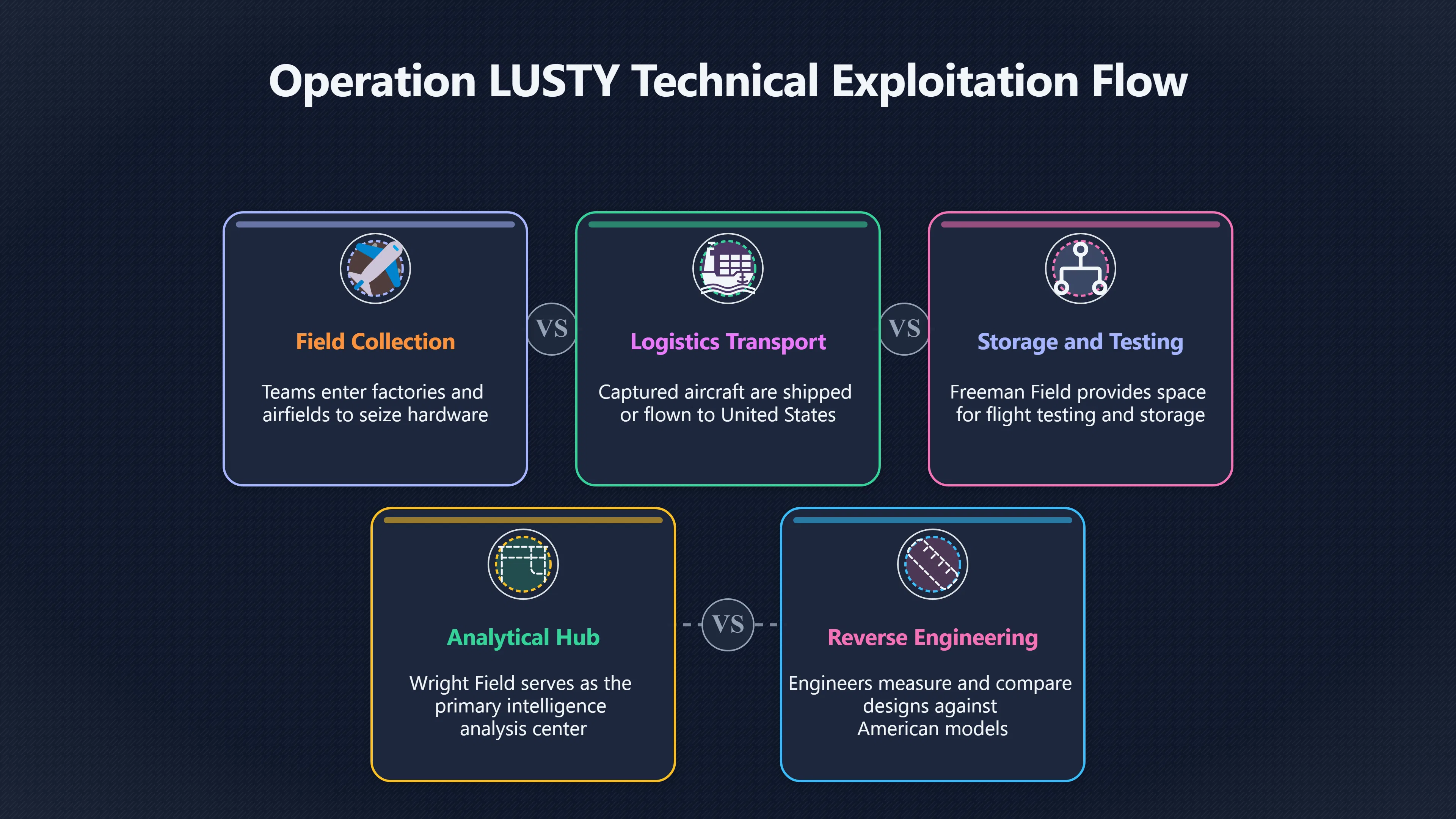
The aviation branch of Paperclip cannot be separated from Operation LUSTY, short for “Luftwaffe Secret Technology”. As Germany collapsed in 1945, American Air Technical Intelligence teams entered research centres, factories and airfields searching for aircraft, engines, documents and scientific personnel. These teams had long been connected to Wright Field’s intelligence apparatus, and the captured material was funnelled back into the United States for detailed examination.[Wikipedia]WikipediaOperation LUSTYOperation LUSTY
Colonel Harold E. Watson, a former Wright Field test pilot, led the effort to gather significant German aircraft for shipment or ferry flight to the United States. His team collected examples of advanced fighters, jet aircraft and experimental designs from across occupied Germany. These aircraft were sent primarily to Wright Field and, when space became insufficient, to Freeman Field in Indiana. There they were catalogued, repaired, flown, measured and compared against American designs.[af.mil]nasic.af.milNASICNational Air and Space Intelligence Center HeritageOperation Paperclip, a follow-on project, brought over 200 German scientists and…
Freeman Field became a specialised Foreign Aircraft Evaluation Center. Wright Field remained the analytical hub, while Freeman provided room for storage and flight testing. The two installations functioned as parts of the same intelligence system. Captured German aircraft included operational jet fighters, rocket-powered aircraft, advanced piston-engine designs and experimental airframes that represented years of wartime research investment.[Wikipedia]WikipediaFreeman Army AirfieldFreeman Army Airfield
For American engineers, the value of these aircraft went beyond performance figures. Reverse engineering required answers to questions that physical inspection alone could not always provide:
- Why had a particular aerodynamic solution been chosen?
- Which manufacturing compromises had been made under wartime conditions?
- What performance limits had German engineers already discovered?
- Which experimental concepts had failed and why?
These questions increasingly required access to the people who had designed, tested and produced the aircraft. That requirement helped drive the aviation component of Project Paperclip.[National Air and Space Museum]airandspace.si.eduproject paperclip and american rocketry after world war iiNational Air and Space MuseumProject Paperclip and American Rocketry after World War II31 Mar 2023 — Project Paperclip was a program that…
Why Wright Field Needed German Specialists
Operation LUSTY initially focused on collecting aircraft, facilities and documents. As investigators worked through the material, they realised that understanding German aviation research required direct access to the engineers and scientists behind it. The transition from technical exploitation to personnel recruitment followed naturally from that discovery.[Wikipedia]WikipediaOperation LUSTYOperation LUSTY
According to the heritage history of today’s National Air and Space Intelligence Center, more than 200 German scientists and technicians were eventually brought to Wright Field under Project Paperclip to work alongside American personnel. Some became attached directly to laboratory and research activities.[NASIC]nasic.af.milNASICNational Air and Space Intelligence Center HeritageOperation Paperclip, a follow-on project, brought over 200 German scientists and…
The aviation recruits represented a wide range of expertise rather than a single famous team. American authorities sought specialists in:
- Supersonic and transonic aerodynamics.
- Jet and rocket propulsion.
- Guidance and control systems.
- Aircraft structures and materials.
- Aviation and aerospace medicine.
- Flight testing and research methods.[National Air and Space Museum]airandspace.si.eduproject paperclip and american rocketry after world war iiNational Air and Space MuseumProject Paperclip and American Rocketry after World War II31 Mar 2023 — Project Paperclip was a program that…
This breadth is important because it reveals how the Air Force side of Paperclip differed from the better-known rocket narrative. The objective was not simply to reproduce a specific weapon. It was to absorb an entire body of technical knowledge related to advanced flight. In practice, German specialists became living repositories of information that often existed nowhere else in complete form.[National Air and Space Museum]airandspace.si.eduproject paperclip and american rocketry after world war iiNational Air and Space MuseumProject Paperclip and American Rocketry after World War II31 Mar 2023 — Project Paperclip was a program that…
For intelligence officers, this reduced uncertainty. A captured aircraft could show what Germany had built. A designer could explain what Germany had intended to build next. That distinction mattered greatly during the opening years of the Cold War, when American planners feared both technological surprise and Soviet access to the same expertise.[Air & Space Forces Magazine]airandspaceforces.comAir & Space Forces MagazineProject Paperclip1 Jun 2007 — A spontaneous international race to acquire equipment, documents, engineers, and…

Documents, Terminology and Industrial Know-How
Aircraft were only one part of the intelligence haul reaching Wright Field. The post-war exploitation effort also generated an enormous influx of technical records, engineering reports, test data and industrial documentation. Much of the value of Paperclip emerged from connecting these documents with the specialists capable of interpreting them.[NASIC]nasic.af.milNASICNational Air and Space Intelligence Center HeritageOperation Paperclip, a follow-on project, brought over 200 German scientists and…
Under Colonel Howard McCoy’s direction, large quantities of captured German documents were delivered to Wright Field. By the end of 1947, personnel there had processed more than 1,500 tons of technical material. The effort reportedly added over 100,000 technical terms to English-language scientific and engineering usage.[NASIC]nasic.af.milNASICNational Air and Space Intelligence Center HeritageOperation Paperclip, a follow-on project, brought over 200 German scientists and…
This document exploitation effort addressed a recurring problem in reverse engineering. Hardware reveals dimensions, materials and performance characteristics, but it often conceals development history. Technical reports can reveal abandoned approaches, failed experiments, production difficulties and future research directions. When paired with German specialists, the records became far more useful because investigators could question the people who had produced them.[af.mil]nasic.af.milNASICNational Air and Space Intelligence Center HeritageOperation Paperclip, a follow-on project, brought over 200 German scientists and…
The process also transferred industrial knowledge. American analysts were interested not only in aircraft designs but in the research institutions, testing methods and production systems that generated them. Understanding how Germany organised aerodynamic research, wind-tunnel testing and experimental development could be as valuable as acquiring any individual aircraft.[Wikipedia]WikipediaOperation LUSTYOperation LUSTY
The Intelligence Legacy Beyond the Rocket Story
The aviation side of Paperclip demonstrates that post-war technological exploitation was a system rather than a single recruitment programme. Wright Field linked together captured aircraft, intelligence officers, test pilots, research laboratories, document analysts and imported specialists. Each element reinforced the others.[NASIC]nasic.af.milNASICNational Air and Space Intelligence Center HeritageOperation Paperclip, a follow-on project, brought over 200 German scientists and…
The popular image of Paperclip often centres on rockets because later space achievements created a dramatic public narrative. Yet contemporary evidence shows that aviation expertise occupied a major share of the programme. The specialists brought to the United States contributed knowledge in aerodynamics, propulsion, guidance, flight medicine and other fields directly relevant to military aviation and aerospace development.[si.edu]airandspace.si.eduproject paperclip and american rocketry after world war iiNational Air and Space MuseumProject Paperclip and American Rocketry after World War II31 Mar 2023 — Project Paperclip was a program that…
From the perspective of reverse engineering foreign military technology, Wright Field illustrates a crucial lesson: successful exploitation rarely depended on captured hardware alone. The United States sought aircraft, documents and facilities, but it also sought the engineers who could explain them. The aviation branch of Paperclip turned technical intelligence from an exercise in examining enemy machines into an effort to absorb the expertise that had created those machines in the first place.[af.mil]nasic.af.milNASICNational Air and Space Intelligence Center HeritageOperation Paperclip, a follow-on project, brought over 200 German scientists and…

Amazon book picks
Further Reading
Books and field guides related to Paperclip Was Not Only About Rockets. Use these as the next step if you want deeper reading beyond the article.
The Jet Race and the Second World War
Focuses on the technologies intelligence teams sought to exploit.
German Aircraft of the Second World War
Provides context for the aircraft studied at Wright and Freeman Fields.
Skunk Works
Illustrates how aviation innovation depends on design knowledge and testing.
eBay marketplace picks
Marketplace Samples
Live-tested eBay searches with available results related to this page.
Endnotes
1.
Source: [nasic]({{ ‘nasic/’ | relative_url }}). af.mil
Link:https://www.nasic.af.mil/About-Us/Fact-Sheets/Display/Article/611728/national-air-and-space-intelligence-center-heritage/
Source snippet
NASICNational Air and Space Intelligence Center HeritageOperation Paperclip, a follow-on project, brought over 200 German scientists and...
2.
Source: Wikipedia
Title: Operation LUSTY
Link:https://en.wikipedia.org/wiki/Operation_LUSTY
3.
Source: jstor.org
Link:https://www.jstor.org/stable/24911848
Source snippet
German Scientists, American Policy, and the Cold Warby J GIMBEL · 1990 · Cited by 36 — German scientists and technicians ・ designed to ex...
4.
Source: Wikipedia
Title: Freeman Army Airfield
Link:https://en.wikipedia.org/wiki/Freeman_Army_Airfield
5.
Source: Wikipedia
Title: Field Information Agency, Technical
Link:https://en.wikipedia.org/wiki/Field_Information_Agency%2C_Technical
6.
Source: Wikipedia
Title: Operation Paperclip
Link:https://en.wikipedia.org/wiki/Operation_Paperclip
Source snippet
Operation PaperclipOperation Paperclip was a secret United States intelligence program in which more than 1,600 German scientists, eng...
7.
Source: airandspace.si.edu
Title: project paperclip and american rocketry after world war ii
Link:https://airandspace.si.edu/stories/editorial/project-paperclip-and-american-rocketry-after-world-war-ii
Source snippet
National Air and Space MuseumProject Paperclip and American Rocketry after World War II31 Mar 2023 — Project Paperclip was a program that...
8.
Source: airandspaceforces.com
Link:https://www.airandspaceforces.com/article/0607paperclip/
Source snippet
Air & Space Forces MagazineProject Paperclip1 Jun 2007 — A spontaneous international race to acquire equipment, documents, engineers, and...
9.
Source: mjhnyc.org
Title: from wwii to the space race the story of project paperclip
Link:https://mjhnyc.org/events/from-wwii-to-the-space-race-the-story-of-project-paperclip/
Source snippet
Jewish Heritage MuseumFrom WWII to the Space Race: The Story of Project PaperclipBetween 1945 and the 1960s, the United States government...
10.
Source: airandspaceforces.com
Title: Our German Scientists Operation Lusty began
Link:https://www.airandspaceforces.com/article/our-german-scientists/
Source snippet
Our German ScientistsOperation Lusty began April 22, 1945, when the wartime technical intelligence teams merged with the new Exploitation...
Published: April 22, 1945
Additional References
11.
Source: cia.gov
Link:https://www.cia.gov/readingroom/document/00010786
Source snippet
DOCUMENTS FOR PROJECT PAPERCLIP INCLUDES...PERCLIP SPECIALISTS ARE GERMAN SCIENTISTS BEING USED FOR AMERICAN INTEREST IN VARIOUS ENTERPR...
12.
Source: ftpmirror.your.org
Link:https://ftpmirror.your.org/pub/wikimedia/images/wikipedia/en/7/73/NASIC_history.pdf
Source snippet
intelligence centerOperation Paperclip, a follow-on project, 1 Page 3 brought over 200 German scientists and technicians to Wrig...
13.
Source: wsmrmuseum.com
Title: operation paperclip at fort bliss 1945 1950
Link:https://wsmrmuseum.com/2022/03/28/operation-paperclip-at-fort-bliss-1945-1950/
Source snippet
Operation Paperclip at Fort Bliss: 1945-195028 Mar 2022 — The main participants in the V-2 program were the Army Ordnance Sub-Office, Gen...
14.
Source: nationalmuseum.af.mil
Title: Air Force Museum Operation LUSTY
Link:https://www.nationalmuseum.af.mil/Visit/Museum-Exhibits/Fact-Sheets/Display/Article/196144/operation-lusty/
Source snippet
Air Force MuseumOperation LUSTY - National Museum of the USAF - Air ForceOperation LUSTY began with the aim of exploiting captured German...
15.
Source: aviationtrailinc.org
Title: Operation Paperclip
Link:https://www.aviationtrailinc.org/post/2017/01/24/operation-paperclip
Source snippet
Aviation Trail24 Jan 2017 — Wright Field was one of the sites to which the Paperclip Germans came, and some lived in this area until deat...
16.
Source: kbismarck.org
Title: Operation Overcast
Link:https://www.kbismarck.org/forum/viewtopic.php?t=2932
Source snippet
Naval History Forums12 Dec 2009 — The Air Force brought their aircraft to Wright Field, and when the field could no longer handle additio...
17.
Source: youtube.com
Title: Operation Paperclip
Link:https://www.youtube.com/watch?v=OIiz6Zp8wwU
Source snippet
German scientists during 'Operation Paper-clip' at Wright Field in Ohio United States...
18.
Source: youtube.com
Title: Aviation Stuff: Operation Lusty and Watson’s [Whizzers]({{ ‘whizzers/’ | relative_url }})
Link:https://www.youtube.com/watch?v=A0y08v8Y5TY
Source snippet
The Reaper Was A Carrier Full Of The Luftwaffe's Secret Weapons...
19.
Source: rlgeerrobbins.com
Link:https://rlgeerrobbins.com/operation-paperclip-americas-dark-science-fair-project/?srsltid=AfmBOoqsLHTCiUywrqDT9lCIMdr1fUL90x1SUjNtKJGKSdvYxcpLHwLk
Source snippet
Operation Paperclip: America's Dark Science Fair Project4 Apr 2026 — Uncover the controversial story of Operation Paperclip: America's da...
20.
Source: facebook.com
Link:https://www.facebook.com/groups/luft46/posts/27082054194728449/
Source snippet
Rare German aircraft at Freeman Field air show 1945Commenters discuss the significance of captured German aircraft and technology on disp...
Topic Tree