Within Countermeasures
Why some decoys fool sensors and others fail
A decoy must look credible to the enemy's sensor chain, not just convincing to human eyes or friendly designers.
On this page
- What makes a false target believable
- Signature mistakes that expose a decoy
- How real threat data improves decoy design
Page outline Jump by section
Introduction
A decoy succeeds only when the enemy sensor accepts a false story about reality. It does not matter how convincing the decoy appears to a human observer or how closely it matches a designer’s assumptions. If the radar, infrared seeker, tracking algorithm or fire-control system detects inconsistencies, the deception fails. This is why reverse engineering foreign military technology has often been as valuable for countermeasure development as for intelligence collection. Real enemy hardware reveals what a sensor actually measures, what features it ignores, and which clues cause it to reject a false target. A decoy that looks impressive in testing can become useless if the threat’s sensor chain notices a mismatch in motion, spectrum, timing, geometry or behaviour. Conversely, access to genuine threat systems allows engineers to discover exactly what makes a false target believable and what exposes it.[ResearchGate]researchgate.netResearch Gate Advances in Anti-Deception Jamming Strategies for RadarAdvances in Anti-Deception Jamming Strategies for Radar…March 1, 2025 — 17 Mar 2025 — This paper offers a comprehensive re…

What makes a false target believable
The central mistake in decoy design is assuming that matching a single characteristic is enough. Modern sensors rarely identify targets from one feature alone. They combine multiple measurements and look for consistency across them.
A radar-guided weapon may compare target position, velocity, acceleration and radar cross-section over time. An infrared seeker may evaluate brightness, spectral content, movement and source size simultaneously. A decoy therefore has to fit into the sensor’s broader picture of the target rather than merely imitate one visible signature.[MDPI]mdpi.comDeception Velocity-Based Method to Discriminate Physical…by Q Li · 2024 · Cited by 12 — The proposed deception velocity-based (DVB…
This is why successful decoys are often described as creating a credible false target rather than simply generating a strong signal. Towed radar decoys, for example, do not merely reflect energy. They attempt to present a target that appears more attractive to the missile’s tracking logic than the aircraft itself.[arXiv]arxiv.orgAdvances in Anti-Deception Jamming Strategies for Radar…by H Calatrava · 2025 · Cited by 21 — An additional jamming strategy, dec…
The challenge becomes harder as sensors gain more processing power. Modern radar target recognition systems increasingly exploit subtle target characteristics, including dynamic radar cross-section behaviour and detailed scattering patterns. As a result, the sensor is often evaluating whether all observed features belong together in a physically plausible way.[Online Journals]online-journals.orgOnline JournalsFeature Based on Detection of Aviation Decoy Targets…7 days ago — This study proposes a robust feature-fusion framework…
Signature mistakes that expose a decoy
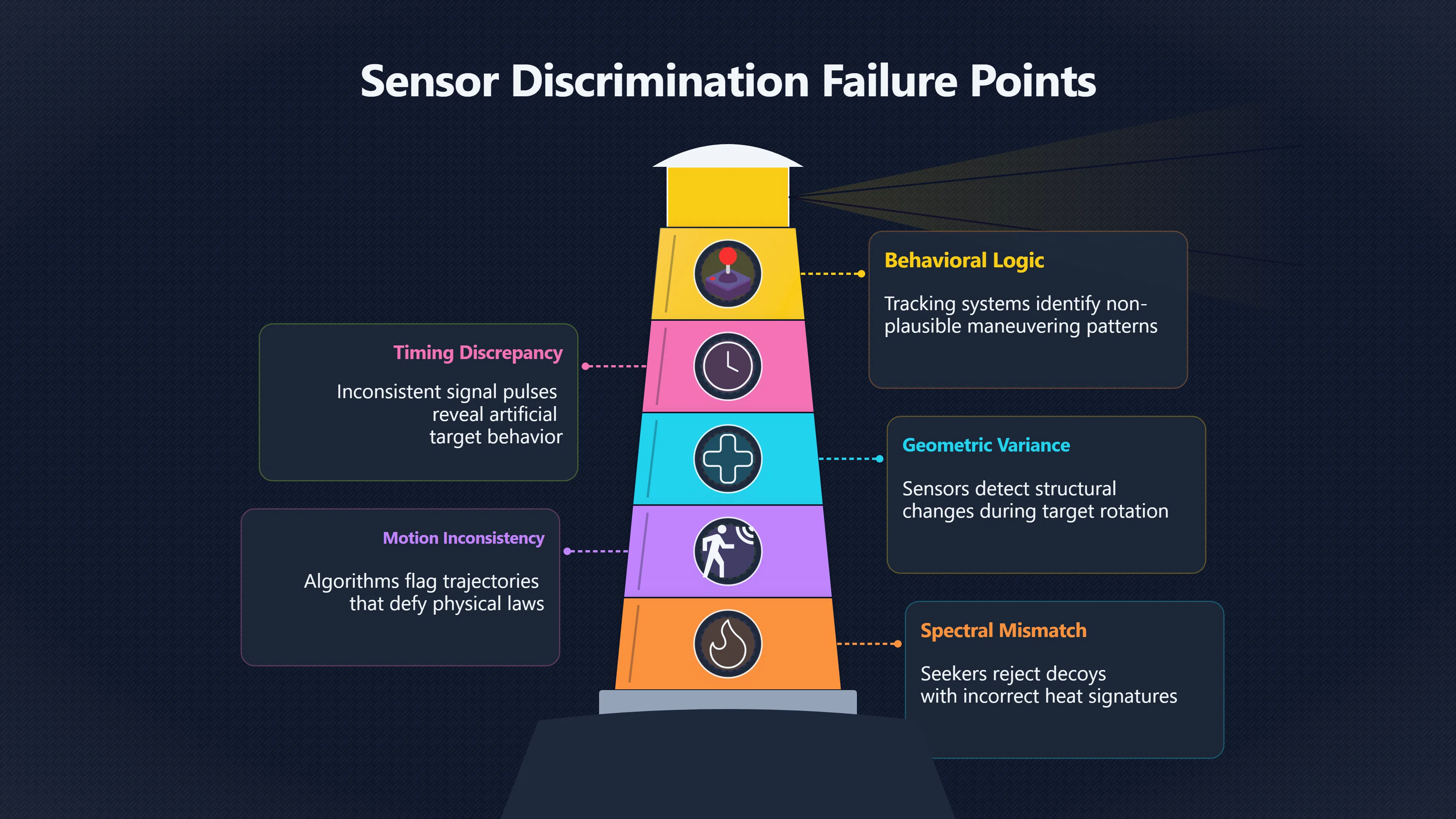
Many decoys fail because they reproduce the wrong part of the target signature.
The spectral mismatch problem
Infrared flares illustrate this problem clearly. Early heat-seeking missiles often pursued the brightest heat source available. Under those conditions, a flare only needed to burn hotter than the aircraft engine.
Later seekers introduced counter-countermeasures designed specifically to reject flares. These systems analyse the spectral composition of the heat source rather than simply its intensity. If the emitted energy does not resemble the spectral characteristics of an aircraft engine, the seeker can classify it as a decoy and continue tracking the aircraft. Researchers have identified spectral discrimination as one of the most important methods used by modern seekers to defeat traditional flares.[researchgate.net]researchgate.netResearch Gate Pyrotechnic Countermeasures: IIAdvanced Aerial Infrared…Missile-seeker head counter-countermeasures include spectral discrimination, kinematical discrimination, rise…
This creates an important lesson: a decoy may produce a strong signal yet still fail because it produces the wrong kind of signal.
Motion that does not make sense
A second common failure occurs when the target behaves in a way the sensor considers implausible.
Radar discrimination research repeatedly exploits differences in motion between genuine targets and false ones. Algorithms can compare measured trajectories against expected physical behaviour. If a decoy accelerates, drifts or manoeuvres in a manner inconsistent with the target it claims to be, the deception becomes vulnerable to rejection. Studies examining active radar decoys and missile-defence discrimination show that motion patterns themselves can become identifying signatures.[researchgate.net]researchgate.netResearch Gate Discrimination algorithm of active decoy and radar targetDiscrimination algorithm of active decoy and radar target…February 5, 2009 — 17 Mar 2026 — The problem of discriminating a…
This means that a false radar return is not enough. The return must also move like the real object would move.
Geometry and size inconsistencies
Modern sensors increasingly examine target structure rather than treating all reflections as identical.
Research into dynamic radar cross-section analysis demonstrates that temporal and geometric characteristics can help distinguish aircraft from decoys. A decoy may generate the correct average radar return yet fail to reproduce how that return changes as viewing angle changes or as the target moves. Those inconsistencies can reveal the deception.[Online Journals]online-journals.orgOnline JournalsFeature Based on Detection of Aviation Decoy Targets…7 days ago — This study proposes a robust feature-fusion framework…
In practice, sensors often exploit exactly the small details that designers are tempted to ignore.

Why sensor evolution breaks old decoys
A recurring pattern in military history is that an effective decoy becomes ineffective after the threat acquires new discrimination capabilities.
Infrared missile development provides a clear example. Modern seekers incorporate combinations of spectral analysis, ultraviolet sensing, source-size estimation, rise-time analysis and trajectory discrimination. Each new discriminator is intended to identify characteristics that older decoys failed to reproduce accurately.[researchgate.net]researchgate.netResearch Gate Pyrotechnic Countermeasures: IIAdvanced Aerial Infrared…Missile-seeker head counter-countermeasures include spectral discrimination, kinematical discrimination, rise…
The result is an ongoing cycle. A decoy exploits a weakness in the seeker. The seeker gains a method for detecting the deception. The decoy must then evolve to imitate additional target characteristics.
This cycle explains why countermeasure effectiveness can vary dramatically between generations of sensors. A decoy proven against one threat may perform poorly against a newer seeker that evaluates a different set of features.[aimt.cz]aimt.czSelf Protection of Aircraft versus Resistance of Missile Optic…by R Doskočil · 2010 · Cited by 5 — Abstract: The paper deals with one…
How real threat data improves decoy design
The most important contribution of reverse engineering is not learning what a foreign system is supposed to do. It is discovering what the real system actually accepts as credible.
Laboratory models and intelligence estimates may predict that a radar tracks a target based primarily on one parameter. Examination of the actual hardware may reveal additional filters, processing steps or rejection criteria that were previously unknown. Once engineers know those criteria, they can redesign decoys to survive the sensor’s scrutiny.[ResearchGate]researchgate.netResearch Gate Advances in Anti-Deception Jamming Strategies for RadarAdvances in Anti-Deception Jamming Strategies for Radar…March 1, 2025 — 17 Mar 2025 — This paper offers a comprehensive re…
Captured or otherwise exploited systems allow developers to measure:
- Which target features dominate the sensor’s decision-making.
- Which features are ignored.
- What thresholds trigger rejection.
- How discrimination changes across operating modes.
- Whether fielded performance differs from theoretical specifications.
Those details are difficult to infer from observation alone because many exist inside signal-processing software or seeker electronics rather than in visible external behaviour.[ResearchGate]researchgate.netResearch Gate Advances in Anti-Deception Jamming Strategies for RadarAdvances in Anti-Deception Jamming Strategies for Radar…March 1, 2025 — 17 Mar 2025 — This paper offers a comprehensive re…
For countermeasure designers, this information is often more valuable than basic performance data. Knowing that a radar operates on a certain frequency is useful. Knowing why it rejects a false target is what determines whether a decoy will work.
The real risk: designing for assumptions instead of sensors
The most dangerous decoy design error is building a deception around friendly assumptions rather than enemy acceptance criteria.
A development team may focus on producing a large radar signature, a bright infrared source or a visually convincing target. Yet the enemy sensor may be evaluating completely different attributes. In that case, the decoy is optimised for the wrong audience.
Research into radar target recognition, anti-deception processing and seeker counter-countermeasures repeatedly points to the same conclusion: sensors succeed by exploiting differences that decoy designers fail to replicate. The more sophisticated the sensor becomes, the more likely it is to reject a false target that only imitates superficial characteristics.[researchgate.net]researchgate.netResearch Gate Advances in Anti-Deception Jamming Strategies for RadarAdvances in Anti-Deception Jamming Strategies for Radar…March 1, 2025 — 17 Mar 2025 — This paper offers a comprehensive re…
That reality explains why countermeasures built from real enemy systems occupy such an important place in foreign materiel exploitation. A decoy is not judged by how well it resembles a target in theory. It is judged by whether the enemy sensor believes the lie. When the sensor does not, the deception collapses regardless of how convincing it looked on the drawing board.[ResearchGate]researchgate.netResearch Gate Advances in Anti-Deception Jamming Strategies for RadarAdvances in Anti-Deception Jamming Strategies for Radar…March 1, 2025 — 17 Mar 2025 — This paper offers a comprehensive re…
Amazon book picks
Further Reading
Books and field guides related to Why some decoys fool sensors and others fail. Use these as the next step if you want deeper reading beyond the article.
Electronic Warfare and Radar Systems Engineering Handbook
Explains radar deception, decoys, and sensor behavior.
The Pentagon's Brain
Provides context for advanced military countermeasure development.
Skunk Works
Demonstrates the engineering and testing culture behind survivability systems.
Information Warfare and Security
Addresses deception, perception, and adversary decision-making.
eBay marketplace picks
Marketplace Samples
Live-tested eBay searches with available results related to this page.



Endnotes
1.
Source: researchgate.net
Title: Research Gate Advances in Anti-Deception Jamming Strategies for Radar
Link:https://www.researchgate.net/publication/389548760_Advances_in_Anti-Deception_Jamming_Strategies_for_Radar_Systems_A_Survey
Source snippet
Advances in Anti-Deception Jamming Strategies for Radar...March 1, 2025 — 17 Mar 2025 — This paper offers a comprehensive re...
Published: March 1, 2025
2.
Source: aimt.cz
Link:https://www.aimt.cz/index.php/aimt/article/download/1623/100
Source snippet
Self Protection of Aircraft versus Resistance of Missile Optic...by R Doskočil · 2010 · Cited by 5 — Abstract: The paper deals with one...
3.
Source: mdpi.com
Link:https://www.mdpi.com/2072-4292/16/2/382
Source snippet
Deception Velocity-Based Method to Discriminate Physical...by Q Li · 2024 · Cited by 12 — The proposed deception velocity-based (DVB...
4.
Source: researchgate.net
Title: Research Gate Pyrotechnic Countermeasures: II
Link:https://www.researchgate.net/publication/227694494_Pyrotechnic_Countermeasures_II_Advanced_Aerial_Infrared_Countermeasures
Source snippet
Advanced Aerial Infrared...Missile-seeker head counter-countermeasures include spectral discrimination, kinematical discrimination, rise...
5.
Source: arxiv.org
Link:https://arxiv.org/pdf/2503.00285
Source snippet
Advances in Anti-Deception Jamming Strategies for Radar...by H Calatrava · 2025 · Cited by 21 — An additional jamming strategy, dec...
6.
Source: online-journals.org
Link:https://online-journals.org/index.php/iTDAF/article/view/61479
Source snippet
Online JournalsFeature Based on Detection of Aviation Decoy Targets...7 days ago — This study proposes a robust feature-fusion framework...
7.
Source: mdpi.com
Link:https://www.mdpi.com/2072-4292/15/15/3742
Source snippet
Radar Target Characterization and Deep Learning in...by W Jiang · 2023 · Cited by 94 — This paper reviews the progress of deep learning...
8.
Source: researchgate.net
Title: Research Gate Discrimination algorithm of active decoy and radar target
Link:https://www.researchgate.net/publication/298221221_Discrimination_algorithm_of_active_decoy_and_radar_target_based_on_ballistic_trajectory%27s_planarity
Source snippet
Discrimination algorithm of active decoy and radar target...February 5, 2009 — 17 Mar 2026 — The problem of discriminating a...
Published: February 5, 2009
9.
Source: archive.conscientiabeam.com
Link:https://archive.conscientiabeam.com/index.php/76/article/view/3308/7617
Source snippet
Cross Section of Miniature Air-Launched Decoy...This study focuses on imitating the radar cross section of warplanes by deceiving enemy...
Additional References
10.
Source: archive.ll.mit.edu
Link:https://archive.ll.mit.edu/publications/journal/pdf/vol07_no1/7.1.3.discriminationperformance.pdf
Source snippet
MIT Lincoln LaboratoryMissile DefenseDiscrimination is a remote-sensing operation wherein sensor measure- ments of target observables are...
11.
Source: eikleaf.com
Title: dark flares the countermeasure that saves aircraft without giving them away
Link:https://www.eikleaf.com/dark-flares-the-countermeasure-that-saves-aircraft-without-giving-them-away/
Source snippet
Dark flares: the countermeasure that saves aircraft without...18 Mar 2026 — A missile seeker equipped with spectral discrimination capab...
12.
Source: youtube.com
Link:https://www.youtube.com/watch?v=KzRhQnLl9b0
Source snippet
Protection Systems of AircraftHow do fighter jets really evade missiles? This video explains the real science behind flares, chaff, radar...
13.
Source: tnsr.org
Link:https://tnsr.org/2021/09/better-monitoring-and-better-spying-the-implications-of-emerging-technology-for-arms-control/
Source snippet
will mean that transparency comes at the expense of high threats to security...
14.
Source: reddit.com
Link:https://www.reddit.com/r/WarCollege/comments/y79ori/can_objects_with_high_radar_cross_section_be_used/
Source snippet
o size and be towed few hundred meters away from anti air radars such...
15.
Source: militarymachine.com
Title: missile countermeasures chaff flares decoys
Link:https://militarymachine.com/missile-countermeasures-chaff-flares-decoys
Source snippet
credible false target... It emits radio-frequency energy that creates a radar cross-section larger and more attractive than the aircraft...
16.
Source: secretprojects.co.uk
Title: Method to discriminate ICBM decoys?
Link:https://www.secretprojects.co.uk/threads/method-to-discriminate-icbm-decoys-decoys-are-useless.37332/
Source snippet
decoys are useless?5 Jun 2021 — What are the methods to discriminate ICBM decoys? are they truly useless as stated by Stuart Slade? I fou...
17.
Source: inspirehep.net
Link:https://inspirehep.net/files/9c0bb49e75d4b05024e35bcbc33eb85a
Source snippet
Enhancing underwater sensor network security using QKDby S Rajnarayanan · 2026 — QKD is used to develop unbreakable encryption through ph...
18.
Source: ucs.org
Title: technicalrealities fullreport
Link:https://www.ucs.org/sites/default/files/2019-09/technicalrealities_fullreport.pdf
Source snippet
Technical Realitiesby RP FEYNMAN · 2004 — The radars that will be part of the Block 2004 system will not be able to discriminate warheads...
19.
Source: Wikipedia
Title: Flare (countermeasure)
Link:https://en.wikipedia.org/wiki/Flare_%28countermeasure%29
Source snippet
Flare (countermeasure)A flare or decoy flare is an aerial infrared countermeasure used by an aircraft to counter an infrared homing ("...
Topic Tree