Within Foreign Materiel
What Export Weapons Give Away
Bought or exported systems can give analysts legal or indirect access to foreign designs and performance limits.
On this page
- Legal acquisition paths
- Export downgrades
- Intelligence from maintenance
Page outline Jump by section
Introduction
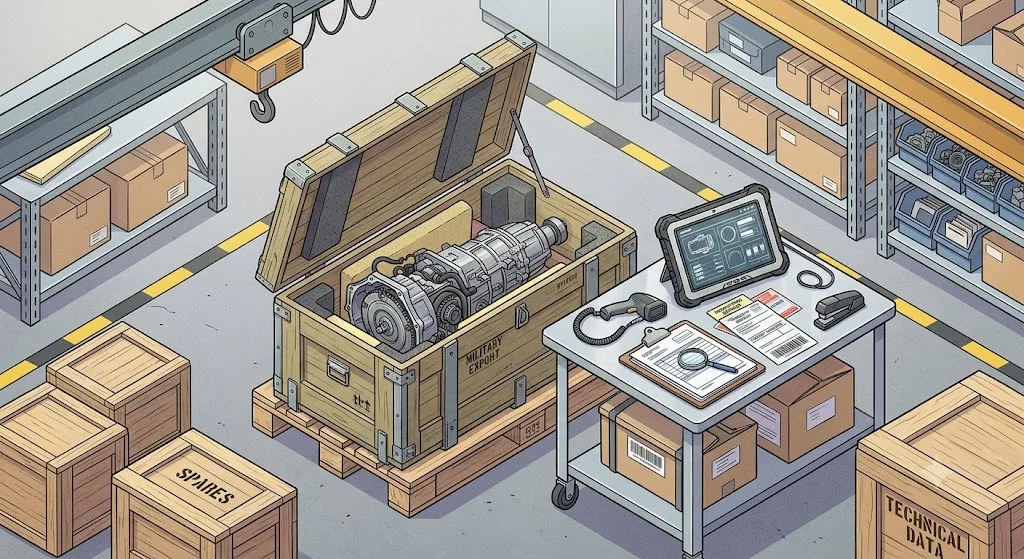
Exported weapons can give away far more than a brochure admits. A state that buys a fighter, missile battery, radar, armoured vehicle or naval system may receive not only the hardware, but also training, spares, diagnostic equipment, manuals, software interfaces, depot support and years of contact with the supplier’s engineers. For analysts studying foreign military technology, this creates a legal and indirect route to insight: the weapon does not need to be captured in combat if it can be purchased, leased, operated by a partner, inspected during maintenance, or observed through a buyer’s use.
That access is never unlimited. Exporters often remove sensitive features, restrict software, control spare parts, block re-transfer, and monitor end use. Yet the very act of designing an export version reveals what the seller considers sensitive. Buyers also reveal something of their own: how the system performs outside ideal test conditions, what breaks, which parts are hard to source, how crews adapt it, and whether the advertised capability survives real sustainment. In the wider story of reverse engineering foreign military technology, export systems occupy a grey zone between open procurement and intelligence exploitation. They are legal products, but they can still become sources of technical, operational and political intelligence.[Defense Security Cooperation Agency]samm.dsca.milDefense Security Cooperation Agency Chapter 3Defense Security Cooperation Agency Chapter 3
Legal acquisition is still a route to technical insight
Buying a weapon is not the same as capturing one, but it can still produce a rich technical picture. A modern arms sale is rarely just a box of equipment. In the US Foreign Military Sales system, the Defence Security Cooperation Agency describes major-system sales as a “total package” that can include training, spare parts and support needed to sustain a system through its first years of service. That package is what makes export weapons valuable to operators — and what makes them informative to analysts.[Defense Security Cooperation Agency]dsca.milOpen source on dsca.mil.
For a buyer, legal acquisition can reveal the system as a working organism rather than a museum specimen. Training exposes crew procedures and maintenance rhythms. Spare-parts catalogues show which assemblies are modular, fragile or controlled. Support contracts reveal which faults require factory intervention. Software updates and diagnostic tools indicate which parts of performance depend on code rather than metal. Even when the buyer is an ally, these details matter because they convert abstract capability claims into practical knowledge.
This is why export governance treats “technology” as more than physical hardware. US International Traffic in Arms Regulations govern not only defence articles, but also defence services, technical data, brokering and the temporary import of controlled defence items. The Arms Export Control Act authorises control over both defence articles and defence services, and the State Department’s Directorate of Defense Trade Controls is responsible for administering that system.[state.gov]pmddtc.state.govDDTC Public Portal International Traffic in Arms Regulations (ITARDDTC Public Portal International Traffic in Arms Regulations (ITAR
The same logic appears in European dual-use controls. The European Commission defines dual-use items as goods, software and technology with both civilian and military applications, and notes that EU controls cover export, transit, brokering and technical assistance. German export-control guidance is even more explicit about technical assistance: repairs, development, manufacture, assembly, testing, maintenance, instruction, advice, training and transmission of working knowledge can all become controlled channels of know-how.[Trade and Economic Security]policy.trade.ec.europa.euTrade and Economic Security Exporting dual-use itemsTrade and Economic Security Exporting dual-use items
The policy lesson is straightforward: the sale of a weapon is also the managed release of an ecosystem. A government that approves the platform but mishandles the manuals, spares, field-service access or software support may give away more than it intended.

Export downgrades show what sellers fear losing
Export variants are often deliberately different from the seller’s domestic version. This is not just a marketing decision; it is a form of technology-protection policy. Exporters may reduce sensor performance, withhold certain weapons, alter electronic-warfare suites, restrict encryption, limit software modes, remove classified components, or supply an older configuration. The downgrade is meant to preserve the seller’s own military edge while still earning revenue, building influence or supporting a partner.
The most revealing point is not simply that downgrades happen. It is what they disclose about the seller’s hierarchy of secrets. If a radar mode, missile seeker, electronic countermeasure, propulsion component or mission computer is removed from export models, analysts can infer that the seller regards that element as especially sensitive. A downgrade is therefore both a shield and a signal.
US security-assistance rules make this logic visible. The Security Assistance Management Manual has a dedicated chapter on technology transfer and disclosure, covering export controls, disclosure of classified and controlled unclassified information, and system-specific release requirements for sensitive technologies. It also states that the most sensitive and sophisticated technology requires the highest degree of protection, using as a test whether unauthorised disclosure could cause exceptionally grave damage to US critical military or intelligence advantage.[Defense Security Cooperation Agency]samm.dsca.milDefense Security Cooperation Agency Chapter 3Defense Security Cooperation Agency Chapter 3
Downgrades can also protect against buyer defection or political change. The Iranian F-14 case is a lasting warning. Iran became the only foreign customer for the US Navy’s F-14 Tomcat before the 1979 revolution; after relations collapsed, Washington cut off support, and later took extraordinary measures to stop spare parts reaching Iran. The case illustrates a core export-control problem: a friendly buyer at the time of sale may become an adversary while still holding the hardware, trained personnel and accumulated maintenance knowledge.[Wikipedia]WikipediaGrumman F-14 TomcatGrumman F-14 Tomcat
Export controls are therefore not only about the moment of transfer. They are about the life of the system after political conditions change. A fighter, radar or missile battery can remain in service for decades, long after the alliance assumptions behind the original sale have expired.
Buyers reveal performance through use, faults and adaptation
A buyer does not need to hand over blueprints to reveal useful information. Its normal operation of an imported system can expose what the system can sustain, what it cannot, and which claims were optimistic. Open arms-transfer data already shows who received what and when; the Stockholm International Peace Research Institute’s Arms Transfers Database tracks major conventional arms transfers from 1950 through the most recent full calendar year and is designed to answer questions about suppliers, recipients, weapons and changing relationships.[SIPRI]sipri.orgOpen source on sipri.org.
Once a system is in service, the buyer becomes an unwitting test environment. Analysts can watch whether aircraft achieve expected sortie rates, whether air-defence systems are integrated into national command networks, whether ships spend excessive time in dock, whether armoured vehicles require unusual levels of depot support, and whether imported missiles are kept in reserve because of cost, scarcity or reliability concerns. These observations do not replace laboratory exploitation, but they narrow the range of uncertainty.
Maintenance is especially revealing because it turns hidden design assumptions into visible behaviour. A system that depends heavily on contractor support tells analysts that domestic sustainment is difficult. Repeated parts shortages reveal bottlenecks. Workarounds show which components are replaceable and which are not. If a buyer cannibalises older platforms to keep a fleet alive, that says something about the fragility of the supply chain and the buyer’s industrial improvisation.
This is one reason spare parts receive intense policy attention. A 2003 US Government Accountability Office report warned that Air Force controls were insufficient to prevent spare parts containing sensitive military technology from being released to foreign countries ineligible to receive them. A 2004 GAO report on Army foreign military sales similarly found inadequate controls over blanket orders, creating risk that classified spare parts and unclassified items containing military technology could be shipped to countries not entitled to receive them.[gao.gov]gao.gov03 939r03 939r
Those findings matter beyond bureaucratic compliance. Spare parts are often where the real technology sits. A radar line-replaceable unit, digital processor, refuelling kit, cryptographic component or electronic-warfare module may reveal more than the outer platform. Export governance therefore has to treat sustainment as a continuing disclosure pathway, not an afterthought.
The S-400 case shows why co-location can be intelligence-sensitive
The Turkish purchase of Russia’s S-400 air-defence system is a clear example of how an export weapon can create intelligence concerns even without a formal reverse-engineering programme. Turkey bought the S-400 from Russia while also being a partner in the US-led F-35 programme. US and NATO concerns centred on the possibility that operating the Russian system near F-35 aircraft could allow data collection on the aircraft’s signatures and behaviour.[waw.pl]osw.waw.plOpen source on waw.pl.
The issue was not that Turkey would necessarily dismantle the F-35 or the S-400. The risk was interaction. A sophisticated air-defence system is a sensor, data processor and training tool. If it repeatedly observes advanced aircraft under controlled or semi-controlled conditions, it may help the system’s supplier refine detection, tracking or engagement knowledge. That makes co-location, integration and operational testing politically sensitive.
The US response reflected that concern. Turkey was suspended and later removed from the F-35 programme after taking delivery of the S-400, and the dispute triggered sanctions under the Countering America’s Adversaries Through Sanctions Act. Public US messaging described the S-400 as incompatible with the F-35 because of the risk that it could be used to learn about the aircraft’s advanced capabilities.[Wikipedia]WikipediaS-400 missile systemS-400 missile system
For export-governance purposes, the case shows that risk is not limited to the exported item itself. A weapon bought from one country can become an intelligence window onto another country’s technology if it is operated in the same training, basing or data environment. That is a central problem for alliances where members buy from competing suppliers.

Export systems create dependency as well as disclosure
Exported weapons can reveal foreign technology, but they also bind the buyer to the seller. High-end systems need training pipelines, software updates, depot maintenance, test equipment, munitions, batteries, engines, sensors and authorised spares. This dependency can be a source of leverage for the exporter and a source of vulnerability for the buyer.
The US Foreign Military Sales model openly recognises sustainment as part of the sale. Its “total package” approach can make the system more usable and reliable for the partner, but it also means the supplier has continuing visibility into the buyer’s maintenance needs, operational tempo and upgrade path.[Defense Security Cooperation Agency]dsca.milOpen source on dsca.mil.
For analysts, those support relationships are informative. A buyer’s requests for spares can reveal which components are wearing out. Training requests can reveal skill gaps. Upgrade negotiations can reveal dissatisfaction with performance. Requests for re-transfer, local production or third-party repair can reveal where the buyer wants independence. DSCA guidance notes that foreign governments may not transfer title or possession of US-origin defence articles or services to unauthorised parties without prior written US consent, showing how re-transfer control is built into the governance of exported systems.[Defense Security Cooperation Agency]samm.dsca.milOpen source on dsca.mil.
Dependency also affects reverse-engineering incentives. A state that cannot reliably obtain spares may try to manufacture substitutes, adapt another supplier’s components, or build a domestic analogue. The Iranian F-14 sustainment story illustrates this pressure: after US support ended, Iran had to rely on repair, cannibalisation, clandestine procurement and domestic adaptation to keep parts of the fleet viable.[Wikipedia]WikipediaGrumman F-14 TomcatGrumman F-14 Tomcat
This does not mean every buyer can copy a system. Reverse engineering a modern fighter radar, missile seeker or engine is technically demanding. But the buyer does not need to reproduce the whole platform for the intelligence value to be real. Learning what fails, what can be substituted, what requires factory calibration and what is impossible to replicate is itself valuable knowledge.
Arms-transfer patterns reveal alliances, gaps and technology appetites
Export weapons also reveal buyer priorities at the strategic level. A state’s import choices show which threats it fears, which domestic industries are weak, which alliances it trusts, and which capabilities it cannot yet build. Arms-transfer data is therefore not just a trade record; it is an intelligence map of military dependence.
SIPRI’s database is useful because it allows analysts to trace suppliers, recipients and categories of major conventional weapons over time. Its 2026 update covers transfers for 1950–2025, and its public description highlights questions such as who supplies whom, what weapons specific countries export or import, how supplier-recipient relationships change, and where states in conflict obtain weapons.[SIPRI]sipri.orgOpen source on sipri.org.
The 2021–2025 period shows why this matters. Reporting on SIPRI’s latest figures notes that Europe became the world’s largest arms-importing region, driven by Russian aggression, support for Ukraine and efforts to rebuild national militaries. The United States remained the dominant exporter, while Russia’s export share fell sharply as the Ukraine war strained production and damaged confidence in Russian supply.[reuters.com]reuters.comEurope now world's biggest arms importer, think tank saysIn contrast, Middle Eastern arms imports declined by 13%, mainly due to the phasing out of large previous Saudi orders. However, new orde…
For reverse-engineering analysis, this kind of pattern has two uses. First, it tells analysts where foreign systems are likely to be available for observation, testing or partner access. Second, it reveals which systems buyers think are worth importing despite cost, political strings or dependency. A sudden rush for air defence, drones, electronic warfare equipment or long-range fires is a clue to what recent conflicts have made urgent.
There is a trap, however: import data does not prove performance. A country may buy a system because it is politically available, financially attractive, interoperable with existing stocks, or bundled with credit and training. Export choices reveal perceptions and constraints as much as battlefield truth.
Governance has to manage the whole life cycle
The policy challenge is to gain the benefits of arms exports without turning them into uncontrolled technology-transfer channels. That means governing not only the initial sale, but also training, upgrades, maintenance, re-export, third-party access, software, technical data and end-use monitoring.
A practical export-control system therefore needs several layers:
- Release decisions: decide which version of a system can be exported and which components, modes or data must remain protected.
- Technical-data controls: manage manuals, drawings, software, diagnostic tools and informal engineering support as sensitive transfers, not paperwork.
- Sustainment controls: track spare parts and repairs because replacement components can contain the most sensitive technology.
- End-use and re-transfer rules: prevent a buyer from passing equipment, data or services to unauthorised third parties.
- Political-change planning: assume that buyers, alliances and regimes can change during a weapon’s decades-long service life.
- Co-location controls: assess whether one exported system can collect intelligence on another sensitive system in the buyer’s possession.
US and EU rules both point in this direction by treating technical assistance, defence services, controlled information and re-transfer as part of the export-control problem. The GAO findings on spare-parts controls show why implementation matters: even a sophisticated legal framework can leak value if logistics systems do not identify and stop sensitive components before shipment.[ecfr.gov]ecfr.govOpen source on ecfr.gov.
The hardest governance choices are not always technical. They are political. Exporters sell weapons to build influence, support allies, sustain industry, deter adversaries and recover development costs. But every sale increases the number of people, bases, workshops and networks that touch the system. The wider the export footprint, the harder it becomes to ensure that sensitive knowledge stays within the intended boundary.
What export weapons really give away
Export weapons give away three different kinds of knowledge. The first is design knowledge: what the hardware contains, what is missing from the export version, and which subsystems the seller protects most carefully. The second is performance knowledge: how the system behaves when ordinary crews operate it in ordinary climates, with real maintenance budgets and imperfect supply chains. The third is relationship knowledge: who depends on whom, where alliances are shifting, and which technologies buyers cannot yet build for themselves.
That is why export systems matter to the study of reverse engineering foreign military technology. They sit in a legally authorised channel, but the intelligence value can be substantial. A captured missile fragment may reveal materials and circuitry; an exported missile battery may reveal training practices, maintenance burdens, software controls, buyer frustrations and long-term dependency. The first is a snapshot. The second is a living case study.
The central governance problem is not whether arms exports reveal anything. They do. The real question is whether states can decide, deliberately and continuously, which disclosures are acceptable, which must be downgraded, which require monitoring, and which sales create more intelligence risk than strategic benefit.
Amazon book picks
Further Reading
Books and field guides related to What Export Weapons Give Away. Use these as the next step if you want deeper reading beyond the article.
Military Power
Helps readers understand how equipment performs within real military organizations.
The Pentagon's Brain
Provides context on how governments exploit technology and intelligence for defense purposes.
Arms and Influence
Explains how military capabilities, exports and strategic relationships create political leverage.
eBay marketplace picks
Marketplace Samples
Live-tested eBay searches with available results related to this page.
Endnotes
1.
Source: samm.dsca.mil
Title: Defense Security Cooperation Agency Chapter 3
Link:https://samm.dsca.mil/chapter/chapter-3
2.
Source: samm.dsca.mil
Title: Defense Security Cooperation Agency Chapter 4
Link:https://samm.dsca.mil/chapter/chapter-4
3.
Source: sipri.org
Link:https://www.sipri.org/databases/armstransfers
4.
Source: dsca.mil
Link:https://www.dsca.mil/Resources/Foreign-Military-Sales-FAQ
5.
Source: pmddtc.state.gov
Title: DDTC Public Portal International Traffic in Arms Regulations (ITAR)
Link:https://www.pmddtc.state.gov/ddtc_public?id=ddtc_kb_article_page&sys_id=24d528fddbfc930044f9ff621f961987
6.
Source: ecfr.gov
Link:https://www.ecfr.gov/current/title-22/chapter-I/subchapter-M/part-120
7.
Source: pmddtc.state.gov
Title: DDTC Public Portal Understand The ITAR
Link:https://www.pmddtc.state.gov/ddtc_public?id=ddtc_public_portal_itar_landing
8.
Source: Wikipedia
Title: Grumman F-14 Tomcat
Link:https://en.wikipedia.org/wiki/Grumman_F-14_Tomcat
9.
Source: sipri.org
Title: trends international arms transfers 2025
Link:https://www.sipri.org/publications/2026/sipri-fact-sheets/trends-international-arms-transfers-2025
10.
Source: gao.gov
Title: 03 939r
Link:https://www.gao.gov/products/gao-03-939r
11.
Source: govinfo.gov
Title: GAOREPORTS GAO 04 327
Link:https://www.govinfo.gov/content/pkg/GAOREPORTS-GAO-04-327/pdf/GAOREPORTS-GAO-04-327.pdf
12.
Source: gao.gov
Link:https://www.gao.gov/products/gao
13.
Source: Wikipedia
Title: S-400 missile system
Link:https://en.wikipedia.org/wiki/S-400_missile_system
14.
Source: samm.dsca.mil
Link:https://samm.dsca.mil/chapter/chapter-2
15.
Source: reuters.com
Title: Europe now world’s biggest arms importer, think tank says
Link:https://www.reuters.com/business/aerospace-defense/europe-now-worlds-biggest-arms-importer-think-tank-says-2026-03-08/
Source snippet
In contrast, Middle Eastern arms imports declined by 13%, mainly due to the phasing out of large previous Saudi orders. However, new orde...
16.
Source: sipri.org
Title: trends international arms transfers 2024
Link:https://www.sipri.org/publications/2025/sipri-fact-sheets/trends-international-arms-transfers-2024
17.
Source: jsc.defense.gov
Title: NDAA FY 19
Link:https://jsc.defense.gov/Portals/99/[Documents
18.
Source: comptroller.defense.gov
Title: FY2022 Budget Request Overview Book
Link:https://comptroller.defense.gov/Portals/45/Documents/defbudget/FY2022/FY2022_Budget_Request_Overview_Book.pdf
19.
Source: comptroller.defense.gov
Title: FY2024 OM Overview
Link:https://comptroller.defense.gov/Portals/45/Documents/defbudget/FY2024/FY2024_OM_Overview.pdf
20.
Source: comptroller.defense.gov
Title: fy2010 ssj
Link:https://comptroller.defense.gov/portals/45/documents/defbudget/fy2010/fy2010_ssj.pdf
21.
Source: comptroller.defense.gov
Title: fy2018 OM Overview
Link:https://comptroller.defense.gov/Portals/45/Documents/defbudget/fy2018/fy2018_OM_Overview.pdf
22.
Source: comptroller.defense.gov
Title: RDTE Vol2 MDA RDTE PB20 Justification Book
Link:https://comptroller.defense.gov/Portals/45/Documents/defbudget/fy2020/budget_justification/pdfs/03_RDT_and_E/RDTE_Vol2_MDA%20RDTE_PB20_Justification_Book.pdf
23.
Source: comptroller.defense.gov
Title: fy2013 om overview
Link:https://comptroller.defense.gov/portals/45/documents/defbudget/fy2013/fy2013_om_overview.pdf
24.
Source: comptroller.defense.gov
Title: FY2022 OM Overview
Link:https://comptroller.defense.gov/Portals/45/Documents/defbudget/FY2022/FY2022_OM_Overview.pdf
25.
Source: comptroller.defense.gov
Title: fy2017 budget request overview book
Link:https://comptroller.defense.gov/portals/45/documents/defbudget/fy2017/fy2017_budget_request_overview_book.pdf
26.
Source: media.defense.gov
Title: fy20 industrial capabilities report
Link:https://media.defense.gov/2021/jan/14/2002565311/-1/-1/0/fy20-industrial-capabilities-report.pdf
27.
Source: secnav.navy.mil
Title: mil FOREIG N DISCLOSURE Manual
Link:https://www.secnav.navy.mil/doni/SECNAV%20Manuals1/5510.1.pdf
28.
Source: 2017-2021.state.gov
Title: foreign military sales process and policy
Link:https://2017-2021.state.gov/foreign-military-sales-process-and-policy/
29.
Source: 2001-2009.state.gov
Link:https://2001-2009.state.gov/documents/organization/97932.pdf
30.
Source: state.gov
Link:https://www.state.gov/wp-content/uploads/2026/04/FY2027-Department-of-State-Congressional-Budget-Justification-Final-4.20.2026.pdf
31.
Source: 2021-2025.state.gov
Link:https://2021-2025.state.gov/report/custom/4d6014a7e2/
32.
Source: pmddtc.state.gov
Link:https://www.pmddtc.state.gov/sys_attachment.do?sys_id=9c52bc864761f2d027972464336d43d0
33.
Source: state.gov
Title: FY 2027 CBJ A 1 5.1 508 compliant for posting online
Link:https://www.state.gov/wp-content/uploads/2026/05/FY-2027-CBJ-A-1-5.1-508-compliant-for-posting-online.pdf
34.
Source: 2021-2025.state.gov
Link:https://2021-2025.state.gov/wp-content/uploads/2018/12/FY-2019-Department-of-State-Foreign-Operations-Congressional-Budget-Justification-Appendix-2-.pdf
35.
Source: state.gov
Link:https://www.state.gov/wp-content/uploads/2022/03/22-00768-INCSR-2022-Vol-2.pdf
36.
Source: 2001-2009.state.gov
Link:https://2001-2009.state.gov/r/pa/ho/frus/kennedyjf/50766.htm
37.
Source: state.gov
Title: FY 2024 CBJ FINAL 3.10.23 9AM
Link:https://www.state.gov/wp-content/uploads/2023/03/FY-2024-CBJ-FINAL_3.10.23-9AM.pdf
38.
Source: 2009-2017.state.gov
Title: govone-piece PDF
Link:https://2009-2017.state.gov/documents/organization/29749.pdf
39.
Source: pmddtc.state.gov
Link:https://www.pmddtc.state.gov/
40.
Source: sipri.org
Link:https://www.sipri.org/commentary/topical-backgrounder/2025/politicization-export-controls-and-its-impacts-arms-industry-supply-chains-case-australia
41.
Source: sipri.org
Link:https://www.sipri.org/sites/default/files/files/RR/SIPRIRR11.pdf
42.
Source: armstransfers.sipri.org
Link:https://armstransfers.sipri.org/
43.
Source: sipri.org
Link:https://www.sipri.org/databases
44.
Source: samm.dsca.mil
Title: mil All Updates
Link:https://samm.dsca.mil/all-updates
45.
Source: samm.dsca.mil
Title: mil Chapter 5
Link:https://samm.dsca.mil/chapter/chapter-5
46.
Source: Wikipedia
Title: Export variants of Soviet military equipment
Link:https://en.wikipedia.org/wiki/Export_variants_of_Soviet_military_equipment
47.
Source: Wikipedia
Title: International Traffic in Arms Regulations
Link:https://en.wikipedia.org/wiki/International_Traffic_in_Arms_Regulations
48.
Source: gao.gov
Title: 09 725t
Link:https://www.gao.gov/products/gao-09-725t
49.
Source: gao.gov
Link:https://www.gao.gov/assets/820/817474.pdf
50.
Source: army.mil
Title: 2020 2021 Weapon Systems Handbook
Link:https://www.army.mil/e2/downloads/rv7/2020-2021_Weapon_Systems_Handbook.pdf
51.
Source: policy.trade.ec.europa.eu
Title: Trade and Economic Security Exporting dual-use items
Link:https://policy.trade.ec.europa.eu/help-exporters-and-importers/exporting-dual-use-items_en
52.
Source: osw.waw.pl
Link:https://www.osw.waw.pl/en/publikacje/osw-commentary/2019-06-12/s-400-turkey-crisis-turkish-american-relations-escalates
53.
Source: bakerinstitute.org
Title: turkey us missile crisis possible outcomes
Link:https://www.bakerinstitute.org/research/turkey-us-missile-crisis-possible-outcomes
54.
Source: lemonde.fr
Link:https://www.lemonde.fr/en/economy/article/2025/03/09/france-consolidates-its-position-as-the-world-s-second-largest-arms-exporter_6738982_19.html
Source snippet
U.S. companies dominate the arms market, with major players such as Lockheed Martin and Boeing leading global sales, especially in fighte...
55.
Source: reliefweb.int
Title: sipri fact sheet march 2025 trends international arms transfers 2024 encasv
Link:https://reliefweb.int/report/world/sipri-fact-sheet-march-2025-trends-international-arms-transfers-2024-encasv
Published: march 2025
56.
Source: youtube.com
Link:https://www.youtube.com/watch?v=NrzpKw128JA
57.
Source: europarl.europa.eu
Title: A 8 2017 0390 AM 099 099 EN
Link:https://www.europarl.europa.eu/doceo/document/A-8-2017-0390-AM-099-099_EN.pdf
58.
Source: commission.europa.eu
Title: eu Sanctions on dual-use goods
Link:https://commission.europa.eu/topics/eu-solidarity-ukraine/eu-sanctions-against-russia-following-invasion-ukraine/sanctions-dual-use-goods_en
59.
Source: consilium.europa.eu
Title: think tank reports on the invasion of ukraine 2022 february 2024
Link:https://www.consilium.europa.eu/en/documents-publications/library/library-blog/posts/think-tank-reports-on-the-invasion-of-ukraine-2022-february-2024/
Published: february 2024
60.
Source: deccspmddtc.servicenowservices.com
Title: ddtc public
Link:https://deccspmddtc.servicenowservices.com/ddtc_public?id=ddtc_public_portal_faq_detail&sysparm_article=KB0010865
Additional References
61.
Source: youtube.com
Link:https://www.youtube.com/watch?v=7nVyQHYF95g
Source snippet
EW23: Fundamentals of Foreign Military Sales...
62.
Source: youtube.com
Link:https://www.youtube.com/watch?v=4E8tnNWmqgI
Source snippet
Will India Accept Su-57 Downgraded Export Version?...
63.
Source: youtube.com
Title: Will India Accept Su-57 Downgraded Export Version?
Link:https://www.youtube.com/watch?v=LPlbtQFBjYI
Source snippet
R&D NIGHTMARE? Russia's Biggest Military Secrets Exposed By Ukraine, STRATEGIC Data Sold to West...
64.
Source: youtube.com
Title: EW23: Fundamentals of Foreign Military Sales
Link:https://www.youtube.com/watch?v=JjHoORkoQ08
Source snippet
Arms Sales and the Middle East: Another Arena for Great Power Competition?...
65.
Source: reddit.com
Link:https://www.reddit.com/r/WarCollege/comments/1if6mor/degraded_soviet_avionics_in_export_planes/
66.
Source: facebook.com
Link:https://www.facebook.com/firstpostin/posts/fpworld-chinas-arms-exports-have-experienced-a-significant-decline-in-recent-yea/714765940684396/
67.
Source: facebook.com
Link:https://www.facebook.com/groups/139168989452694/posts/10077588925610601/
68.
Source: rand.org
Link:https://www.rand.org/pubs/monograph_reports/MR1119.html
69.
Source: everycrsreport.com
Link:https://www.everycrsreport.com/reports/98-485F.html
70.
Source: everyspec.com
Link:https://everyspec.com/USN/NAVY-General/download.php?spec=DON_FOREIGN_DISCLOSURE_MAN_2007.035499.pdf
Topic Tree