Within Sidewinder
How One Sidewinder Became a Soviet Missile
The 1958 Taiwan Strait recovery gave Soviet engineers a real missile to measure, copy and turn into the K-13 air-to-air weapon.
On this page
- The Taiwan Strait recovery that changed the evidence base
- What Soviet engineers could copy from the AIM 9 B
- Why the K 13 still had to become a Soviet weapon
Page outline Jump by section
Introduction
A failed missile detonation during the 1958 Taiwan Strait crisis gave Soviet engineers something far more valuable than photographs or intelligence reports: a complete American AIM-9B Sidewinder that could be measured, dismantled and tested. Within a few years, that captured missile became the basis of the Soviet K-13, known to NATO as the AA-2 Atoll. The episode is one of the clearest examples of successful Cold War reverse engineering, but it was not simply a matter of copying dimensions. The Soviet programme combined direct replication of proven American design features with extensive adaptation to Soviet manufacturing methods, aircraft and military requirements. The result looked remarkably like a Sidewinder, yet it also became a distinctly Soviet weapon.[Global Security]globalsecurity.orgGlobal SecurityAA-2 ATOLL13 Sept 2021 — The missile was sent to Toropov's engineering office to be copied, and the product the K-13, long…

The Taiwan Strait Recovery That Changed the Evidence Base
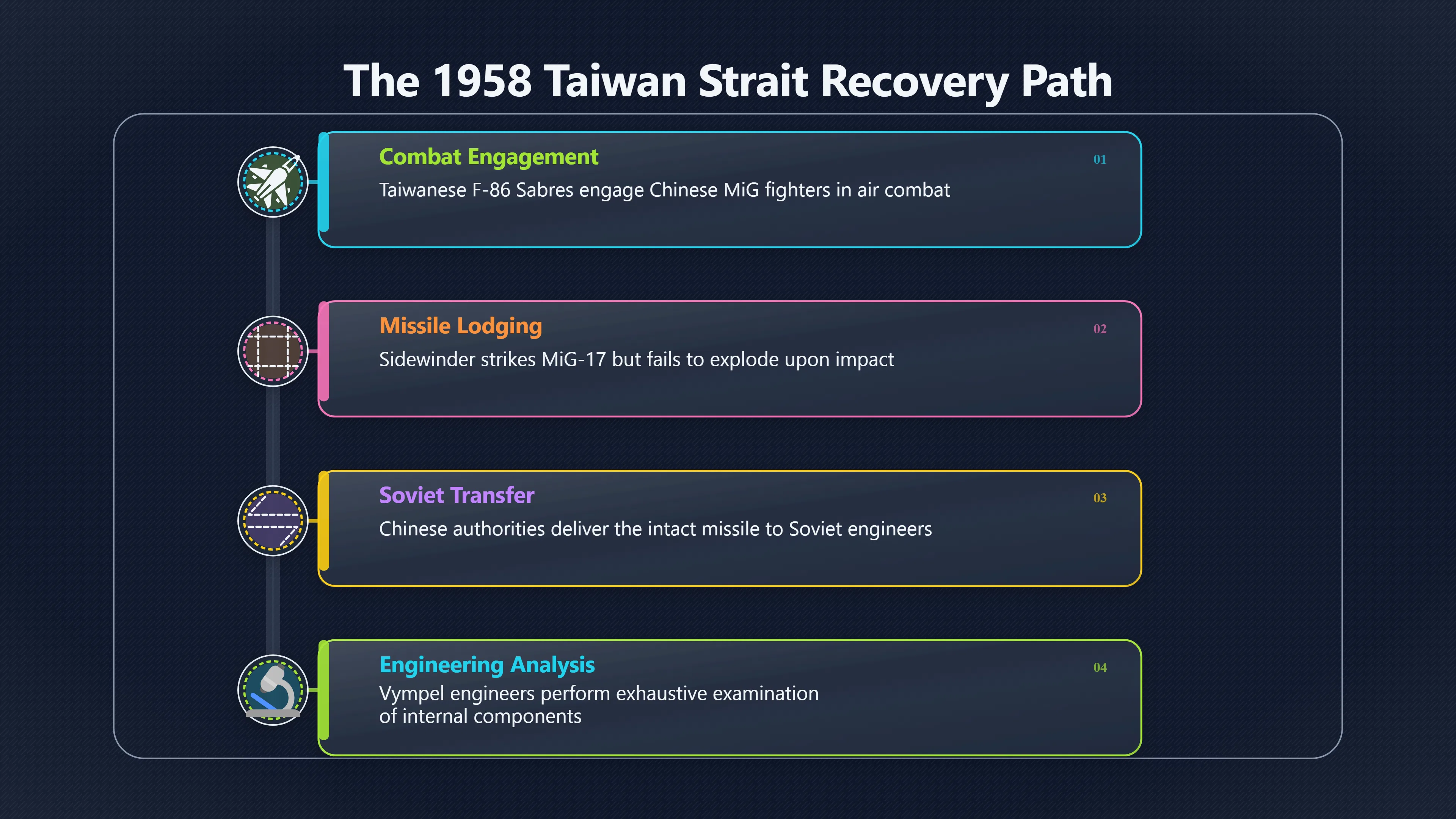
The crucial event occurred during air combat between Taiwanese F-86 Sabres and Chinese MiG fighters in September 1958. Taiwanese aircraft had recently received AIM-9B Sidewinder missiles through a secret American effort to improve their combat effectiveness. During one engagement, a Sidewinder struck a Chinese MiG-17 but failed to explode. Instead of destroying the aircraft, the missile lodged in the airframe and was carried back to base.[Wikipedia]WikipediaAIM-9 SidewinderAIM-9 Sidewinder
For Soviet designers, this was an intelligence breakthrough. Reverse engineering is dramatically easier when engineers possess a complete physical specimen rather than fragments, photographs or technical estimates. Chinese authorities eventually transferred the recovered missile to the Soviet Union, where it was subjected to exhaustive examination. Soviet accounts later described the captured Sidewinder as a practical education in modern missile design. Vympel engineer Gennadiy Sokolovskiy famously compared it to a university course that transformed Soviet understanding of missile construction and production methods.[Wikipedia]WikipediaK-13 (missileK-13 (missile
The importance of the recovery lay not only in obtaining a weapon but in obtaining a weapon that had survived largely intact. Engineers could inspect packaging arrangements, internal wiring, electronic components, seeker mechanisms, control systems and manufacturing techniques. They no longer had to infer how the missile worked; they could directly observe it.[Global Security]globalsecurity.orgGlobal SecurityAA-2 ATOLL13 Sept 2021 — The missile was sent to Toropov's engineering office to be copied, and the product the K-13, long…
What Soviet Engineers Could Copy From the AIM-9B
The AIM-9B impressed Soviet engineers because it achieved effective infrared guidance with a surprisingly elegant and compact design. Rather than relying on complex aircraft guidance after launch, the missile carried its own heat-seeking system and guidance logic. The captured missile revealed how American engineers had integrated seeker, warhead, propulsion and control systems into a relatively small and reliable package.[Wikipedia]WikipediaK-13 (missileK-13 (missile
Several features were particularly valuable:
- External geometry and aerodynamics: The missile’s dimensions, fin arrangement and overall layout could be measured precisely.
- Seeker packaging: Engineers could examine how the infrared guidance components were arranged and protected.
- Control mechanisms: The internal organisation of steering and stabilisation systems became visible.
- Manufacturing solutions: Production techniques, component standardisation and assembly methods were exposed in ways that intelligence reports rarely reveal.[Global Security]globalsecurity.orgGlobal SecurityAA-2 ATOLL13 Sept 2021 — The missile was sent to Toropov's engineering office to be copied, and the product the K-13, long…
The degree of copying became famous. Western observers later noted that parts from captured K-13 missiles appeared so similar to Sidewinder components that some could be physically interchanged. Stories circulated that even part numbering systems had been replicated, illustrating how closely the original missile had been studied. While some of these accounts have acquired an almost legendary quality, there is broad agreement that the K-13 represented one of the most faithful reverse-engineered weapon copies of the Cold War.[Wikipedia]WikipediaK-13 (missileK-13 (missile
Why the K-13 Still Had to Become a Soviet Weapon
The popular version of the story suggests that the Soviet Union simply duplicated the AIM-9B and immediately fielded an identical missile. The reality was more complicated.
Even with a complete missile in hand, Soviet engineers still had to reproduce components using domestic materials, manufacturing processes and industrial capabilities. Reverse engineering reveals what exists, but it does not automatically reveal every production tolerance, quality-control practice or testing procedure that made the original system work reliably. Soviet designers therefore had to translate an American product into a weapon that Soviet factories could build at scale.[Wikipedia]WikipediaK-13 (missileK-13 (missile
This adaptation process explains why the earliest Soviet versions did not perform exactly like the original. The initial K-13, also designated R-3 or Object 300, entered limited service around 1960, but development continued. The later R-3S became the first mass-produced version and incorporated refinements needed for operational use within Soviet air forces. Some characteristics differed from the AIM-9B, including seeker behaviour and operational procedures.[Wikipedia]WikipediaK-13 (missileK-13 (missile
Integration with Soviet aircraft also required engineering work. The missile had to function with Soviet fighter avionics, launch rails and maintenance systems. A missile copied from an American weapon could not simply be bolted onto a MiG and expected to operate without modification. The K-13 therefore became part of a broader Soviet air-combat ecosystem rather than remaining a direct laboratory duplicate of the Sidewinder.[Wikipedia]WikipediaK-13 (missileK-13 (missile
From Copy to Soviet Missile Family
The most significant evidence that the K-13 became more than a clone is what happened after its introduction. Once Soviet engineers understood the basic architecture revealed by the captured AIM-9B, they began developing variants that diverged from the original American design.
The K-13 family expanded into radar-guided and improved infrared-guided versions. Later models introduced more capable seekers, longer range and enhanced manoeuvrability. These developments reflected Soviet operational requirements rather than simple imitation of the 1958 missile that had arrived from China.[Wikipedia]WikipediaK-13 (missileK-13 (missile
The design also became the basis for further technology transfer within the communist bloc. China produced its own derivative, the PL-2, while other countries manufactured or operated K-13 variants. The captured Sidewinder therefore influenced far more than a single Soviet missile programme; it helped establish a lineage of air-to-air weapons across multiple states.[Wikipedia]WikipediaK-13 (missileK-13 (missile
What the K-13 Case Reveals About Reverse Engineering
The transformation of a recovered AIM-9B into the K-13 demonstrates both the power and the limits of reverse engineering. The captured missile dramatically shortened Soviet development time by providing a proven design that could be analysed in detail. The K-13 entered service only a few years after the recovery, showing how valuable physical access to advanced technology can be.[Global Security]globalsecurity.orgGlobal SecurityAA-2 ATOLL13 Sept 2021 — The missile was sent to Toropov's engineering office to be copied, and the product the K-13, long…
At the same time, the story illustrates that copying is only the beginning. Soviet engineers still had to reproduce the design, adapt it to local industry, integrate it with Soviet aircraft and continue improving it after production began. The recovered Sidewinder supplied the blueprint, but the K-13 became successful because Soviet designers turned that blueprint into a weapon system that fit their own technological and military environment.[Wikipedia]WikipediaK-13 (missileK-13 (missile
eBay marketplace picks
Marketplace Samples
Live-tested eBay searches with available results related to this page.
Endnotes
1.
Source: Wikipedia
Title: AIM-9 Sidewinder
Link:https://en.wikipedia.org/wiki/AIM-9_Sidewinder
2.
Source: Wikipedia
Link:https://en.wikipedia.org/wiki/Second_Taiwan_Strait_Crisis
Source snippet
Second Taiwan Strait Crisis... AIM-9 Sidewinder air-to-air missiles. These missiles gave the Nationalist... reverse-engineered into t...
3.
Source: Wikipedia
Title: K-13 (missile)
Link:https://en.wikipedia.org/wiki/K-13_%28missile%29
4.
Source: Wikipedia
Link:https://en.wikipedia.org/wiki/K
Source snippet
KK (minuscule: k) is the eleventh letter of the Latin alphabet, used in the modern English alphabet, the alphabets of other western Eu...
5.
Source: youtube.com
Title: AIM-9 Sidewinder: Inception to Operational Mastery
Link:https://www.youtube.com/watch?v=BMtS_0vhZo0
Source snippet
Sidewinder - The Weapon That Changed Air Combat...
6.
Source: youtube.com
Link:https://www.youtube.com/watch?v=TGTOVA3tWpQ
Source snippet
This video provides an in-depth breakdown of how the Soviet Union acquired and reverse-engineered the captured technology: ATOLL: The Sov...
7.
Source: globalsecurity.org
Link:https://www.globalsecurity.org/military/world/russia/aa-2.htm
Source snippet
Global SecurityAA-2 ATOLL13 Sept 2021 — The missile was sent to Toropov's engineering office to be copied, and the product the K-13, long...
Additional References
8.
Source: facebook.com
Link:https://www.facebook.com/CommemorativeAF/posts/the-age-of-the-sidewinder-began-on-september-24-1958-when-the-first-combat-engag/1219739800192234/
Source snippet
Commemorative Air ForceThe missile was so revolutionary when it came out that the Soviet Union reverse-engineered it from a Sidewinder fi...
9.
Source: twz.com
Title: the legendary sidewinder missile made its first kill over the taiwan strait
Link:https://www.twz.com/42544/the-legendary-sidewinder-missile-made-its-first-kill-over-the-taiwan-strait
Source snippet
The Legendary Sidewinder Missile Made Its First Kill Over...29 Sept 2021 — Taiwan's Republic of China Air Force (ROCAF) obtained its fir...
10.
Source: strasam.org
Link:https://strasam.org/en/defense/aerospace-industry/how-the-soviets-were-able-to-copy-the-american-aim-9-sidewinder-airborne-missile-through-reverse-engineering-and-espionage-during-the-cold-war-3362
Source snippet
The first successful Sidewinder engagement took place on 24 September 1958. In the summer of 1958...Read more...
Published: September 1958
11.
Source: youtube.com
Link:https://www.youtube.com/watch?v=oBJjMZJWSBI
12.
Source: si.edu
Link:https://www.si.edu/object/missile-air-air-atoll-also-designated-k-13-aa-2%3Anasm_A19930363000
Source snippet
Smithsonian InstituteMissile, Air-to-Air, AA-2 Atoll (Russian: Vympel K-13)Atoll originated in 1958, when a Sidewinder fired from a Taiwa...
13.
Source: airandspace.si.edu
Link:https://airandspace.si.edu/collection-objects/missile-air-air-atoll-also-designated-k-13-aa-2/nasm_A19930363000
Source snippet
dewinder air-to-air, heat-seeking missile. Atoll originated in 1958, when a Sidewinder...Read more...
14.
Source: reddit.com
Link:https://www.reddit.com/r/todayilearned/comments/o4dv7o/til_the_soviet_k13_missile_is_almost_an_exact/
Source snippet
On 28 September, 1958, a Chinese MiG-17 was struck with a sidewinder that didn't...Read more...
15.
Source: militaryaviationvideos.com
Title: how one missile changed air combat the aim 9 sidewinder
Link:https://militaryaviationvideos.com/how-one-missile-changed-air-combat-the-aim-9-sidewinder/
Source snippet
AIM-9 Sidewinder: How one missile changed air combat14 Aug 2025 — The AIM-9 Sidewinder missile, a pioneering infrared heat-seeking air-to...
16.
Source: eurasiantimes.com
Title: aim 9x sidewinder how russia china stole us missile
Link:https://www.eurasiantimes.com/aim-9x-sidewinder-how-russia-china-stole-us-missile/
Source snippet
AIM-9X Sidewinder: How Russia & China Stole US...Feb 12, 2023 — The Soviet Union was able to obtain this advanced heat-seeking missile w...
17.
Source: popularmechanics.com
Link:https://www.popularmechanics.com/military/weapons/a60734289/aim-9-sidewinder-missile-history/
Source snippet
AIM-9 Sidewinder: How Russia Copied America's...5 Jun 2024 — America's groundbreaking Sidewinder was poised to rule the skies...
Topic Tree