Within Threat Training
The Enemy Vehicle Is Not Enough
Threat hardware works best when paired with opponents who think, move and punish mistakes like the enemy being represented.
On this page
- Why old aggressors fought too much like Americans
- How doctrine makes equipment cues meaningful
- Why free thinking opponents improve exercises
Page outline Jump by section
Introduction
Captured enemy equipment can make training more realistic, but equipment alone does not create a realistic enemy. A Soviet-designed tank driven by a crew that thinks and fights like an American unit teaches only part of the lesson. The most effective training programmes discovered that realistic opposing forces (OPFOR) require both authentic equipment cues and authentic doctrine, tactics and decision-making. The value of reverse engineering foreign military technology therefore extends beyond understanding hardware. It also includes understanding how an adversary employs that hardware, what risks it accepts, how it organises formations, and how commanders interpret opportunities on the battlefield. When those behavioural elements are missing, training can become an exercise in fighting friendly forces disguised as the enemy rather than learning to defeat the actual threat. U.S. Army Center of Military History[history.army.mil]history.army.milArmy Center of Military HistoryThe Origins and Development of the National Training…December 20, 2010 — by AW Chapman · Cited by 5 — D…

The Enemy Vehicle Is Not Enough
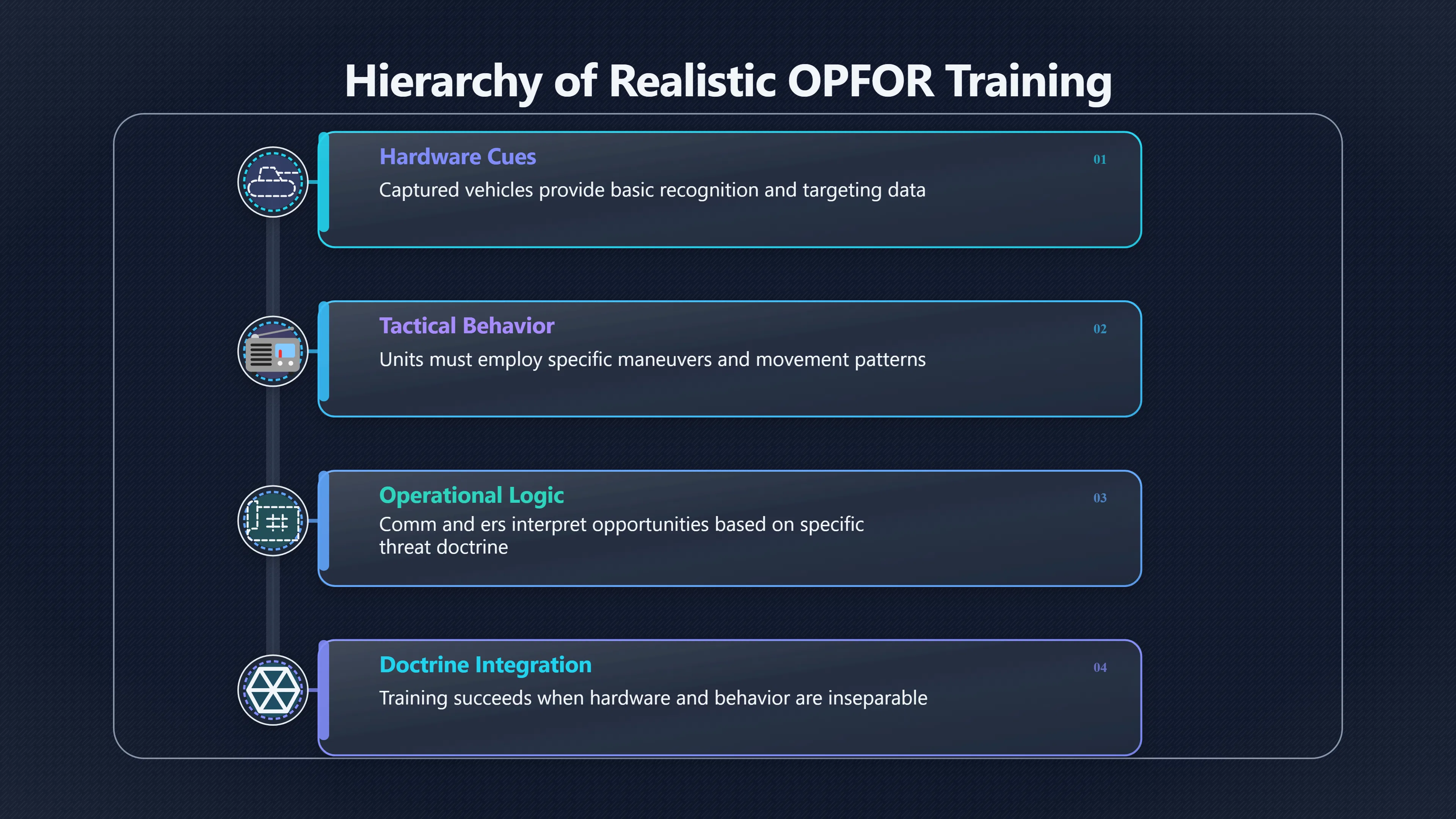
The central problem is that military equipment and military doctrine are inseparable. A vehicle, radar or aircraft is designed to support a particular way of fighting. If trainees encounter only the hardware, they may learn recognition skills while missing the operational logic that gives the equipment its real battlefield value.
During the Cold War, American training organisations increasingly concluded that reproducing Soviet equipment without reproducing Soviet methods created misleading lessons. As information about Warsaw Pact organisation, tactics and doctrine became more widely available, Army planners deliberately incorporated those elements into dedicated OPFOR programmes. The goal was not simply to place Soviet-looking vehicles on the battlefield, but to create an enemy that manoeuvred, concentrated forces, conducted reconnaissance and attacked according to threat doctrine. U.S. Army Center of Military History[history.army.mil]history.army.milArmy Center of Military HistoryThe Origins and Development of the National Training…December 20, 2010 — by AW Chapman · Cited by 5 — D…
This insight mirrors the logic behind air aggressor squadrons. Fighter pilots do not merely train against aircraft painted in enemy colours. They train against instructors who deliberately use enemy tactics, techniques and procedures. The aircraft is only a platform; the real training value comes from the behaviour of the pilot using it.[Wikipedia]WikipediaAggressor squadronAggressor squadron
Why Old Aggressors Fought Too Much Like Americans
Before specialised OPFOR organisations became widespread, many training exercises suffered from a recurring weakness: the “enemy” was usually another friendly unit temporarily assigned a different role.
Historical accounts of early aggressor systems describe how these forces often continued to think and operate according to familiar American methods. Even when given different uniforms or equipment, they generally used the doctrine they already knew. In practice, training audiences learned how to defeat another version of themselves rather than a realistic adversary. Army histories and later analyses note that this problem contributed to a perception that aggressor forces were predictable and insufficiently challenging.[Global Security]globalsecurity.orgGlobal SecurityExercise Scenario Worlds: Aggressor, Krasnovia, Aragon…23 Apr 2026 — The Aggressor role became synonymous with passivi…
The creation of the National Training Center represented a deliberate attempt to solve that problem. Soviet equipment, Soviet organisational structures, Soviet tactical manuals and Soviet operational concepts were studied together. Dedicated OPFOR units were expected to immerse themselves in threat doctrine rather than simply imitate enemy appearances. Information from intelligence organisations and technical exploitation programmes fed into this effort, allowing the training enemy to evolve alongside assessments of real-world adversaries. U.S. Army Center of Military History[history.army.mil]history.army.milArmy Center of Military HistoryThe Origins and Development of the National Training…December 20, 2010 — by AW Chapman · Cited by 5 — D…
The distinction mattered because battlefield decisions emerge from doctrine. An enemy trained to value mass, deception, reconnaissance or operational tempo may react very differently from an American force presented with the same situation. Equipment cannot teach those reactions by itself.[The Washington Post]washingtonpost.comThe Washington Post AT ARMY'S TRAINING CENTER, THE BAD GUYS STILLThe Washington PostAT ARMY'S TRAINING CENTER, THE BAD GUYS STILL…January 21, 1992 — 20 Jan 1992 — Army tacticians said the doctrine, w…
How Doctrine Makes Equipment Cues Meaningful
Captured or replicated equipment becomes far more valuable when it is embedded within realistic tactical behaviour.
Consider a tank, air-defence system or reconnaissance vehicle acquired through foreign materiel exploitation. The hardware may reveal technical characteristics such as range, mobility or sensor performance. Yet the battlefield significance of those characteristics depends on doctrine:
- Deployment patterns: Where and how the system is positioned.
- Command relationships: Which headquarters controls it and when it can be employed.
- Risk tolerance: Whether commanders preserve assets or expend them aggressively.
- Combined-arms integration: How the system cooperates with infantry, artillery, engineers or aircraft.
- Decision cycles: How quickly commanders gather information and react.
A radar discovered through technical exploitation may appear vulnerable when studied in isolation. However, when integrated into a broader air-defence doctrine that includes deception, mobility and layered coverage, it may become a far more difficult target. Likewise, a tank’s weaknesses may be offset by tactics designed to minimise exposure. Training that reproduces only the equipment risks teaching crews to exploit vulnerabilities that a competent enemy would never expose.[bits.de]bits.deThe Soviet Army: Operations and TacticsThese field manuals serve as the definitive source of unclassified information on. Soviet ground f…
This is why Army OPFOR doctrine publications emphasise creating a plausible adversary capable of employing military and paramilitary capabilities in a coherent manner rather than simply fielding threat-looking equipment. The objective is to replicate the operational challenge posed by an opponent, not merely the appearance of one.[GovInfo]govinfo.govGOVPUB D101 PURL gpo122554Opposing Force Tactics9 Dec 2011 — an OPFOR than can cover the entire spectrum of military and paramilitary capabilities against w…
Why Free-Thinking Opponents Improve Exercises
The strongest OPFOR organisations are not scripted actors. They are professional adversaries encouraged to exploit mistakes, adapt to changing circumstances and seek victory within the exercise framework.
A free-thinking opponent produces lessons that equipment displays alone cannot provide. When trainees know that the opposing force is actively searching for weaknesses, they must solve tactical problems rather than follow exercise checklists. The resulting uncertainty better approximates combat conditions. Military training centres routinely describe OPFOR units as challenging forces whose purpose is to test readiness against capable near-peer opponents rather than merely facilitate predetermined training events.[DVIDS]dvidshub.netsmall opposing force takes much larger element during combined resolveDVIDSSmall opposing force takes on a much larger element…10 May 2018 — The OPFOR operates as the JMRC enemy force that offers brigade…
This philosophy also helps prevent institutional mirror-imaging. Military organisations naturally assume that adversaries will make similar decisions under pressure. Dedicated OPFOR units exist partly to challenge those assumptions. By studying foreign doctrine and then exercising initiative within that framework, they force trainees to confront unfamiliar patterns of behaviour and unexpected courses of action.[cimsec.org]cimsec.orginsights from the national training centers opposing force pt 1Opposing Force for Marine Corps force-on-force training. Both services could gain from opposing a thinking enemy that operates a bit diff…
The result is often more important than the hardware itself. A visually modified tank or captured vehicle can create recognition and targeting cues, but a thinking enemy can create uncertainty, surprise and operational friction. Those are the conditions that reveal weaknesses in plans, command systems and battlefield judgement.
The Governance Challenge: Keeping OPFOR Current
Creating realistic doctrine-based opponents is not a one-time task. Threat organisations change, and training systems must change with them.
This creates a governance challenge for military institutions. Intelligence findings, foreign materiel exploitation results, doctrinal studies and lessons from contemporary conflicts must be translated into updated OPFOR practices. If equipment is modernised but doctrine is not, exercises drift away from reality. If doctrine evolves while threat simulators remain unchanged, trainees may receive conflicting signals about the enemy they are expected to face.
For that reason, modern OPFOR programmes are closely tied to intelligence and threat-analysis functions. Technical exploitation of foreign equipment supplies data about capabilities, while doctrinal analysis explains how those capabilities are likely to be used. Effective training depends on combining both streams into a coherent adversary model.[medium.com]medium.comJoining the Soviet 32nd Guards Motorized Rifle Regiment …The 32nd Guards Motorized Rifle Regiment (MRR) — the backbone of the OPFOR (OpMediumJoining the Soviet 32nd Guards Motorized Rifle Regiment …The 32nd Guards Motorized Rifle Regiment (MRR) — the backbone of the OPF…

Realism Comes From the Combination
The enduring lesson from decades of threat-replication programmes is that realism emerges from the interaction of equipment and doctrine. Captured vehicles, foreign weapons and reverse-engineered systems provide valuable technical insight, but their training value is limited when separated from the concepts that govern their use.
A realistic OPFOR therefore represents more than enemy hardware. It represents an enemy way of fighting. Only when crews encounter both the equipment and the doctrine behind it do the cues on the training range begin to resemble the challenges of a real battlefield. U.S. Army Center of Military History+2Wikipedia[history.army.mil]history.army.milArmy Center of Military HistoryThe Origins and Development of the National Training…December 20, 2010 — by AW Chapman · Cited by 5 — D…
Amazon book picks
Further Reading
Books and field guides related to The Enemy Vehicle Is Not Enough. Use these as the next step if you want deeper reading beyond the article.
The Art of War
Highlights the importance of understanding an opponent's thinking and methods.
On War
Provides foundational concepts linking doctrine, behavior, and combat outcomes.
The Face of Battle
Explores how real combat behavior differs from simplified assumptions.
Armored Cav
Demonstrates how equipment effectiveness depends on tactics and command decisions.
eBay marketplace picks
Marketplace Samples
Live-tested eBay searches with available results related to this page.
Endnotes
1.
Source: history.army.mil
Link:https://history.army.mil/portals/143/Images/Publications/catalog/69-3.pdf
Source snippet
Army Center of Military HistoryThe Origins and Development of the National Training...December 20, 2010 — by AW Chapman · Cited by 5 — D...
Published: December 20, 2010
2.
Source: Wikipedia
Title: Aggressor squadron
Link:https://en.wikipedia.org/wiki/Aggressor_squadron
3.
Source: medium.com
Link:https://medium.com/%40carbonemd/chapter-26-joining-the-soviet-32nd-guards-motorized-rifle-regiment-opfor-at-[fort-irwin
Source snippet
Joining the Soviet 32nd Guards Motorized Rifle Regiment...The 32nd Guards Motorized Rifle Regiment (MRR) — the backbone of the OPF...
4.
Source: bits.de
Link:https://www.bits.de/NRANEU/others/amd-us-archive/FM%20100-2-1%2884%29.pdf
Source snippet
The Soviet Army: Operations and TacticsThese field manuals serve as the definitive source of unclassified information on. Soviet ground f...
5.
Source: govinfo.gov
Title: GOVPUB D101 PURL gpo122554
Link:https://www.govinfo.gov/content/pkg/GOVPUB-D101-PURL-gpo122554/pdf/GOVPUB-D101-PURL-gpo122554.pdf
Source snippet
Opposing Force Tactics9 Dec 2011 — an OPFOR than can cover the entire spectrum of military and paramilitary capabilities against w...
6.
Source: odin.t2com.army.mil
Title: ODINFM 7-100.1 Opposing Forces Operations
Link:https://odin.t2com.army.mil/TC/FM_7-100.1_Opposing_Forces_Operations
Source snippet
7-100.1 Opposing Forces Operations - ODIN - Army.mil28 Sept 2023 — An Opposing Force (OPFOR) is a training tool that should allow the U.S...
7.
Source: dvidshub.net
Title: small opposing force takes much larger element during combined resolve
Link:https://www.dvidshub.net/news/276483/small-opposing-force-takes-much-larger-element-during-combined-resolve
Source snippet
DVIDSSmall opposing force takes on a much larger element...10 May 2018 — The OPFOR operates as the JMRC enemy force that offers brigade...
Published: May 2018
8.
Source: cimsec.org
Title: insights from the national training centers opposing force pt 1
Link:https://cimsec.org/insights-from-the-national-training-centers-opposing-force-pt-1/
Source snippet
Opposing Force for Marine Corps force-on-force training. Both services could gain from opposing a thinking enemy that operates a bit diff...
9.
Source: Wikipedia
Title: Opposing force
Link:https://en.wikipedia.org/wiki/Opposing_force
Source snippet
Opposing forceAn opposing force (abbreviated OPFOR or OpFor; alternatively known as enemy force)... ↑ FM 30-101 Aggressor The Maneuve...
10.
Source: cpest3.army.mil
Link:https://www.cpest3.army.mil/Project-Offices/PM-SIM/PdM-FTS/OPFOR/
Source snippet
Forces (OPFOR)... enemy during training exercises and war games. OPFOR is used to develop and train U.S. forces without a specific advers...
11.
Source: bits.de
Title: FM7 100.1(04)
Link:https://www.bits.de/NRANEU/others/amd-us-archive/FM7-100.1%2804%29.pdf
Source snippet
Opposing Force Operations2004 — The OPFOR operational doctrine outlined in FM 7-100.1 represents a realistic composite of potential adver...
12.
Source: globalsecurity.org
Link:https://www.globalsecurity.org/military/ops/ex-world.htm
Source snippet
Global SecurityExercise Scenario Worlds: Aggressor, Krasnovia, Aragon...23 Apr 2026 — The Aggressor role became synonymous with passivi...
13.
Source: washingtonpost.com
Title: The Washington Post AT ARMY’S TRAINING CENTER, THE BAD GUYS STILL
Link:https://www.washingtonpost.com/archive/politics/1992/01/21/at-armys-training-center-the-bad-guys-still-fight-like-soviets/51985538-d930-43f0-a5bb-33962cb70c8f/
Source snippet
The Washington PostAT ARMY'S TRAINING CENTER, THE BAD GUYS STILL...January 21, 1992 — 20 Jan 1992 — Army tacticians said the doctrine, w...
Published: January 21, 1992
14.
Source: youtube.com
Title: Opposing Force
Link:https://www.youtube.com/watch?v=HsjAkmIW7AU
Source snippet
Better than Half-Life 1?Comparing Opposing Force to Half-Life 1 instead of Blue Shift for a change! 13th of August 2023 Join The #Opposin...
Published: August 2023
Additional References
15.
Source: tigerland-action-force.com
Link:https://www.tigerland-action-force.com/opfor-e/
Source snippet
OPFOR [OPPosing force]OPFOR (= Opposing Force) refers to so-called enemy actors who enable armies around the world to train their own tro...
16.
Source: facebook.com
Link:https://www.facebook.com/NATO.JFTC/posts/opposing-force-or-opfor-is-a-training-tool-that-allows-nato-to-train-against-a-c/1925880090952630/
Source snippet
"Opposing Force, or OPFOR, is a training tool that allows...OPFOR allows our training audiences to train against a demanding and realist...
17.
Source: youtube.com
Title: M113A3 OPFOR Surrogate Vehicle: The Armored Trainer Built for Modern Warfare
Link:https://www.youtube.com/watch?v=3BBS6RMgyxc
Source snippet
Disrupt, Attrit, & Counterattack: The Art of the Defense w/JRTC OPFOR's [Experts]({{ 'experts/' | relative_url }})...
18.
Source: youtube.com
Title: Disrupt, Attrit, & Counterattack: The Art of the Defense w/JRTC OPFOR’s Experts
Link:https://www.youtube.com/watch?v=vpUl0dLxNIo
Source snippet
3 Years of OPFOR: What Playing the Enemy Taught Me...
19.
Source: youtube.com
Title: How to Win Against the OPFOR w/Geronimo’s S-2 Intel Officer, CPT Branower
Link:https://www.youtube.com/watch?v=A9WfwCCJrIs
Source snippet
US Air Force's F-35 Aggressor Squadron Focus on China...
20.
Source: files.eric.ed.gov
Link:https://files.eric.ed.gov/fulltext/ED369659.pdf
Source snippet
Origins and Development of the National Training...by AW Chapman · 1992 — During that period, information on Soviet equipment, tactics...
21.
Source: youtube.com
Title: 3 Years of OPFOR: What Playing the Enemy Taught Me
Link:https://www.youtube.com/watch?v=4EaPQon8klY
Source snippet
How to Win Against the OPFOR w/Geronimo's S-2 Intel Officer, CPT Branower...
22.
Source: amazon.nl
Title: The U.S
Link:https://www.amazon.nl/OPFOR-professional-opposing-forces-1982-2022/dp/1804513687?tag=searcht-20
Source snippet
Army's professional opposing forces 1982-2022Each OPFOR unit has unique uniforms, emblems and vehicles to help it portray an enemy force...
23.
Source: facebook.com
Link:https://www.facebook.com/groups/tamiyamodelmagazine/posts/10159403829609821/
Source snippet
It covers tactics, defense strategy, etc., etc. It includes...Read more...
24.
Source: youtube.com
Title: US Air Force’s F-35 Aggressor Squadron Focus on China
Link:https://www.youtube.com/watch?v=tMIwbUM_E5w
Topic Tree