Within Materials
How labs keep fragment evidence honest
Calibration, reference materials, and traceable methods help turn fragment measurements into reliable exploitation evidence.
On this page
- Why calibration matters in elemental testing
- Reference materials and traceable measurements
- Screening results versus defensible evidence
Page outline Jump by section
Introduction
Metal fragments recovered from missiles, munitions and other military systems can reveal alloy composition, heat treatment history, manufacturing quality and supply-chain choices. Yet those conclusions only matter if decision-makers trust the laboratory results. In foreign materiel exploitation, a measurement that cannot be repeated, checked or traced back to recognised standards is far less valuable than one that can withstand scrutiny months or years later. The difference between a preliminary indication and defensible evidence often comes down to calibration, reference materials, traceability and laboratory quality controls. International testing standards do not guarantee that every conclusion is correct, but they create a framework that allows results to be verified, compared across laboratories and challenged when necessary.[ISO]iso.orgISO/IEC 17025:2017(en), General requirements for the…This document contains requirements for laboratories to enable them to demonst…
Why calibration matters in elemental testing
Elemental analysis techniques such as X-ray fluorescence (XRF), scanning electron microscopy with energy-dispersive spectroscopy (SEM-EDS), optical emission spectroscopy and related methods are widely used to characterise weapon fragments. These instruments do not directly report truth; they report signals that must be linked to known reference values through calibration.
A key lesson from metrology is that instruments drift, detectors age and measurement conditions change. Laboratories therefore calibrate equipment against known standards and regularly verify that the calibration remains valid. NIST research on XRF and SEM-EDS demonstrates how calibration procedures and validation materials are used to establish accurate elemental measurements and to connect analytical results to recognised measurement systems.[NIST]nist.govVALIDATION AND TRACEABILITY OF XRF AND SEM-EDSVALIDATION AND TRACEABILITY OF XRF AND SEM-EDS…September 9, 2014 — by JR Sieber · 2014 · Cited by 6 — A procedure and calibration…
For fragment exploitation, calibration affects practical questions such as:
- Whether a trace alloying element is genuinely present or is an instrument artefact.
- Whether two fragments came from the same manufacturing batch.
- Whether an apparent substitution of strategic materials reflects design intent or measurement error.
- Whether small differences between samples are meaningful enough to support intelligence assessments.
Without calibration, a laboratory may still produce numbers. What it cannot produce is confidence.
Reference materials and traceable measurements
Why certified reference materials matter
A certified reference material (CRM) is a sample whose composition or properties have been carefully characterised and documented. Instead of relying solely on instrument settings, analysts compare unknown fragments against materials with known values.
Reference materials perform several functions:[vrxrf.com]vrxrf.comCertified Reference Materials (CRMs) for XRF AccuracyLearn why Certified Reference Materials (CRMs) are essential for XRF calibration, IS…
- Establish calibration curves.[accreditedlabs.com]accreditedlabs.cominstrument calibration accuracy traceability documentation explainedInstrument Calibration: Accuracy, Traceability &…16 Jun 2026 — ISO/IEC 17025:2017 — the international standard for calibration laborat…
- Verify that instruments continue to operate correctly.
- Detect analytical bias.
- Allow different laboratories to compare results on a common basis.
NIST notes that many certified reference materials are specifically intended to provide higher-order calibration and validation materials that support metrologically traceable measurements.[NIST Publications]nvlpubs.nist.govNIST PublicationsNIST Special Publication 260-136 2021 EditionSeptember 16, 2021 — The intended purpose of most NIST CRMs is to provide h…
This becomes especially important when analysing strategic alloying elements such as nickel, chromium, molybdenum, tungsten, cobalt or rare-earth additions. Small analytical errors can alter conclusions about manufacturing sophistication, sourcing or industrial capability.
Traceability is a chain, not a label
One of the most misunderstood concepts in testing is traceability. According to NIST, traceability is a property of the measurement result itself, not simply of an instrument or laboratory certificate. A measurement is traceable only when it can be linked through an unbroken chain of comparisons to recognised standards, with each step documented and quantified.[NIST]nist.govIt is notMetrological Traceability: Frequently Asked Questions and…It is important to note that traceability is the property of the result…
For fragment analysis, traceability means an analyst should be able to answer questions such as:
- Which instrument produced the result?
- When was it calibrated?
- Against which standards?
- What reference materials verified performance?[vrxrf.com]vrxrf.comCertified Reference Materials (CRMs) for XRF AccuracyLearn why Certified Reference Materials (CRMs) are essential for XRF calibration, IS…
- What uncertainty accompanies the measurement?
This chain allows later investigators to reconstruct and evaluate the evidence rather than accepting it on authority alone.
The role of ISO/IEC 17025 in trusted fragment analysis
The most influential international framework for laboratory competence is ISO/IEC 17025. The standard specifies requirements that laboratories must meet to demonstrate technical competence and generate valid results.[ISO]iso.orgISO/IEC 17025:2017(en), General requirements for the…This document contains requirements for laboratories to enable them to demonst…
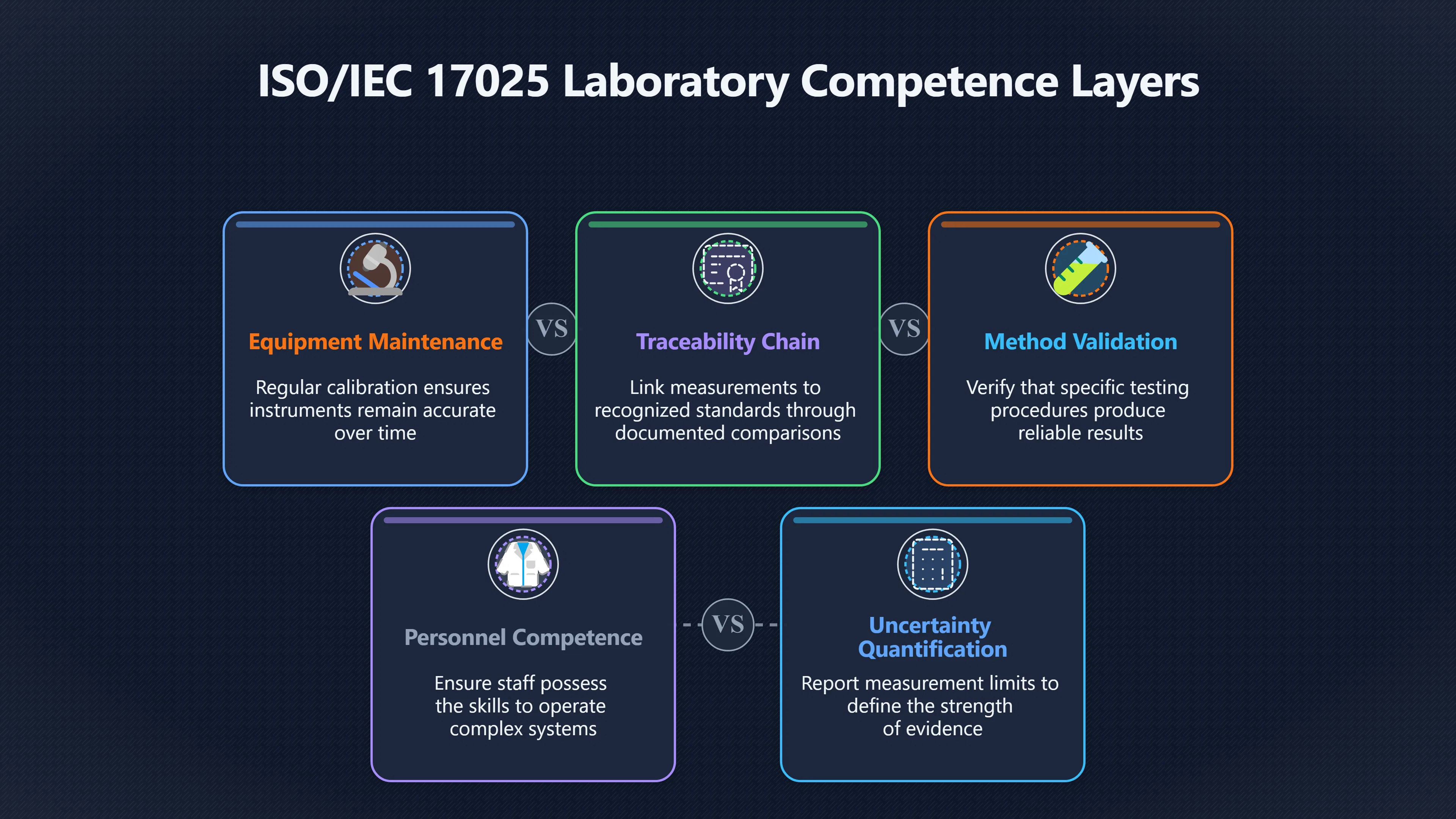
For materials laboratories examining weapon fragments, ISO/IEC 17025 places particular emphasis on:
- Equipment calibration and maintenance.[vsl.nl]vsl.nlcalibration of laboratory equipment iso iec 17025 accreditation in five stepsCalibration of laboratory equipmentObtaining ISO/IEC 17025 accreditation for calibration activities requires a thorough technical a…
- Metrological traceability.
- Method validation.
- Personnel competence.
- Record keeping.
- Measurement uncertainty.[analyticalscience.wiley.com]analyticalscience.wiley.comjournal highlight validation and traceability xrf and sem eds elemental analysisand traceability of XRF and SEM-EDS elemental…The secondary purpose is to validate calibrations using a certified reference material t…
- Quality assurance procedures.
The standard does not prescribe a single testing method. Instead, it requires laboratories to demonstrate that whatever methods they use are appropriate, controlled and capable of producing reliable results.[PMC]pmc.ncbi.nlm.nih.govComplying with the resource requirements of ISO/IEC 17025…by FSH Krismastuti · 2022 · Cited by 17 — The laboratory not only needs t…
In practice, intelligence and defence organisations often place greater confidence in results generated by accredited laboratories because the supporting documentation is available for review and audit.
Why measurement uncertainty changes the strength of evidence
A laboratory result without an uncertainty estimate can create a false impression of precision. Modern metrology treats uncertainty as part of the result rather than an optional footnote.
Suppose a fragment is reported as containing 1.0% molybdenum. The evidential value changes significantly depending on whether the uncertainty is ±0.01%, ±0.1% or ±0.5%. One conclusion may support attribution to a specific alloy family; another may not.
ISO/IEC 17025 requires laboratories to evaluate measurement uncertainty where relevant, and accredited systems increasingly expect uncertainty to be documented and understood.[calproof.co.uk]calproof.co.ukiso 17025 requirementsISO/IEC 17025 Requirements: Complete UK Guide for…30 May 2026 — ISO/IEC 17025:2017 §7.6 requires every calibration laboratory…
For foreign materiel exploitation, uncertainty estimates help analysts determine:
- Whether two samples are distinguishable.
- Whether manufacturing variation is significant.
- Whether an observed trend is real.
- How strongly a technical conclusion should be weighted in broader intelligence assessments.
A defensible intelligence judgement often depends as much on understanding uncertainty as on obtaining the measurement itself.
Screening results versus defensible evidence
Not every laboratory result carries the same evidential weight.
Rapid screening
Field and rapid-response laboratories frequently use portable XRF and other screening tools to obtain immediate indications. These methods can quickly identify broad alloy classes and potential points of interest.
Screening results are valuable because they guide further examination. However, they may be influenced by surface contamination, coatings, corrosion products, geometry effects or limited calibration ranges. As a result, screening findings often serve as leads rather than final conclusions.[AZoM]azom.comAZo MChoose the Right XRF Standards For Elemental AnalysisChoose the Right XRF Standards For Elemental AnalysisOctober 9, 2025 — 20 Oct 2025 — Learn how to select the right XRF calibration st…
Defensible evidence
A result becomes more defensible when it is supported by:
- Validated analytical methods.
- Documented calibration records.
- Certified reference materials.[vrxrf.com]vrxrf.comCertified Reference Materials (CRMs) for XRF AccuracyLearn why Certified Reference Materials (CRMs) are essential for XRF calibration, IS…
- Traceable measurements.
- Quantified uncertainty.
- Independent review.
- Reproducibility by another competent laboratory.
In intelligence exploitation, these additional steps can determine whether an observation remains an internal working hypothesis or becomes evidence used to support procurement decisions, threat assessments or attribution claims.
Interlaboratory comparison as a safeguard
Even well-equipped laboratories can develop systematic biases. One of the strongest protections against this problem is interlaboratory comparison, often called proficiency testing or round-robin testing.
In these exercises, multiple laboratories analyse the same material and compare results. Significant discrepancies can reveal calibration problems, procedural weaknesses or interpretation errors. International proficiency-testing frameworks and guidance documents treat these comparisons as an important tool for demonstrating competence and validating analytical performance.[usbcertification.com]usbcertification.comUSB CertificationQualification Tests and Reference Material ProviderProficiency testing is a performance verification method that enables…
For fragment exploitation, interlaboratory verification is particularly valuable when findings carry strategic implications. A conclusion that survives independent testing by multiple laboratories is generally more persuasive than one produced by a single facility, regardless of that facility’s reputation.
What decision-makers ultimately trust
The most persuasive fragment analysis is rarely the one with the most sophisticated instrument. It is the one supported by a transparent chain of evidence. Calibration records show that equipment was functioning correctly. Certified reference materials demonstrate accuracy. Traceability links measurements to recognised standards. Measurement uncertainty defines the limits of confidence. Accreditation and proficiency testing provide independent checks on laboratory performance. Together, these practices transform a metal fragment from a piece of debris into evidence that can withstand technical challenge and support high-consequence decisions.[nist.gov]nist.govIt is notMetrological Traceability: Frequently Asked Questions and…It is important to note that traceability is the property of the result…
Amazon book picks
Further Reading
Books and field guides related to How labs keep fragment evidence honest. Use these as the next step if you want deeper reading beyond the article.
Metallurgy for the Non-metallurgist
Provides context for laboratory examination of metal fragments.
Measurement Uncertainty
Directly addresses traceability, calibration and defensible measurements.
Statistics for Experimenters
Supports validation and interpretation of laboratory results.
eBay marketplace picks
Marketplace Samples
Live-tested eBay searches with available results related to this page.




Endnotes
1.
Source: iso.org
Link:https://www.iso.org/obp/ui/en/
Source snippet
ISO/IEC 17025:2017(en), General requirements for the...This document contains requirements for laboratories to enable them to demonst...
2.
Source: iso.org
Title: ISO IEC 17025 testing and calibration laboratories
Link:https://www.iso.org/ISO-IEC-17025-testing-and-calibration-laboratories.html
Source snippet
ISO/IEC 17025 — Testing and calibration laboratoriesISO/IEC 17025 enables laboratories to demonstrate that they operate competently...
3.
Source: nist.gov
Title: VALIDATION AND TRACEABILITY OF XRF AND SEM-EDS
Link:https://www.nist.gov/publications/validation-and-traceability-xrf-and-sem-eds-elemental-analysis-results-solder-high
Source snippet
VALIDATION AND TRACEABILITY OF XRF AND SEM-EDS...September 9, 2014 — by JR Sieber · 2014 · Cited by 6 — A procedure and calibration...
Published: September 9, 2014
4.
Source: tsapps.nist.gov
Link:https://tsapps.nist.gov/publication/get_pdf.cfm?pub_id=915136
Source snippet
nist.gov1 Validation and Traceability of XRF and SEM-EDS...The secondary purpose is to validate calibrations using a certified reference...
5.
Source: nvlpubs.nist.gov
Link:https://nvlpubs.nist.gov/nistpubs/SpecialPublications/NIST.SP.260-136-2021.pdf
Source snippet
NIST PublicationsNIST Special Publication 260-136 2021 EditionSeptember 16, 2021 — The intended purpose of most NIST CRMs is to provide h...
Published: September 16, 2021
6.
Source: nist.gov
Title: It is not
Link:https://www.nist.gov/metrology/metrological-traceability
Source snippet
Metrological Traceability: Frequently Asked Questions and...It is important to note that traceability is the property of the result...
7.
Source: pmc.ncbi.nlm.nih.gov
Link:https://pmc.ncbi.nlm.nih.gov/articles/PMC9579603/
Source snippet
Complying with the resource requirements of ISO/IEC 17025...by FSH Krismastuti · 2022 · Cited by 17 — The laboratory not only needs t...
8.
Source: azom.com
Title: AZo MChoose the Right XRF Standards For Elemental Analysis
Link:https://www.azom.com/article.aspx?ArticleID=24735
Source snippet
Choose the Right XRF Standards For Elemental AnalysisOctober 9, 2025 — 20 Oct 2025 — Learn how to select the right XRF calibration st...
Published: October 9, 2025
9.
Source: compalab.org
Link:https://www.compalab.org/
Source snippet
A proficiency testing program (PTP) or interlaboratory comparison (ILC) allows to evaluate the reliability of laboratories servic...
10.
Source: bam.de
Link:https://bam.de/en/services/scientific-services/proficiency-testing
Source snippet
Proficiency testingThey are used, for example, to validate analytical procedures, characterise samples (e.g. reference materials), or tes...
11.
Source: iarma.co.uk
Link:https://www.iarma.co.uk/services/analytical-proficiency-tests-2/
Source snippet
Proficiency TestsProficiency testing provides objective evidence of the laboratory competence within the context of a comprehensive labor...
12.
Source: iso.org
Link:https://www.iso.org/home.html
Source snippet
International Organization for StandardizationISO is an independent, non-governmental international organization. It brings global...
13.
Source: calproof.co.uk
Title: iso 17025 requirements
Link:https://calproof.co.uk/guides/iso-17025-requirements/
Source snippet
ISO/IEC 17025 Requirements: Complete UK Guide for...30 May 2026 — ISO/IEC 17025:2017 §7.6 requires every calibration laboratory...
Published: May 2026
14.
Source: labmanager.com
Title: uncertainty in measurement [training]({{ ‘training/’ | relative_url }}) program 16756
Link:https://www.labmanager.com/uncertainty-in-measurement-training-program-16756
Source snippet
Understanding ISO/IEC 17025 Requirements for...Jan 30, 2025 — ISO/IEC 17025 mandates that measurement uncertainty must be reported where...
15.
Source: usbcertification.com
Link:https://usbcertification.com/services/industrial-certification/qualification-tests-and-reference-material-provider/
Source snippet
USB CertificationQualification Tests and Reference Material ProviderProficiency testing is a performance verification method that enables...
16.
Source: vrxrf.com
Link:https://www.vrxrf.com/es/blog/certified-reference-materials-why-you-need-standards/
Source snippet
Certified Reference Materials (CRMs) for XRF AccuracyLearn why Certified Reference Materials (CRMs) are essential for XRF calibration, IS...
Additional References
17.
Source: mpplstandards.com
Link:https://mpplstandards.com/metallurgical-testing/
Source snippet
Metallurgical Testing Services | Metallographic analysisExplore our expert metallurgical testing services - coating thickness & carburiza...
18.
Source: amcoe.org
Link:https://amcoe.org/proficiency-testing-program/
19.
Source: researchgate.net
Link:https://www.researchgate.net/figure/NIST-standard-reference-materials-used-for-XRF-calibration_tbl1_262724910
20.
Source: ics-schneider.de
Link:https://www.ics-schneider.de/ensuring-the-traceability-of-measurement-instruments-in-compliance-with-iso-standards/?lang=en
Source snippet
Ensuring the Traceability of Measurement Instruments in...21 Jul 2025 — A traceable calibration process ensures that each measurement re...
21.
Source: analyticalscience.wiley.com
Title: journal highlight validation and traceability xrf and sem eds elemental analysis
Link:https://analyticalscience.wiley.com/content/article-do/journal-highlight-validation-and-traceability-xrf-and-sem-eds-elemental-analysis
Source snippet
and traceability of XRF and SEM-EDS elemental...The secondary purpose is to validate calibrations using a certified reference material t...
22.
Source: vsl.nl
Title: calibration of laboratory equipment iso iec 17025 accreditation in five steps
Link:https://www.vsl.nl/en/articles/calibration-of-laboratory-equipment-iso-iec-17025-accreditation-in-five-steps/
Source snippet
Calibration of laboratory equipmentObtaining ISO/IEC 17025 accreditation for calibration activities requires a thorough technical a...
23.
Source: accreditedlabs.com
Title: instrument calibration accuracy traceability documentation explained
Link:https://www.accreditedlabs.com/blog/instrument-calibration-accuracy-traceability-documentation-explained
Source snippet
Instrument Calibration: Accuracy, Traceability &...16 Jun 2026 — ISO/IEC 17025:2017 — the international standard for calibration laborat...
24.
Source: linkedin.com
Title: isoiec 17025 uncertainty measurement explained eur ing james a 1iixe
Link:https://www.linkedin.com/pulse/isoiec-17025-uncertainty-measurement-explained-eur-ing-james-a–1iixe
Source snippet
ISO/IEC 17025: Uncertainty of Measurement Explained...The latest revision of ISO/IEC 17025 reinforces a principle that underpins all tec...
25.
Source: processsensing.com
Link:https://www.processsensing.com/en-us/blog/guide-measurement-uncertainty-traceability.htm
Source snippet
It is a comparison of an instrument's output with a known reference under controlled and...Read more...
26.
Source: researchgate.net
Link:https://www.researchgate.net/publication/51509627_Proficiency_test_for_the_determination_of_heavy_metals_in_mineral_feed_The_importance_of_correctly_selecting_the_certified_reference_materials_during_method_validation
Source snippet
The importance of correctly selecting the certified reference materials during method...Read more...
Topic Tree