Within Foreign Materiel
What the Mi G 25 Really Revealed
The MiG-25 case shows how examining a real aircraft can puncture exaggerated fears and reveal design tradeoffs.
On this page
- Before the defection
- What inspection changed
- Lessons about threat inflation
Page outline Jump by section
Introduction
Viktor Belenko’s 1976 flight to Japan in a Soviet MiG-25P mattered because it turned a feared aircraft from an intelligence silhouette into an object that could be measured, opened, photographed and argued over. Before the defection, the MiG-25 looked to many Western observers like a possible super-fighter: very fast, high-flying, large-winged and apparently a sign that Soviet fighter technology had leapt ahead. Inspection showed something more specific and more useful: the MiG-25 was a formidable high-speed interceptor, but not an agile all-purpose air-combat machine. Its power came from brute-force engines, a simple and rugged structure, a powerful but limited radar fit, and design choices shaped by Soviet industrial capacity and air-defence doctrine. The case remains a classic example of why reverse engineering foreign military technology can puncture myths as well as reveal real strengths.[cia.gov]cia.govFormer Soviet Pilot Viktor Belenko's Knee Pad Notebook with Flight DataFormer Soviet Pilot Viktor Belenko's Knee Pad Notebook with Flight Data
Before the Defection
The MiG-25 acquired much of its mystique before Western analysts could inspect one closely. It had first flown in the 1960s and appeared publicly at the 1967 Moscow air show, where its size, speed and high-altitude promise alarmed observers. Air & Space Forces Magazine describes the Foxbat as a “new menace” that seemed to combine interceptor speed with fighter-like agility; the speed assumption was right, but the agility assumption later proved misleading.[Air & Space Forces Magazine]airandspaceforces.comAir & Space Forces Magazine Ascendent Eagle | Air & Space Forces MagazineAir & Space Forces Magazine Ascendent Eagle | Air & Space Forces Magazine
The confusion was understandable. From the outside, large wings could be read as evidence of manoeuvrability. In reality, the MiG-25 needed wing area partly because it was heavy and optimised for high-altitude, high-speed interception. The West could observe the shape and infer the threat, but it could not easily know the aircraft’s internal structure, radar limitations, engine tolerances, fuel consumption or operating doctrine. That gap between visible outline and hidden design logic is exactly where military threat inflation often grows.
The MiG-25 was not imaginary hype. It was genuinely fast. The National Museum of the US Air Force lists the type as a high-speed interceptor and reconnaissance aircraft with a top speed of Mach 2.83, powerful radar and capacity for four air-to-air missiles. It was built to reach targets quickly at altitude, not to fight like a lightweight turning fighter. The problem before 1976 was that Western assessments had to combine partial observation, Soviet secrecy and worst-case planning into a threat picture that could easily overstate the aircraft’s versatility.[Air Force Museum]nationalmuseum.af.milMikoyan-Gurevich MiG-25 > National Museum of the United States Air Force > Display…

What Belenko Put on the Table
On 6 September 1976, Soviet Lieutenant Viktor Belenko flew his MiG-25 Foxbat from the Soviet Far East to Hakodate, Japan. The CIA’s own museum account says Belenko was a Soviet Air Defence Forces pilot based at Chuguyevka, near the eastern edge of the Soviet Union, and that his landing gave Western military and civilian experts a rare chance to see the aircraft first-hand and debrief the pilot.[CIA]cia.govFormer Soviet Pilot Viktor Belenko's Knee Pad Notebook with Flight DataFormer Soviet Pilot Viktor Belenko's Knee Pad Notebook with Flight Data
The aircraft immediately became a diplomatic problem as well as an intelligence prize. Japan had to manage Soviet demands for return, US interest in exploitation, and its own legal and diplomatic exposure. The CIA museum notes that the Japanese government limited US access before the aircraft was disassembled and returned to the Soviet Union in 30 crates. The National Security Archive’s reproduction of a President’s Daily Brief excerpt similarly records that Japan agreed to return the aircraft only after US and Japanese exploitation teams had completed their examination.[CIA]cia.govFormer Soviet Pilot Viktor Belenko's Knee Pad Notebook with Flight DataFormer Soviet Pilot Viktor Belenko's Knee Pad Notebook with Flight Data
The Association for Diplomatic Studies and Training’s account, based on Nicholas Platt’s oral history, captures the practical urgency: no one in NATO had seen this advanced Soviet fighter up close, and Washington wanted a careful look. The arrangement that followed allowed US Air Force personnel to examine and repackage the aircraft’s parts before it was shipped back, avoiding a larger diplomatic rupture while still extracting major intelligence value.[ADST]adst.orgOpen source on adst.org.
What Inspection Changed
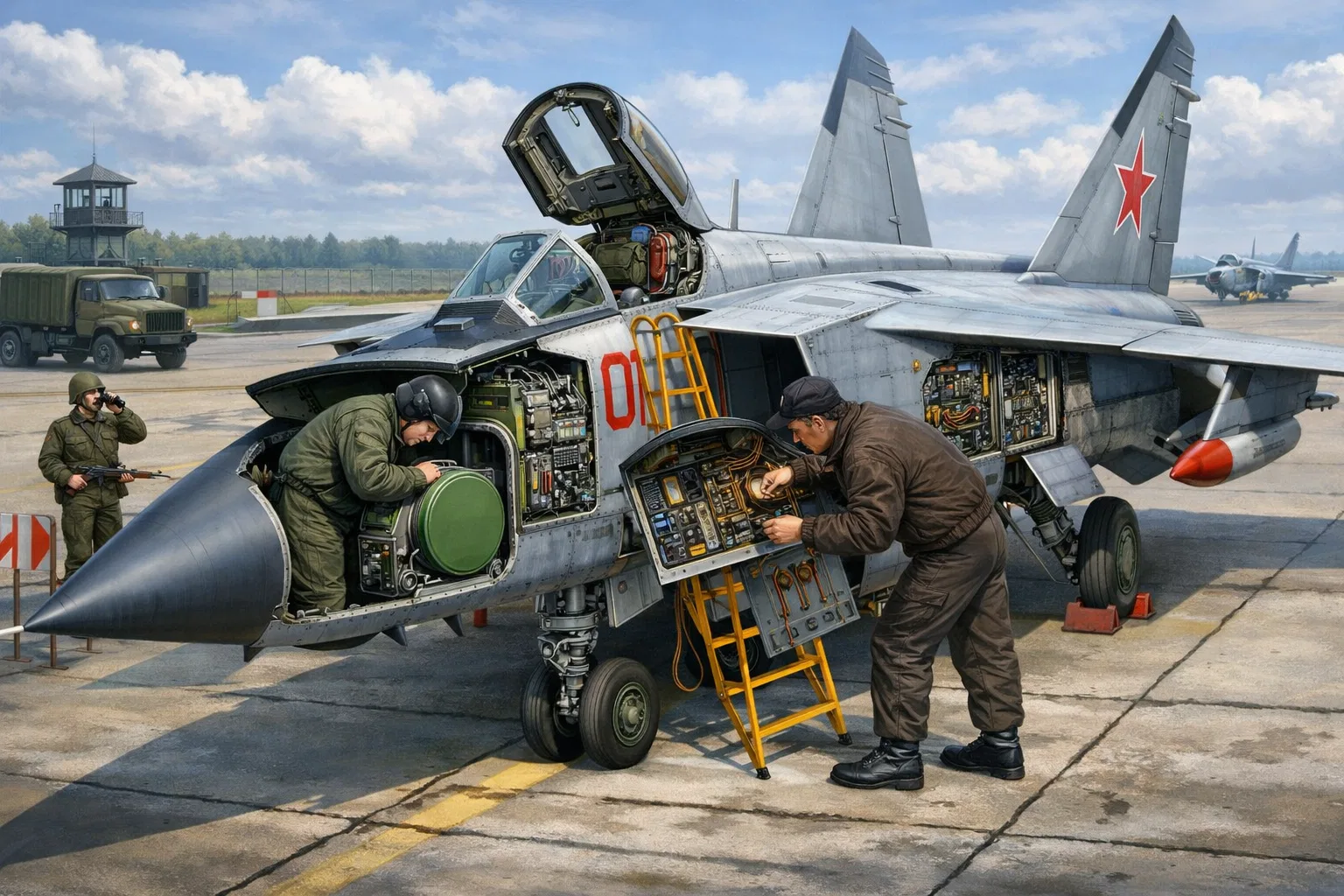
The central discovery was not that the MiG-25 was useless. It was that its excellence was narrower than many had feared. US Air Force museum material describes the post-defection analysis as revealing a “simple-yet-functional” design, with vacuum-tube electronics, two massive turbojet engines and only sparing use of advanced materials such as titanium. That is a very different image from a lightweight, highly agile super-fighter built around the latest electronics and exotic metallurgy.[Air Force Museum]nationalmuseum.af.milMikoyan-Gurevich MiG-25 > National Museum of the United States Air Force > Display…
The aircraft’s structure told analysts a great deal about Soviet design priorities. Specialist aviation accounts describe the MiG-25 as relying heavily on nickel-steel construction rather than titanium, a choice that made sense for heat tolerance, cost, manufacturability and Soviet production realities, even though it increased weight. Steel was not a sign of stupidity; it was a tradeoff. It allowed the Soviets to build an aircraft that could endure high-speed thermal stress without relying on titanium manufacturing capacity at a scale and quality that would have been much harder to sustain.[The Aviation Geek Club]theaviationgeekclub.comOpen source on theaviationgeekclub.com.
The avionics also changed the story. Vacuum tubes looked old-fashioned to Western engineers used to solid-state electronics, but they were not simply a joke. They reflected Soviet electronics constraints and ruggedness priorities. In a high-heat, nuclear-war-oriented air-defence environment, older components could be serviceable, robust and easier to maintain. The important intelligence point was not “the Soviets were backward”; it was that the aircraft had achieved a real mission through different engineering compromises than Western observers had imagined.[Air Force Museum]nationalmuseum.af.milMikoyan-Gurevich MiG-25 > National Museum of the United States Air Force > Display…
Performance data narrowed the threat further. Air & Space Forces Magazine notes that after the aircraft was disassembled and studied, the MiG-25 proved to be a true high-speed interceptor rather than the feared air-combat powerhouse; it could turn at less than five g, a major limitation for close-in fighter combat. That finding punctured the myth of a huge, fast and highly manoeuvrable Soviet fighter that could outclass Western aircraft across the board.[Air & Space Forces Magazine]airandspaceforces.comAir & Space Forces Magazine Ascendent Eagle | Air & Space Forces MagazineAir & Space Forces Magazine Ascendent Eagle | Air & Space Forces Magazine

The Myths That Fell Away
The MiG-25 case is often retold too simply as “the West panicked and then discovered junk”. That is not quite right. The aircraft was not junk, and the alarm was not invented from nothing. What fell away were several inflated assumptions.
First, the MiG-25 was not a dogfighting super-fighter. Its great speed and altitude performance were real, but they came with weight, fuel and manoeuvrability penalties. The aircraft was built to intercept high-speed, high-altitude intruders under air-defence control, not to replace every other fighter role.[Air Force Museum]nationalmuseum.af.milMikoyan-Gurevich MiG-25 > National Museum of the United States Air Force > Display…
Second, “advanced” did not mean “built like a Western aircraft”. The inspection showed a rugged, direct, mission-focused machine with large engines, steel-heavy construction and older electronic technology. That could look crude if judged by Western design preferences, but it made sense inside Soviet air-defence requirements, industrial constraints and maintenance assumptions.[Air Force Museum]nationalmuseum.af.milMikoyan-Gurevich MiG-25 > National Museum of the United States Air Force > Display…
Third, technical surprise cut both ways. Western analysts had overestimated some aspects of the MiG-25, especially agility and sophistication, but they also gained respect for the aircraft’s specific strengths. A machine that can reach Mach 2.83, carry large missiles and operate as a high-altitude interceptor is still a serious military system. Reverse engineering did not turn the MiG-25 from monster into nothing; it turned a vague monster into a defined threat.[Air Force Museum]nationalmuseum.af.milMikoyan-Gurevich MiG-25 > National Museum of the United States Air Force > Display…
Why the Case Matters for Reverse Engineering
The Belenko defection shows the special value of physical access. Before 1976, Western intelligence could observe flights, study photographs, collect radar tracks and hear claims. After the defection, analysts could inspect the aircraft’s materials, electronics, cockpit, engines, radar installation and maintenance logic. That changed the question from “what might this aircraft be?” to “what does this aircraft actually contain, and what does that imply?”[National Security Archive]nsarchive.gwu.eduOpen source on gwu.edu.
This is one reason foreign materiel exploitation can be strategically valuable even when no one copies the captured system. The point was not to build an American MiG-25. The point was to update threat models, improve training assumptions, understand Soviet design habits, and identify limits that could shape tactics and procurement. A real aircraft revealed which fears were justified, which were exaggerated, and which design decisions reflected a different military problem.
The case also shows that reverse engineering is not just technical archaeology. It interacts with diplomacy, alliance management and crisis control. Japan had to return the aircraft; the United States wanted intelligence; the Soviet Union wanted its secret system back. The exploitation succeeded because analysts were given enough time and access to dismantle and examine the aircraft before it was shipped home.[ADST]adst.orgOpen source on adst.org.

Lessons About Threat Inflation
The MiG-25 myth grew from a normal intelligence problem: when an adversary reveals only part of a system, observers fill in the rest. During the Cold War, responsible planners often had incentives to assume the worst, because underestimating an enemy aircraft could be more dangerous than overestimating it. But the Foxbat shows how a worst-case estimate can turn a specialised system into an imagined all-rounder.
The F-15 connection illustrates the nuance. Air & Space Forces Magazine argues that the MiG-25’s 1967 appearance was one of the shocks that helped free the US Air Force to pursue a dedicated air-superiority fighter; by 1969 McDonnell Douglas had been selected to build what became the F-15. Yet Belenko’s aircraft arrived in Japan only in 1976, after the F-15 had already flown and as the first operational aircraft were being accepted. Inspection therefore did not create the F-15; it retrospectively clarified that the Foxbat threat which helped shape the urgency had been partly misunderstood.[Air & Space Forces Magazine]airandspaceforces.comAir & Space Forces Magazine Ascendent Eagle | Air & Space Forces MagazineAir & Space Forces Magazine Ascendent Eagle | Air & Space Forces Magazine
That is the enduring lesson. Reverse engineering does not merely expose weaknesses. It disciplines imagination. It can confirm that an adversary has a formidable capability while also showing the tradeoffs hidden behind that capability. In the MiG-25’s case, the West learned that Soviet engineers had built a fast, rugged interceptor suited to a particular air-defence mission — not the universal super-fighter suggested by silhouette, secrecy and fear.
Amazon book picks
Further Reading
Books and field guides related to What the MiG-25 Really Revealed. Use these as the next step if you want deeper reading beyond the article.
Skunk Works
Provides context for Cold War aerospace intelligence and technology evaluation.
eBay marketplace picks
Marketplace Samples
Live-tested eBay searches with available results related to this page.



Endnotes
1.
Source: cia.gov
Title: Former Soviet Pilot Viktor Belenko’s Knee Pad Notebook with Flight Data
Link:https://cia.gov/legacy/museum/artifact/former-soviet-pilot-viktor-belenkos-knee-pad-notebook-with-flight-data/
2.
Source: nationalmuseum.af.mil
Title: Air Force Museum
Link:https://www.nationalmuseum.af.mil/Visit/Museum-Exhibits/Fact-Sheets/Display/Article/196331/mikoyan-gurevich-mig-25/
Source snippet
Mikoyan-Gurevich MiG-25 > National Museum of the United States Air Force > Display...
3.
Source: adst.org
Link:https://adst.org/2018/03/a-very-japanese-arrangement-to-dismantle-a-soviet-mig-25/
4.
Source: cia.gov
Title: Former Soviet Pilot Viktor Belenko’s Military Identity
Link:https://cia.gov/legacy/museum/artifact/former-soviet-pilot-viktor-belenkos-military-identity-document/
5.
Source: cia.gov
Link:https://www.cia.gov/readingroom/docs/CIA-RDP90-00806R000100140073-5.pdf
6.
Source: cia.gov
Link:https://www.cia.gov/resources/csi/static/StudiesExtracts-March2022-Vol66No1-4.pdf
7.
Source: cia.gov
Link:https://www.cia.gov/readingroom/docs/CIA-RDP90-00552R000100490007-2.pdf
8.
Source: cia.gov
Title: NEW S, VIEWS, AND ISSUES[SANITIZED]
Link:https://www.cia.gov/readingroom/document/02623720
9.
Source: cia.gov
Link:https://www.cia.gov/readingroom/docs/CIA-RDP90-00552R000100490012-6.pdf
10.
Source: cia.gov
Link:https://www.cia.gov/readingroom/docs/CIA-RDP88-01314R000300620003-2.pdf
11.
Source: cia.gov
Link:https://www.cia.gov/readingroom/docs/CIA-RDP90-00552R000100490006-3.pdf
12.
Source: cia.gov
Link:https://www.cia.gov/readingroom/docs/CIA-RDP90-00552R000100490008-1.pdf
13.
Source: cia.gov
Link:https://www.cia.gov/readingroom/docs/CIA-RDP90-00552R000100490011-7.pdf
14.
Source: cia.gov
Link:https://www.cia.gov/readingroom/document/05093953
15.
Source: time.com
Title: intelligence bonanza or bust
Link:https://time.com/archive/6848376/intelligence-bonanza-or-bust/
16.
Source: airandspaceforces.com
Title: Air & Space Forces Magazine Ascendent Eagle | Air & Space Forces Magazine
Link:https://www.airandspaceforces.com/article/0713eagle/
17.
Source: nsarchive.gwu.edu
Link:https://nsarchive.gwu.edu/document/16291-document-36-mig-25-japan-excerpt
18.
Source: theaviationgeekclub.com
Link:https://theaviationgeekclub.com/how-soviet-propaganda-on-mig-25-led-to-the-development-of-the-f-15-the-premier-air-superiority-fighter-of-the-20th-century/
19.
Source: legacy.com
Title: viktor belenko obituary
Link:https://www.legacy.com/us/obituaries/washingtonpost/name/viktor-belenko-obituary?id=53291095
20.
Source: theaviationgeekclub.com
Title: did you know the defection of viktor belenko inspired clint eastwoods firefox
Link:https://theaviationgeekclub.com/did-you-know-the-defection-of-viktor-belenko-inspired-clint-eastwoods-firefox/
21.
Source: theaviationgeekclub.com
Link:https://theaviationgeekclub.com/photos-show-viktor-belenkos-defecting-mig-25-foxbat-buzzing-hakodate-rooftops-before-landing-at-the-citys-international-airport/
22.
Source: theaviationgeekclub.com
Link:https://theaviationgeekclub.com/did-you-know-the-soviet-union-was-charged-40000-shipping-cost-for-the-return-of-the-mig-25-foxbat-stolen-by-viktor-belenko/
23.
Source: theaviationgeekclub.com
Link:https://theaviationgeekclub.com/the-defection-of-viktor-belenko-the-pilot-who-stole-the-super-secret-soviet-mig-25-fighter-jet/
24.
Source: theaviationgeekclub.com
Link:https://theaviationgeekclub.com/viktor-belenko-who-defected-to-the-west-in-a-mig-25-foxbat-jet-fighter-has-passed-away/
25.
Source: Wikipedia
Title: Viktor Belenko
Link:https://en.wikipedia.org/wiki/Viktor_Belenko
26.
Source: Wikipedia
Title: Mikoyan Gurevich Mi G 25
Link:https://en.wikipedia.org/wiki/Mikoyan-Gurevich_MiG-25
27.
Source: airandspaceforces.com
Link:https://www.airandspaceforces.com/article/0481tactical/
28.
Source: globalaircraft.org
Title: Mi G-25 Foxbat
Link:https://www.globalaircraft.org/planes/mig-25_foxbat.pl
29.
Source: fordlibrarymuseum.gov
Link:https://www.fordlibrarymuseum.gov/library/document/0324/1553701.pdf
30.
Source: skyandspacetravel.com
Title: MI G-25 Foxbat
Link:https://www.skyandspacetravel.com/mig25_foxbat.html
31.
Source: historynet.com
Title: mig 25
Link:https://historynet.com/mig-25/
Additional References
32.
Source: youtube.com
Link:https://www.youtube.com/watch?v=HiRfMP4AVgI
Source snippet
Victor Belenko | The Pilot Who Stole the Soviet Union's Greatest Secret...
33.
Source: youtube.com
Title: Victor Belenko | The Pilot Who Stole the Soviet Union’s Greatest Secret
Link:https://www.youtube.com/watch?v=_sAvkr4LbWw
Source snippet
He Stole the MiG-25 to Escape the Soviet Union...
34.
Source: youtube.com
Title: He Stole the Mi G-25 to Escape the Soviet Union
Link:https://www.youtube.com/watch?v=S_ecrZ7eD48
Source snippet
HUMILIATION! How Japan Shipped Belenko's MiG-25 Back to Moscow in 30 Crates...
35.
Source: youtube.com
Title: The Mach 3 Monster with a Drinking Problem
Link:https://www.youtube.com/watch?v=YmAimkXikWI
Source snippet
The Stolen MiG-25 "Foxbat" and Viktor Belenko's Defection of 1976...
36.
Source: facebook.com
Link:https://www.facebook.com/avpayltd/posts/built-for-speed-not-style-the-mig-25-foxbat-shocked-the-west-with-its-raw-perfor/1568760608592438/
37.
Source: facebook.com
Link:https://www.facebook.com/groups/1378802532139295/posts/9449268578425943/
38.
Source: reddit.com
Link:https://www.reddit.com/r/WarCollege/comments/13f0xc3/did_the_usafdiacia_really_believe_the_mig25_was/
39.
Source: facebook.com
Link:https://www.facebook.com/militarymechanicsie/posts/from-the-f-15-eagle-to-the-mig-25-foxbat-these-legendary-fighters-prove-that-som/122303006366191911/
40.
Source: reddit.com
Link:https://www.reddit.com/r/WarCollege/comments/1hq253l/how_much_should_the_perceived_threat_of_the_mig25/
41.
Source: nationalinterest.org
Link:https://nationalinterest.org/blog/buzz/how-crazy-defection-soviet-pilot-viktor-belenko-inspired-clint-eastwoods-blockbuster/
Topic Tree