Within Missile Seekers
Can a Flying Decoy Look Like a Ship?
Nulka shows how an active decoy must look convincing to a radar seeker, not merely produce a large signal away from the ship.
On this page
- What Nulka is publicly described as doing
- Why radar seekers judge more than signal strength
- How counter countermeasures pressure decoy design
Page outline Jump by section
Introduction
Nulka is one of the clearest public examples of how missile-defence engineers use knowledge of seeker behaviour rather than simply trying to overpower it. The system was developed by Australia and the United States as an off-board active decoy for warships. Its purpose is not merely to create a strong radar signal away from the ship. Instead, it attempts to present a false target that looks believable to the radar seeker of an incoming anti-ship missile. Public descriptions consistently emphasise that Nulka generates a large, ship-like radar return and entices the missile to transfer its tracking from the real vessel to the decoy.[navy.mil]navy.milU.S. Navy MK 53U.S. NavyMK 53 - Decoy Launching System (Nulka) - Navy.mil16 Jan 2019 — After launch, the Nulka decoy radiates a large, ship-like radar c…
This distinction matters in the broader field of missile seeker reverse engineering. If engineers learn how a foreign radar seeker identifies and prioritises targets, they can design decoys that exploit those assumptions. Nulka illustrates the central problem: a decoy succeeds only if the missile’s seeker believes the false target is a plausible ship.
Can a Flying Decoy Look Like a Ship?
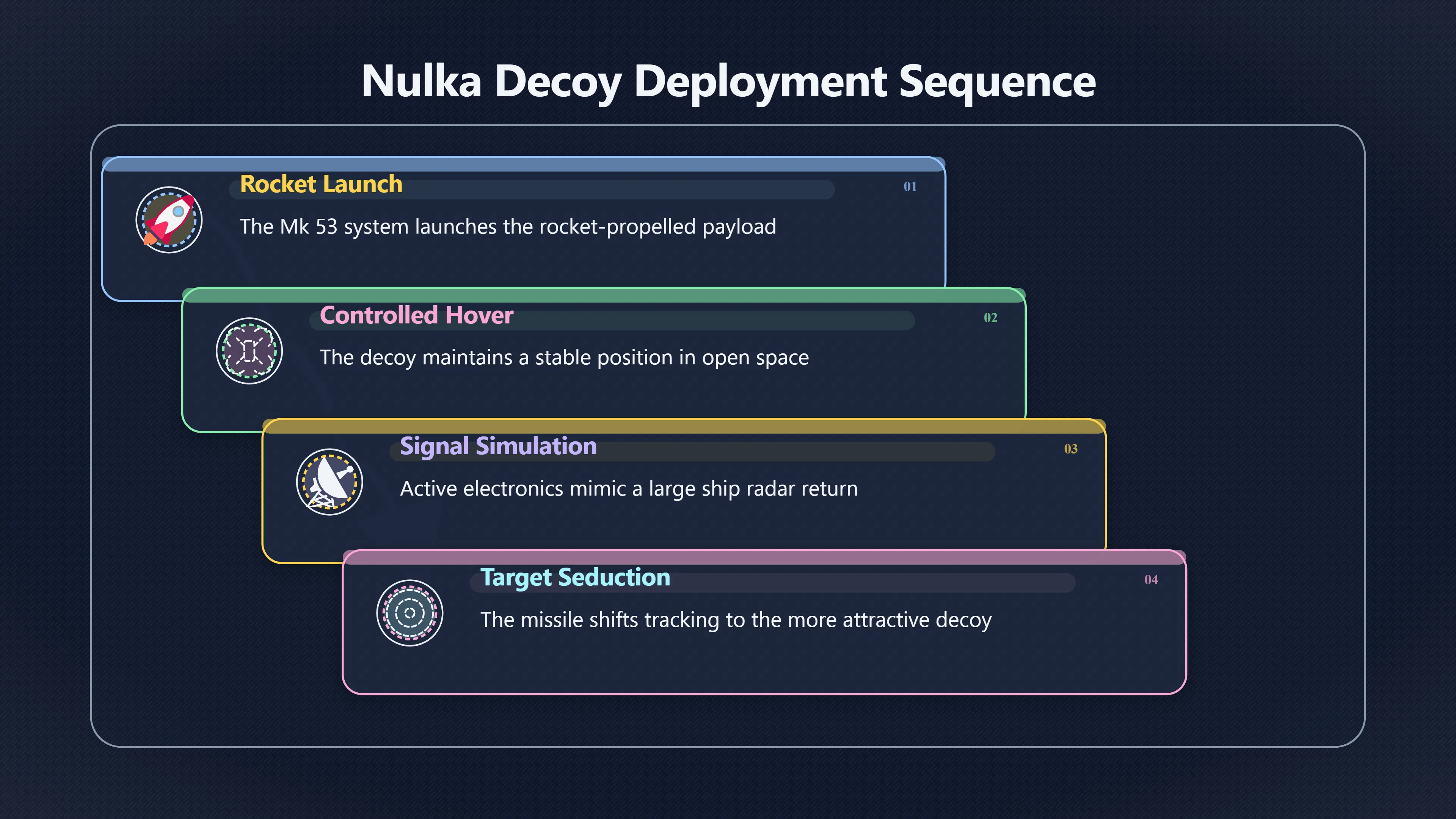
Publicly available descriptions portray Nulka as a rocket-propelled decoy that launches away from a warship, hovers in controlled flight, and carries an active electronic warfare payload. Rather than remaining attached to the ship or floating passively on the sea surface, it creates a separate radar target in space.[defence.gov.au]dst.defence.gov.auNulka Active Missile DecoyIts unique hovering rocket containing an active electronic…
The key feature is not the hovering rocket itself but what the payload is intended to represent. Official and industry descriptions state that Nulka simulates a large ship radar return and presents a more attractive target to the incoming missile. The decoy is launched off-board, overlaps or competes with the ship’s own radar signature, and then draws the missile away from the defended vessel.[l3harris.com]l3harris.comL3Harris® Fast. Forward.NulkaThe L3Harris rocket motor launches the decoy payload and hovers it away from the ship where it simulates a r…
This reflects a fundamental lesson from seeker exploitation. A missile seeker is not usually searching for the strongest possible reflection in the abstract. It is searching for what its designers taught it to recognise as a valid target. The challenge for the decoy is therefore to satisfy those expectations better than the real ship does.
Why Radar Seekers Judge More Than Signal Strength
A common misunderstanding is that radar-guided missiles can be defeated simply by producing a larger radar echo somewhere else. Modern anti-ship missile seekers are generally designed to evaluate multiple characteristics of a contact rather than raw signal intensity alone.
Although the detailed algorithms of contemporary seekers remain classified, open technical literature and official descriptions of naval countermeasures indicate that seekers can assess factors such as target position, apparent size, movement, stability of the return, and consistency with expected ship behaviour. A contact that suddenly appears as an enormous radar reflector in an implausible location may not automatically be accepted as the preferred target. This is precisely why Nulka’s designers emphasise ship-like behaviour rather than simple jamming power.[tealgroup.com]tealgroup.comNulka & Anti-Ship Missile (ASM) Electronic…Apr 1, 2017 — Nulka consists of a dedicated launcher, the Decoy Launching System (Mk 53), a…
The publicly described Nulka approach addresses several seeker expectations simultaneously:
- A believable radar cross-section: official sources describe the decoy as producing a large ship-like radar return rather than an arbitrary electronic signal.[U.S. Navy]navy.milU.S. Navy MK 53U.S. NavyMK 53 - Decoy Launching System (Nulka) - Navy.mil16 Jan 2019 — After launch, the Nulka decoy radiates a large, ship-like radar c…
- Spatial separation from the vessel: the hovering rocket creates a physically distinct target rather than merely masking the ship.[dst.defence.gov.au]dst.defence.gov.auNulka Active Missile DecoyIts unique hovering rocket containing an active electronic…
- Target transfer opportunity: by presenting a competing contact that appears more attractive, the missile can be induced to shift tracking away from the ship.[L3Harris® Fast. Forward.]l3harris.comL3Harris® Fast. Forward.NulkaThe L3Harris rocket motor launches the decoy payload and hovers it away from the ship where it simulates a r…
- Persistence during terminal engagement: the hovering flight profile allows the decoy to remain in a useful location while the missile seeker is making final targeting decisions.[dst.defence.gov.au]dst.defence.gov.auNulka Active Missile DecoyIts unique hovering rocket containing an active electronic…
In effect, Nulka embodies a practical answer to a reverse-engineering question: what must a false target look like before a missile will treat it as real?

What Nulka Is Publicly Described as Doing
Government and industry sources are unusually consistent in their description of the system. Australia’s Defence Science and Technology organisation states that the hovering rocket carries an active electronic warfare package and follows a programmed flight path to entice sea-skimming missiles away from the ship.[dst.defence.gov.au]dst.defence.gov.auNulka Active Missile DecoyIts unique hovering rocket containing an active electronic…
The US Navy describes the decoy as radiating a large, ship-like radar cross section while flying a trajectory that lures anti-ship missiles away from their intended targets.[U.S. Navy]navy.milU.S. Navy MK 53U.S. NavyMK 53 - Decoy Launching System (Nulka) - Navy.mil16 Jan 2019 — After launch, the Nulka decoy radiates a large, ship-like radar c…
Industry descriptions go further, explaining that the payload simulates the radar return of a large ship and provides a more attractive target to the missile seeker.[L3Harris® Fast. Forward.]l3harris.comL3Harris® Fast. Forward.NulkaThe L3Harris rocket motor launches the decoy payload and hovers it away from the ship where it simulates a r…
These public statements reveal an important design philosophy. Nulka is often characterised as a “seduction” decoy rather than merely a jammer. In naval electronic warfare terminology, seduction implies convincing the missile to pursue a false target. The missile is not simply blinded; it is encouraged to make the wrong choice.[BAE Systems]baesystems.comBAE SystemsNulkaNulka is a rocket-propelled, expendable, offboard, active decoy designed to 'seduce' modern anti-ship missiles away from…
How Counter-Countermeasures Shape Decoy Design
The existence of Nulka also highlights the continual competition between missile designers and defensive engineers.
Missile developers understand that warships deploy decoys. As a result, newer seekers are often designed with electronic counter-countermeasures intended to reject obvious false targets. Exact capabilities vary by missile and are rarely disclosed, but the general trend is well established: seekers increasingly attempt to distinguish genuine ships from deceptive signals.
This pressure creates a demanding design requirement. A decoy must not only attract attention; it must survive scrutiny. If a seeker compares target characteristics over time, the false target has to remain believable. If a seeker expects a certain type of radar behaviour from a ship, the decoy has to reproduce enough of those characteristics to trigger the desired response.
Nulka’s evolution and continuing upgrade programmes reflect this reality. Public sources note ongoing efforts to enhance its effectiveness against advancing threats, indicating that decoy design cannot remain static while seeker technology improves.[BAE Systems]baesystems.comBAE SystemsNulkaThe Nulka active missile decoy is the most sophisticated soft-kill anti-ship missile defence system available for the pro…
The broader lesson for reverse engineering foreign military technology is straightforward. Recovering and analysing missile seekers is valuable because it reveals the assumptions that decoys must exploit. Every improvement in understanding seeker logic can inform a more convincing false target, while every improvement in seeker discrimination forces decoys to become more sophisticated.

Why Nulka Matters as a Seeker-Reverse-Engineering Case
Nulka is significant not because it demonstrates a particular electronic trick, but because it captures the central challenge of radar deception. A successful decoy must align with the missile’s internal model of what a ship looks like.
Public descriptions repeatedly return to the same concept: a hovering off-board decoy that generates a ship-like radar signature and persuades the missile to pursue it instead of the real vessel.[navy.mil]navy.milU.S. Navy MK 53U.S. NavyMK 53 - Decoy Launching System (Nulka) - Navy.mil16 Jan 2019 — After launch, the Nulka decoy radiates a large, ship-like radar c…
That emphasis reveals the practical outcome of seeker analysis. The goal is not merely to make noise or create distance. The goal is to understand the target-recognition process well enough that the missile confidently chooses the wrong object. Nulka stands as one of the most visible examples of that principle in operational naval defence.[defense.info]defense.infoupdating the nulka anti ship defense systemUpdating the Nulka Anti-Ship Defense System3 Jan 2022 — What emerged from the Australian research was Nulka, a 'soft kill' hovering decoy…
Amazon book picks
Further Reading
Books and field guides related to Can a Flying Decoy Look Like a Ship?. Use these as the next step if you want deeper reading beyond the article.
Introduction to Airborne Radar
Gives the radar principles needed to understand why a decoy must look target-like.
Tactical Missile Design
Connects radar decoy effectiveness to missile seeker and engagement design.
Electronic Warfare in the Information Age
Places radar deception and electronic attack in a wider operational EW setting.
Radar Handbook
Covers radar signatures, tracking and electronic countermeasure background.
eBay marketplace picks
Marketplace Samples
Live-tested eBay searches with available results related to this page.


Endnotes
1.
Source: navy.mil
Title: U.S. Navy MK 53
Link:https://www.navy.mil/Resources/Fact-Files/Display-FactFiles/Article/2167877/mk-53-decoy-launching-system-nulka/
Source snippet
U.S. NavyMK 53 - Decoy Launching System (Nulka) - Navy.mil16 Jan 2019 — After launch, the Nulka decoy radiates a large, ship-like radar c...
2.
Source: l3harris.com
Link:https://www.l3harris.com/all-capabilities/nulka
Source snippet
L3Harris® Fast. Forward.NulkaThe L3Harris rocket motor launches the decoy payload and hovers it away from the ship where it simulates a r...
3.
Source: dst.defence.gov.au
Title: Nulka Active Missile Decoy
Link:https://www.dst.defence.gov.au/innovation/nulka-active-missile-decoy
Source snippet
Its unique hovering rocket containing an active electronic...
4.
Source: navy.gov.au
Title: Royal Australian Navy Nulka active missile decoy
Link:https://www.navy.gov.au/capabilities/weapons/nulka-active-missile-decoy
Source snippet
Royal Australian NavyNulka active missile decoy - Royal Australian NavyIt is a rocket-propelled, disposable, off board, active decoy with...
5.
Source: tealgroup.com
Link:https://www.tealgroup.com/index.php/teal-group-media-news-briefs-2/teal-group-news-media/item/nulka-anti-ship-missile-asm-electronic-countermeasures-ecm-systems
Source snippet
Nulka & Anti-Ship Missile (ASM) Electronic...Apr 1, 2017 — Nulka consists of a dedicated launcher, the Decoy Launching System (Mk 53), a...
6.
Source: defense.info
Title: updating the nulka anti ship defense system
Link:https://defense.info/defense-systems/updating-the-nulka-anti-ship-defense-system/
Source snippet
Updating the Nulka Anti-Ship Defense System3 Jan 2022 — What emerged from the Australian research was Nulka, a 'soft kill' hovering decoy...
7.
Source: youtube.com
Title: CENTURION Naval Decoy Launcher by Chemring Countermeasures
Link:https://www.youtube.com/watch?v=wjIBv_GD0H0
Source snippet
US Navy Soft Kill System Stops Missiles Without Firing Weapons | WION Podcast...
8.
Source: youtube.com
Title: US Navy Soft Kill System Stops Missiles Without Firing Weapons | WION Podcast
Link:https://www.youtube.com/watch?v=tZlqKiUdhPo
9.
Source: baesystems.com
Link:https://www.baesystems.com/en-aus/product/nulka
Source snippet
BAE SystemsNulkaNulka is a rocket-propelled, expendable, offboard, active decoy designed to 'seduce' modern anti-ship missiles away from...
10.
Source: lockheedmartin.com
Title: Lockheed Martin Nulka
Link:https://www.lockheedmartin.com/content/dam/lockheed-martin/rms/[documents
Source snippet
The decoy provides a larger, more attractive target to the missile.Read more...
11.
Source: baesystems.com
Link:https://www.baesystems.com/en/product/nulka
Source snippet
BAE SystemsNulkaThe Nulka active missile decoy is the most sophisticated soft-kill anti-ship missile defence system available for the pro...
12.
Source: Wikipedia
Link:https://en.wikipedia.org/wiki/Nulka
Source snippet
NulkaNulka is a rocket-propelled, disposable, offboard, active decoy designed to lure anti-ship missiles away from their targets...
13.
Source: baesystems.com
Link:https://www.baesystems.com/en-us/product/nulka
Source snippet
NulkaNulka is a rocket-propelled, expendable, offboard, active decoy designed to 'seduce' modern anti-ship missiles away from their targe...
14.
Source: deagel.com
Link:https://www.deagel.com/components/nulka/a001189
Source snippet
Nulka is an active missile decoy system developed by BAE Systems Australia under a collaborative program between the governments of...
Additional References
15.
Source: facebook.com
Link:https://www.facebook.com/militarymechanicsie/posts/mass-decoy-system-protects-german-navy-ships-in-under-3-seconds-%EF%B8%8F-50-units-count/122196863516191911/
Source snippet
MASS decoy system protects German Navy ships in under...MASS decoy system protects German Navy ships in under 3 seconds! 50 units counte...
16.
Source: twz.com
Link:https://www.twz.com/news-features/nulka-combat-use-shows-warships-need-longer-lasting-electronic-warfare-enabled-decoys
Source snippet
Nulka Combat Use Shows Warships Need Longer-Lasting...Jan 20, 2025 — The US Navy's use of expendable Nulka decoys in combat has highligh...
17.
Source: youtube.com
Link:https://www.youtube.com/watch?v=b1Ajazd-230
Source snippet
History of Nulka | BAE Systems AustraliaNACA is an active missile decoy. It uses unique hovering rocket technology to divert incoming ant...
18.
Source: facebook.com
Link:https://www.facebook.com/100064488918348/posts/the-aussie-made-nulka-missile-decoy-has-received-glowing-reviews-from-the-us-nav/1017401617086126/
Source snippet
lying a trajectory that lures ASMs away from their intended...Read more...
19.
Source: reddit.com
Link:https://www.reddit.com/r/LessCredibleDefence/comments/zuba05/how_the_nulka_active_missile_decoy_works_as/
Source snippet
spectrum as the enemy radar receiver typically gets from the ship...
20.
Source: youtube.com
Link:https://www.youtube.com/watch?v=54uSqprF5zs
Source snippet
CENTURION Naval Decoy Launcher by Chemring Countermeasures...
21.
Source: youtube.com
Title: Nulka away!
Link:https://www.youtube.com/watch?v=0k0IWzyfIgk
Source snippet
Indo Pacific 2023: NULKA decoy system, SERCO MUSV, Rheinmetall mine laying system, uncrewed systems...
22.
Source: youtube.com
Title: Top 10 Most Powerful Weapons Produced by Australia!
Link:https://www.youtube.com/watch?v=y8GLdilgXJY
Source snippet
Nulka away...
Topic Tree