Within Radar Signatures
The Weaknesses a Radar Cannot Hide
Captured systems can expose blind sectors, jamming susceptibility and tracking limits that outside signal collection may miss.
On this page
- Why absence is useful intelligence
- Testing failure points under stress
- Turning radar limits into tactics
Page outline Jump by section
Introduction
Exploitation finds what a radar cannot do by moving from passive observation to controlled testing. Intercepted signals may show that a radar is present, what frequency it is using, and how it behaves during one observed mission. A captured or closely instrumented system can be pushed through awkward angles, clutter, jamming, target speeds, antenna positions and mode transitions until it fails. That matters because military value often lies in the negative space: the sector it cannot see, the waveform it cannot separate, the false target it accepts, the track it drops, or the countermeasure that forces it into a less useful mode.
In reverse engineering foreign military technology, this is the difference between admiring a system’s advertised capability and building a practical map of its limits. Modern electronic-warfare data is not just a catalogue of emitter names; US doctrine describes the Electronic Warfare Integrated Reprogramming Database as a source of technical parametric and performance data for non-communications emitters, used to support mission data and reprogramming across the services. That kind of database becomes more useful when it includes not only “what this radar emits” but “where its recognition, tracking and resistance to interference begin to break down”.[E-Publishing]static.e-publishing.af.milJune 2, 2021 — 2 Jun 2021 — EWIRDB—electronic warfare integrated reprogramming database. FLDCOM… parametric and performance data on no…
Why absence is useful intelligence
A radar’s weakness is rarely printed on its casing. It appears when a test asks a narrow question and the answer is silence, confusion or instability. Can the radar maintain a track when the target crosses a beam edge? Does it lose low-flying targets in ground clutter? Does a jammer need to overpower the receiver, or merely create a more convincing false return? Does the system preserve a track through evasive manoeuvres, or does it repeatedly reacquire from scratch?
That “absence” is useful because outside collection can easily overstate a radar. A signal intercepted in the field may show a powerful search mode, but not the blind sectors created by antenna placement, terrain masking, scan geometry, sidelobes, operator settings or processing thresholds. Radar warning receiver research commonly describes identification as the sorting of observed pulse data by features such as time of arrival, pulse width, carrier frequency, power and angle of arrival; exploitation adds a second layer by asking what happens when those features are incomplete, ambiguous or deliberately manipulated.[Academia]academia.eduOpen source on academia.edu.
The classic Bruneval raid in February 1942 shows why physical access changed the quality of intelligence. British forces brought back key parts of a German Würzburg radar, allowing scientists to study its operating characteristics rather than relying only on distant observation. Accounts of the raid note that the captured material helped British analysts understand the system well enough to develop countermeasures; later summaries connect that knowledge to Window and more targeted jamming against Würzburg-related air-defence functions.[Wikipedia]WikipediaOperation BitingOperation Biting
The most important lesson is not simply that the Allies learned “how Würzburg worked”. They learned where its practical air-defence process could be overloaded or confused. One later account of Bruneval’s impact argues that the Freya-Würzburg combination could be exploited because it could handle only limited tracking demands, helping Bomber Command adopt concentrated bomber streams to swamp the German monitoring and interception process.[The Times]thetimes.co.ukThe Times Operation Biting: the daring raid to steal Hitler's radarThe Times Operation Biting: the daring raid to steal Hitler's radar
How testers force a radar to show its limits
Exploitation turns a captured radar into a test subject. Engineers can feed it controlled returns, vary signal strength, change target geometry, alter pulse timing, introduce clutter and measure how the radar reacts. The aim is not to make the radar fail once in a dramatic demonstration. It is to produce repeatable data: the conditions under which detection becomes intermittent, tracking becomes unstable, classification becomes ambiguous, or electronic protection stops working.
Modern radar and electronic-warfare testing reflects the same logic. Test-and-evaluation literature stresses that radar systems now operate in contested, congested and constrained electromagnetic environments, making realistic assessment difficult but necessary. Multi-emitter test guidance likewise emphasises that realistic EW testing may require simulated environments with thousands of emitters and millions of pulses arriving from multiple directions, because simple one-signal tests do not expose how systems behave under pressure.[IET Research Journals]ietresearch.onlinelibrary.wiley.comOpen source on wiley.com.
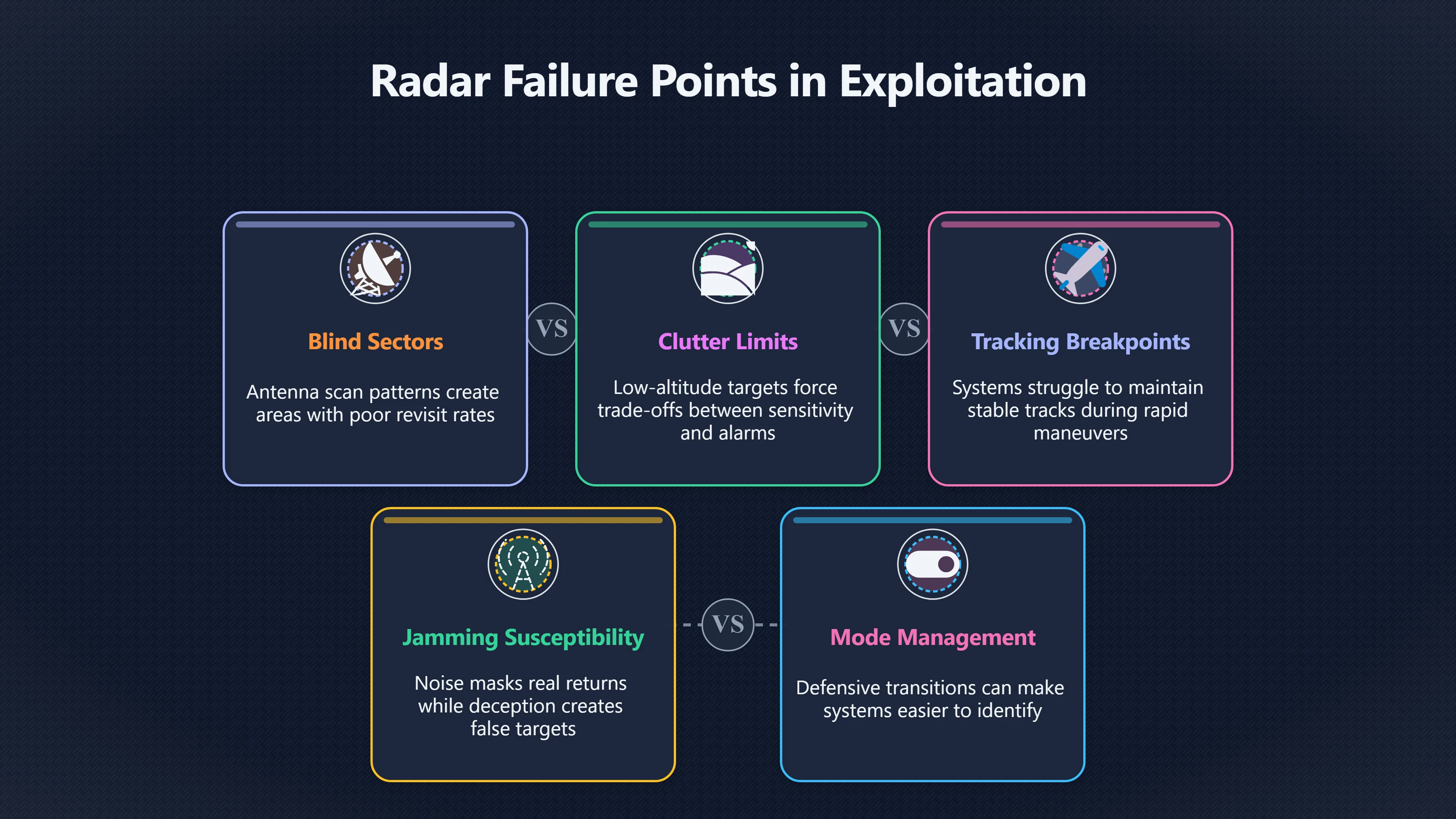
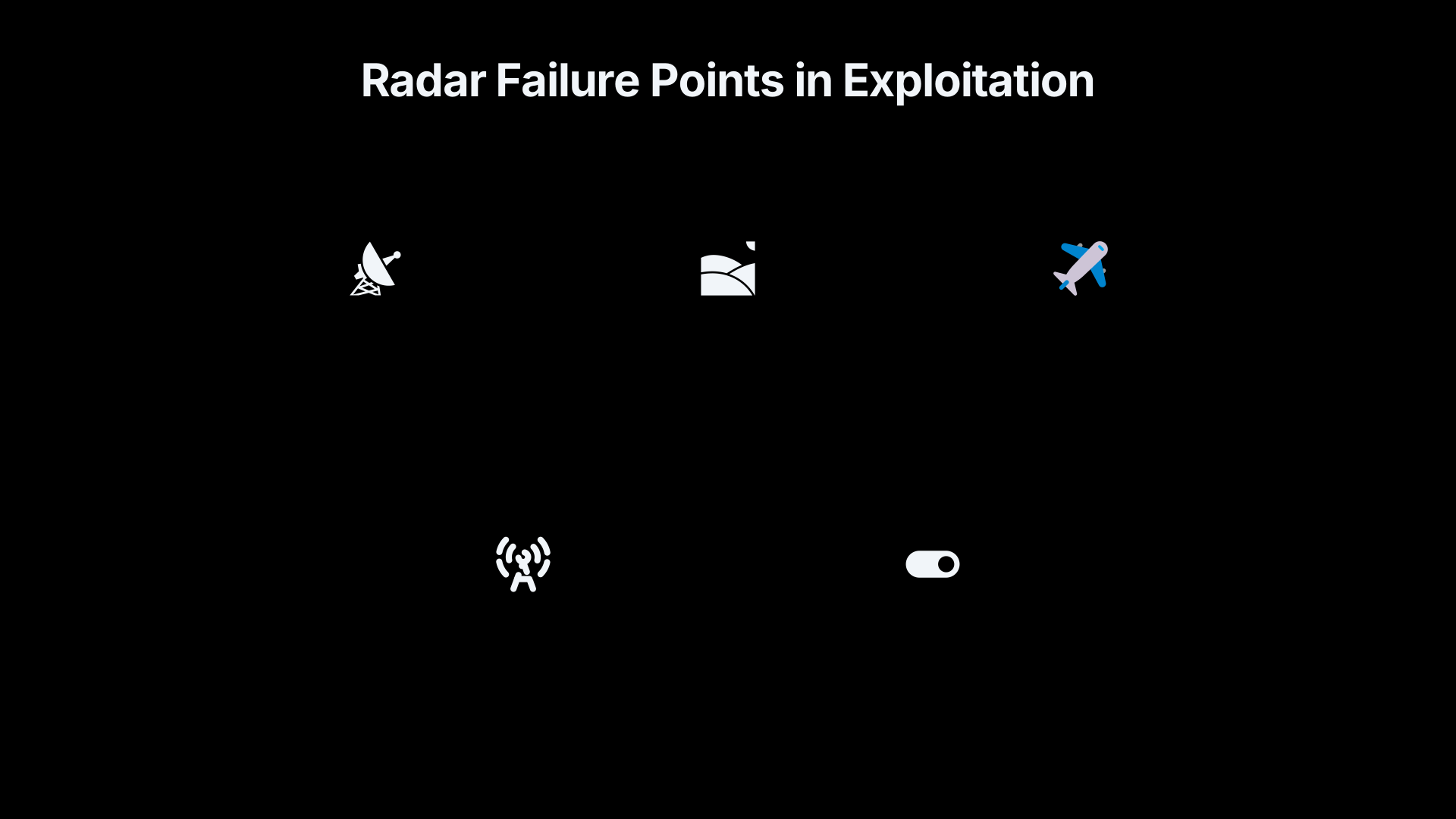
The failure points usually fall into a few practical categories:
- Blind or weak sectors: antenna scan patterns, beam width, dwell time and platform geometry can create areas where revisit rate or sensitivity is poor. A radar may nominally cover a region but still give a target only brief illumination or irregular track updates.
- Clutter limits: low-altitude targets, weather, terrain and sea returns can force the processor to choose between sensitivity and false alarms. Exploitation can test where that tradeoff becomes operationally costly.
- Tracking break points: a radar may detect a target before it can hold a stable track, especially in manoeuvre, interference or sparse observation conditions. Recent tracking research describes the early track phase as unstable, with possible transitions between detection, track loss and restoration in complex interference conditions.[MDPI]mdpi.comOpen source on mdpi.com.
- Jamming susceptibility: noise and deception do different kinds of damage. Noise may mask a real return; deception may create false information that diverts search, acquisition or tracking away from the real target.[arXiv]arxiv.orgOpen source on arxiv.org.
- Mode-management limits: some radars can resist one countermeasure only by changing mode, narrowing search, slowing update rate, increasing emissions, or making themselves easier to identify.
This is why a captured radar is more than a source of spare parts or diagrams. Schematics may show what the designers intended. Stress testing shows what the system actually prioritises when several bad things happen at once.

Jamming tests reveal more than receiver strength
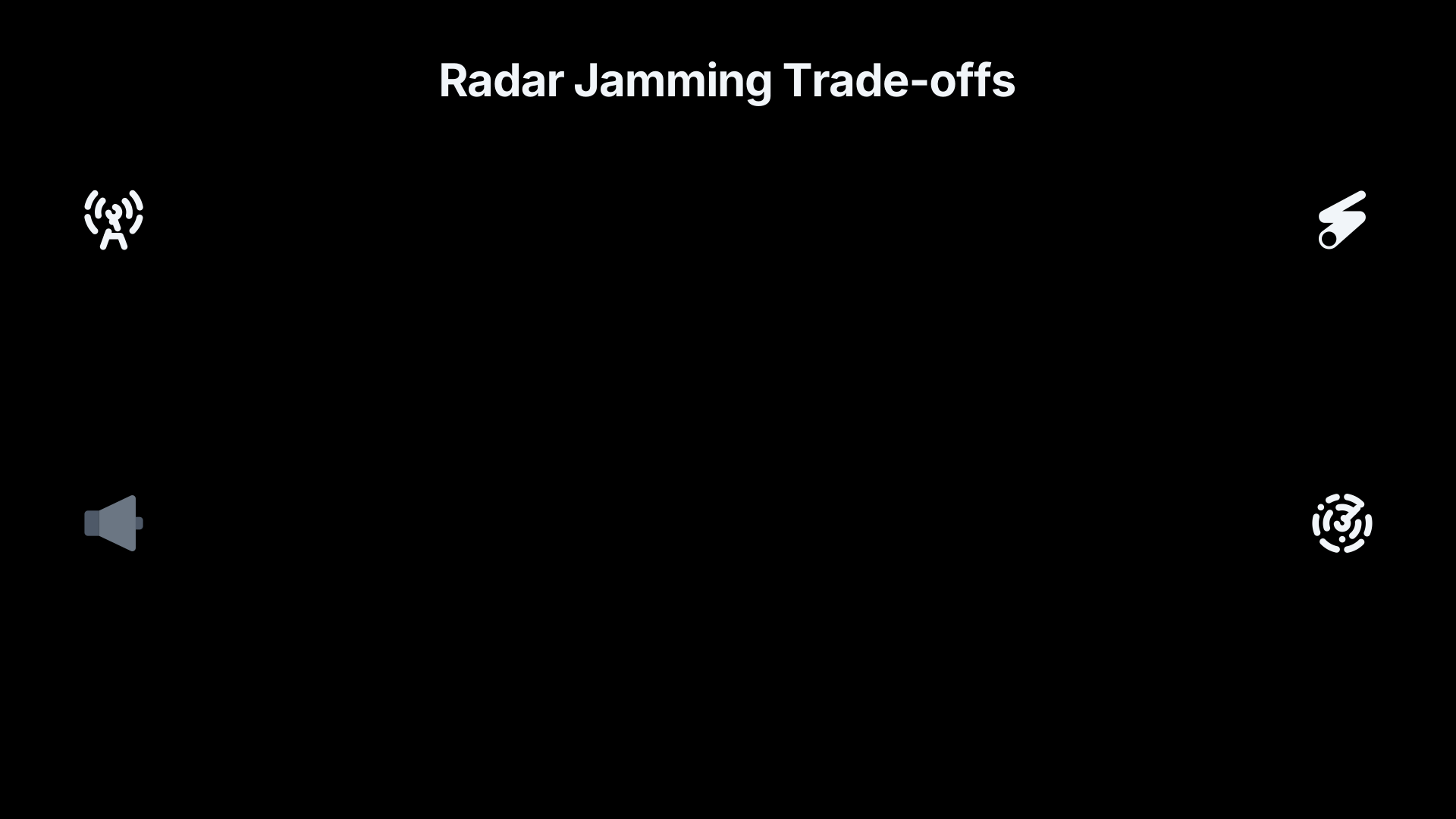
A common misunderstanding is that radar jamming is mainly a contest of power: if the jammer is strong enough, the radar is blinded; if not, it survives. Exploitation is more subtle. It can reveal whether the radar is vulnerable to deception, whether it rejects false targets, whether its sidelobe suppression works as intended, whether its automatic gain controls can be manipulated, and whether its operators are forced into slower or more predictable procedures.
Deception jamming is especially revealing because it attacks the radar’s assumptions. A 2025 survey of anti-deception jamming describes deceptive techniques as interfering with radar search, acquisition and tracking by introducing false information, including false targets that overload processing or pull attention away from the physical target.[arXiv]arxiv.orgOpen source on arxiv.org. A captured radar allows testers to try these techniques repeatedly and record which false returns are ignored, which are accepted, and which force the radar into an identifiable defensive mode.
Historical radar countermeasures show the same pattern. Angle deception against conical-scanning radars worked because it exploited the way those radars inferred target position; it could make a radar “walk” away from the true target. That technique became less useful against monopulse radars, which were adopted partly because they reduced that specific vulnerability.[Wikipedia]WikipediaAngle deception jammingAngle deception jamming The exploitation value lies in discovering which family of assumptions a particular radar belongs to, rather than treating all radars as equally vulnerable to the same jammer.
Noise jamming still matters, but it is not just a question of whether a radar display fills with noise. Barrage and spot jamming illustrate tradeoffs: spreading power across many frequencies can cover more emitters but reduces energy at any one frequency, while narrow jamming can be more efficient but requires better knowledge of the target radar.[Wikipedia]WikipediaBarrage jammingBarrage jamming A captured radar helps convert that tradeoff from guesswork into measured tactics: which frequencies, bandwidths, timing patterns and angles produce the most disruption for the least exposure.
Tracking limits are often tactical, not just technical
A radar’s inability may appear as a tactical limitation rather than a broken component. It may be able to detect a target but not maintain a fire-control-quality track. It may track one target well but struggle when several returns cross, split or appear in rapid sequence. It may work cleanly in a lab and then degrade in terrain, clutter, weather or a dense emitter environment.
That distinction is important for foreign materiel exploitation. The question is not simply whether the radar functions. It is whether it can support the operational job claimed for it: early warning, target acquisition, missile guidance, counter-battery location or air-defence command. Radar warning receivers and electronic-support systems benefit from knowing these transitions because the aircraft’s response may depend on whether an emitter is merely searching or has entered a more dangerous track or weapon-support behaviour. Commercial RWR descriptions reflect this operational purpose: they are designed to detect and identify radar threats and provide timely warning for survivability.[BAE Systems]baesystems.comBAE Systems AN/ALR-56 Radar Warning Receivers (RWRBAE Systems AN/ALR-56 Radar Warning Receivers (RWR
Testing can also show when the radar pays a price for protecting itself. A system that changes waveform, narrows a beam, increases dwell time or alters scan rate may become harder to jam in one respect but less useful in another. For example, spending more time on one sector can improve local track quality while reducing the rate at which other sectors are revisited. Exploitation therefore looks for the practical bargain hidden inside the design: what the radar gives up when it tries not to fail.
This is where “cannot do” becomes a dataset rather than a vague weakness. Analysts want repeatable boundaries: target speed ranges, altitude bands, approach angles, clutter conditions, jamming-to-signal ratios, false-target densities, mode-transition delays and reacquisition times. Some of those values may never be public, but the structure of the problem is visible in open radar and EW research: modern systems must classify emitters, manage incomplete data, resist unknown jamming and maintain tracks in interference-heavy environments.[electricajournal.org]electricajournal.orgCognitive Electronic Warfare Application to EmitterCognitive Electronic Warfare Application to Emitter
Turning radar limits into tactics
The practical output of exploitation is not a trophy report. It is a set of choices for operators, mission planners and electronic-warfare reprogramming teams. If a radar has a blind sector, planners may route around it. If it loses track under a particular kind of manoeuvre or clutter, crews may time an approach to exploit that condition. If it becomes more identifiable when it switches to a defensive mode, RWR libraries can be updated to warn crews that the radar is under stress or escalating.
The modern mission-data system exists for that reason. Official US guidance describes EW reprogramming as an integrated process that changes reprogrammable EW equipment, software, tactics and settings, and describes the EWIRDB as a primary source for mission and reprogramming data.[E-Publishing]static.e-publishing.af.milJune 2, 2021 — 2 Jun 2021 — EWIRDB—electronic warfare integrated reprogramming database. FLDCOM… parametric and performance data on no… In plain terms, exploitation evidence has to move from the lab into aircraft, ships, ground systems and training so that it changes behaviour before combat.
The same finding can support several tactical outputs:
- Threat-library refinement: if the radar emits a distinctive pattern when losing lock or entering an anti-jam mode, that pattern can become a warning cue.
- Countermeasure selection: if noise jamming is inefficient but deception works against a specific tracking method, crews can avoid wasting power on the wrong technique.
- Route and altitude planning: if detection is weak at certain look angles, terrain relationships or low-altitude conditions, planners can exploit those boundaries without assuming the radar is generally ineffective.
- Saturation tactics: if a radar or radar-controlled system can handle only a limited number of useful tracks, planners may concentrate activity to exceed that practical capacity.
- Training realism: if crews know what a radar looks like when it is confused, tracking, searching or recovering, they are less likely to misread a warning in flight.
This is why exploitation findings must be treated carefully. A radar that fails in one laboratory configuration may perform better after software updates, operator adaptation, networked cueing or integration with other sensors. Conversely, a radar that performs well in a clean test may underperform in a dense electromagnetic environment. Good exploitation therefore avoids the easy conclusion that “the radar is weak” and instead states the conditional finding: weak against what, from which direction, under which settings, and with what tactical cost.
The weakness is the boundary line
The most useful exploitation result is often a boundary line. On one side, the radar detects, tracks, classifies and supports engagement. On the other, it hesitates, misclassifies, loses track, accepts deception or forces its operators into a less capable mode. That boundary may be narrow, conditional and hard to exploit, but it is more valuable than a broad claim about range or power.
Radar exploitation and electronic signatures therefore belong together. The signature tells friendly systems what the radar is doing; exploitation of limits tells them what the radar may be unable to do next. In the wider practice of reverse engineering foreign military technology, that is the deeper intelligence gain: not merely copying the adversary’s design, but learning where the design’s promises end.
Amazon book picks
Further Reading
Books and field guides related to The Weaknesses a Radar Cannot Hide. Use these as the next step if you want deeper reading beyond the article.
Introduction to Airborne Radar
Explains radar performance constraints such as clutter, geometry, beamwidth and detection tradeoffs.
Principles of Modern Radar
Gives rigorous grounding in radar detection, signal processing and performance limits.
Radar Principles
Explains the theory behind detection thresholds, resolution, clutter and radar limitations.
Radar Handbook
Covers radar performance, detection limits, antennas, clutter and electronic countermeasures.
eBay marketplace picks
Marketplace Samples
Live-tested eBay searches with available results related to this page.


Endnotes
1.
Source: academia.edu
Link:https://www.academia.edu/33812260/Introduction_to_Radar_Warning_Receivers
2.
Source: Wikipedia
Title: Operation Biting
Link:https://en.wikipedia.org/wiki/Operation_Biting
3.
Source: Wikipedia
Title: Carpet (jammer)
Link:https://en.wikipedia.org/wiki/Carpet_%28jammer%29
4.
Source: mdpi.com
Link:https://www.mdpi.com/2076-3417/15/13/7072
5.
Source: arxiv.org
Link:https://arxiv.org/pdf/2503.00285
6.
Source: Wikipedia
Title: Angle deception jamming
Link:https://en.wikipedia.org/wiki/Angle_deception_jamming
7.
Source: Wikipedia
Title: Barrage jamming
Link:https://en.wikipedia.org/wiki/Barrage_jamming
8.
Source: electricajournal.org
Title: Cognitive Electronic Warfare Application to Emitter
Link:https://www.electricajournal.org/index.php/pub/article/download/1264/1253
9.
Source: Wikipedia
Title: Radar jamming and deception
Link:https://en.wikipedia.org/wiki/Radar_jamming_and_deception
10.
Source: Wikipedia
Title: Radar warning receiver
Link:https://en.wikipedia.org/wiki/Radar_warning_receiver
11.
Source: youtube.com
Title: Every Type Of Electronic Warfare Explained
Link:https://www.youtube.com/watch?v=XDGMevjCubY
Source snippet
Electronic Warfare...
12.
Source: youtube.com
Title: Electronic Warfare
Link:https://www.youtube.com/watch?v=V0DJnecWJ6I
13.
Source: static.e-publishing.af.mil
Link:https://static.e-publishing.af.mil/production/1/af_a5/publication/dafman10-703/dafman10-703.pdf
Source snippet
June 2, 2021 — 2 Jun 2021 — EWIRDB—electronic warfare integrated reprogramming database. FLDCOM... parametric and performance data on no...
Published: June 2, 2021
14.
Source: thetimes.co.uk
Title: The Times Operation Biting: the daring raid to steal Hitler’s radar
Link:https://www.thetimes.co.uk/article/operation-biting-second-world-war-max-hastings-l93tzdljt
15.
Source: ietresearch.onlinelibrary.wiley.com
Link:https://ietresearch.onlinelibrary.wiley.com/doi/full/10.1049/rsn2.12614
16.
Source: baesystems.com
Title: BAE Systems AN/ALR-56 Radar Warning Receivers (RWR)
Link:https://www.baesystems.com/en/product/an-alr-56-radar-warning-receivers
17.
Source: scholar.hit.edu.cn
Title: multi task open set radar jamming recognition based on convolutio
Link:https://scholar.hit.edu.cn/en/publications/multi-task-open-set-radar-jamming-recognition-based-on-convolutio/
18.
Source: static.e-publishing.af.mil
Title: i10 703 minotafbsup
Link:https://static.e-publishing.af.mil/production/1/minotafb/publication/afi10-703_minotafbsup/afi10-703_minotafbsup.pdf
19.
Source: combinedops.com
Link:https://www.combinedops.com/Bruneval.htm
20.
Source: globalsecurity.org
Link:https://www.globalsecurity.org/intell/systems/ewirdb.htm
21.
Source: repository.neelain.edu.sd
Link:https://repository.neelain.edu.sd/bitstreams/8b11bf5c-2651-44f5-98cb-4f7b600911ef/download
Additional References
22.
Source: youtube.com
Link:https://www.youtube.com/watch?v=5RxRDtXk5o8
Source snippet
US Electronic Warfare Strategy | Explained...
23.
Source: jcs.mil
Title: CJCSI 3210.04B
Link:https://www.jcs.mil/Portals/36/[Documents
Source snippet
Joint Chiefs of Staffcjcsi 3210.04b16 Dec 2022 — The EWIRDB is the primary. Department of Defense-approved source for technical parametri...
24.
Source: researchgate.net
Link:https://www.researchgate.net/publication/291779944_Radar_Cross_Section_RCS_Measurements
25.
Source: researchgate.net
Link:https://www.researchgate.net/publication/398009719_Cognitive_Electronic_Warfare_Application_to_Emitter_Identification_Process_in_Airborne_Radar_Warning_Receiver_Systems
26.
Source: northropgrumman.com
Link:https://www.northropgrumman.com/what-we-do/mission-solutions/radars/an-apr-39-digital-radar-warning-receiver-family
27.
Source: indragroup.com
Link:https://www.indragroup.com/sites/default/files/indra_alr-400_rwr.pdf
28.
Source: normandybunkers.com
Link:https://www.normandybunkers.com/upper-normandy/bruneval-radar-site
29.
Source: upload.wikimedia.org
Link:https://upload.wikimedia.org/wikipedia/commons/4/49/Design_and_analysis_of_an_object-oriented_database_of_electronic_warfare_data_%28IA_designndnalysiso1094532145%29.pdf
30.
Source: beckassets.blob.core.windows.net
Link:https://beckassets.blob.core.windows.net/product/readingsample/662083/9780890065266_excerpt_001.pdf
31.
Source: srcinc.com
Link:https://www.srcinc.com/services/intel-analysis-and-production/ewirdb.html
Topic Tree