Within Recovery Teams
How Vietnam Turned Captured Gear Into a System
Vietnam showed that battlefield recovery only works when collection points, logistics channels and exploitation centres are organised together.
On this page
- Why ad hoc recovery was not enough
- Collection points at corps and division level
- Lessons for moving materiel without losing context
Page outline Jump by section
Introduction
The Vietnam War demonstrated that recovering foreign military equipment was not primarily a technical challenge. It was an organisational one. Captured weapons, radios, mines, ammunition, documents and support equipment only became useful intelligence when they moved through a structured system that preserved information about where they were found, how they were used, and what other items accompanied them. By the late 1960s, U.S. and South Vietnamese forces had built a formal captured materiel exploitation network centred on the Combined Materiel Exploitation Center (CMEC), supported by collection points, screening teams and logistics channels that connected the battlefield to specialist analysts.[Webdoc]webdoc.sub.gwdg.deChapter II: Combined Intelligence8 Jan 2003 — The Combined Materiel Exploitation Center was charged with collecting and exploiting…

For students of reverse engineering foreign military technology, Vietnam is important because it showed that technical exploitation begins long before engineers examine a device. The crucial step was creating a system that could move captured equipment from remote combat zones to exploitation facilities without losing the evidence needed to understand enemy capabilities.[Webdoc]webdoc.sub.gwdg.deChapter II: Combined Intelligence8 Jan 2003 — The Combined Materiel Exploitation Center was charged with collecting and exploiting…
Why Ad Hoc Recovery Was Not Enough
In the early stages of large-scale American involvement, technical intelligence in Vietnam was fragmented and often performed as an additional duty rather than as a dedicated mission. Captured enemy equipment might be examined locally, retained by units, cannibalised for parts, or simply lost within normal logistics flows. This made systematic exploitation difficult and limited the intelligence value that could be extracted from enemy materiel.[Webdoc]webdoc.sub.gwdg.deChapter II: Combined Intelligence8 Jan 2003 — The Combined Materiel Exploitation Center was charged with collecting and exploiting…
Military Assistance Command, Vietnam (MACV) therefore developed a formal captured materiel programme in cooperation with South Vietnamese forces. A June 1966 agreement established a combined exploitation system and led to the creation of the Combined Materiel Exploitation Center, formally activated near Tan Son Nhut in December 1966. Its mission was not merely to store captured equipment but to collect, analyse, evaluate and report on enemy materiel across all categories.[Scribd]scribd.comCommand History 1968 Volume II5) An agreement between the US and RVN ca~ling for a combined captured enemy materiel exploitation program was completed…Read more…
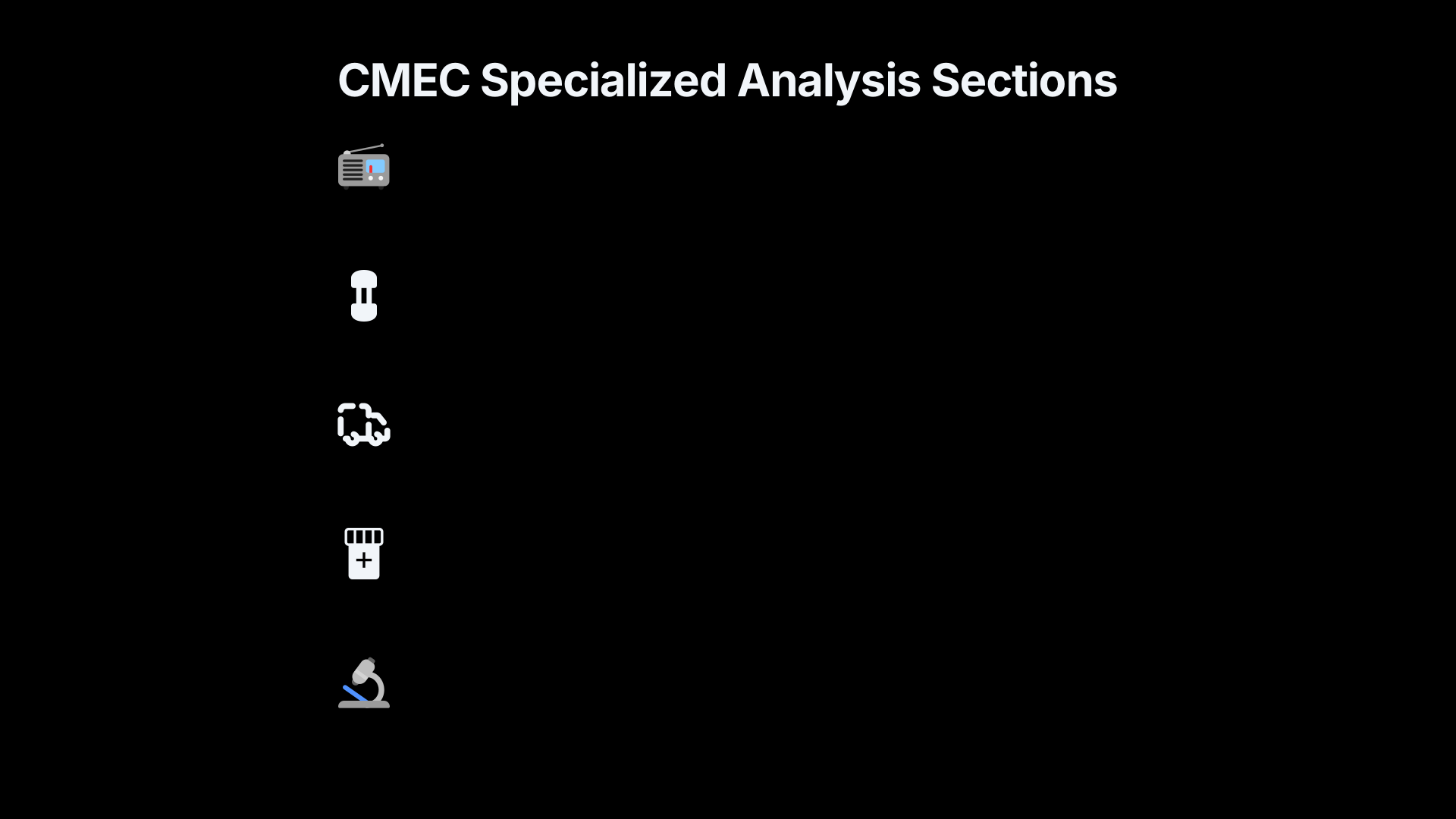
The centre incorporated specialised sections for communications equipment, weapons and munitions, mobility and engineer systems, medical supplies, general equipment, photography and laboratory analysis. This structure reflected an important lesson: intelligence value often depended on integrating findings from multiple technical disciplines rather than treating every captured item as an isolated object.[Webdoc]webdoc.sub.gwdg.deChapter II: Combined Intelligence8 Jan 2003 — The Combined Materiel Exploitation Center was charged with collecting and exploiting…
Collection Points at Corps and Division Level
The most distinctive feature of the Vietnam system was the network that connected battlefield recovery to the exploitation centre. Captured materiel was channelled through collecting points located within the support areas of the corps tactical zones. These sites served as controlled transfer hubs where equipment could be screened, documented and examined before further movement.[Webdoc]webdoc.sub.gwdg.deChapter II: Combined Intelligence8 Jan 2003 — The Combined Materiel Exploitation Center was charged with collecting and exploiting…
Division and separate brigade headquarters had limited exploitation responsibilities. Their primary task was to determine immediate tactical significance and ensure rapid evacuation of important items. Rather than conducting extensive analysis in the field, they pushed materiel into the larger exploitation network. This prevented scarce specialists from being dispersed across numerous tactical formations and concentrated expertise where it could be used most effectively.[Webdoc]webdoc.sub.gwdg.deChapter II: Combined Intelligence8 Jan 2003 — The Combined Materiel Exploitation Center was charged with collecting and exploiting…
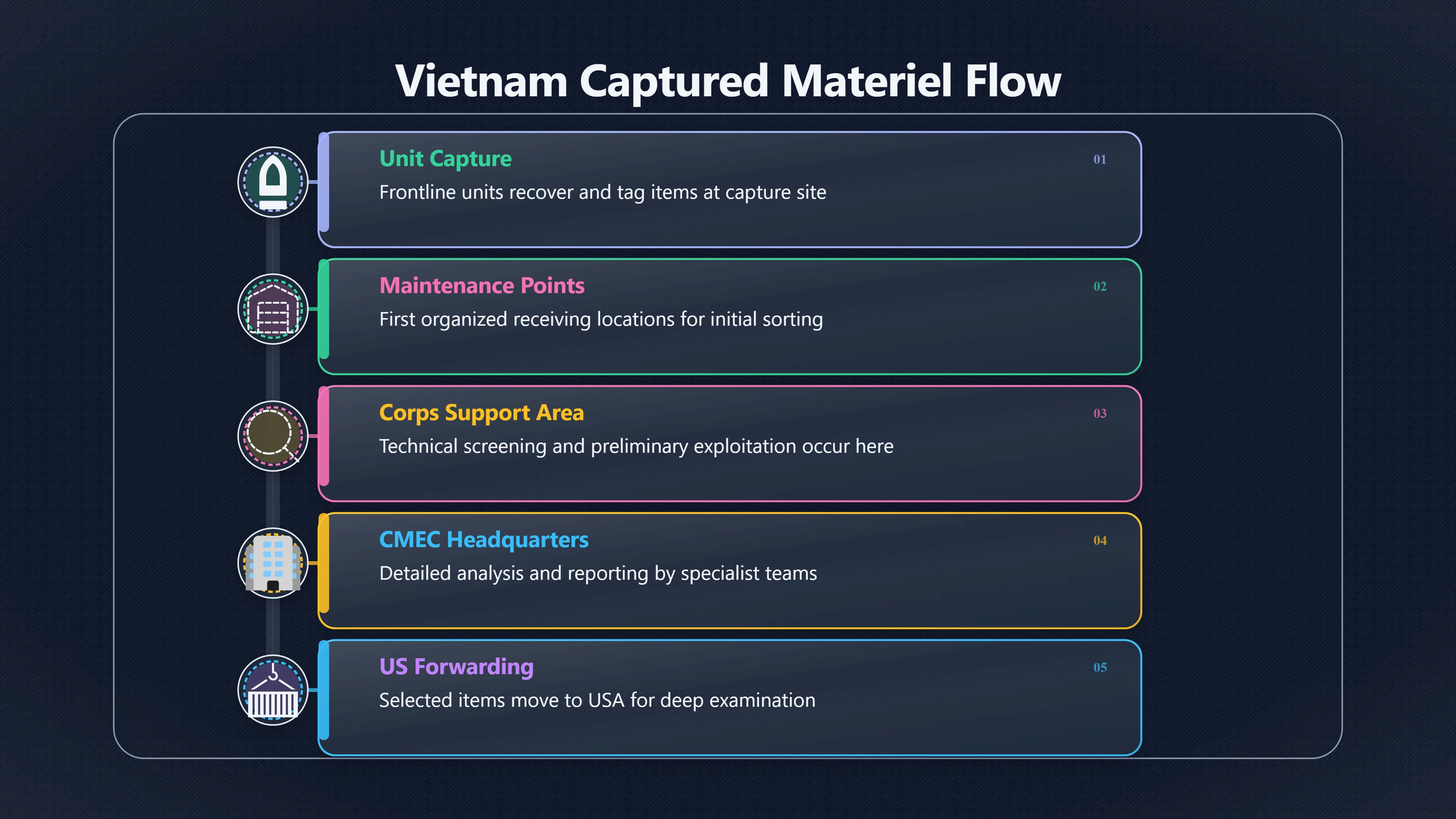
Several layers worked together:
- Capturing units recovered and tagged materiel at the point of capture.
- Maintenance collecting points acted as the first organised receiving locations.
- Corps support area collecting points provided technical screening and preliminary exploitation.
- CMEC headquarters conducted detailed analysis and reporting.
- Selected items were forwarded onward to the United States for deeper technical examination when required.[Webdoc]webdoc.sub.gwdg.deChapter II: Combined Intelligence8 Jan 2003 — The Combined Materiel Exploitation Center was charged with collecting and exploiting…
The system ensured that equipment moved through identifiable custody stages rather than disappearing into ordinary supply channels. This was particularly important for unusual weapons, newly observed ammunition types and communications equipment whose intelligence value might not be obvious to front-line units.[Webdoc]webdoc.sub.gwdg.deChapter II: Combined Intelligence8 Jan 2003 — The Combined Materiel Exploitation Center was charged with collecting and exploiting…
Field Coordination Teams as the Missing Link
Collection points alone could not solve the problem. Vietnam’s exploitation system therefore relied on field coordination teams that normally operated in corps and division support areas. These teams screened incoming materiel, identified items of intelligence interest and helped gathering units understand what should be preserved and evacuated.[Webdoc]webdoc.sub.gwdg.deChapter II: Combined Intelligence8 Jan 2003 — The Combined Materiel Exploitation Center was charged with collecting and exploiting…
Their role was significant because battlefield units often viewed captured equipment through operational rather than intelligence lenses. A radio might be seen as a useful trophy, a cache as a demolition target, or a weapon as a source of spare parts. Field teams acted as technical filters, ensuring that potentially important items reached analysts before disposal or reuse.[Webdoc]webdoc.sub.gwdg.deChapter II: Combined Intelligence8 Jan 2003 — The Combined Materiel Exploitation Center was charged with collecting and exploiting…
When particularly significant equipment was discovered, CMEC could dispatch specialised “go teams” to the field. These rapid-response groups performed on-site exploitation of large caches or items considered especially important. The arrangement allowed intelligence collection to occur even when immediate evacuation was impractical.[Webdoc]webdoc.sub.gwdg.deChapter II: Combined Intelligence8 Jan 2003 — The Combined Materiel Exploitation Center was charged with collecting and exploiting…
Preserving Context While Moving Materiel
A major challenge in reverse engineering is that hardware loses value when separated from its context. Vietnam’s procedures explicitly attempted to preserve that context throughout the evacuation process. Collection requirements identified categories of equipment that commanders should report immediately. Capturing units tagged materiel and transmitted information through intelligence channels while the physical item moved through logistics channels.[Webdoc]webdoc.sub.gwdg.deChapter II: Combined Intelligence8 Jan 2003 — The Combined Materiel Exploitation Center was charged with collecting and exploiting…
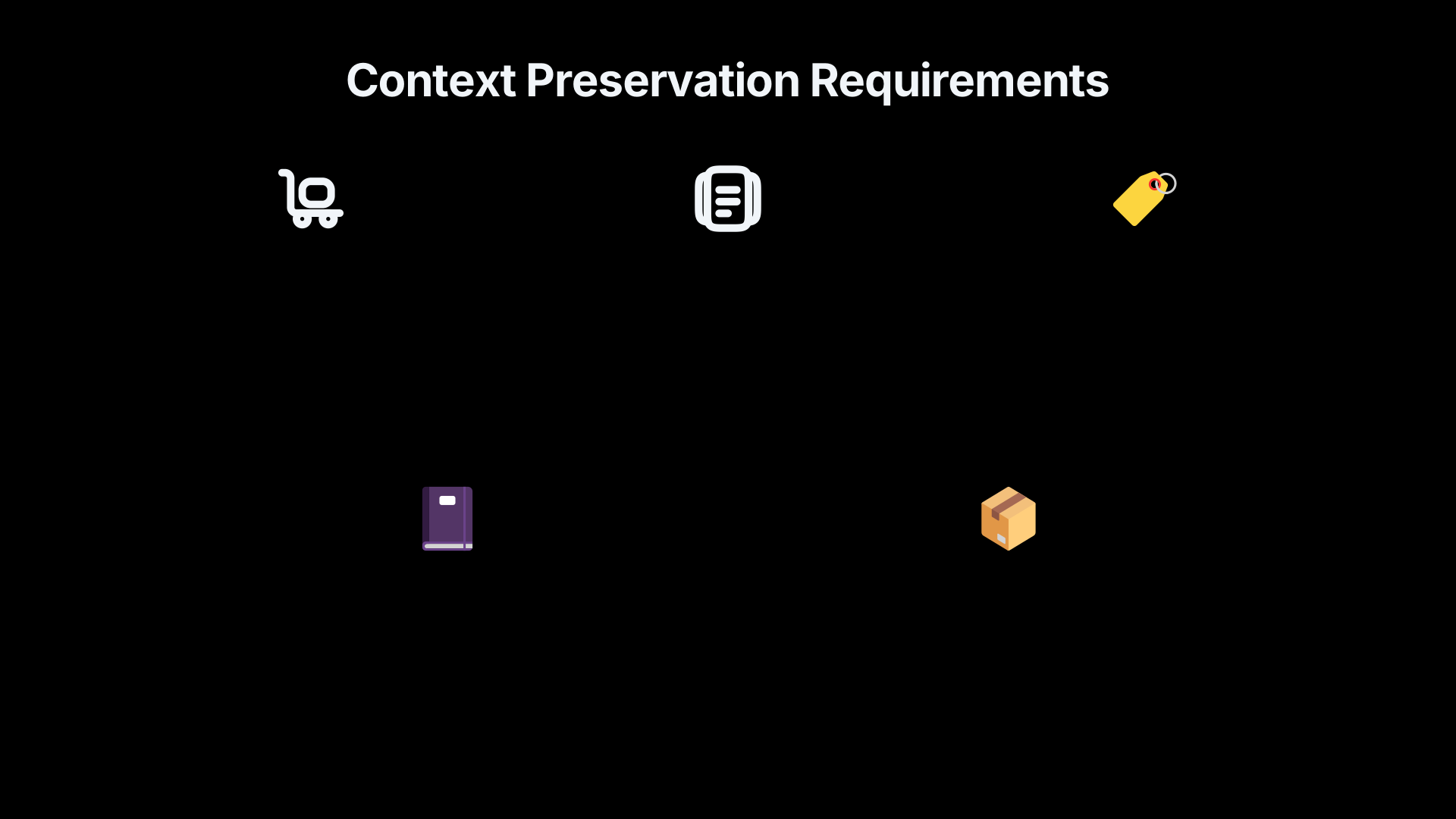
The system emphasised recording:
- Capture location.
- Associated documents.
- Serial numbers and markings.
- Tactical circumstances of recovery.
- Links to related equipment found in the same cache or position.[Webdoc]webdoc.sub.gwdg.deChapter II: Combined Intelligence8 Jan 2003 — The Combined Materiel Exploitation Center was charged with collecting and exploiting…
This approach recognised that a radio, mine or weapon could reveal far more when analysed alongside manuals, firing tables, packing slips, maintenance records or operational documents recovered at the same site. Significant items were therefore evacuated together with associated technical paperwork whenever possible.[Webdoc]webdoc.sub.gwdg.deChapter II: Combined Intelligence8 Jan 2003 — The Combined Materiel Exploitation Center was charged with collecting and exploiting…
The same logic appeared in other intelligence centres operating in Vietnam. The Combined Document Exploitation Center processed captured documents, while interrogation and intelligence-production centres integrated information from multiple sources. Captured materiel exploitation was thus embedded within a larger intelligence architecture rather than functioning as a standalone laboratory activity.[ttu.edu]vietnam.ttu.eduVietnam Tech UniversityCombined Document Exploitation Center (CDEC) CollectionThe Combined Document Exploitation Center was created by th…
Special Handling for Ammunition and Sensitive Equipment
Some categories of materiel required dedicated collection routes. Ammunition, explosives and mines could not simply be moved through ordinary channels. Explosive ordnance disposal teams first inspected caches and declared items safe for handling. Unsafe items were destroyed, while safe items moved to designated ammunition facilities where screening and preliminary exploitation occurred before selected examples were forwarded to CMEC.[Webdoc]webdoc.sub.gwdg.deChapter II: Combined Intelligence8 Jan 2003 — The Combined Materiel Exploitation Center was charged with collecting and exploiting…
Communications and electronic equipment received similarly careful treatment. Such items were screened under specific directives before being evacuated to corps collecting points for technical examination. This process reflected their high intelligence value, since radios, signalling equipment and related devices could reveal enemy communications methods, production standards and operational practices.[Webdoc]webdoc.sub.gwdg.deChapter II: Combined Intelligence8 Jan 2003 — The Combined Materiel Exploitation Center was charged with collecting and exploiting…
The handling procedures reveal an important principle of technical intelligence: different technologies require different recovery pathways. A captured rifle, a radio set and an ammunition cache might all originate from the same battlefield, but each demanded a distinct chain of custody and exploitation process.[Webdoc]webdoc.sub.gwdg.deChapter II: Combined Intelligence8 Jan 2003 — The Combined Materiel Exploitation Center was charged with collecting and exploiting…
Lessons for Moving Materiel Without Losing Context
Vietnam’s captured materiel system showed that successful exploitation depends on linking recovery, logistics and analysis into a single process. The most important innovation was not a laboratory technique or engineering method. It was the creation of organised collection points and evacuation procedures that preserved the relationship between an item and the circumstances of its capture.[Webdoc]webdoc.sub.gwdg.deChapter II: Combined Intelligence8 Jan 2003 — The Combined Materiel Exploitation Center was charged with collecting and exploiting…
Three enduring lessons emerged:
Recovery must be integrated with logistics. Valuable equipment cannot be exploited if there is no reliable route from the battlefield to technical specialists. Vietnam relied heavily on existing support organisations and backhaul transportation to move materiel through the system.[Webdoc]webdoc.sub.gwdg.deChapter II: Combined Intelligence8 Jan 2003 — The Combined Materiel Exploitation Center was charged with collecting and exploiting…
Collection points are intelligence filters. Corps and division support-area collection sites prevented important equipment from being lost among routine battlefield debris. Screening teams identified what deserved detailed examination and what could be released or disposed of.[Webdoc]webdoc.sub.gwdg.deChapter II: Combined Intelligence8 Jan 2003 — The Combined Materiel Exploitation Center was charged with collecting and exploiting…
Context is often more valuable than the object itself. Capture reports, associated documents, location data and linked equipment frequently provided insights that pure hardware analysis could not. The Vietnam system explicitly sought to preserve these connections throughout the exploitation chain.[Webdoc]webdoc.sub.gwdg.deChapter II: Combined Intelligence8 Jan 2003 — The Combined Materiel Exploitation Center was charged with collecting and exploiting…
For later technical intelligence and reverse-engineering programmes, Vietnam provided a practical model: battlefield recovery succeeds when collection points, transportation channels, screening teams and exploitation centres operate as parts of one coordinated system rather than as separate activities.[Webdoc]webdoc.sub.gwdg.deChapter II: Combined Intelligence8 Jan 2003 — The Combined Materiel Exploitation Center was charged with collecting and exploiting…
Amazon book picks
Further Reading
Books and field guides related to How Vietnam Turned Captured Gear Into a System. Use these as the next step if you want deeper reading beyond the article.
About Face
Offers operational insight into military systems and battlefield processes.
Vietnam: an Epic Tragedy: 1945-1975
Explains the environment in which captured-materiel systems developed.
eBay marketplace picks
Marketplace Samples
Live-tested eBay searches with available results related to this page.



Endnotes
1.
Source: scribd.com
Title: Command History 1968 Volume II
Link:https://www.scribd.com/document/81653556/Command-History-1968-Volume-II
Source snippet
(5) An agreement between the US and RVN ca~ling for a combined captured enemy materiel exploitation program was completed...Read more...
2.
Source: lexisnexis.com
Title: Lexis Nexis MILITARY ASSISTANCE COMMAND VIETNAM Part 2
Link:https://www.lexisnexis.com/documents/academic/upa_cis/3210_recsmacvpt2.pdf
Source snippet
Classified...A Combined Materiel Exploitation Center examined and reported upon new and... The studies produced by the RA Branch were c...
3.
Source: lexisnexis.com
Link:https://www.lexisnexis.com/documents/academic/upa_cis/3208_recsmacvpt1.pdf
4.
Source: webdoc.sub.gwdg.de
Link:https://webdoc.sub.gwdg.de/ebook/p/2005/CMH_2/www.army.mil/cmh-pg/books/vietnam/mi/ch02.htm
Source snippet
Chapter II: Combined Intelligence8 Jan 2003 — The Combined Materiel Exploitation Center was charged with collecting and exploiting...
5.
Source: history.army.mil
Link:https://history.army.mil/portals/143/Images/Publications/catalog/90-19.pdf
Source snippet
army.mil[PDF] 1965-1967 - U.S. Army Center of Military Historycombined center. The prompt evacuation of significant items of captured mat...
6.
Source: vietnam.ttu.edu
Link:https://www.vietnam.ttu.edu/resources/cdec/
Source snippet
Vietnam Tech UniversityCombined Document Exploitation Center (CDEC) CollectionThe Combined Document Exploitation Center was created by th...
7.
Source: army.mil
Title: intelligence force had role in vietnam conflict
Link:https://www.army.mil/article/143996/intelligence_force_had_role_in_vietnam_conflict
Source snippet
Exploitation Center, Combined Materiel Exploitation Center, Combined Military Interrogation Center, and the Combined Intelligence Center...
8.
Source: edmoise.sites.clemson.edu
Link:https://edmoise.sites.clemson.edu/cdec.html
Source snippet
clemson.eduMoïse's Bibliography: CDECThe Combined Document Exploitation Center (CDEC) was established in 1966 as the main repository of c...
Additional References
9.
Source: asalives.org
Link:https://www.asalives.org/ASAONLINE/miopsvn.htm
Source snippet
Military Intelligence in VietnamAuthorized strength was over 300. The Combined Material Exploitation Center (CMEC) was charged with colle...
10.
Source: pdf.textfiles.com
Link:https://pdf.textfiles.com/manuals/MILITARY/united_states_army_fm_4-30x13%20-%201_march_2001%20-%20part04.pdf
Source snippet
Textfiles PDFCaptured Enemy AmmunitionVIETNAM WAR. 12-4. During the Vietnam War, the Captured Materiel Exploitation. Center was establish...
11.
Source: dvidshub.net
Title: combined military interrogation center established saigon 27 sep 1965
Link:https://www.dvidshub.net/news/481446/combined-military-interrogation-center-established-saigon-27-sep-1965
Source snippet
combined centers for document exploitation, materiel exploitation, and interrogations.... centers in each division and corps area as wel...
12.
Source: archives.gov
Link:https://www.archives.gov/publications/ref-info-papers/90/part-2.html
Source snippet
from the Vietnam War Era, 1960-1994...
13.
Source: youtube.com
Title: Why MACV-SOG Never Found the Pipeline that Fueled North Vietnam’s Victory
Link:https://www.youtube.com/watch?v=4fpy02C3LX4
Source snippet
Behind the Piles - Captured Viet Cong Weapons & Propaganda...
14.
Source: bits.de
Title: fm2 22.401(06)
Link:https://www.bits.de/NRANEU/others/amd-us-archive/fm2-22.401%2806%29.pdf
Source snippet
[PDF] TECHINT: Multi-Service Tactics, Techniques, and Procedures for...June 9, 2006 — TECHINT includes the identification, assessment, c...
Published: June 9, 2006
15.
Source: youtube.com
Title: Every Weapon MACV SOG Used in Vietnam Jungle
Link:https://www.youtube.com/watch?v=Hq0x7gYDBmw
Source snippet
Why MACV-SOG Never Found the Pipeline that Fueled North Vietnam's Victory...
16.
Source: facebook.com
Link:https://www.facebook.com/groups/Namwarnow/posts/3976953005910268/
Source snippet
Army uncovers North Vietnamese intelligence operationDecember 19, 2024 — Veterans (from left) Tom Kemper, Gene Richert and Lee Bishop tal...
Published: December 19, 2024
17.
Source: irp.fas.org
Link:https://irp.fas.org/doddir/army/fm34-37/Ch8.htm
Source snippet
Above Corps Battlefield Technical IntelligenceTypical items historically exploited are enemy river crossing systems, amphibious equipment...
18.
Source: youtube.com
Title: Inside Task Force Alpha: Vietnam’s Secret Tech Hub
Link:https://www.youtube.com/watch?v=sW7fD06GqJo
Source snippet
Task Force Alpha: Vietnam's Secret Tech Revolution...
Topic Tree