Within Foreign Materiel
When a Replica Is Good Enough
Sometimes the goal is not to own the enemy weapon but to build a credible stand-in for testing and training.
On this page
- Threat simulators
- Replica radars and vehicles
- Accuracy versus cost
Page outline Jump by section
Introduction
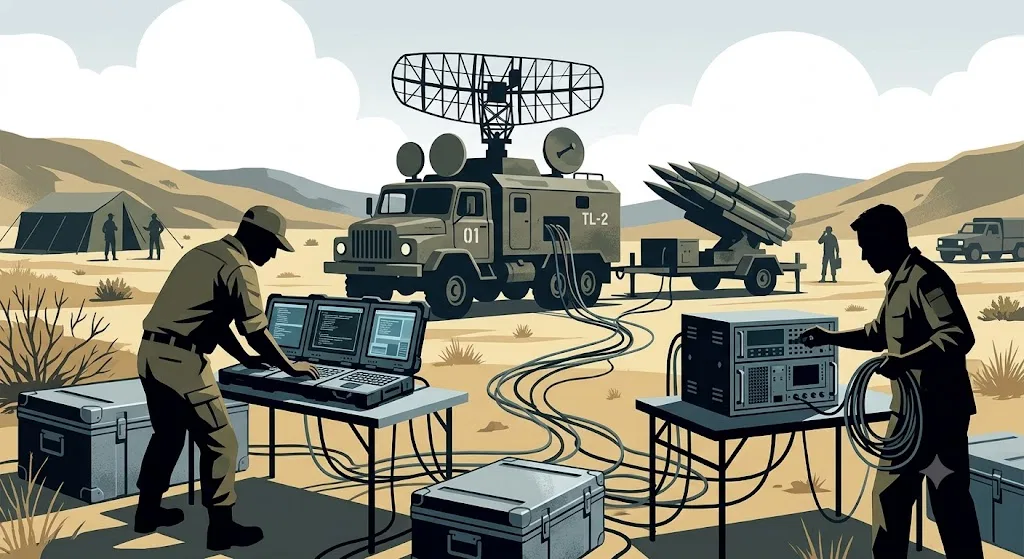
A realistic threat replica is a deliberately “good enough” stand-in for an adversary system: a radar emitter that makes an aircraft’s warning receiver behave as if a hostile surface-to-air missile battery were nearby, a visually modified vehicle that looks like a foreign armoured carrier at training distance, or a digital model that lets crews rehearse against threats too scarce, secret, expensive or dangerous to use routinely. Within reverse engineering foreign military technology, replicas and simulators are a practical end point: the aim is not always to own or clone the enemy weapon, but to reproduce the signatures, behaviours and tactical cues that matter for testing and training.
That distinction is important. Captured or exploited equipment may reveal frequencies, scan patterns, silhouettes, heat signatures, vehicle layouts, crew procedures or failure modes. Militaries then decide which of those traits must be reproduced physically, electronically or digitally. US Department of Defense audit work has explicitly treated foreign materiel exploitation as support for “threat simulator and target development, modelling and simulation, and training and tactics”, not just intelligence reporting.[U.S. Department of War]media.defense.govU.S. Department of War Use of Foreign Materiel Exploitation ResultsU.S. Department of War Use of Foreign Materiel Exploitation Results(https://media.defense.gov/1997/Oct/08/2001715489/-1/-1/1/98-005.pdf)
Why a stand-in can be more useful than the real thing
The original foreign system is often the best source of truth, but it is rarely the best training tool. A captured radar may be too few in number, too fragile, unsafe to radiate routinely, difficult to maintain, or politically sensitive to expose on an open range. A replica can be built to survive repeated use, moved between exercises, updated with new threat files and instrumented to record exactly how trainees responded.
That is why threat replication usually starts by asking what the trainee or test system must perceive. An aircrew does not need to see every internal circuit in an enemy radar; its aircraft may need to detect the correct radio-frequency emissions, classify the threat, receive realistic launch or tracking indications, and practise countermeasures under pressure. A gunner, drone operator or reconnaissance platoon may need a target that looks, moves and reflects radar or heat in the right way, even if its engine, armour and internal architecture are entirely domestic.
The logic appears clearly in US test and evaluation infrastructure. The Director, Operational Test and Evaluation describes high-power and portable range threat simulators as ruggedised, deployable, ground-based radio-frequency systems designed to emulate threat radar signals in free space, including full-threat modulations and simultaneous engagement scenarios. The same official description gives their frequency coverage: HPRTS from 4 to 18 gigahertz and the smaller PRTS from 2 to 18 gigahertz.[Dote]dote.osd.milWarfighter Training…
Threat simulators: copying the signal, not the weapon
The most important replicas in air warfare are often invisible to the public: electronic emitters that imitate hostile radar behaviour. These systems are not mere noise generators. A useful radar threat simulator must imitate enough of the adversary’s search, acquisition, tracking and engagement sequence to trigger real aircraft sensors and force realistic decisions from the crew.
Modern examples show the layers involved. The Georgia Tech Research Institute describes the Advanced Radar Threat System Variant 1 as a 142-ton threat simulator that lets aircrews see how radars used to guide hostile surface-to-air missiles interact with warning systems on their aircraft.[Georgia Tech Research Institute]gtri.gatech.eduOpen source on gatech.edu. Northrop Grumman’s Joint Threat Emitter is described as a mobile, reprogrammable, multi-threat system for training pilots against current and emerging radio-frequency threats.[Northrop Grumman]northropgrumman.comNorthrop Grumman Joint Threat Emitter (JTE) | Northrop GrummanNorthrop Grumman Joint Threat Emitter (JTE) | Northrop Grumman These are not captured missile batteries parked on a range; they are engineered representations of the threat’s electronic behaviour.
For the pilot, the meaningful replica is the one that makes cockpit systems and human instincts respond correctly. The simulator needs to reproduce such things as pulse characteristics, scan timing, tracking logic, engagement cues, antenna behaviour and the way a threat changes state during an encounter. When those features are wrong, crews may learn the wrong timing for evasive manoeuvres, misjudge the value of jamming, or become overconfident about warning receiver indications.
The same principle extends beyond fixed training ranges. NATO-linked exercises have used mobile radar threat simulation to give fighter pilots a more realistic air-defence environment; Eviden says its ARPEGE surface-to-air radar threat simulation system, based on Mobile Radar Threat Simulator technology, was central to a NATO Tactical Leadership Program exercise at Los Llanos Air Base in Spain.[Eviden]eviden.comOpen source on eviden.com. The value lies in repeatability: the threat can be presented again and again, varied across scenarios, and inserted into allied exercises without relying on scarce original hardware.
Replica radars and vehicles
Not every threat representation is electronic. Ground forces need to recognise, track and engage adversary-like targets in daylight, thermal imagery, radar, drone video and weapons sights. A vehicle can therefore be “realistic” in several different ways at once: visual shape, size, movement, radar return, heat pattern, acoustic profile and tactical behaviour.
The US Army’s opposing-force surrogate vehicles are a clear example of practical compromise. Anniston Army Depot reported overhauling M113A3/BMP-2 Opposing Forces Surrogate Vehicles and M113A3 main battle tank surrogates; from 1,000 metres away, the depot said, they look like Russian combat vehicles, while remaining US-built underneath.[Defense Logistics Agency]dla.milANAD teamwork ensures completion of OSVs > Defense Logistics Agency > News Article View… That distance qualifier matters. These are not perfect copies for museum inspection. They are training tools designed to create the right recognition and engagement problem for soldiers at battlefield-relevant ranges.
The same idea appears in smaller visual modification kits. In a US Army account of Fort Benning training, opposing-force personnel used uniforms, visually modified vehicles, weapons and equipment to replicate a complex threat environment; one kit altered a Humvee profile to simulate a BRDM reconnaissance vehicle.[Army]army.milOpen source on army.mil. The purpose is not industrial piracy. It is to make friendly troops practise against shapes, tactics and cues they might otherwise encounter only in slide decks.
Testing ranges also build targets for sensors rather than for human eyesight alone. The US Army’s Yuma Proving Ground notes that munitions, artillery and aircraft testing all need targets, and that aircraft and drones need targets to test radar functionality.[Army]army.milOpen source on army.mil. In that setting, a replica may be judged less by whether it “looks right” to a visitor and more by whether a radar, seeker, fire-control system or drone payload responds to it as expected.
What reverse engineering contributes
Reverse engineering helps decide which features of the foreign system deserve replication. A captured radar may reveal signal parameters. A recovered missile seeker may show what decoys it is likely to reject. A damaged armoured vehicle may reveal thermal hotspots, construction materials or sensor placement. A photographed or bought foreign vehicle may be enough to design visual modification kits for recognition training, while deeper physical exploitation may be needed to reproduce radar or infrared signatures.
The output is often a threat library rather than a copied object. Engineers and intelligence analysts turn measurements into emitter files, target signatures, digital models, training scenarios, red-force vehicle kits, range instrumentation and test plans. In US Army operational-environment work, the opposing-forces modelling and simulation function defines technical requirements for replicating threat capabilities across analysis, acquisition and training communities, including digital environments such as OneSAF and the Joint Land Component Constructive Training Capability.[oe.t2com.army.mil]oe.t2com.army.milOPFO R | Opposing Forces Program | T2COM G2 Operational Environment EnterpriseOPFO R | Opposing Forces Program | T2COM G2 Operational Environment Enterprise
This is where “replica” becomes broader than a physical mock-up. A foreign tank can be represented by a surrogate vehicle at a training centre, a radar or thermal target on a range, a digital entity in a constructive simulation, and a set of tactics used by an opposing-force unit. Each representation is partial, but together they can give soldiers and engineers a much richer adversary model than a static captured specimen would.
Accuracy versus cost
The central implementation choice is not “real or fake”; it is how much realism is worth paying for. A replica that is accurate in every dimension may become too costly, scarce or maintenance-heavy to support frequent training. A cheap visual mock-up may be good enough for recognition drills but useless for testing radar warning receivers. A portable emitter may be excellent for ground checks but inadequate for full-range flight training against a dense integrated air-defence scenario.
The trade-offs usually fall into four categories:
- Signal fidelity: Does the simulator reproduce the radar, infrared, optical or acoustic cues that the system under test actually uses?
- Behavioural fidelity: Does it act like the threat tactically, including search, tracking, engagement, movement, shutdown, deception and coordination with other systems?
- Physical fidelity: Does it look, move, heat up and reflect energy like the real target at relevant ranges and angles?
- Training practicality: Can it be maintained, transported, reset, instrumented and used often enough to change performance?
The US Department of Defense has wrestled with the cost side for decades. A 1992 Inspector General report found that separate military departments were developing electronic-warfare threat simulator programmes that duplicated advanced threat signals; the report said more than $194 million had been programmed across four systems including replications of the same advanced threat signals.[U.S. Department of War]media.defense.govU.S. Department of War Use of Foreign Materiel Exploitation ResultsU.S. Department of War Use of Foreign Materiel Exploitation Results(https://media.defense.gov/1992/Jul/15/2001714601/-1/-1/1/92-125.pdf) The lesson is still relevant: once the hard work is abstracted into signal models, emitter behaviours or digital threat files, duplication can be wasteful unless services coordinate what is being represented and why.
But too much standardisation can also be limiting. The Army, Navy and Air Force may need different versions of the same threat because their training problems differ. A ground force may care about visual replication of a radar vehicle at short range and mobility during manoeuvre. An air force may care more about high-power emissions, dense range scenarios and the exact way aircraft survivability equipment reacts. The correct replica depends on the operational question.
Why simulators are becoming more important
Several trends make threat replicas more valuable. First, modern weapons are sensor-driven. Training against a silhouette alone is no longer enough when aircraft, missiles, drones and armoured vehicles are making decisions through radar, infrared, electro-optical sensors, electronic support measures and software classifiers. The replica must increasingly satisfy machines as well as people.
Second, many advanced threats cannot be safely or legally reproduced in their original form on open ranges. Dense air-defence networks, long-range missiles, anti-satellite effects, cyber-electromagnetic interactions and high-power emitters can exceed what a physical training area can host. The US National Academies, discussing test and evaluation challenges, notes that joint simulation environments are intended to provide more realistic and denser threat environments than physical test ranges can create, including threats too dangerous to reproduce in the real world.[National Academies]nationalacademies.orgOpen source on nationalacademies.org.
Third, the pace of adversary change favours reprogrammable stand-ins. A captured system may show what one version did at one moment. A simulator can be updated as intelligence changes, letting training ranges represent new modes, new tactics or blended threats without rebuilding the entire hardware base. That is one reason modern emitter systems are marketed and procured around mobility, reprogrammability and multi-threat representation rather than one-for-one copying.
The risk of false realism
The danger of replicas is that they can look convincing while teaching the wrong lesson. A radar simulator that emits the right frequency but reacts too slowly may train aircrews to delay countermeasures. A vehicle surrogate that has the right silhouette but not the right thermal profile may mislead sensor testing. A digital threat model built from thin intelligence may make an exercise appear rigorous while hiding uncertainty.
This is why the best threat-replication programmes treat a replica as a hypothesis that needs validation. Foreign materiel exploitation supplies measurements; test ranges compare simulator outputs with known behaviour; operators report whether the scenario drives realistic decisions; and intelligence updates the model as new evidence appears. The goal is not theatrical resemblance. It is controlled realism: enough fidelity in the variables that matter, enough transparency about what is approximate, and enough repetition to improve combat readiness without pretending the stand-in is the enemy system itself.
Realistic threat replicas therefore occupy a middle ground in reverse engineering foreign military technology. They are not simple copies, and they are not imaginary training props. They are engineered translations of adversary equipment into usable training and test environments, built around the practical question every range, lab and opposing-force unit must answer: which parts of the threat must be real for this decision to matter?
Amazon book picks
Further Reading
Books and field guides related to When a Replica Is Good Enough. Use these as the next step if you want deeper reading beyond the article.
The Kill Chain
Discusses realistic threat representation and modern military adaptation.

The Pentagon's Brain: An Uncensored History of DARPA, America...
Explores military innovation, modeling and experimentation.
eBay marketplace picks
Marketplace Samples
Live-tested eBay searches with available results related to this page.




Endnotes
1.
Source: media.defense.gov
Title: U.S. Department of War Use of Foreign Materiel Exploitation Results
Link:https://media.defense.gov/1997/Oct/08/2001715489/-1/-1/1/98-005.pdf
2.
Source: dote.osd.mil
Link:https://www.dote.osd.mil/About/Organization/CCM/Warfighter-Training/
Source snippet
Warfighter Training...
3.
Source: eviden.com
Link:https://eviden.com/insights/press-releases/the-eviden-developed-arpege-surface-to-air-radar-threat-simulation-system-deployed-during-a-nato-air-force-training-exercise/
4.
Source: dla.mil
Title: Defense Logistics Agency
Link:https://www.dla.mil/About-DLA/News/News-Article-View/Article/1338320/anad-teamwork-ensures-completion-of-osvs/
Source snippet
ANAD teamwork ensures completion of OSVs > Defense Logistics Agency > News Article View...
5.
Source: army.mil
Link:https://www.army.mil/article/215461/donovians_attack_fictional_country_invades_fort_benning_tests_trainees
6.
Source: army.mil
Link:https://www.army.mil/article/251253/right_on_target_threat_systems_target_simulation_shop
7.
Source: oe.t2com.army.mil
Title: OPFO R | Opposing Forces Program | T2COM G2 Operational Environment Enterprise
Link:https://oe.t2com.army.mil/opfor-opposing-forces-program/
8.
Source: media.defense.gov
Link:https://media.defense.gov/1992/Jul/15/2001714601/-1/-1/1/92-125.pdf
9.
Source: armysbir.army.mil
Link:https://armysbir.army.mil/topics/threat-target-sensor-stimulation-technology/
10.
Source: asafm.army.mil
Title: mil RDT E
Link:https://www.asafm.army.mil/Portals/72/[Documents
11.
Source: asc.army.mil
Link:https://asc.army.mil/web/category/science-and-technology/
12.
Source: army.mil
Title: yuma proving ground remains at the forefront of army transformation efforts
Link:https://www.army.mil/article/289471/yuma_proving_ground_remains_at_the_forefront_of_army_transformation_efforts
13.
Source: army.mil
Title: anad teamwork ensures completion of osvs
Link:https://www.army.mil/article/195090/anad_teamwork_ensures_completion_of_osvs
14.
Source: asafm.army.mil
Title: WTCV ARMY II
Link:https://www.asafm.army.mil/Portals/72/Documents/BudgetMaterial/2023/Base%20Budget/Procurement/WTCV_ARMY_II.pdf
15.
Source: home.army.mil
Title: mil Catastrophic outages
Link:https://home.army.mil/hawaii/download_file/2139/950
16.
Source: asc.army.mil
Title: mil DESIG N DEVELOP DELIVER DOMINATE
Link:https://asc.army.mil/armyalt/Spring2022/html/print/AL%26T%20Spring22_DL.pdf
17.
Source: armyupress.army.mil
Title: mil Mission Command Symposium
Link:https://www.armyupress.army.mil/Portals/7/military-review/Archives/English/100-Landing/PDFs/Mission-Command-Symposium.pdf
18.
Source: history.army.mil
Link:https://history.army.mil/portals/143/Images/Publications/catalog/70-110-1.pdf
19.
Source: home.army.mil
Title: mil Home:: Yuma Proving Ground
Link:https://home.army.mil/yuma/
20.
Source: history.army.mil
Link:https://history.army.mil/portals/143/Images/Publications/catalog/69-3.pdf
21.
Source: armyupress.army.mil
Title: mil’” c
Link:https://www.armyupress.army.mil/Portals/7/military-review/Archives/English/MilitaryReview_20100228_art001.pdf
22.
Source: oe.t2com.army.mil
Link:https://oe.t2com.army.mil/opfor-opposing-forces-program/training-support/
23.
Source: publications.sto.nato.int
Link:https://publications.sto.nato.int/publications/STO%20Meeting%20Proceedings/STO-MP-MSG-121/%24MP-MSG-121-T.pdf
24.
Source: publications.sto.nato.int
Link:https://publications.sto.nato.int/publications/STO%20Meeting%20Proceedings/STO-MP-MSG-229/MP-MSG-229-21.pdf
25.
Source: military.com
Title: ntcs new opfor combat vehicles will look and perform modern enemy battle wagons
Link:https://www.military.com/daily-news/2021/03/17/ntcs-new-opfor-combat-vehicles-will-look-and-perform-modern-enemy-battle-wagons.html
26.
Source: youtube.com
Title: Declassified: America’s Mi G Squadron
Link:https://www.youtube.com/watch?v=VhPjl3rTza0
Source snippet
Joint Threat Emitter - Navy and Air Force Radar Systems...
27.
Source: youtube.com
Title: Joint Threat Emitter
Link:https://www.youtube.com/watch?v=mPztkg0kKAk
Source snippet
How Vietnam's Air War Led U.S. Pilots to Train Against Real MiGs...
28.
Source: gtri.gatech.edu
Link:https://www.gtri.gatech.edu/newsroom/advanced-radar-threat-system-helps-aircrews-train-evade-enemy-missiles
29.
Source: northropgrumman.com
Title: Northrop Grumman Joint Threat Emitter (JTE) | Northrop Grumman
Link:https://www.northropgrumman.com/what-we-do/mission-solutions/joint-threat-emitter-jte
30.
Source: nationalacademies.org
Link:https://www.nationalacademies.org/read/26150/chapter/1
31.
Source: sam.gov
Title: Advanced Radar Threat System
Link:https://sam.gov/opp/0da6e04459034d57962de9078e445ee5/view
32.
Source: sam.gov
Link:https://sam.gov/workspace/contract/opp/a19942deb9984b9bbf6d8e32f0cffca3/view
33.
Source: Wikipedia
Title: Yuma Proving Ground
Link:https://en.wikipedia.org/wiki/Yuma_Proving_Ground
34.
Source: chelton.com
Link:https://www.chelton.com/what-we-do/avionics/electronic-warfare-system/threat-simulation/
Additional References
35.
Source: youtube.com
Title: Elbit Systems / Mobile Simulation & Training Field
Link:https://www.youtube.com/watch?v=U3cp-zsViag
Source snippet
Military Decoys in Ukraine - Fake equipment, inflatables & lessons in deception for foreign forces...
36.
Source: youtube.com
Title: How Vietnam’s Air War Led U.S. Pilots to Train Against Real Mi Gs
Link:https://www.youtube.com/watch?v=iDgqpXh_cKY
Source snippet
Elbit Systems / Mobile Simulation & Training Field...
37.
Source: discover.govdash.com
Link:https://discover.govdash.com/solicitations/019f145d-dec7-741a-b779-52e315484016–advanced-radar-threat-simulator-arts-variant-3-subset
38.
Source: stratvocate.com
Link:https://www.stratvocate.com/files/2021/FY21_AF_RDTE_vII-p753/FY21_AF_RDTE_vII.html
39.
Source: reddit.com
Link:https://www.reddit.com/r/TankPorn/comments/1thgbs7/american_m113a3_opfor_surrogate_vehicle_these/
40.
Source: srcinc.com
Link:https://www.srcinc.com/pdf/electronic-warfare-common-electronic-attack-receiver.pdf
41.
Source: leonardodrs.com
Link:https://www.leonardodrs.com/what-we-do/products-and-services/electronic-warfare-ew-threat-simulators/
42.
Source: leidos.com
Link:https://www.leidos.com/capabilities/cyber/electronic-warfare
43.
Source: marketintelo.com
Link:https://marketintelo.com/report/electronic-warfare-training-range-market
44.
Source: textronsystems.com
Link:https://www.textronsystems.com/sites/default/files/_documents/006_TEST%2C%20TRAINING%20%26amp%3B%20SIMULATION_HPRTS_SINGLE%20DIGITAL.pdf
Topic Tree