Within Maintenance
What Repeated Wear Says About Enemy Readiness
Recurring cracks, scorched wiring, thrown tracks, and worn running gear can reveal which failures an enemy force struggles to prevent.
On this page
- How repeat damage differs from random battlefield damage
- What tracks, tyres, wiring, optics, and engines can reveal
- How analysts separate design weakness from wartime strain
Page outline Jump by section
Introduction
Captured military vehicles are more than examples of foreign engineering. They are long-term records of use, maintenance, and failure. When intelligence teams find the same crack in multiple hulls, the same scorched wiring route, repeated thrown tracks, or identical wear on suspension components, they gain evidence about what an enemy force struggles to keep operational. Unlike combat damage, which is often random, recurring wear patterns accumulate over weeks or months and can reveal chronic reliability problems, maintenance shortfalls, training issues, supply constraints, or design weaknesses.

For analysts engaged in reverse engineering foreign military technology, repeated wear is valuable because it exposes the difference between how a system was designed to perform and how it actually survives sustained field use. Patterns that recur across many vehicles often reveal more about operational readiness than a single damaged vehicle ever could. Military reliability research consistently shows that recurring failures tend to cluster around specific subsystems rather than appearing randomly, making failure repetition itself an important intelligence signal.[researchgate.net]researchgate.netResearch Gate An Analysis of Reliability of Military Vehiclesreliability for military vehicles in the second phase of operation Similarly, a function of failure, i.e. an empirical cumulative distrib…
How Repeat Damage Differs from Random Battlefield Damage
A vehicle disabled by artillery or a mine may tell analysts little about underlying reliability. A vehicle fleet showing the same mechanical failure repeatedly tells a different story.
The central question is whether damage reflects an isolated event or a recurring failure mode. Reliability engineering relies heavily on identifying repeated failures because repetition usually indicates a common cause rather than chance. Across military and industrial systems, analysts use recurring failure patterns to identify components that consume disproportionate maintenance effort and create readiness bottlenecks.[ijietap.com]ijietap.comThen, functional failures, failure modes, and effects are defined. This methodology manages the identified risks, knowing…Read more…
Several characteristics distinguish recurring wear from battlefield damage:
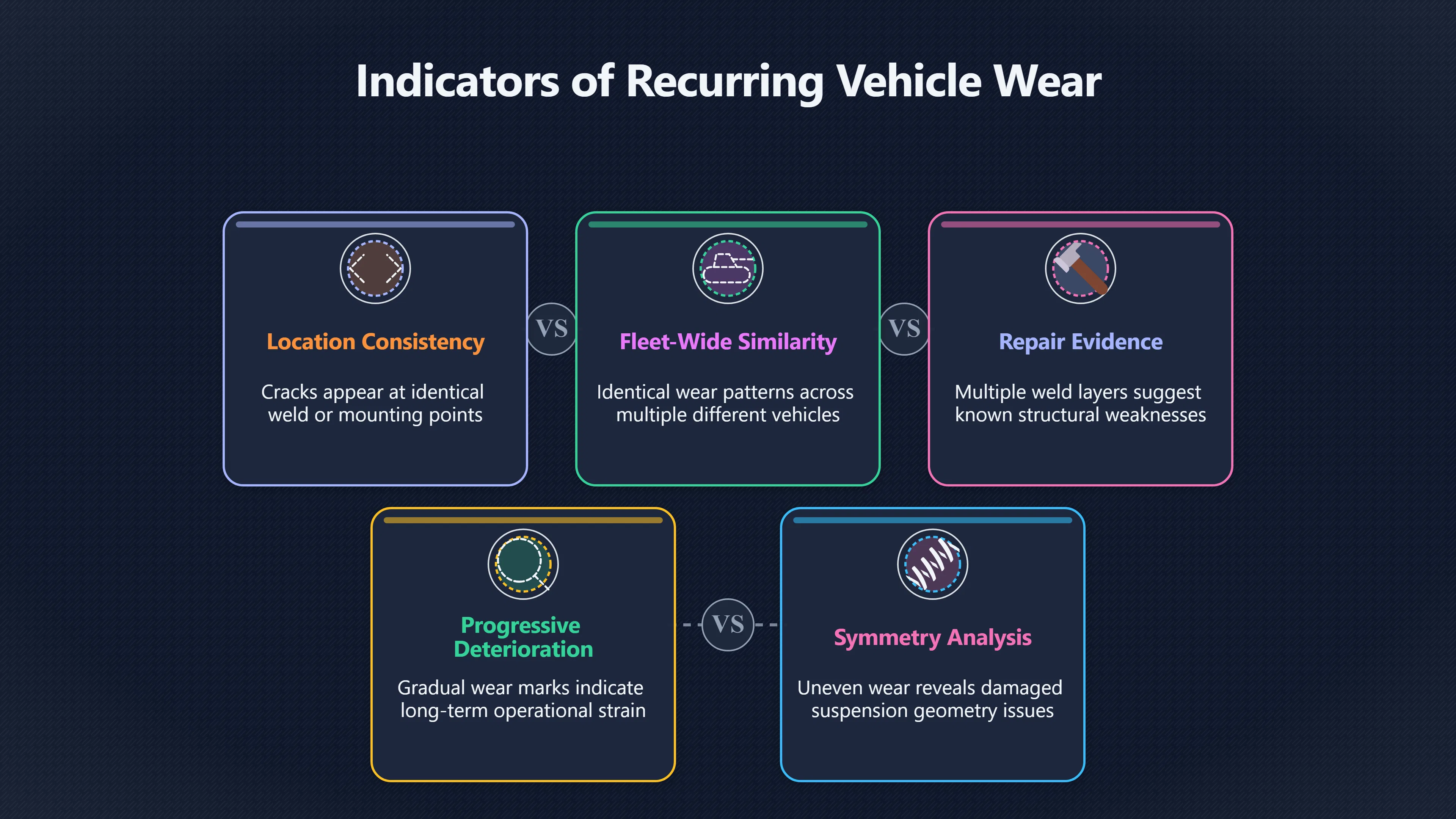
- Consistency of location: Cracks repeatedly appearing at the same weld, bracket, or mounting point suggest a stress concentration problem.
- Similarity across multiple vehicles: Identical wear appearing on different examples indicates a fleet-level issue rather than individual misuse.
- Evidence of repeated repair: Multiple weld layers, reinforced brackets, or recurring replacement parts suggest a known weakness.
- Progressive deterioration: Wear marks that develop gradually indicate long-term operational strain rather than sudden combat effects.
When exploitation teams observe the same fault across captured vehicles from different units or time periods, confidence increases that the problem reflects a genuine sustainment challenge rather than an isolated incident.
What Tracks and Running Gear Can Reveal
Running gear often provides some of the clearest evidence of long-term readiness problems because it absorbs constant stress from terrain, weight, speed, and manoeuvre.
Tracked vehicles place enormous strain on road wheels, suspension components, track pins, guide horns, idlers, and drive sprockets. Studies of tracked vehicle systems consistently identify tracks and running gear as among the least reliable and most maintenance-intensive components.[researchgate.net]researchgate.netThe continuous track in tracked vehicles is one of the least reliable…
Repeated observations of the following conditions can be particularly revealing:
- Frequent track-throwing damage.
- Excessively worn guide horns.
- Uneven road-wheel wear.
- Repeated replacement of track links.
- Cracked suspension arms.
- Distorted idlers or sprockets.
A fleet suffering chronic track failures may indicate several different problems: inadequate maintenance intervals, insufficient spare tracks, poor crew training in track tension adjustment, excessive vehicle weight growth, or a design vulnerable to certain terrain conditions.
Analysts also compare wear symmetry. Uniform wear often suggests disciplined maintenance. Highly uneven wear may indicate rushed servicing, damaged suspension geometry, or prolonged operation despite known faults.
The significance lies not in any single damaged track but in repeated evidence showing that mobility failures occur faster than maintenance systems can prevent them.
What Tyres Can Reveal About Logistics and Operating Conditions
Wheeled military vehicles leave a different maintenance signature.
Tyres record information about terrain, load management, inflation practices, and maintenance discipline. Uneven shoulder wear may indicate chronic overloading. Distinctive centre wear can suggest overinflation, while sidewall damage patterns may point to repeated operation on rocky terrain or inadequate driver training.
Repeated tyre failures become especially informative when replacement tyres appear scarce. Vehicles may display mixed tyre types, differing tread depths, or repairs extending far beyond normal service life. Such patterns can indicate supply shortages rather than engineering problems.
If multiple captured vehicles show the same tyre degradation despite different operational histories, analysts may infer that the underlying issue is systemic. The question becomes not merely whether tyres wear out, but whether the enemy possesses sufficient logistics capacity to replace them before readiness suffers.
What Wiring Damage Reveals About Reliability Problems
Electrical systems often expose failures that are difficult to identify from design documents alone.
Scorched wiring looms, recurring insulation damage, and repeated rerouting of cables can reveal hidden weaknesses in vehicle architecture. A wiring route that repeatedly overheats may indicate insufficient thermal protection, poor component placement, or power systems operating beyond their intended limits.
Repeated electrical repairs are particularly valuable because maintainers often leave traces behind:
- Non-standard connectors.
- Replacement wire segments.
- Additional insulation.
- Locally added protective sleeves.
- Bypass circuits.
When these modifications appear repeatedly across vehicles, they suggest that field units have developed unofficial solutions to recurring faults.
From an intelligence perspective, such evidence is useful because crews usually repair electrical problems only after those problems become operationally significant. Recurring field modifications therefore identify vulnerabilities serious enough to affect combat capability.

What Optics and Sensor Wear Can Reveal
Optics often receive careful treatment because they are expensive, difficult to replace, and central to combat effectiveness.
Repeated damage around optical mounts, stabilisation mechanisms, or protective covers can reveal chronic vibration problems, transportation stresses, or weaknesses in suspension systems. If sensor housings repeatedly require reinforcement or replacement, analysts may infer that shock loads exceed design expectations.
Wear patterns around viewing systems can also reveal how equipment is actually used. For example:
- Excessive abrasion on protective covers may indicate frequent operation in dusty conditions.
- Repeated replacement of sight housings may suggest vulnerability to vibration.
- Consistent sealing repairs can indicate environmental protection shortcomings.
Because modern combat systems increasingly depend on sensors, recurring optical failures may reveal readiness limitations disproportionate to the physical size of the damaged component.
What Engine Wear Reveals About Operational Strain
Engine compartments provide some of the richest sustainment evidence because thermal, mechanical, and lubrication problems accumulate visibly over time.
Repeated overheating indicators may include:
- Burnt paint around cooling systems.
- Discoloured exhaust components.
- Heat-damaged wiring.
- Recurrent coolant repairs.
- Evidence of frequent engine replacement.
Reliability studies consistently show that recurring failures tend to emerge in predictable patterns as mileage and operating hours accumulate. Analysts exploit this principle by examining which engine components fail repeatedly and how quickly replacement parts appear to wear.[researchgate.net]researchgate.netResearch Gate An Analysis of Reliability of Military Vehiclesreliability for military vehicles in the second phase of operation Similarly, a function of failure, i.e. an empirical cumulative distrib…
A single overheated engine may reflect unusual circumstances. Multiple captured vehicles showing identical overheating signatures suggest a broader issue involving cooling capacity, maintenance quality, operating doctrine, or environmental conditions.
Engine wear can also expose tempo. Vehicles operated at unusually high rates often display accelerated degradation that exceeds expected service intervals. In this way, wear becomes indirect evidence of operational demand.

Separating Design Weakness from Wartime Strain
One of the most difficult analytical tasks is determining whether recurring wear originates from flawed engineering or harsh operating conditions.
Analysts rarely reach conclusions from a single vehicle. Instead, they compare:
- Multiple captured examples.
- Maintenance records.
- Spare-part inventories.
- Training documentation.
- Historical imagery.
- Manufacturing variations.
Several indicators favour a design weakness interpretation:
- The same failure appears across many units.
- Failures occur in predictable locations.
- Field modifications consistently target the same component.
- Newer vehicles show the same problem as older vehicles.
Indicators favouring wartime strain include:
- Failures concentrated in heavily used formations.
- Wear patterns linked to terrain or climate.
- Evidence of deferred maintenance.
- Shortages of replacement parts.
In practice, both factors often interact. A design may function adequately under peacetime conditions yet fail repeatedly when subjected to sustained combat operations. Captured equipment is valuable precisely because it records this interaction between engineering design and operational reality.
Why Recurring Wear Matters More Than Individual Failures
A single broken vehicle may reveal how a system can fail. Repeated wear patterns reveal how often it fails, how difficult it is to sustain, and whether the operator can keep pace with the maintenance burden.
For reverse engineering efforts, recurring cracks, scorched wiring, worn running gear, damaged optics, and persistent engine problems provide evidence about the real-world limits of foreign military technology. They identify not only technical weaknesses but also the organisational capacity required to manage those weaknesses. Repetition transforms ordinary damage into intelligence: each recurring failure narrows the gap between theoretical performance and actual battlefield readiness.
Amazon book picks
Further Reading
Books and field guides related to What Repeated Wear Says About Enemy Readiness. Use these as the next step if you want deeper reading beyond the article.
Maintenance Engineering Handbook
Useful for interpreting chronic equipment degradation.
Reliability-centered Maintenance
Rating: 4.5/5 from 7 Google Books ratings
Directly addresses recurring failures and wear patterns.
eBay marketplace picks
Marketplace Samples
Example marketplace items related to this page. Use the search link to explore similar finds on eBay.



Endnotes
1.
Source: researchgate.net
Title: Research Gate An Analysis of Reliability of Military Vehicles
Link:https://www.researchgate.net/publication/336951717_An_Analysis_of_Reliability_of_Military_Vehicles
Source snippet
reliability for military vehicles in the second phase of operation Similarly, a function of failure, i.e. an empirical cumulative distrib...
2.
Source: mdpi.com
Link:https://www.mdpi.com/2076-3417/12/5/2622
Source snippet
Reliability Analysis of Military Vehicles Based on Censored...by M Oszczypała · 2022 · Cited by 28 — The developed indicator took into a...
3.
Source: researchgate.net
Link:https://www.researchgate.net/publication/278058862_Predictive_Maintenance_of_Military_Systems_Based_on_Physical_Failure_Models
Source snippet
The purpose of this article is to...Read more...
4.
Source: ijietap.com
Link:https://ijietap.com/index.php/ijie/article/download/8255/1289/48675
Source snippet
Then, functional failures, failure modes, and effects are defined. This methodology manages the identified risks, knowing...Read more...
5.
Source: researchgate.net
Link:https://www.researchgate.net/publication/353693678_Prediction_of_the_Lifetime_of_Tank_Track_Components_Using_the_Accelerated_Testing
Source snippet
The continuous track in tracked vehicles is one of the least reliable...
6.
Source: navsea.navy.mil
Link:https://www.navsea.navy.mil/Portals/103/Documents/NSWC_Crane/SD-18/Test%20Methods/MILHDBK338B.pdf
Source snippet
Number of Failures....................... 5-27. 5.4. Failure Modeling...
7.
Source: reference-global.com
Title: ama 2023 0010
Link:https://reference-global.com/download/article/10.2478/ama-2023-0010.pdf
Source snippet
assessment of the impact of wear and tear of rubber elements...by P RYBAK · 2023 · Cited by 2 — Articles considering the impact of agein...
Additional References
8.
Source: marines.mil
Link:https://www.marines.mil/portals/1/MCRP%203-17.7A%20z.pdf
Source snippet
FM 5-430-00-1The manual is intended to be used by. United States (US) Army Corps of Engineers personnel.... enemy observation and to pro...
9.
Source: ibiblio.org
Link:https://www.ibiblio.org/hyperwar/NHC/NewPDFs/USArmy/USArmy%20MID%20Intelligence%20Bulletins/USArmy%20MID%20Intelligence%20Bulletin%20Vol.%201%20No.%2001%201942-09-00.pdf
Source snippet
INTELLIGENCE BULLETINHaving decided where to strike, the enemy next brings forward his tanks, supported by motorized in fantry. He covers...
10.
Source: bits.de
Link:https://www.bits.de/NRANEU/others/amd-us-archive/Fm30-10%2859%29.pdf
Source snippet
TERRAIN INTELLIGENCECaptured Enemy Documents. Maps and other intelligence documents captured from the enemy often are of great value as s...
11.
Source: history.army.mil
Link:https://history.army.mil/portals/143/Images/Publications/catalog/60-13.pdf
Source snippet
IntelligenceI ntelligence has been defined as the an of "knowing one's enemies,'' and mili- tary intelligence is as old as war itself. Ho...
12.
Source: facebook.com
Link:https://www.facebook.com/specopsmag/posts/a-lone-operator-sits-amongst-the-carnage-of-a-raid-carried-out-under-project-ome/1495714151942497/
Source snippet
often hes got so many enemies, and you cpuld be so hard to identify...
13.
Source: facebook.com
Link:https://www.facebook.com/tankmuseum/posts/believe-it-or-not-tanks-and-other-tracked-vehicles-sometimes-struggle-to-get-tra/1289948583316980/
Source snippet
out like a snowshoe, allowing it to glide over deep Russian mud...
14.
Source: tpm4u.wordpress.com
Link:https://tpm4u.wordpress.com/wp-content/uploads/2008/02/an-introduction-to-predictive-maintenance.pdf
Source snippet
Monitoring and Analysis. 114........ 7.1 Vibration analysis applications... Failure-Mode Analysis. 285.......................... 14.1...
15.
Source: soucy-defense.com
Title: Tracks of Tomorrow
Link:https://soucy-defense.com/tracks-of-tomorrow-the-strategic-role-of-durable-and-adaptable-mobility-solutions/
Source snippet
strategic role of Mobility SolutionsComposite rubber track demonstrates greater resilience and reliability over steel track, with additio...
16.
Source: army.mil
Title: the reliability challenge
Link:https://www.army.mil/article/286649/the_reliability_challenge
Source snippet
Army trucks and other vehicles are another area where maintenance and failure hamper the objectives. In the twelve...Read more...
17.
Source: govinfo.gov
Title: Piercing the Fog
Link:https://www.govinfo.gov/content/pkg/GOVPUB-D301-PURL-LPS47632/pdf/GOVPUB-D301-PURL-LPS47632.pdf
Source snippet
Fog tells the intriguing story of how airmen built intelligence organizations to collect and process information about the enemy and to p...
Topic Tree