Within Mi G 25
What the Mi G 25's Structure Really Revealed
Inspection showed a steel-heavy interceptor optimized for speed, heat tolerance and production realities rather than elegance.
On this page
- Steel Versus Titanium
- Heat and Speed Requirements
- Production and Maintenance Choices
Page outline Jump by section
Introduction
When Western engineers finally inspected Viktor Belenko’s MiG-25 after his 1976 defection, one of the most important discoveries was not a secret radar mode or missile specification. It was the aircraft’s structure. Many analysts had assumed that an aircraft capable of sustained Mach 2.8-plus performance must be built from large amounts of titanium and incorporate highly sophisticated manufacturing techniques. Instead, inspection revealed a machine built primarily from welded nickel-steel alloys, with comparatively small amounts of titanium and aluminium. That finding exposed a deeper reality about Soviet design philosophy: the MiG-25 prioritised speed, heat resistance, ruggedness and producibility over elegance, weight reduction or fighter-like agility. The aircraft’s construction became a case study in how reverse engineering can reveal not just capabilities, but the industrial and strategic priorities behind a weapon system.[Wikipedia]WikipediaMikoyan-Gurevich Mi G-25Mikoyan-Gurevich Mi G-25
Steel Versus Titanium
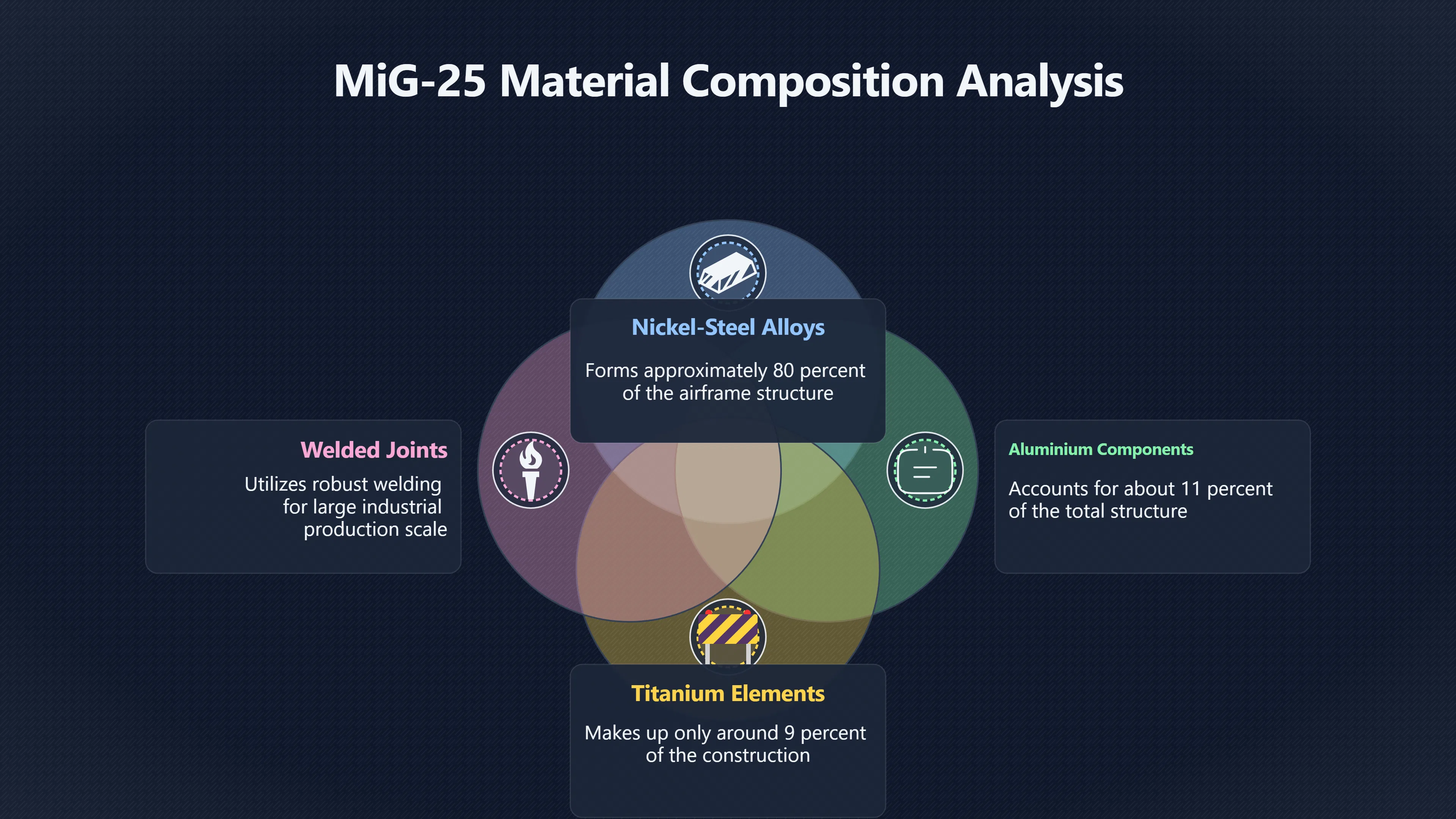
The most famous revelation concerned materials. Western observers had often assumed that the Foxbat’s extraordinary speed required a largely titanium airframe comparable to the American SR-71 programme. Examination showed otherwise. The MiG-25 was built primarily from nickel-steel and stainless-steel alloys, with roughly 80 percent of the structure consisting of steel, about 11 percent aluminium and only around 9 percent titanium.[wikipedia.org]WikipediaMikoyan-Gurevich Mi G-25Mikoyan-Gurevich Mi G-25
This was not simply a technological shortcoming. It reflected a conscious trade-off.
At Mach 3-class speeds, aerodynamic heating becomes a major engineering problem. Aluminium loses strength at temperatures that a high-speed interceptor routinely encounters. Titanium offered excellent performance but was expensive, difficult to manufacture and challenging to weld in large thin-walled structures. Soviet designers therefore chose steel for most of the aircraft, accepting additional weight in exchange for lower cost, easier fabrication and reliable heat resistance.[wikipedia.org]WikipediaMikoyan-Gurevich Mi G-25Mikoyan-Gurevich Mi G-25
The result was an aircraft that looked technologically crude by some Western standards but was optimised for Soviet realities. Rather than pursuing the lightest possible structure, designers pursued one that could survive extreme temperatures while being produced in substantial numbers by the Soviet industrial system. The discovery challenged a common Cold War assumption that Soviet aerospace engineers always sought to imitate Western material choices. In this case, they selected a different solution because it better matched their priorities.[wikipedia.org]WikipediaMikoyan-Gurevich Mi G-25Mikoyan-Gurevich Mi G-25
Why Heat Resistance Mattered More Than Weight
The MiG-25’s mission helps explain its unusual construction. It was designed primarily as an interceptor for high-altitude threats such as strategic bombers, reconnaissance aircraft and other targets approaching Soviet airspace at extreme speed. Its central requirement was rapid climb and sustained high-speed flight rather than close-range manoeuvring combat.[warhistoryonline]warhistoryonline.comThe Mikoyan-Gurevich Mi G-25 Scared the WestThe Mikoyan-Gurevich MiG-25 Scared the WestJanuary 30, 2024 — 30 Jan 2024 — The Mikoyan-Gurevich MiG-25 was designed to g…
At such speeds, air friction generated intense heat. The aircraft therefore needed a structure capable of tolerating repeated thermal cycles without losing strength or suffering major distortion. Steel offered an effective answer even though it increased overall weight. The Foxbat’s large engines could compensate for much of that weight penalty, allowing designers to prioritise thermal durability over aerodynamic refinement.[wikipedia.org]WikipediaMikoyan-Gurevich Mi G-25Mikoyan-Gurevich Mi G-25
Inspection of the aircraft reinforced the conclusion that Soviet engineers had optimised for a specific operational problem rather than maximum all-around performance. The MiG-25 could achieve remarkable speed and altitude, but those achievements came partly because resources were concentrated on propulsion and heat management rather than agility. The aircraft was exceptionally good at its intended mission and comparatively less impressive outside it.[Wikipedia]WikipediaMikoyan-Gurevich Mi G-25Mikoyan-Gurevich Mi G-25

Production and Maintenance Choices
The airframe also revealed much about Soviet manufacturing philosophy. Western investigators found extensive use of welding techniques and relatively simple production methods. Some construction details appeared rough compared with contemporary Western fighters. Rivet heads were sometimes left exposed where they would not significantly affect performance, and portions of the structure were assembled using labour-intensive but robust welding methods.[wikipedia.org]WikipediaMikoyan-Gurevich Mi G-25Mikoyan-Gurevich Mi G-25
What initially looked unsophisticated often reflected practical priorities. Steel could be welded by a large industrial workforce using established methods. Production did not depend on extensive supplies of costly titanium or highly specialised fabrication infrastructure. The aircraft could therefore be manufactured in significant numbers while maintaining the performance required by Soviet air-defence doctrine.[Facebook]facebook.comMikoyan-Gurevich MiG-25 The MiG-25's capabilities were…The MiG 25's primary structure used nickel steel alloy, not titanium. S…
The Foxbat also appeared designed around major functional systems rather than around achieving the lightest possible airframe. Analysts noted that the aircraft seemed built around its powerful engines, emphasising rapid interception performance over refined weight optimisation. This reinforced the broader picture of a design culture willing to accept mass and inefficiency in some areas if operational requirements could be met reliably and affordably.[Wikipedia]WikipediaMikoyan-Gurevich Mi G-25Mikoyan-Gurevich Mi G-25
What Reverse Engineering Revealed About Soviet Priorities
The most significant lesson from the MiG-25’s structure was not that Soviet technology lagged behind Western technology. Rather, it demonstrated that Soviet designers often solved problems differently.
The aircraft embodied several priorities that became visible only after close inspection:
- Mission effectiveness over elegance. The aircraft was designed to intercept high-speed threats, not to excel in every fighter role.[warhistoryonline]warhistoryonline.comThe Mikoyan-Gurevich Mi G-25 Scared the WestThe Mikoyan-Gurevich MiG-25 Scared the WestJanuary 30, 2024 — 30 Jan 2024 — The Mikoyan-Gurevich MiG-25 was designed to g…
- Heat tolerance over low weight. Material choices favoured survivability at extreme speed rather than minimum mass.[Wikipedia]WikipediaMikoyan-Gurevich Mi G-25Mikoyan-Gurevich Mi G-25
- Mass production over exotic materials. Steel allowed large-scale manufacturing with existing industrial capabilities.[Facebook]facebook.comMikoyan-Gurevich MiG-25 The MiG-25's capabilities were…The MiG 25's primary structure used nickel steel alloy, not titanium. S…
- Robustness over refinement. Construction methods prioritised durability and practicality rather than cosmetic sophistication.[globalaircraft.org]globalaircraft.orgMi G-25 FoxbatMiG-25 Foxbat - Global Aircraft* The aircraft was built of a nickel-steel alloy and not titanium as was assumed (though some titanium was…
For intelligence analysts, this was one of the most valuable outcomes of the Belenko defection. The MiG-25’s structure showed that understanding a foreign weapon requires looking beyond outward performance figures. Materials, manufacturing methods and engineering compromises can reveal strategic assumptions, industrial constraints and operational doctrine just as clearly as radar systems or missile specifications. In the Foxbat’s case, the airframe itself became evidence of how the Soviet Union balanced technological ambition with the practical demands of defending a vast territory against high-speed aerial threats.[wikipedia.org]WikipediaMikoyan-Gurevich Mi G-25Mikoyan-Gurevich Mi G-25

Amazon book picks
Further Reading
Books and field guides related to What the MiG-25's Structure Really Revealed. Use these as the next step if you want deeper reading beyond the article.
SR-71 Revealed : The Untold Story
Useful comparison for materials and heat-management challenges.
eBay marketplace picks
Marketplace Samples
Live-tested eBay searches with available results related to this page.




Endnotes
1.
Source: Wikipedia
Title: Mikoyan-Gurevich [Mi G-25]({{ ‘mi-g-25/’ | relative_url }})
Link:https://en.wikipedia.org/wiki/Mikoyan-Gurevich_MiG-25
2.
Source: facebook.com
Link:https://www.facebook.com/AFmuseum/posts/mikoyan-gurevich-mig-25the-mig-25s-capabilities-were-not-discovered-until-1976-w/804980591661828/
Source snippet
Mikoyan-Gurevich MiG-25 The MiG-25's capabilities were...The MiG 25's primary structure used nickel steel alloy, not titanium. S...
3.
Source: warhistoryonline.com
Title: The Mikoyan-Gurevich Mi G-25 Scared the West
Link:https://www.warhistoryonline.com/aircraft/mikoyan-gurevich-mig-25.html
Source snippet
The Mikoyan-Gurevich MiG-25 Scared the WestJanuary 30, 2024 — 30 Jan 2024 — The Mikoyan-Gurevich MiG-25 was designed to g...
Published: January 30, 2024
4.
Source: globalaircraft.org
Title: Mi G-25 Foxbat
Link:https://www.globalaircraft.org/planes/mig-25_foxbat.pl
Source snippet
MiG-25 Foxbat - Global Aircraft* The aircraft was built of a nickel-steel alloy and not titanium as was assumed (though some titanium was...
5.
Source: facebook.com
Link:https://www.facebook.com/CitizenKamran/posts/the-mig-25-the-soviet-fighter-that-terrified-the-westuntil-they-opened-one-upin-/1381981900642840/
Source snippet
Around 80% of its structure was made from welded nickel- steel. It was heavy, but easier for Soviet...Read more...
6.
Source: facebook.com
Link:https://www.facebook.com/61558447791901/posts/why-was-the-mig-25-so-fastat-the-heart-of-the-mig-25s-performance-were-its-two-t/122142854894281593/
Source snippet
Why was the MiG-25 so fast? At the heart...The MiG 25's primary structure used nickel steel alloy, not titanium. Steel was cheap, abunda...
7.
Source: nationalsecurityjournal.org
Title: National Security Journal U.S
Link:https://nationalsecurityjournal.org/u-s-intelligence-thought-russias-mig-25-foxbat-was-made-of-titanium-it-was-actually-cheap-stainless-steel/
Source snippet
Intelligence Thought Russia's MiG-25 Foxbat Was...14 May 2026 — The MiG-25's airframe was constructed using stainless steel, along with...
Published: May 2026
8.
Source: theaviationgeekclub.com
Link:https://theaviationgeekclub.com/how-soviet-propaganda-on-mig-25-led-to-the-development-of-the-f-15-the-premier-air-superiority-fighter-of-the-20th-century/
Source snippet
The Aviation Geek ClubHow Soviet Propaganda on MiG-25 led to the development...It cost far less than titanium and allowed for welding, a...
9.
Source: popularmechanics.com
Title: Popular Mechanics This Mi G Super Fighter Terrified NATO
Link:https://www.popularmechanics.com/military/aviation/a38083125/mig-super-fighter-nato/
Source snippet
Then a Soviet Pilot...16 Nov 2021 — But the Soviets were forced to make most of the Foxbat from heavier stainless steel. They reserved t...
10.
Source: historynet.com
Title: mig 25
Link:https://historynet.com/mig-25/
Source snippet
The MiG-25 Terrified the West Until a Defector Exposed Its...20 Jul 2022 — Instead of titanium, the Soviets turned to stainless steel, e...
Additional References
11.
Source: reddit.com
Link:https://www.reddit.com/r/todayilearned/comments/2h8pub/til_that_the_soviet_union_couldnt_figure_out_how/
12.
Source: grosswald.org
Link:https://www.grosswald.org/mikoyan-gurevich-mig-25-a-supersonic-legacy-of-soviet-engineering/
Source snippet
MiG-25 Foxbat: Soviet Supersonic Icon in Aviation HistoryMaterial Innovation: Steel, Nickel, Titanium: Unlike many contemporary fighters...
13.
Source: aviation.stackexchange.com
Title: can stainless steel replace titanium for mach 3 speeds
Link:https://aviation.stackexchange.com/questions/32175/can-stainless-steel-replace-titanium-for-mach-3-speeds
Source snippet
Aviation Stack ExchangeCan stainless steel replace titanium for Mach 3+ speeds?7 Oct 2016 — In the documentary Wings of Russia: MiG-25 an...
14.
Source: reddit.com
Title: The steel components were formed by a combination of spot welding.Read more
Link:https://www.reddit.com/r/SpaceXLounge/comments/betyze/spacex_stainless_steel_the_mig25_and_sovietstyle/
Source snippet
SpaceX, Stainless Steel, the MiG-25, and Soviet-style...The MiG-25 was constructed from 80% nickel-steel alloy, 11% aluminum, and 9% tit...
15.
Source: youtube.com
Title: This Jet Terrified the West: The Mi G-25 Foxbat
Link:https://www.youtube.com/watch?v=W1L1sU0uI0o
Source snippet
[Slow Weapon Explanation] MiG-25, a fighter jet so dangerous that even Belenko fled, with the fas...
16.
Source: alternatehistory.com
Title: what if the mig 25 was made of titanium.520750
Link:https://www.alternatehistory.com/forum/threads/what-if-the-mig-25-was-made-of-titanium.520750/
Source snippet
Titanium alloys could have done the job with...Read more...
17.
Source: youtube.com
Title: The Mi G-25 Foxbat: The Fastest Jet Built to Rival the SR-71 Blackbird
Link:https://www.youtube.com/watch?v=uZjcxWJH0ZQ
Source snippet
This Jet Terrified the West: The MiG-25 Foxbat...
18.
Source: youtube.com
Title: The Jet So Fast It Burned Up Its Own Engines
Link:https://www.youtube.com/watch?v=pAHz1rmgAO0
Source snippet
The MiG-25 Foxbat: The Fastest Jet Built to Rival the SR-71 Blackbird...
19.
Source: secretprojects.co.uk
Title: page 3
Link:https://www.secretprojects.co.uk/threads/mikoyan-mig-25-foxbat.4099/page-3
Source snippet
Mikoyan MiG-25 "FOXBAT" | Page 321 Aug 2007 — I found something interesting. There is a particular aluminum alloy (D-19T) used in the MiG...
20.
Source: youtube.com
Link:https://www.youtube.com/watch?v=Ve80dBZq2zI
Topic Tree