Within Sidewinder
Why China's Sidewinder Copy Took Years
China's PL-2 path shows how recovered hardware and Soviet data still required years of manufacturing, testing and adaptation.
On this page
- From recovered missile clues to Soviet technical help
- The subsystems that slowed imitation
- How industrial limits shaped PL 2 performance
Page outline Jump by section
Introduction
China’s PL-2 programme is often described as a copy of the American AIM-9B Sidewinder, but that shorthand misses the most important lesson. China did not move directly from recovering Sidewinder components in 1958 to fielding a reliable missile. Instead, the PL-2 emerged through a long process that combined battlefield intelligence, Soviet technical assistance, reverse engineering, manufacturing development, repeated testing and adaptation to the realities of China’s aerospace industry. The result was a weapon that traced its lineage to the Sidewinder, yet also revealed how difficult it was to transform possession of a foreign design into a sustainable missile-production capability.[wikipedia.org]WikipediaOpen source on wikipedia.org.
From Recovered Missile Clues to Soviet Technical Help
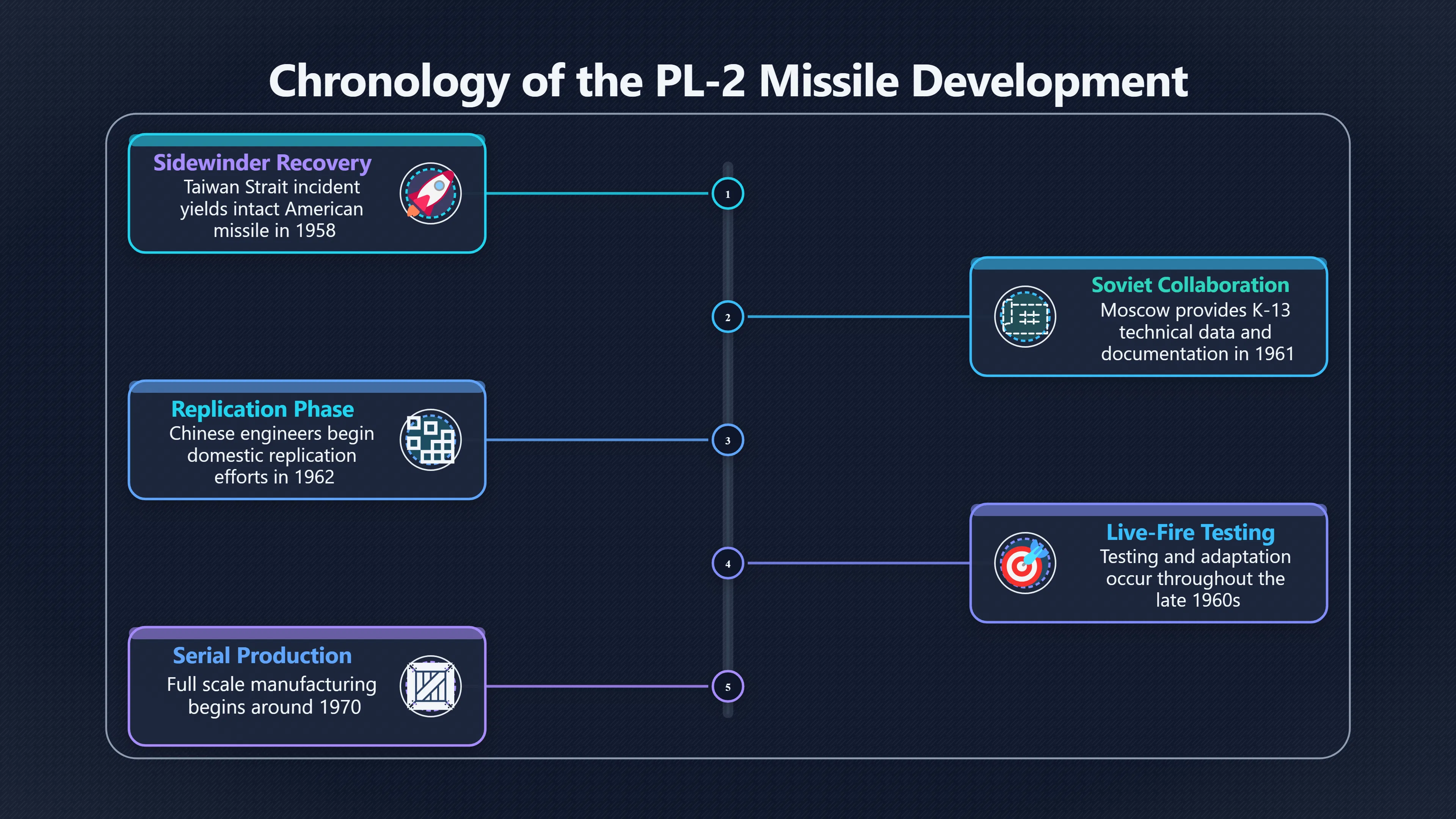
The starting point was the famous Taiwan Strait incident of September 1958. During air combat, a Taiwanese-launched AIM-9B Sidewinder struck a Chinese MiG-17 but failed to detonate. The missile was recovered largely intact, giving Chinese engineers access to one of the West’s most advanced short-range air-to-air weapons. China subsequently shared the recovered missile with the Soviet Union, whose engineers conducted a detailed reverse-engineering effort. Soviet designers later described the Sidewinder as an educational breakthrough that reshaped their understanding of missile construction and production methods.[wikipedia.org]WikipediaK-13 (missileK-13 (missile
China initially attempted to study the missile itself but lacked the industrial and technical base to duplicate it independently. The crucial step came when Moscow agreed to provide technical assistance derived from its own reverse-engineered version, the K-13 (NATO designation AA-2 Atoll). Despite the deterioration of Sino-Soviet relations, China received K-13 examples and technical documentation in 1961. Rather than copying the original American missile directly, China’s PL-2 was therefore built largely from Soviet interpretations of the Sidewinder design.[wikipedia.org]WikipediaOpen source on wikipedia.org.
This distinction matters. The recovered Sidewinder provided clues, measurements and engineering concepts, but the practical path to the PL-2 depended heavily on Soviet work that had already translated those clues into production drawings, manufacturing techniques and tested subsystems.[Wikipedia]WikipediaOpen source on wikipedia.org.
The Subsystems That Slowed Imitation
Possessing a missile and understanding a missile are not the same thing. The PL-2 programme demonstrates that reverse engineering required mastery of several specialised technologies simultaneously.
Guidance and Seeker Technology
The infrared seeker was among the most difficult components to reproduce. A heat-seeking missile depended on sensitive detectors, optical systems, signal-processing electronics and stable guidance behaviour. These were not technologies that could simply be measured with calipers after disassembly. Engineers had to understand why components were arranged in particular ways and then reproduce them using domestic suppliers and manufacturing methods.[Air University]af.eduAir University Prepared by Text Ore, IncAir UniversityIn 1958 China recovered an intact example of the newly-developed AIM-9B. Sidewinder missile, when a missile fired by a Taiw…
Even small differences in detector quality, electronic reliability or assembly standards could reduce tracking performance. The challenge was not merely copying hardware but reproducing the performance characteristics that made the original missile effective.[Air University]af.eduAir University Prepared by Text Ore, IncAir UniversityIn 1958 China recovered an intact example of the newly-developed AIM-9B. Sidewinder missile, when a missile fired by a Taiw…
Rocket Motors and Materials
The propulsion system posed another obstacle. A solid-fuel rocket motor appears straightforward compared with radar systems or jet engines, yet performance depends on propellant chemistry, manufacturing consistency and quality control. A missile may look externally identical to the original while producing different thrust, burn characteristics or reliability.[Global Security]globalsecurity.orgGlobal SecurityPL-28 Jan 2021 — The "Pili"-2 air-to-air missile is the first domestically-made air-to-air missile that China has imitated…
China’s missile industry in the 1960s was still developing many of these capabilities. Reproducing the dimensions of a Sidewinder-derived missile was easier than reproducing the industrial processes behind it.[Global Security]globalsecurity.orgGlobal SecurityPL-28 Jan 2021 — The "Pili"-2 air-to-air missile is the first domestically-made air-to-air missile that China has imitated…
Production Engineering
Reverse engineering is often portrayed as a purely technical exercise, but production engineering was equally important. Factories had to manufacture thousands of components repeatedly within acceptable tolerances. Tooling, inspection procedures, supplier networks and workforce training all influenced the final weapon.[Popular Mechanics]popularmechanics.comhow china built air to air misslePopular MechanicsHow China Copied Its Way to Building a World-Class Air-…20 Aug 2024 — It took roughly a decade more for mass producti…
This is one reason the PL-2 timeline stretched for years. China began replication efforts in the early 1960s, conducted live-fire testing in the second half of the decade, and only moved into wider production around 1970. The gap between receiving Soviet data and achieving practical production illustrates how much effort remained after the design itself became available.[Wikipedia]WikipediaOpen source on wikipedia.org.
Why the Programme Took So Long
The chronology alone shows that reverse engineering was not an instant shortcut.
China received K-13-related assistance in 1961. Replication efforts began in 1962. Live-fire tests followed years later, and serial production was delayed until around 1970. In other words, access to the design did not eliminate the need for a lengthy development cycle.[Wikipedia]WikipediaOpen source on wikipedia.org.
Political conditions compounded the technical difficulties. The Cultural Revolution disrupted scientific institutions, industrial management and defence production throughout the late 1960s. Programmes that already faced engineering challenges now had to operate in an environment where expertise, continuity and quality assurance were frequently interrupted. Sources on the PL-2’s production history consistently identify these disruptions as a major reason for delays.[Wikipedia]WikipediaOpen source on wikipedia.org.
The missile therefore became more than a copying project. It became a test of whether China could sustain the industrial ecosystem necessary to manufacture advanced guided weapons at scale.
How Industrial Limits Shaped PL-2 Performance
The PL-2 eventually entered service and filled a critical gap in Chinese air-to-air missile capability. Yet operational experience highlighted the consequences of industrial limitations.
Chinese accounts and later analyses describe reliability problems associated with seeker performance and missile quality. Investigations in the early 1980s reportedly found substantial variation among missiles in service, with guidance and propulsion issues affecting effectiveness. Extensive testing revealed that some missiles performed far below their intended specifications. These findings suggested that reproducing a design on paper was easier than maintaining consistent quality across large production runs.[Global Security]globalsecurity.orgGlobal SecurityPL-28 Jan 2021 — The "Pili"-2 air-to-air missile is the first domestically-made air-to-air missile that China has imitated…
The PL-2 nevertheless served an important developmental purpose. It gave Chinese engineers experience with infrared seekers, missile aerodynamics, warheads, rocket motors, testing procedures and production management. Later Chinese missiles such as the PL-5 emerged from this foundation and incorporated improvements beyond the original Sidewinder-derived baseline.[Wikipedia]WikipediaOpen source on wikipedia.org.
What the PL-2 Reveals About Reverse Engineering
The PL-2 path illustrates a recurring pattern in military technology acquisition. Captured hardware can reveal architecture, dimensions and engineering solutions. Foreign technical assistance can accelerate understanding. But neither automatically creates an advanced weapons industry.
China possessed valuable Sidewinder clues in 1958 and obtained Soviet technical support a few years later. Even so, turning those advantages into a domestically produced missile required nearly a decade of engineering work, industrial preparation, testing and organisational adaptation. The PL-2 therefore stands as a useful case study in the limits of copying: a recovered missile can teach a nation how a weapon works, but building a reliable production base remains a separate and much longer challenge.[wikipedia.org]WikipediaOpen source on wikipedia.org.
Amazon book picks
Further Reading
Books and field guides related to Why China's Sidewinder Copy Took Years. Use these as the next step if you want deeper reading beyond the article.
The Chinese Air Force Evolving Concepts, Roles, and Capabilities
Places PL-2 development within Chinese aerospace growth.
The Chinese Air Force
First published 2012. Subjects: China, China. Zhongguo ren min jie fang jun. Kong jun, Air power.
eBay marketplace picks
Marketplace Samples
Live-tested eBay searches with available results related to this page.



Endnotes
1.
Source: Wikipedia
Link:https://en.wikipedia.org/wiki/PL-2
2.
Source: Wikipedia
Title: K-13 (missile)
Link:https://en.wikipedia.org/wiki/K-13_%28missile%29
3.
Source: twz.com
Title: the legendary sidewinder missile made its first kill over the taiwan strait
Link:https://www.twz.com/42544/the-legendary-sidewinder-missile-made-its-first-kill-over-the-taiwan-strait
Source snippet
That resulted in the reverse-engineered Vympel K-13 (AA-2 Atoll)...Read more...
4.
Source: twz.com
Title: a guide to chinas increasingly impressive air to air missile inventory
Link:https://www.twz.com/a-guide-to-chinas-increasingly-impressive-air-to-air-missile-inventory
Source snippet
A Guide To China's Increasingly Impressive Air-To-Air...1 Sept 2022 — The PL-2 was not a direct copy of the Sidewinder, but it was based...
5.
Source: Wikipedia
Title: AIM 9 Sidewinder
Link:https://en.wikipedia.org/wiki/AIM-9_Sidewinder
Source snippet
AIM-9 SidewinderThe AIM-9 Sidewinder is a short-range air-to-air missile. PL-2: Chinese-produced R-3S. S was being introduced in 1961...
6.
Source: globalsecurity.org
Link:https://www.globalsecurity.org/military/world/china/pl-2.htm
Source snippet
Global SecurityPL-28 Jan 2021 — The "Pili"-2 air-to-air missile is the first domestically-made air-to-air missile that China has imitated...
7.
Source: airuniversity.af.edu
Title: Air University Prepared by Text Ore, Inc
Link:https://www.airuniversity.af.edu/Portals/10/CASI/[documents
Source snippet
Air UniversityIn 1958 China recovered an intact example of the newly-developed AIM-9B. Sidewinder missile, when a missile fired by a Taiw...
8.
Source: popularmechanics.com
Title: how china built air to air missle
Link:https://www.popularmechanics.com/military/aviation/a61856884/how-china-built-air-to-air-missle/
Source snippet
Popular MechanicsHow China Copied Its Way to Building a World-Class Air-...20 Aug 2024 — It took roughly a decade more for mass producti...
9.
Source: popularmechanics.com
Link:https://www.popularmechanics.com/military/weapons/a60734289/aim-9-sidewinder-missile-history/
Source snippet
Popular MechanicsAIM-9 Sidewinder: How Russia Copied America's...5 Jun 2024 — By 1960, the Soviet Union had completed its reverse-engine...
Additional References
10.
Source: youtube.com
Link:https://www.youtube.com/watch?v=IUcCoMf5GLM
Source snippet
This selection provides critical operational context regarding the 1958 Taiwan Strait Crisis where the unexploded American missile was re...
11.
Source: airandspace.si.edu
Link:https://airandspace.si.edu/collection-objects/missile-air-air-atoll-also-designated-k-13-aa-2/nasm_A19930363000
Source snippet
dewinder air-to-air, heat-seeking missile. Atoll originated in 1958, when a Sidewinder...Read more...
12.
Source: reddit.com
Link:https://www.reddit.com/r/todayilearned/comments/o4dv7o/til_the_soviet_k13_missile_is_almost_an_exact/
Source snippet
On 28 September, 1958, a Chinese MiG-17 was struck with a sidewinder that didn't...Read more...
13.
Source: forum.warthunder.com
Title: chinese air to air missiles history performance discussion
Link:https://forum.warthunder.com/t/chinese-air-to-air-missiles-history-performance-discussion/822
Source snippet
31080×689 65.9 KB. The PL-2 missile is the Soviet K-13 missile introduced by China. The K-13 is developed on the basis of the AIM-9B...R...
14.
Source: si.edu
Link:https://www.si.edu/object/missile-air-air-atoll-also-designated-k-13-aa-2%3Anasm_A19930363000
Source snippet
pied the design, mass-produced the missile, and exported Atolls to its client...Read more...
15.
Source: facebook.com
Link:https://www.facebook.com/officeofnavalresearch/posts/the-worlds-most-widely-used-air-to-air-missile-began-as-a-side-project-today-mor/1048334627463454/
Source snippet
September 24, 1958, with the Republic of China (Taiwan) Air Force, during the...Read more...
Published: September 24, 1958
16.
Source: vpk.name
Title: 628947 air to air missiles of the chinese air force
Link:https://vpk.name/en/628947_air-to-air-missiles-of-the-chinese-air-force.html
Source snippet
Air-to-air missiles of the Chinese Air Force7 Sept 2022 — The PL-2 rocket did not become a direct copy of the Sidewinder, but it was base...
17.
Source: strasam.org
Link:https://strasam.org/en/defense/aerospace-industry/how-the-soviets-were-able-to-copy-the-american-aim-9-sidewinder-airborne-missile-through-reverse-engineering-and-espionage-during-the-cold-war-3362
Source snippet
an-made AIM-9 Sidewinder Airborne Air Missiles through reverse engineering...
18.
Source: theaviationgeekclub.com
Link:https://theaviationgeekclub.com/the-story-of-the-aim-9-sidewinder-that-failed-to-detonate-got-embedded-in-a-mig-17-and-was-reverse-engineered-into-the-soviet-aa-2-atoll/
Source snippet
a MiG-17 and was Reverse-Engineered into the Soviet AA-2 Atoll...
19.
Source: odin.t2com.army.mil
Link:https://odin.t2com.army.mil/WEG/Asset/03939621dfbb69fcaf2fad181c1939aa
Source snippet
army.milK-13 (AA-2 Atoll) Russian Short-Range Infrared Homing Air...Jan 13, 2025 — The Vympel K-13 (NATO reporting name: AA-2 "Atoll") i...
Topic Tree