Within Tu 4 Copy
The hidden systems inside the B 29 copy
Pressurisation, turrets, fire-control equipment and avionics made the B-29 a system problem, not just an airframe problem.
On this page
- Pressurised compartments and long range structure
- Remote turrets and fire control equipment
- Radios and avionics that had to be adapted
Page outline Jump by section
Introduction
The most difficult part of copying the Boeing B-29 was not reproducing its aerodynamic shape. Soviet engineers could measure the airframe, trace components and manufacture metal structures. The harder challenge was reproducing the network of pressurisation equipment, fire-control computers, remote gun turrets, radios, electrical systems and specialised subsystems that made the B-29 one of the most advanced bombers of the Second World War. Contemporary museum and technical sources consistently describe the aircraft as a breakthrough because it combined pressurised crew spaces, remotely controlled defensive armament and sophisticated avionics into a single integrated platform.[af.mil]nationalmuseum.af.milDevelopment of the Boeing B-29Flying combat…Read more…

This distinction matters when examining the Soviet Tupolev Tu-4. The aircraft could be made to look almost identical to a B-29, but matching its operational capabilities required recreating technologies that depended on manufacturing standards, electrical engineering, instrumentation and specialised industrial knowledge. The Tu-4 programme therefore illustrates a broader lesson in reverse engineering foreign military technology: copying the visible object is often easier than copying the invisible systems inside it.[Smithsonian Magazine]smithsonianmag.comSmithsonian MagazineMade in the U.S.S.R.Of course they copied it. The two airplanes could have been twins. But was the Soviets' Tu-4 trul…
Pressurised compartments and long-range structure
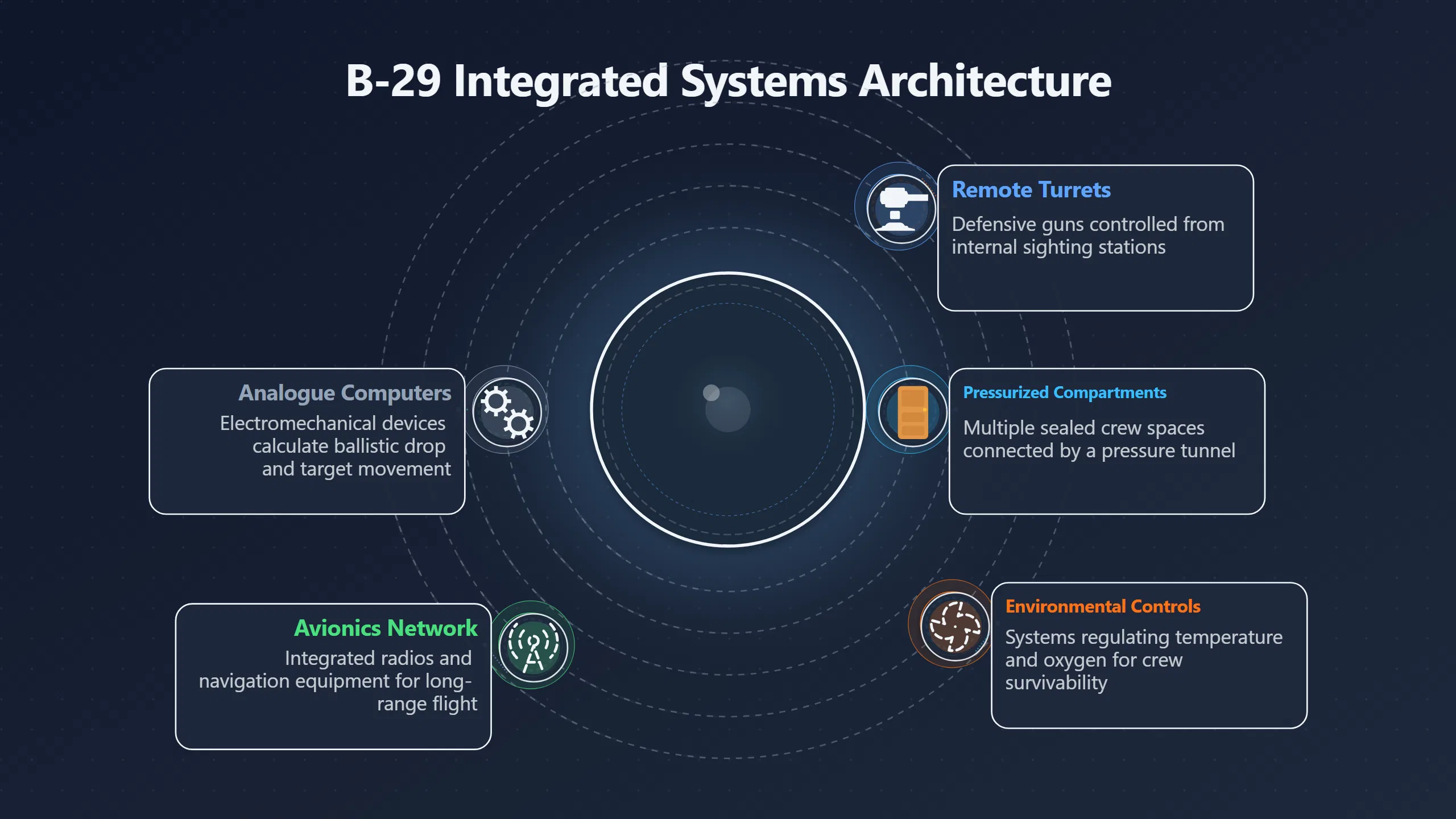
One reason the B-29 represented a systems problem rather than a simple airframe problem was its pressurised crew arrangement. Earlier heavy bombers typically placed crew members in unpressurised positions exposed to extreme cold at high altitude. The B-29 instead used multiple pressurised compartments connected through a pressurised tunnel, allowing crews to operate more effectively on long missions. This required more than sealed metal sections; it demanded reliable pressure regulation, environmental controls, ducting, structural design and maintenance procedures that could withstand repeated pressurisation cycles.[si.edu]airandspace.si.edudefending superbomber b 29s central fire control systemNational Air and Space MuseumDefending the Superbomber: The B-29's Central Fire…Aug 12, 2020 — The specifications for the superbomber…
The challenge was amplified by the aircraft’s intended operating profile. The B-29 was designed for very long-range missions at high altitude, meaning pressurisation interacted with structural loads, crew survivability and aircraft performance. A copied fuselage shape could not automatically reproduce these characteristics. Engineers had to understand how the pressure vessel, bulkheads, seals and supporting systems worked together across thousands of kilometres of flight.[National Air and Space Museum]airandspace.si.edudefending superbomber b 29s central fire control systemNational Air and Space MuseumDefending the Superbomber: The B-29's Central Fire…Aug 12, 2020 — The specifications for the superbomber…
Evidence from accounts of the Tu-4 programme suggests that pressurisation itself became a source of difficulty during Soviet reproduction efforts. Problems were reported with pressurisation systems even after the aircraft’s overall design had been copied, highlighting that operational functionality depended on more than external geometry.[Cold War Museum]coldwar.orgCold War MuseumRussian B-29 Clone — The TU-4 StoryMeanwhile, back in the Soviet Union, problems continued to plague the TU-4 project. The…
Remote turrets and fire-control equipment
The clearest example of the B-29 as an integrated system was its defensive armament. Instead of relying mainly on individual gunners sitting directly in their turrets, the aircraft employed a central fire-control architecture that linked gunsights, remote turrets and analogue computing devices. This was a major technological step beyond the arrangements found in most contemporary bombers.[google.com]artsandculture.google.comGoogle Arts & CultureFire Control System for the B-29But the B-29 was the first production aircraft to use them to remotely aim and fire…
An analogue computer inside a bomber
The B-29’s fire-control system used electromechanical analogue computers to calculate aiming solutions. These devices compensated for factors such as target movement, ballistic drop, parallax between sight and gun, aircraft speed and other variables. The result was that a gunner could control multiple remote turrets and concentrate firepower more effectively than with conventional manually aimed guns.[glennsmuseum.com]glennsmuseum.comGlenn's Computer MuseumB-29 Central Fire Control ComputerThe computer calculated the proper aiming of the turret considering ballistic fa…
This capability depended on a tightly integrated network of components:
- Remote-controlled gun turrets.[nationalmuseum.af.mil]nationalmuseum.af.milDevelopment of the Boeing B-29Flying combat…Read more… * Multiple sighting stations.[nationalmuseum.af.mil]nationalmuseum.af.milB-29 Walk-through FuselageNational Museum of the USAFThe B-29's complex, revolutionary defensive gunnery system featured five sighting stations which could selecti…
- Analogue computing mechanisms.
- Electrical signal transmission systems.
- Gun-switching and turret coordination equipment.
If any element failed to function correctly, the entire concept lost much of its value. The combat capability therefore emerged from the interaction of many subsystems rather than from the turrets alone.[warfarehistorynetwork.com]warfarehistorynetwork.comOpen source on warfarehistorynetwork.com.

Why copying it was harder than measuring it
A Soviet engineer could physically inspect a turret, but understanding the underlying control logic was a different task. The system represented a combination of mechanical engineering, electrical engineering and computation. The Smithsonian notes that the B-29 was the first production aircraft to use analogue computers to remotely aim and fire gun turrets, making it a pioneering application of automated fire control in aviation.[Google Arts & Culture]artsandculture.google.comGoogle Arts & CultureFire Control System for the B-29But the B-29 was the first production aircraft to use them to remotely aim and fire…
The difficulty of reproducing these technologies appears in accounts of the Tu-4 project. Soviet sources and later histories note that the original B-29 turret arrangement could not simply be copied unchanged. The defensive system was redesigned around Soviet weapons, including NS-23 cannon, while reports from the programme indicate that advanced fire-control avionics remained among the most troublesome aspects of the entire effort.[Wikipedia]WikipediaTupolev Tu-4Tupolev Tu-4
The result was a recurring pattern seen in reverse engineering projects: the physical hardware could be replicated, but the deeper challenge lay in reproducing the knowledge embedded in the system.
Radios and avionics that had to be adapted
The B-29’s electronics posed another obstacle. Radios, identification systems, navigation equipment and other avionics were not merely interchangeable boxes that could be copied exactly. They depended on domestic manufacturing capabilities, component standards, frequencies, maintenance infrastructure and military operating procedures.[Wikipedia]WikipediaTupolev Tu-4Tupolev Tu-4
For the Tu-4, some American equipment could not simply be reproduced or reused. Soviet engineers substituted locally available systems in several areas. The aircraft’s radio equipment differed from that of the captured B-29s, and the American identification-friend-or-foe system was unsuitable for Soviet military use, requiring replacement.[Wikipedia]WikipediaTupolev Tu-4Tupolev Tu-4
These adaptations reveal an important limitation of reverse engineering. Even when engineers possess the original hardware, they may still need to redesign portions of the system because the surrounding technological ecosystem is different. Radios must work with domestic networks, identification systems must integrate with national command structures, and maintenance personnel must be able to support the equipment using locally produced components.[Wikipedia]WikipediaTupolev Tu-4Tupolev Tu-4
The same logic applied across the aircraft. The B-29’s combat effectiveness came from the interaction of avionics, communications, crew systems and weapons rather than from any single piece of equipment. Recreating that integration required far more effort than reproducing metal parts.
What the Tu-4 revealed about reverse engineering
The Tu-4 eventually proved that a determined industrial state could reproduce a remarkably sophisticated foreign aircraft. Yet the programme also demonstrated where reverse engineering becomes most difficult. The visible airframe was only the outer shell of a much larger technological package. Behind the skin of the B-29 were pressure-control systems, analogue computers, remote weapon networks, specialised electronics and manufacturing practices that embodied years of American wartime development.[af.mil]nationalmuseum.af.milDevelopment of the Boeing B-29Flying combat…Read more…
That is why the B-29 was fundamentally a systems challenge. Measuring dimensions and copying structures could produce an aircraft that looked like a Superfortress. Reproducing the operational capability of the original required understanding and rebuilding the hidden interactions between crew environment, electronics, computation, weapons and communications. The Tu-4’s history shows that in modern military technology, combat effectiveness often resides less in the shape of a machine than in the systems architecture concealed within it.[smithsonianmag.com]smithsonianmag.comSmithsonian MagazineMade in the U.S.S.R.Of course they copied it. The two airplanes could have been twins. But was the Soviets' Tu-4 trul…
Amazon book picks
Further Reading
Books and field guides related to The hidden systems inside the B-29 copy. Use these as the next step if you want deeper reading beyond the article.
The Pentagon's Brain
Demonstrates how complex military systems depend on hidden technical networks.
Skunk Works
Shows why sophisticated systems integration is harder than copying shapes.

Stalin's aviation gulag
Provides context for Soviet efforts to reproduce advanced systems.
eBay marketplace picks
Marketplace Samples
Live-tested eBay searches with available results related to this page.
Endnotes
1.
Source: nationalmuseum.af.mil
Title: Development of the Boeing B-29
Link:https://www.nationalmuseum.af.mil/Visit/Museum-Exhibits/Fact-Sheets/Display/Article/196652/development-of-the-boeing-b-29/
Source snippet
Flying combat...Read more...
2.
Source: Wikipedia
Title: Tupolev Tu-4
Link:https://en.wikipedia.org/wiki/Tupolev_Tu-4
3.
Source: artsandculture.google.com
Link:https://artsandculture.google.com/story/fire-control-system-for-the-b-29-smithsonian-national-air-and-space-museum/JgWBepHqE25oJg?hl=en
Source snippet
Google Arts & CultureFire Control System for the B-29But the B-29 was the first production aircraft to use them to remotely aim and fire...
4.
Source: nationalmuseum.af.mil
Title: B-29 Walk-through Fuselage
Link:https://www.nationalmuseum.af.mil/Visit/Museum-Exhibits/Fact-Sheets/Display/Article/195885/b-29-walk-through-fuselage/
Source snippet
National Museum of the USAFThe B-29's complex, revolutionary defensive gunnery system featured five sighting stations which could selecti...
5.
Source: Wikipedia
Title: Boeing B 29 Superfortress
Link:https://en.wikipedia.org/wiki/Boeing_B-29_Superfortress
Source snippet
Boeing B-29 SuperfortressGuns: 10 ×.50 in (12.7 mm) Browning M2/ANs in remote-controlled turrets. (omitted from Silverplate B-29s) ·...
6.
Source: airandspace.si.edu
Title: defending superbomber b 29s central fire control system
Link:https://airandspace.si.edu/stories/editorial/defending-superbomber-b-29s-central-fire-control-system
Source snippet
National Air and Space MuseumDefending the Superbomber: The B-29's Central Fire...Aug 12, 2020 — The specifications for the superbomber...
7.
Source: smithsonianmag.com
Link:https://www.smithsonianmag.com/air-space-magazine/made-in-the-ussr-38442437/
Source snippet
Smithsonian MagazineMade in the U.S.S.R.Of course they copied it. The two airplanes could have been twins. But was the Soviets' Tu-4 trul...
8.
Source: coldwar.org
Link:https://coldwar.org/RB-29/HTML/03RelatedStories/03.03shortstories/03.03.10contss.htm
Source snippet
Cold War MuseumRussian B-29 Clone — The TU-4 StoryMeanwhile, back in the Soviet Union, problems continued to plague the TU-4 project. The...
9.
Source: glennsmuseum.com
Link:https://www.glennsmuseum.com/items/b29_fire/
Source snippet
Glenn's Computer MuseumB-29 Central Fire Control ComputerThe computer calculated the proper aiming of the turret considering ballistic fa...
10.
Source: warfarehistorynetwork.com
Link:https://warfarehistorynetwork.com/article/game-changer-the-b29/
11.
Source: airandspace.si.edu
Link:https://airandspace.si.edu/collection-objects/boeing-b-29-superfortress-enola-gay/nasm_A19500100000
Source snippet
B-29 Superfortress Enola GayGunners operated these turrets by remote control--a true innovation. They... The B-29 is now displayed at th...
12.
Source: warbirds.fandom.com
Title: Tupolev Tu 4
Link:https://warbirds.fandom.com/wiki/Tupolev_Tu-4
Source snippet
Tu-4 - Warbirds Wiki - FandomThe Tupolev Tu-4 (NATO reporting name: Bull) was a piston-engined Soviet strategic bomber that served the So...
13.
Source: planehistoria.com
Title: Tupolev Tu-4
Link:https://planehistoria.com/tupolev-tu-4/
Source snippet
The Copy/Paste Bomber19 Jun 2023 — Led by Andrei Tupolev, one of the Soviet Union's foremost aircraft designers, a team was assembled to...
Additional References
14.
Source: aerospaceutah.org
Link:https://www.aerospaceutah.org/museum/our-collections/aircraft-collection/b-29-superfortress/
Source snippet
Boeing B-29-55-MO SuperfortressAdvanced features of the B-29 when introduced to the Army Air Forces included a pressurized cabin, an elec...
15.
Source: airandspaceforces.com
Link:https://www.airandspaceforces.com/article/0609bomber/
Source snippet
Carbon Copy BomberThe Soviet Union had done the impossible: It had reverse engineered and produced flyable B-29 replicas in two short yea...
16.
Source: twinbeech.com
Link:https://www.twinbeech.com/CFCsystem.htm
Source snippet
Central Station Fire Control SystemThe Remote Control Turret System (RCT) or Central Station Fire Control System was first used in the Bo...
17.
Source: neam.org
Link:https://neam.org/pages/boeing-b-29-superfortress
Source snippet
New England Air MuseumBOEING B-29 SUPERFORTRESSFeatures included a pressurized cabin, an electronic fire-control system and remote contro...
18.
Source: ww2aircraft.net
Title: b 29s pressurized cabin and remote controlled machine gun turrets.28879
Link:https://ww2aircraft.net/forum/threads/b-29s-pressurized-cabin-and-remote-controlled-machine-gun-turrets.28879/
Source snippet
B-29's pressurized cabin and remote-controlled machine-gun...26 Apr 2011 — It had three separate pressurized crew compartment...
19.
Source: nationalinterest.org
Title: The American bird had remote-controlled gun turrets, a Norden
Link:https://nationalinterest.org/blog/buzz/soviet-tu-4-bomber-looked-like-b-29-stratofortress-bw
Source snippet
The Soviet Tu-4 Bomber Looked an Awful Lot Like the B-29...Jul 7, 2025 — Soviet engineers further struggled in replicating the B-29s adv...
20.
Source: nationalinterest.org
Link:https://nationalinterest.org/blog/reboot/b-29-bomber-russia-loved-and-copied-iconic-plane-180065/
Source snippet
r hour, though the Russian plane boasted a higher service ceiling of thirty-six...Read more...
21.
Source: secretprojects.co.uk
Title: Manually operated turret armed Boeing B-29 Superfortress
Link:https://www.secretprojects.co.uk/threads/manually-operated-turret-armed-boeing-b-29-superfortress.7396/
Source snippet
August 6, 2009 — The 'B-29 in Action' has some close ups of the retracted aft ball turret, and a fairly good close up of the waist and af...
Published: August 6, 2009
22.
Source: reddit.com
Link:https://www.reddit.com/r/mechanical_gifs/comments/vpgsdd/restored_centrallycontrolled_gun_turret_on_a_wwii/
Source snippet
urized cabin, dual-wheeled tricycle landing gear, and an analog computer-...Read more...
23.
Source: theaviationgeekclub.com
Link:https://theaviationgeekclub.com/did-you-know-that-in-the-1960s-china-used-the-soviet-copy-of-the-b-29-to-intercept-cia-b-17-and-p-2-spy-flights-from-taiwan/
Source snippet
In 1952, ten of them were transferred to China as a personal gift from Stalin to Mao...
Topic Tree