Within Foreign Materiel
Why Capturing a Weapon Is Not Enough
A captured weapon is not a shortcut unless the copier can reproduce materials, tooling, tolerances and know-how.
On this page
- Hidden manufacturing knowledge
- Materials and tooling gaps
- Testing and reliability problems
Page outline Jump by section
Introduction
Capturing an advanced weapon can reveal what it is, how it is arranged, and sometimes how it performs, but it rarely hands the captor a working production system. The hard part is not sketching the shape of a missile, aircraft, radar or engine. It is reproducing the materials, tolerances, suppliers, software, test data, tooling, quality control and accumulated shop-floor judgement that made the original reliable. That is why foreign materiel exploitation is often more valuable for intelligence and countermeasures than for direct copying: it can show vulnerabilities, component sources and design assumptions without magically creating the industrial base needed to manufacture the system at scale. US foreign materiel exploitation descriptions, for example, frame captured systems as sources of operational understanding and future capability development, not merely as templates for cloning.[NASIC]nasic.af.milNASICAcquire, Assess, ExploitNASICAcquire, Assess, Exploit
The captured object is only the visible layer
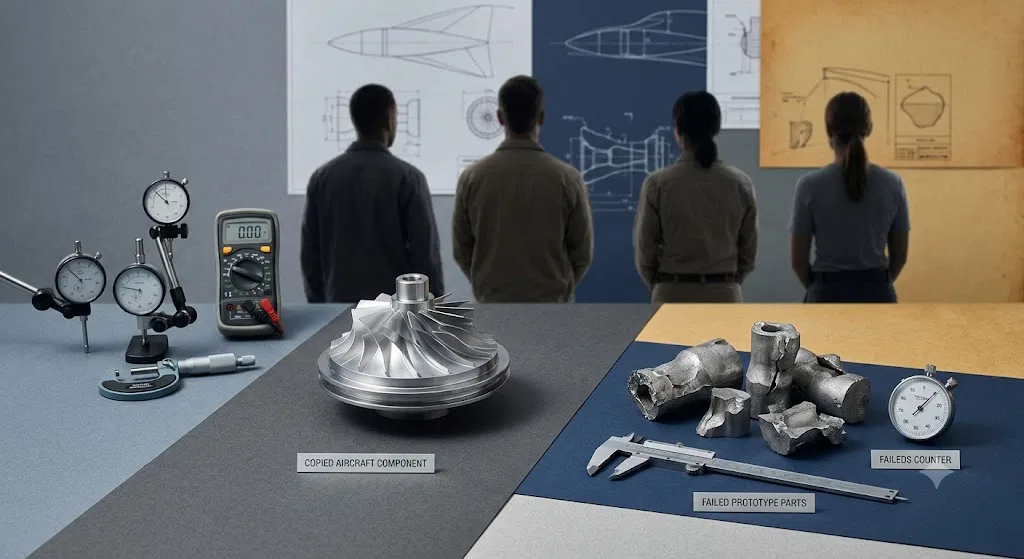
A weapon is not just an object; it is the final physical expression of a much larger production ecosystem. A recovered missile seeker, stealth aircraft panel or electronic warfare pod may show dimensions, circuit boards and materials, but not the full chain of decisions behind them: which tolerances were critical, which defects were acceptable, which suppliers had special processes, how components were screened, or what tests were used to reject marginal parts.
That distinction matters because reverse engineering answers the question “what is this?” more easily than “how do we make thousands of these with the same performance?” Andrea and Mauro Gilli’s widely cited study of military-technological imitation argues that modern weapons have become harder to imitate not because information never leaks, but because the production of top-tier systems depends on complex, specialised manufacturing processes and systems integration that cannot be copied from drawings alone.[MIT Press Direct]direct.mit.eduWhy China Has Not Caught Up Yet MilitaryWhy China Has Not Caught Up Yet Military
The difference is clearest when a weapon depends on many interacting subsystems. A radar-guided missile is not only a radar, a warhead, a motor and a control surface assembly. It is also the way those parts exchange data, survive vibration, manage heat, resist interference, maintain calibration and behave after months in storage. A copied part that looks correct may still fail if it produces slightly different electrical noise, expands differently under heat, or drifts out of tolerance after repeated launches or flights.
Hidden manufacturing knowledge
The most valuable knowledge in an advanced weapon is often not visible in the captured item. It may live in production notes, tooling setups, software repositories, supplier process controls, inspection routines and the experience of technicians who know when a part is “right” before a formal test catches the problem. This is sometimes called tacit knowledge: know-how that is hard to reduce to a blueprint.
That is why official and industrial reverse-engineering efforts often emphasise technical data that goes beyond geometry. The US Army’s reverse engineering equipment topic, for instance, describes the need to capture materials, dimensional tolerances and mechanical properties in an integrated engineering platform, because a usable design package has to contain more than a scanned shape.[Army SBIR/STTR Program]armysbir.army.milOpen source on army.mil.
A copier may be able to measure a component’s dimensions, but not know which dimensions matter most. In an aircraft structure, a hole drilled slightly out of process can affect fatigue life; in a missile, a small assembly variation can alter balance, vibration behaviour or thermal performance. The Defense Contract Management Agency’s 2024 report on an F-35 centre wing assembly audit is a useful public example from a friendly production line: a “drill hole” audit found an improper process that could have compromised structural integrity and caused loss of structural life or unplanned repairs.[Defense Contract Management Agency]dcma.milOpen source on dcma.mil.
That case is not about a foreign copier, but it shows the broader point. Even the original industrial team, with authorised data and qualified suppliers, needs formal quality assurance to prevent small process errors from becoming operational problems. A reverse engineer working from a captured article starts with far less context.
Materials and tooling gaps
Advanced weapons often depend on materials that are difficult to reproduce consistently: high-temperature alloys, composites, energetic materials, coatings, ceramics, optical materials, precision bearings and radiation-hardened or military-grade electronics. Knowing that a part uses a particular alloy is not the same as reproducing the heat treatment, grain structure, coating adhesion, contamination limits and inspection regime that give it the required performance.
The Soviet Tu-4 bomber, copied from interned US B-29 Superfortresses after the Second World War, is a useful historical anchor because it shows both the possibility and the cost of copying. The Soviet Union succeeded, but the effort reportedly involved vast industrial mobilisation, new drawings, re-engineering around metric materials and bringing unfamiliar alloys and other materials into production. The result was not a casual copy made from a captured aircraft; it was a national industrial project involving design bureaux, factories and research institutes.[Wikipedia]WikipediaTupolev Tu-4Tupolev Tu-4
Modern systems raise the bar further. Stealth aircraft, for example, depend not only on external shape but on materials, coatings, apertures, seams, maintenance practices and manufacturing consistency. Public F-35 reporting illustrates how demanding even authorised production and sustainment can be: US oversight and defence reporting have repeatedly discussed quality defects, low-observable maintenance burdens, software integration and readiness shortfalls across the programme.[pogo.org]pogo.orgF-35 Testing Report Reveals Problems with ProductionF-35 Testing Report Reveals Problems with Production
Tooling is a separate barrier. A captured turbine blade, composite skin or missile casing does not provide the machines, moulds, fixtures, measurement tools and process controls used to make it. A state may know the target shape but lack the five-axis machining capacity, autoclaves, precision casting methods, clean rooms, metrology equipment or energetic-material handling infrastructure needed to manufacture it safely and repeatedly.
Supply chains are part of the weapon
Reverse engineering often reveals that a weapon is less nationally self-contained than its markings suggest. Investigations into Russian weapons used in Ukraine have repeatedly found foreign-made electronics inside missiles, drones and other systems. RUSI’s 2022 examination of 27 Russian military systems concluded that many of Russia’s modern weapons relied on foreign microelectronics, while Conflict Armament Research has documented thousands of missile and UAV components recovered from the war.[Royal United Services Institute]rusi.orgsilicon lifeline western electronics heart russias war machinesilicon lifeline western electronics heart russias war machine
This cuts both ways. For analysts, captured components can expose supply-chain dependencies and sanctions vulnerabilities. For a would-be copier, however, those same findings show that building the weapon may require access to global semiconductor, sensor, optics and machine-tool networks. If the original manufacturer quietly relied on imported chips, specialised test equipment or foreign machine tools, a copier cut off from those inputs may have to redesign the system rather than simply reproduce it.
Even major defence producers struggle with these industrial dependencies. CSIS has described solid rocket motors for missile defence as a constrained industrial-base sector shaped by complex supply chains, demand cycles and government-industry incentives. Recent reporting on US efforts to expand rocket-motor and munitions production has likewise highlighted bottlenecks in motors, igniters, guidance systems and production capacity.[CSIS]csis.orgOpen source on csis.org.
The lesson for reverse engineering is blunt: a captured missile does not include a qualified supply chain. It may show what inputs the original used, but not guarantee that the copier can buy, substitute or domestically manufacture them without degrading performance.
Testing turns a copy into a weapon
A reverse-engineered system may look convincing long before it is safe, reliable or militarily useful. Weapons must survive storage, transport, vibration, moisture, electromagnetic interference, temperature extremes, operator error and combat stress. Testing is the process that discovers whether the copy works outside a laboratory.
This is especially important because some failures only appear after repeated use or long-duration exposure. A copied missile motor might pass one static firing but age poorly in storage. A cloned radar might work in clean conditions but fail under jamming. A copied aircraft component might pass dimensional inspection yet develop fatigue cracks earlier than expected. These are not cosmetic differences; they determine whether commanders can trust the system.
US watchdog reporting on weapons testing shows how difficult this is even for the original acquirer. GAO’s work on weapon-system testing has stressed the importance of involving testers early, using iterative testing, applying digital engineering tools and obtaining user feedback throughout development.[GAO]gao.govgao 26 107009gao 26 107009
That testing burden is one reason captured hardware can be more useful for countermeasures than replication. If engineers can measure a seeker’s operating behaviour, they may be able to design jamming, decoys or tactics faster than they could build an equivalent missile. Exploitation turns the object into knowledge; replication turns it into an industrial obligation.
Reliability is harder to copy than appearance
The most misleading reverse-engineering success is the look-alike: a weapon that resembles the original but cannot match its reliability, maintainability or production consistency. Reliability depends on ordinary-looking details: connectors, seals, coatings, software fault handling, calibration procedures, spare-parts quality and how quickly technicians can diagnose failures.
The F-35 offers a public example of how reliability and production quality remain hard even inside the authorised programme. A 2015 Department of Defense Inspector General report found that reducing the assembly defect rate was important for reaching full-rate production goals, and later public reporting has continued to identify production quality, maintenance and readiness problems.[U.S. Department of War]media.defense.govU.S. Department of War Quality Assurance Assessmentof the F-35 Lightning IIU.S. Department of War Quality Assurance Assessmentof the F-35 Lightning II(https://media.defense.gov/2015/Mar/11/2001713476/-1/-1/1/DODIG-2015-092.pdf)
For a foreign copier, the challenge is steeper. The original manufacturer may have years of failure data: which components crack, which sensors drift, which coatings wear, which parts need redesign, and which maintenance intervals are realistic. A captured system gives a snapshot, not the learning curve. Without that accumulated reliability data, the copy may repeat old mistakes that the original producer already fixed.
This is why a state may produce a derivative rather than a true copy. It may keep the visible layout but substitute available electronics, use a different engine, simplify manufacturing, or accept lower performance. That can still be militarily useful, especially when quantity matters more than sophistication, but it is not the same as replicating the original’s full capability.
Software and integration create invisible barriers
In many modern weapons, software is not an accessory; it is part of the weapon’s performance. Flight-control laws, sensor fusion, electronic warfare libraries, target-recognition logic, navigation filtering and fault management can determine whether a platform is merely functional or genuinely advanced. A captured circuit board may reveal chips and layout, but not necessarily source code, training data, update pipelines, classified threat libraries or the engineering rationale behind software behaviour.
Systems integration is the bigger invisible barrier. A high-performance aircraft, missile or air-defence system is a network of subsystems that must work together under severe timing, power, cooling and space constraints. Gilli and Gilli’s argument is especially relevant here: as military technology becomes more complex, imitation becomes harder because the challenge shifts from copying individual components to integrating many specialised elements into a reliable whole.[Belfer Center]belfercenter.orgOpen source on belfercenter.org.
This is why “stealing the design” can disappoint. Drawings may reveal the architecture, and cyber espionage may reveal some files, but the copier still has to reproduce the engineering organisation that can build, debug, test, update and sustain the system. A radar, missile or aircraft with unstable software, poor cooling, unreliable data links or weak diagnostics can be dangerous to its own operators before it is dangerous to the enemy.
Copying can teach more than it delivers
Reverse engineering is not useless. It can be extremely valuable. Captured weapons can reveal component origins, design priorities, manufacturing shortcuts, software practices, quality-control changes and operational weaknesses. Ukraine’s wartime exploitation of recovered Russian systems, and public databases of foreign components in weapons, show how recovered materiel can become a source of supply-chain intelligence and countermeasure development.[Conflict Armament Research]conflictarm.comfield dispatchesfield dispatches
The realistic payoff is often learning rather than cloning. A state may discover how an adversary solved a packaging problem, what commercial chips it used, how it arranged antennas, or where its quality has declined under pressure. That knowledge can guide domestic design, sanctions policy, battlefield countermeasures or training. It may also shorten development in selected subsystems, especially where the copier already has a strong industrial base.
But the central critique remains: possession is not production. A captured weapon can answer many intelligence questions, but it cannot supply the missing factories, materials science, skilled labour, process discipline, testing history or supplier ecosystem. In reverse engineering foreign military technology, the object is the beginning of the investigation, not the shortcut people imagine.
Amazon book picks
Further Reading
Books and field guides related to Why Capturing a Weapon Is Not Enough. Use these as the next step if you want deeper reading beyond the article.
The Pentagon's Brain
Provides context on advanced defense technologies and development ecosystems.
Skunk Works
Shows the hidden manufacturing, testing and engineering ecosystem behind advanced systems.
The Machine That Changed the World
Illustrates how production systems matter beyond designs and drawings.
eBay marketplace picks
Marketplace Samples
Live-tested eBay searches with available results related to this page.




Endnotes
1.
Source: [nasic]({{ ‘nasic/’ | relative_url }}). af.mil
Title: NASICAcquire, Assess, Exploit
Link:https://www.nasic.af.mil/News/Article-Display/Article/1010245/acquire-assess-exploit/
2.
Source: media.defense.gov
Link:https://media.defense.gov/1997/Oct/08/2001715489/-1/-1/1/98-005.pdf
3.
Source: direct.mit.edu
Title: Why China Has Not Caught Up Yet Military
Link:https://direct.mit.edu/isec/article/43/3/141/12218/Why-China-Has-Not-Caught-Up-Yet-Military
4.
Source: armysbir.army.mil
Link:https://armysbir.army.mil/topics/reverse-engineering-equipment/
5.
Source: Wikipedia
Title: Tupolev Tu-4
Link:https://en.wikipedia.org/wiki/Tupolev_Tu-4
6.
Source: pogo.org
Title: F-35 Testing Report Reveals Problems with Production
Link:https://www.pogo.org/analyses/f-35-testing-report-reveals-problems-with-production-decisions
7.
Source: stripes.com
Title: f 35 production quality issues pentagon 16705254
Link:https://www.stripes.com/theaters/us/2025-02-03/f-35-production-quality-issues-pentagon-16705254.html
8.
Source: rusi.org
Title: silicon lifeline western electronics heart russias war machine
Link:https://www.rusi.org/explore-our-research/publications/special-resources/silicon-lifeline-western-electronics-heart-russias-war-machine
9.
Source: csis.org
Link:https://www.csis.org/analysis/solid-rocket-motors-missile-defense-challenges-and-opportunities-expanding-industrial-base
10.
Source: gao.gov
Title: gao 26 107009
Link:https://www.gao.gov/assets/gao-26-107009.pdf
11.
Source: media.defense.gov
Title: U.S. Department of War Quality Assurance Assessmentof the F-35 Lightning II
Link:https://media.defense.gov/2015/Mar/11/2001713476/-1/-1/1/DODIG-2015-092.pdf
12.
Source: gao.gov
Link:https://www.gao.gov/assets/a303517.html
13.
Source: gao.gov
Title: gao 25 107569
Link:https://www.gao.gov/assets/gao-25-107569.pdf
14.
Source: gao.gov
Title: gao 18 45
Link:https://www.gao.gov/assets/gao-18-45.pdf
15.
Source: gao.gov
Title: 11 171r
Link:https://www.gao.gov/assets/gao-11-171r.pdf
16.
Source: rusi.org
Link:https://www.rusi.org/explore-our-research/publications/special-resources/silicon-lifeline-western-electronics-heart-russias-war-machine/interactive-summary
17.
Source: Wikipedia
Title: Reverse engineering
Link:https://en.wikipedia.org/wiki/Reverse_engineering
18.
Source: direct.mit.edu
Title: Correspondence Military Technological Imitation
Link:https://direct.mit.edu/isec/article/44/2/185/12234/Correspondence-Military-Technological-Imitation
19.
Source: direct.mit.edu
Link:https://direct.mit.edu/isec/article-abstract/43/3/141/12218
20.
Source: belfercenter.org
Link:https://www.belfercenter.org/publication/why-china-has-not-caught-yet-military-technological-superiority-systems-integration-and
21.
Source: dcma.mil
Link:https://www.dcma.mil/News/Article-View/Article/3896460/qa-identifies-helps-fix-critical-f-35-assembly-flaw/
22.
Source: conflictarm.com
Title: field dispatches
Link:https://www.conflictarm.com/field-dispatches/
23.
Source: war-sanctions.gur.gov.ua
Link:https://war-sanctions.gur.gov.ua/en/components
24.
Source: news.ycombinator.com
Link:https://news.ycombinator.com/item?id=26333649
25.
Source: conflictarm.com
Link:https://www.conflictarm.com/publications/
Additional References
26.
Source: youtube.com
Link:https://www.youtube.com/watch?v=HizZHcPc9UE
Source snippet
LDM #360: Reverse engineering of a Russian missile electronic board #1...
27.
Source: youtube.com
Title: Has Iran seized a stealth missile? Fears of reverse engineering erupt
Link:https://www.youtube.com/watch?v=9wB6RlQmHUU
Source snippet
The Cold War British Jet Engine Blunder That Armed the Soviet Empire. Arming the MiG-15...
28.
Source: youtube.com
Title: LDM #360: Reverse engineering of a Russian missile electronic board #1
Link:https://www.youtube.com/watch?v=5Huo0RA-F0c
Source snippet
What US Engineers Found Inside the MiG-25 After Belenko Defected With It in 1976...
29.
Source: youtube.com
Link:https://www.youtube.com/watch?v=xxvEHCJXgc4
Source snippet
Why China Has Not Caught Up Yet in Military Technology?...
30.
Source: youtube.com
Title: Why China Has Not Caught Up Yet in Military Technology?
Link:https://www.youtube.com/watch?v=eU9WyxhFldk
Source snippet
Has Iran seized a stealth missile? Fears of reverse engineering erupt...
31.
Source: hsgac.senate.gov
Link:https://www.hsgac.senate.gov/wp-content/uploads/09.10.2024-Majority-Staff-Report-The-U.S.-Technology-Fueling-Russias-War-in-Ukraine.pdf
32.
Source: facebook.com
Link:https://www.facebook.com/TimesofIndia/posts/a-report-by-conflict-armament-research-revealed-that-a-north-korean-missile-reco/782049360635920/
33.
Source: airandspaceforces.com
Link:https://www.airandspaceforces.com/article/0609bomber/
34.
Source: nationalinterest.org
Link:https://nationalinterest.org/blog/reboot/americas-massive-b-29-bomber-once-fought-russia-175712
35.
Source: storymaps.arcgis.com
Link:https://storymaps.arcgis.com/stories/288b05993eb041c289fb3749b4e1d4cf
Topic Tree
Follow this branch
Parent topic
Foreign MaterielRelated pages 29
- Beyond Blueprints Why a weapon copy needs more than drawings
- Material Gaps Why the same alloy is not the same weapon
- Quality Control When a tiny defect ruins a weapon copy
- Supply Chains The parts trail inside captured weapons
- Tacit Know How The invisible know how inside advanced weapons
- +1 more in sidebar