Within Industrial Learning From Captured Weapon Design
Why Blueprints Are Not Enough
Reverse engineering breaks down when the copier lacks matching gauges, tooling, suppliers or testing discipline.
On this page
- Tolerances that factories must repeat
- Metric standards and material substitutions
- Testing redesigned parts instead of copying blindly
Page outline Jump by section
Introduction
Reverse engineering foreign military technology often begins with a tempting assumption: if engineers can measure every dimension of a captured weapon, they can reproduce it. In practice, that is frequently wrong. A recovered missile, tank component or drone may reveal geometry, materials and assembly methods, yet successful production depends on something less visible: industrial standards. Factories need calibrated gauges, repeatable machine tools, qualified suppliers, inspection procedures and testing regimes capable of reproducing the original design consistently. When those foundations are missing, copying can fail even when the blueprint appears complete. The result is a recurring lesson in military technology exploitation: captured hardware can teach valuable industrial lessons, but physical possession of a design is not the same as possessing the manufacturing system that created it.[idu.ac.id]ftp.idu.ac.idReverse Engineering: An Industrial PerspectiveJanuary 13, 2008 — Tooling is the standard for manufacturing parts be- cause drawings and digital models either do not exist or are not a…
Tolerances Factories Must Repeat, Not Just Measure
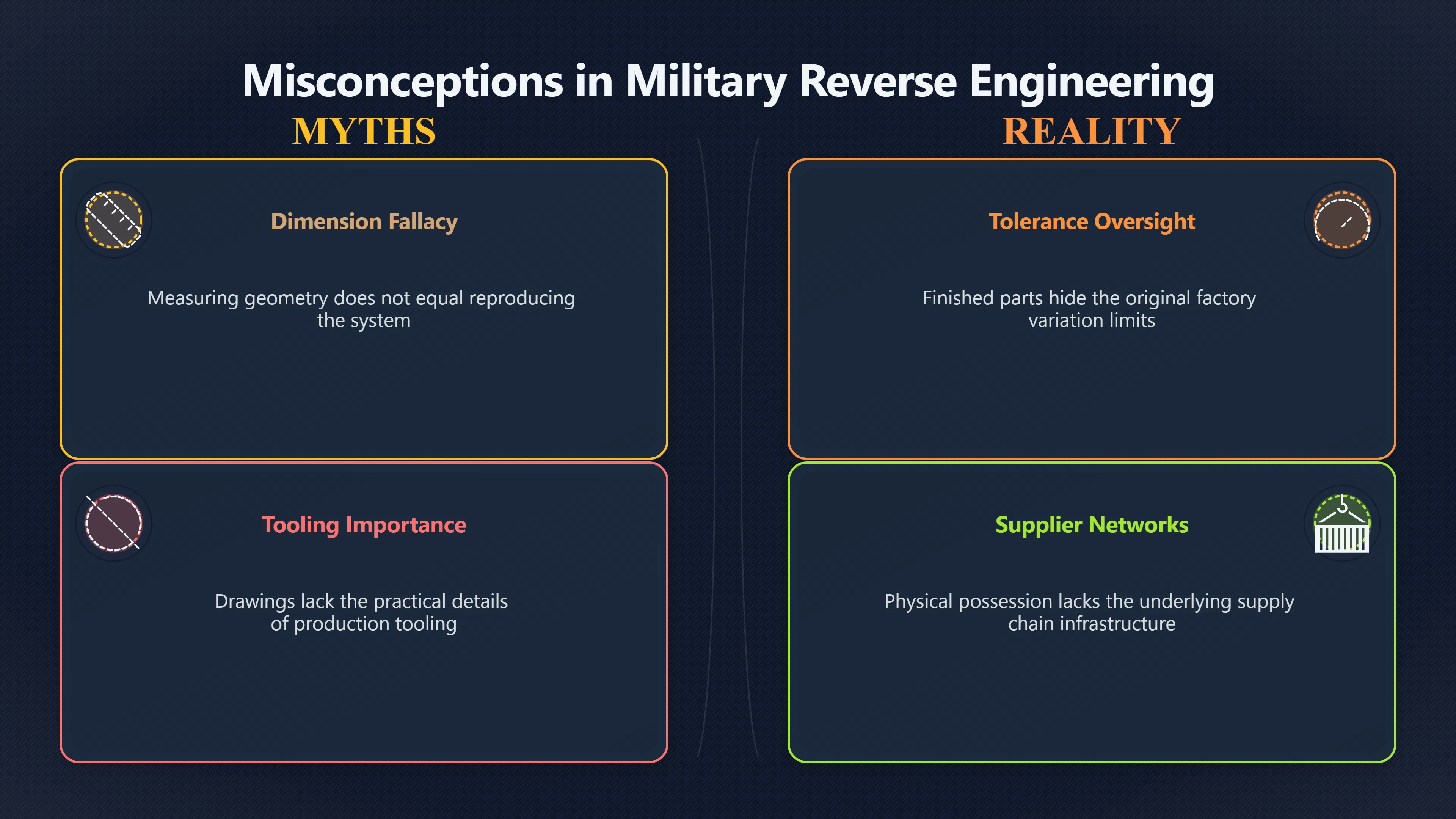
The most common misconception in reverse engineering is that dimensions alone define a product. In reality, every engineered system depends on tolerances: the acceptable variation around a nominal dimension. These limits determine whether moving parts fit together, whether electronics survive vibration, and whether complex assemblies remain reliable after production.
Modern reverse-engineering literature repeatedly notes that tolerances are among the hardest characteristics to recover from a finished object. Measuring a part reveals what was built, but not necessarily what variation the original factory allowed. Researchers studying reverse-engineering processes have highlighted that overlooking tolerances can lead either to unnecessarily expensive manufacturing or to parts that fail qualification. Industrial metrology specialists similarly note that reverse engineering does not automatically reveal nominal values or production tolerances; additional engineering judgement is required before manufacturing can begin.[ResearchGate]researchgate.netHowever, tolerances are often overlooked in a reverse engineering (RE) process…Read more…
This problem becomes especially serious in military systems. A missile fin, bearing surface or guidance component may function correctly only when produced within a narrow range of variation. A copier can reproduce the dimensions of one captured specimen perfectly yet still fail to establish a production process capable of generating thousands of acceptable copies.
The challenge is therefore not measuring a weapon once. The challenge is building a factory that can manufacture it repeatedly without unacceptable drift.
Why Matching Tools Matter More Than Matching Drawings
Captured hardware rarely reveals the entire production environment. Machine settings, inspection fixtures, heat-treatment procedures, calibration standards and manufacturing know-how are often absent.
Industrial studies of reverse engineering repeatedly emphasise the distinction between a physical part and the tooling used to create it. In many sectors, tooling effectively becomes the true manufacturing standard because drawings alone do not capture every practical detail of production. Aerospace and defence industries have long faced this problem when reproducing legacy components: possessing a part does not automatically recreate the production capability behind it.[ftp.idu.ac.id]ftp.idu.ac.idReverse Engineering: An Industrial PerspectiveJanuary 13, 2008 — Tooling is the standard for manufacturing parts be- cause drawings and digital models either do not exist or are not a…
This helps explain why some historical copying efforts achieved only partial success. Reverse engineers could understand how a system worked but struggled to reproduce reliability, lifespan or production speed. Differences in machine precision, surface finishing techniques or quality-control procedures could create subtle defects that only appeared during operational use.
The industrial lesson is that a weapon is not merely a collection of parts. It is the output of an entire manufacturing ecosystem.

Metric Standards, Suppliers and Material Substitutions
Even when dimensions can be reproduced, factories must still obtain suitable materials and components. Captured equipment often contains alloys, coatings, adhesives, electronic packages or manufacturing inputs that are difficult to source elsewhere.
[Reverse engineering]Wikipedia22 May 2019 — Reverse Engineering is NOT engineering, without additional information we are not able to derive tolerances nor nominal val… ng programme may therefore face three choices:
- Obtain the original material.
- Develop an equivalent domestic substitute.
- Redesign the component around available materials.
Each option introduces risk. Material substitutions can alter strength, fatigue life, corrosion resistance or thermal behaviour. Small differences that appear insignificant in laboratory inspection may become important under operational stresses.
Historical examinations of wartime equipment frequently revealed that production quality depended heavily on supply chains. The T-34 tank, for example, demonstrated how manufacturing realities shaped final products. Investigations of wartime production identified variability in weld quality, armour treatment and finishing standards across factories. Soviet designers continually balanced performance against available materials, labour and production capacity.[Wikipedia]WikipediaOpen source on wikipedia.org.
For a copier, reproducing a design without reproducing the supplier network often creates hidden divergence. A component may look identical while behaving differently under field conditions.
The Sidewinder Lesson: Copying the Architecture Is Easier Than Copying the Process
The Soviet exploitation of the captured AIM-9B Sidewinder is often cited as a reverse-engineering success. Soviet engineers obtained an intact missile and used it as the basis for the K-13, later known in NATO terminology as the AA-2 Atoll. Contemporary accounts describe the recovered missile as a remarkable educational resource for missile engineering.[wikipedia.org]WikipediaReverse engineeringReverse engineering
Yet the broader industrial lesson is not that copying is easy. The achievement required more than measuring components. Soviet industry already possessed significant aerospace manufacturing capability, testing infrastructure and engineering expertise. The captured missile provided knowledge, but existing industrial capacity allowed that knowledge to be absorbed and reproduced.
This distinction matters because many reverse-engineering efforts focus on the visible artefact while underestimating the invisible standards behind it. A sophisticated factory can often adapt a captured design. A weaker industrial base may understand the design perfectly and still fail to reproduce it reliably.
Why Testing Often Matters More Than Copying
The most successful reverse-engineering programmes do not attempt exact duplication. Instead, they use captured systems as starting points for redesign.
Testing is the mechanism that makes this possible. Engineers evaluate whether copied parts meet performance requirements, whether substitutes introduce new weaknesses and whether manufacturing variations remain acceptable. Without rigorous testing, a copied design can inherit problems that are difficult to detect during inspection.
Industrial reverse-engineering specialists frequently warn that reproducing geometry is the easy part. Unknown materials, undocumented processes, missing qualification data and absent production history often become the real obstacles. Effective programmes therefore treat reverse engineering as an engineering-development exercise rather than a copying exercise.[Authentise]authentise.comHow to Reverse Engineer a Legacy Part for AdditiveHow to Reverse Engineer a Legacy Part for Additive…May 12, 2026 — 12 May 2026 — Learn how to reverse engineer legacy parts f…
In military technology, this approach is particularly important because operational conditions expose weaknesses that factory inspection may miss. Vibration, temperature extremes, storage conditions, shock loads and combat stresses can reveal failures that are invisible during simple dimensional checks.
Why Blueprints Are Not Enough
The central weakness of blind copying is that it confuses information with capability. Reverse engineering can reveal dimensions, materials and design logic. It cannot automatically recreate supplier networks, metrology systems, tooling standards, inspection culture or manufacturing experience.
That is why captured weapons often provide their greatest value as industrial lessons rather than as templates for exact duplication. They show how another country solved manufacturing problems, where it accepted compromises and which standards it considered essential. Factories that understand those lessons can adapt and redesign. Factories that attempt literal copying without equivalent industrial standards often discover that the hardest part of a weapon was never the blueprint. It was the production system hidden behind it.[idu.ac.id]ftp.idu.ac.idReverse Engineering: An Industrial PerspectiveJanuary 13, 2008 — Tooling is the standard for manufacturing parts be- cause drawings and digital models either do not exist or are not a…
Amazon book picks
Further Reading
Books and field guides related to Why Blueprints Are Not Enough. Use these as the next step if you want deeper reading beyond the article.
To Engineer is Human
Discusses tolerances, design limits and real-world engineering practice.
The Machine That Changed the World
Explains why production systems matter beyond drawings and specifications.
The Goal
Shows how production capability depends on systems and constraints, not just designs.
The Design of Everyday Things
Highlights the gap between design intent and implementation.
eBay marketplace picks
Marketplace Samples
Live-tested eBay searches with available results related to this page.




Endnotes
1.
Source: ftp.idu.ac.id
Title: Reverse Engineering: An Industrial Perspective
Link:https://ftp.idu.ac.id/wp-content/uploads/ebook/tdg/MILITARY%20REFERENCE%20AND%20REVERSE%20ENGINEERING/epdf.pub_reverse-engineering-an-industrial-perspective-spri.pdf
Source snippet
January 13, 2008 — Tooling is the standard for manufacturing parts be- cause drawings and digital models either do not exist or are not a...
Published: January 13, 2008
2.
Source: cmmxyz.com
Title: misconceptions about reverse engineering
Link:https://www.cmmxyz.com/blog/misconceptions-about-reverse-engineering/
Source snippet
22 May 2019 — Reverse Engineering is NOT engineering, without additional information we are not able to derive tolerances nor nominal val...
Published: May 2019
3.
Source: researchgate.net
Link:https://www.researchgate.net/publication/350502966_Tolerance_estimation_and_metrology_for_reverse_engineering_based_remanufacturing_systems
Source snippet
However, tolerances are often overlooked in a reverse engineering (RE) process...Read more...
4.
Source: Wikipedia
Link:https://en.wikipedia.org/wiki/T-34
5.
Source: Wikipedia
Title: Reverse engineering
Link:https://en.wikipedia.org/wiki/Reverse_engineering
6.
Source: reddit.com
Link:https://www.reddit.com/r/hoggit/comments/ai7n8o/til_that_the_soviet_aa2_atoll_missile_was_reverse/
Source snippet
er it became lodged in a Chinese MiG-17 without exploding.Read more...
7.
Source: authentise.com
Title: How to Reverse Engineer a Legacy Part for Additive
Link:https://www.authentise.com/post/how-to-reverse-engineer-a-legacy-part-for-additive-manufacturing
Source snippet
How to Reverse Engineer a Legacy Part for Additive...May 12, 2026 — 12 May 2026 — Learn how to reverse engineer legacy parts f...
Published: May 12, 2026
8.
Source: reddit.com
Link:https://www.reddit.com/r/badhistory/comments/10o3tnr/the_t34_is_not_as_bad_as_you_think_it_is_part_25/
Source snippet
The T-34 is not as bad as you think it is, Part 2/5: r/badhistoryThe welding of the T-34 was known to be pretty weak, often just spot-we...
9.
Source: researchgate.net
Title: 327097892 Reverse Engineering in Product Manufacturing An Overview
Link:https://www.researchgate.net/publication/327097892_Reverse_Engineering_in_Product_Manufacturing_An_Overview
Source snippet
Reverse Engineering in Product Manufacturing: An Overview18 Aug 2018 — The chapter presents review on reverse engineering methodology and...
10.
Source: youtube.com
Link:https://www.youtube.com/watch?v=7ReGItVDwxk
Source snippet
Reverse Engineering, 3D Scanning & Designing for Additive Manufacturing...
11.
Source: youtube.com
Title: Reverse Engineering, 3D Scanning & Designing for Additive Manufacturing
Link:https://www.youtube.com/watch?v=FJRgA2hR3js
Source snippet
LDM #360: Reverse engineering of a Russian missile electronic board #1...
12.
Source: fictiv.com
Title: mro parts reverse engineering guide
Link:https://www.fictiv.com/articles/mro-parts-reverse-engineering-guide
Source snippet
Reverse Engineering for Industrial MRO Parts29 May 2026 — Reverse engineering for MRO parts is the process of capturing technical specifi...
Published: May 2026
13.
Source: formlabs.com
Title: reverse engineering
Link:https://formlabs.com/eu/blog/reverse-engineering/
Source snippet
Guide to Reverse Engineering: All You Need To Know1 Jun 2023 — Learn about the reverse engineering process, the best tools for reverse en...
14.
Source: cmgear.us
Title: reverse engineering gears
Link:https://www.cmgear.us/feeds/blog/reverse-engineering-gears
Source snippet
Advanced Gear Reverse Engineering Techniques Explained2 Mar 2026 — Gear reverse engineering is the systematic process of recreating gear...
15.
Source: enventure.com
Link:https://enventure.com/wp-content/uploads/2018/06/Enventure_PEG_CaseStudy_Reverse_Engineering_for_anAeronauticalComponentManufacturingFirm.pdf
Source snippet
to be reverse engineered to complete the re-engineering of the assembly.Read more...
Additional References
16.
Source: cia.gov
Link:https://www.cia.gov/readingroom/docs/CIA-RDP81-01044R000100070001-4.pdf
Source snippet
This was two inches below that considered necessary by the. U. S. designers. (f) Power traversing could...Read more...
17.
Source: centerline.ro
Title: industrial reverse engineering from used part to accurate 3d model step by step
Link:https://centerline.ro/en/industrial-reverse-engineering-from-used-part-to-accurate-3d-model-step-by-step/
Source snippet
Industrial reverse engineering: a complete technical guide17 Mar 2026 — Reverse engineering is the process of analyzing an existing physi...
18.
Source: tarvinprecision.co.uk
Link:https://tarvinprecision.co.uk/reverse-engineered-parts-practical-guide-to-replacement-components-and-legacy-hardware/
Source snippet
It's tempting to apply tight tolerances “just to be safe,” but that can drive cost up fast –...Read more...
19.
Source: wasinc.com
Title: Schmidt Industrial Services Should You Reverse Engineer?
Link:https://wasinc.com/reverse-engineering-everything-need-to-know/
Source snippet
Everything You Need to...7 Apr 2026 — Done well, reverse engineering restores control, reduces downtime, and improves reliability. Done...
20.
Source: strasam.org
Link:https://strasam.org/en/defense/aerospace-industry/how-the-soviets-were-able-to-copy-the-american-aim-9-sidewinder-airborne-missile-through-reverse-engineering-and-espionage-during-the-cold-war-3362
Source snippet
an-made AIM-9 Sidewinder Airborne Air Missiles through reverse engineering...
21.
Source: gearsolutions.com
Title: recommendations for reverse engineering
Link:https://gearsolutions.com/features/recommendations-for-reverse-engineering/
Source snippet
4 Mar 2011 — Always remember that you are measuring a worn or failed part. Your drawing may have been wrong or a tolerance may have been...
22.
Source: facebook.com
Title: Tight, dark, and brutally functional
Link:https://www.facebook.com/christian.bohm.96930/posts/tight-dark-and-brutally-functionali-step-inside-a-t-34-and-explore-the-tank-from/25405015345814639/
Source snippet
I step inside a T-34...In addition, close examination of the T-34 at the Aberdeen Testing Ground showed that a variety of alloys were us...
23.
Source: popularmechanics.com
Title: how china built air to air missle
Link:https://www.popularmechanics.com/military/aviation/a61856884/how-china-built-air-to-air-missle/
Source snippet
How China Copied Its Way to Building a World-Class Air-...20 Aug 2024 — Though unsuccessful in reverse-engineering the Sidewinder, China...
24.
Source: youtube.com
Title: Flawed Doctrine or Poor [Training]({{ ‘training/’ | relative_url }})
Link:https://www.youtube.com/watch?v=vsYx-8l0c8E
Source snippet
Why Did the T-34 Suffer...The Soviets didn't have any plans to go to war using the T-34 after considering its deficiencies found during...
25.
Source: tankarchives.com
Title: aberdeen t 34 and kv 1 test
Link:https://www.tankarchives.com/2013/04/aberdeen-t-34-and-kv-1-test.html
Source snippet
Aberdeen: T-34 and KV-1 Test2 Apr 2013 — [Documents]({{ 'documents/' | relative_url }}) regarding the Aberdeen proving ground tests of T-34 and KV tanks...
Topic Tree