Within Foreign Materiel
What Repairs Reveal About an Army
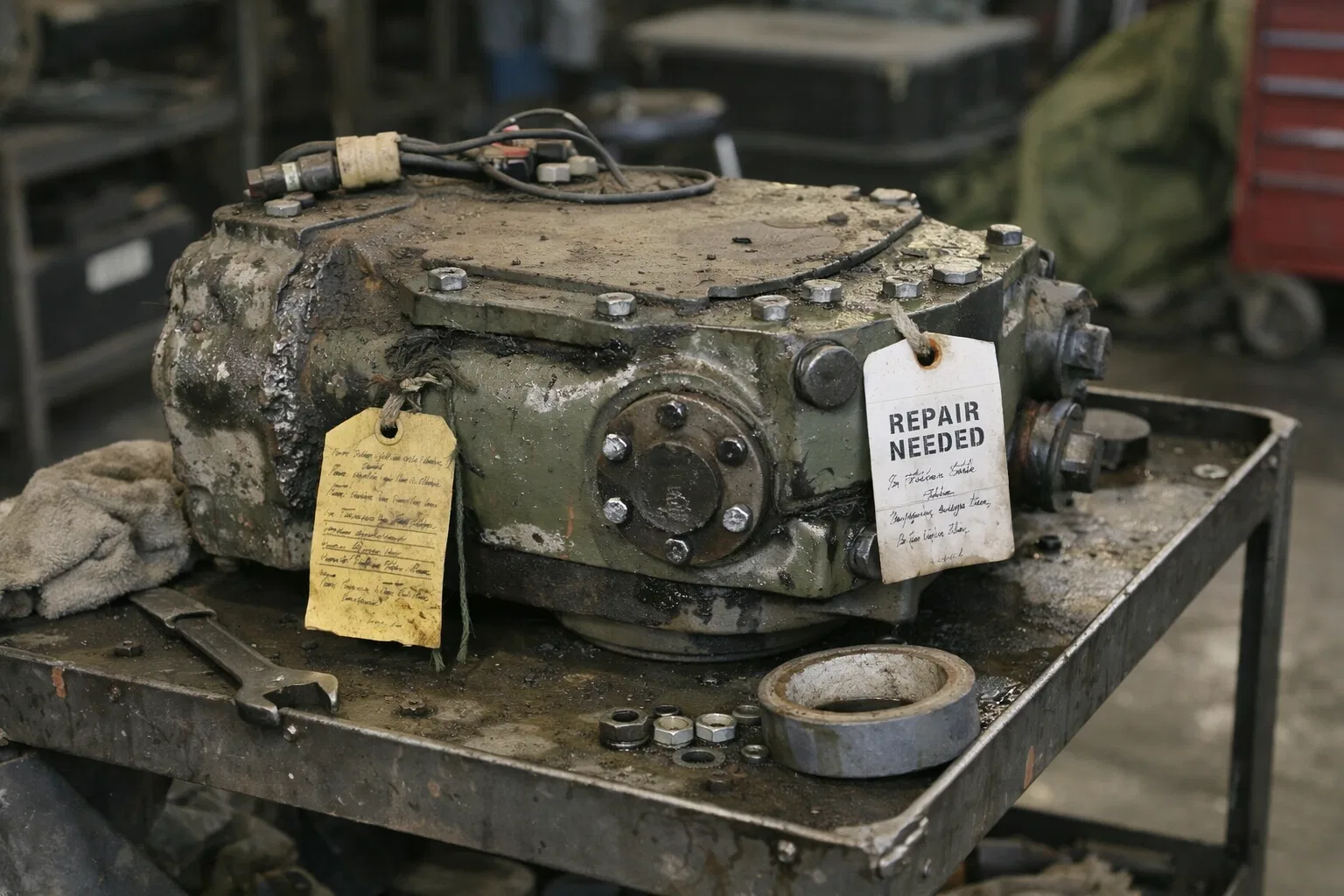
Wear patterns, repairs and packaging can show how a force maintains equipment under real conditions.
On this page
- Wear and failure patterns
- Field modifications
- Logistics assumptions
Page outline Jump by section
Introduction
Captured equipment does not only reveal how a foreign weapon was designed. It can also reveal how it was kept alive after weeks, months or years of real use. Scraped paint, mismatched bolts, welded patches, improvised wiring, missing covers, reused components, local markings and spare-parts packaging can show whether an army maintains equipment through a disciplined supply system, battlefield improvisation, cannibalisation or a mix of all three.
That matters in reverse engineering foreign military technology because the most useful question is often not “what was the design supposed to do?” but “what did the force actually manage to keep working?” Formal specifications can overstate reliability; wreckage can understate it. Maintenance clues sit between the two. They show the gap between factory intent and battlefield practice, and they can expose pressure points: fragile subsystems, scarce components, repair bottlenecks, weak recovery capacity, sanctions workarounds, or adaptations made faster than official doctrine can record. Modern technical intelligence doctrine treats captured enemy materiel, documents and associated support equipment as exploitable intelligence, not as isolated trophies.[Bits]bits.defm2 22.401(06TECHINTJuly 27, 2006 — 9 Jun 2006 — TECHINT includes the identification, assessment, collection, exploitation, and evacuation of capt…
Why maintenance marks are intelligence, not just damage
A captured vehicle or drone is a record of decisions. Some decisions were made by designers: where to place access panels, what fasteners to use, how much redundancy to build into electronics, how easy a gearbox is to remove. Other decisions were made later by soldiers and maintainers: which part was worth replacing, which failure could be worked around, which component was stripped from another system, and which fault was tolerated because no spare was available.
This is why technical exploitation teams try to preserve context. US and NATO-aligned doctrine separates captured enemy documents from captured enemy materiel, but also stresses that manuals, drawings, repair parts and support equipment may need to accompany the captured item until exploitation is complete. That pairing is important: a burnt-out vehicle may show the failure, while a maintenance handbook, spare-parts crate or field repair note may show what the enemy expected to fail.[Public Intelligence |]info.publicintelligence.netUSArmy Document Media ExploitationDOMEX process requires understanding collected, exploited, and processed items. CAPTURED ENEMY…Read more…
Maintenance evidence is especially valuable because it reflects actual operating conditions. A tank inspected in a proving-ground trial tells analysts what happens under controlled testing; a tank recovered from a battlefield may show mud-packed running gear, replaced road wheels, field-welded armour brackets, empty stowage racks, locally adapted radio fits or signs of repeated recovery attempts. The object becomes a small archive of use.
That does not mean every scratch is meaningful. Some damage happens during capture, recovery, transport or post-capture testing. Paint can be applied by the capturing force. Parts may be removed by looters, souvenir hunters or the first unit to reach the vehicle. Good exploitation therefore asks not only “what is different?” but “when did this change probably happen?” The most useful clues are those that can be cross-checked against serial numbers, manuals, photographs, unit markings, maintenance documents, repeated examples and battlefield reports.
Wear and failure patterns
Wear patterns help analysts distinguish design weakness from wartime strain. A repeated crack in the same bracket across several captured vehicles says something different from a single shell strike. So does abnormal wear on track pins, overheated engine compartments, scorched wiring looms, repaired optics mounts or repeatedly replaced tyres. These traces can show what terrain, tempo and maintenance capacity have done to the equipment.
Second World War German armour provides a clear historical example. A US Army historical study of German tank maintenance described how Germany entered the 1941 campaign in the Soviet Union with a largely centralised repair concept, then faced a surge in disabled tanks because of combat damage, mines, long distances, dust, heat, cold and poor transport links. The system had to decentralise under pressure, and German forces relied increasingly on improvisation and cannibalisation. That kind of record helps modern readers understand why a captured tank’s condition can reveal logistics assumptions as much as engineering quality.[GovInfo]govinfo.govGOVPUB D114 PURL gpo81652GOVPUB D114 PURL gpo81652
The same logic applies to present-day Ukraine. Reports from Ukrainian repair sites describe captured Russian tanks and armoured vehicles needing work on engines, steering systems, turrets, undercarriages, braking systems and fuel systems before reuse. Those accounts are not simply stories about battlefield trophies. They show that captured equipment often arrives as a maintenance problem first and an intelligence source second: mechanics must identify faults, find compatible parts, repaint markings, and decide whether the vehicle is worth returning to service.[Stars and Stripes]stripes.comcaptured russian tanks equipment ukraine 8558384captured russian tanks equipment ukraine 8558384
Repeated abandonment is another maintenance clue. A vehicle left intact may indicate a tactical withdrawal, fuel shortage, crew panic, mechanical failure, lack of recovery assets or a damaged but repairable subsystem. Open-source loss trackers such as Oryx only count visually documented losses and caution that totals are incomplete, but the categories they use — destroyed, damaged, abandoned and captured — are useful because abandonment and capture can point to recovery and sustainment failures, not only battlefield defeat.[Oryx]oryxspioenkop.comOryx Attack On Europe: Documenting Russian Equipment LossesOryx Attack On Europe: Documenting Russian Equipment Losses
The most valuable pattern is usually not one dramatic defect but recurrence. If a force keeps losing vehicles with similar thrown tracks, burnt clutches, improvised cooling fixes or missing electronic modules, exploitation teams can infer where the maintenance burden is concentrated. That can inform countermeasures and targeting: not by copying the weapon, but by understanding what the enemy struggles to keep operational.
Field modifications show doctrine under pressure
Field modifications are among the clearest signs that soldiers are adapting faster than formal procurement can respond. They may be crude, clever or both. Extra cages, improvised drone mounts, added cameras, local armour plates, non-standard radios, rewired batteries and makeshift fuel fittings all show a force trying to solve immediate problems with available material.
The Russian Orlan drone became an early example of how small internal details can shape public and technical assessments. Ukrainian and media reports of dismantled Orlan systems highlighted commercial cameras, improvised fittings and even a plastic bottle-top fuel cap. Some of those details were used for ridicule, but the intelligence value is more sober: such construction choices can indicate cost control, availability of commercial parts, ease of field replacement and the extent to which a supposedly military system depends on civilian supply chains.[CALCE]calce.umd.eduOpen source on umd.edu.
Field changes can also show learning. A later report on an Orlan found an added rear-view camera, apparently intended to help the operator respond to Ukrainian interceptor drones. Whether every such modification becomes standard is a separate question, but the clue is important: a captured or downed system may show the enemy’s current adaptation cycle before official manuals or public statements do.[Pravda]pravda.com.uaPravda"Rear-view camera" found on Russian Orlan drone – photoPravda"Rear-view camera" found on Russian Orlan drone – photo
Armoured vehicles offer the same kind of evidence at a larger scale. In Ukraine, captured Russian armour has often required repainting, repair and part substitution before being used by Ukrainian units. The process itself reveals how maintainers make captured systems legible and usable: hostile markings are removed, faults are diagnosed, assemblies are repaired, and vehicles are integrated into a different logistics system.[Stars and Stripes]stripes.comcaptured russian tanks equipment ukraine 8558384captured russian tanks equipment ukraine 8558384
Improvisation should not automatically be read as incompetence. In a long war, even well-organised armies improvise. The distinction is whether field modifications are occasional, disciplined adaptations or signs that normal supply and maintenance channels have broken down. Analysts look for consistency, workmanship, repeatability and whether the same workaround appears across many units.
Packaging and spares reveal logistics assumptions
Inside captured equipment, the most revealing item may be the least dramatic: a spare fuse, a labelled cable, a replacement bearing, a sealed component bag, a maintenance tag, a tool roll or a crate stencil. Packaging and spares show what the user expected to replace in the field and what had to be supplied from deeper depots. They also reveal supply-chain dependencies that may be invisible from the outside.
Doctrine recognises this point. Draft US document-and-media exploitation guidance lists not only weapons, vehicles, aircraft and radios as captured enemy materiel, but also “related spares, repair parts, and support equipment”. In practice, a box of spares can be as telling as the main system because it shows which failures the enemy planned for, how parts were labelled, how modular the design is, and whether maintainers were expected to swap assemblies or repair components in place.[Public Intelligence |]info.publicintelligence.net208. Unidentified and modified warfighting equipment and associated materiel. •. Vehicles. •. Weapons. •. Aircraft…Read more…
Commercial components add another layer. Conflict Armament Research and IISS work on Russian, Iranian and North Korean missiles and UAVs in Ukraine has used recovered components to trace procurement routes, identify foreign-made electronics and examine how sanctions and export controls are being bypassed or tested. Those investigations are usually discussed as supply-chain intelligence, but they are also maintenance intelligence: systems built around commercially available components may be easier to source, replace and adapt than systems dependent on bespoke military parts.[IISS]iiss.orgTracking the Components of Missiles and UAVs Used byTracking the Components of Missiles and UAVs Used by
Packaging can also expose recency. Component date codes, import labels, batch numbers and manufacturing marks may show whether a missile, drone or subsystem was assembled before or after sanctions, after a design change, or during a surge in production. CAR has used markings on recovered components to identify post-invasion parts in Russian weapons, demonstrating how debris can connect battlefield use to procurement timelines.[ArcGIS StoryMaps]storymaps.arcgis.comArc GIS Story Maps Dating newly produced Russian missiles used in Kyiv attacksArc GIS Story Maps Dating newly produced Russian missiles used in Kyiv attacks
For maintainers, standardisation is as important as sophistication. A technically advanced system that needs rare parts, special tools and factory-level repair may impose a heavy wartime burden. A cruder system with common parts may be easier to keep moving. Reverse engineering therefore looks at the support ecosystem as well as the object: how many components are unique, how much can be repaired by a field workshop, and how much must be replaced as a sealed module.

Cannibalisation is a clue to scarcity and resilience
Cannibalisation — stripping one damaged system to repair another — is often treated as a sign of shortage. It can be that, but it is also a normal wartime sustainment practice when production, recovery and transport cannot match the tempo of losses. Captured equipment can reveal both sides of the story: scarcity when too many systems are incomplete, resilience when maintainers use dead equipment to keep a smaller number operational.
The war in Ukraine has made this visible. Ukrainian repair units have reportedly used captured Russian equipment as a source of parts for Ukrainian tanks and artillery, creating informal “banks” of components stripped from enemy vehicles. That tells analysts something practical: common Soviet-legacy design lineages can make captured Russian hardware useful not only as trophies, but as sustainment stock for Ukrainian units operating related equipment.[Defense Express]en.defence-ua.comcaptured russian equipment helps in repairing ukrainian tanks and howitzers 8956captured russian equipment helps in repairing ukrainian tanks and howitzers 8956
The same pattern appears in drones. Recent reporting has described both Ukrainian and Russian efforts to refurbish, strip and reuse drone components as electronic warfare, attrition and rapid design cycles make large numbers of UAVs obsolete or damaged. Whether the exact output figures in battlefield claims are independently verifiable or not, the broader maintenance point is clear: in a drone-heavy war, repairability, modularity and parts recovery are operational advantages.[TechRadar]techradar.comTo combat this, the ReDrone workshop—run by the Sternenko Community Foundation—refurbishes up to 2,000 drones monthly, repurposing parts…
Historical examples show that this is not new. Allied ordnance technical intelligence teams in the Second World War reconditioned and cannibalised captured German artillery, enabling captured guns and ammunition to be turned back against German forces. That work required technical understanding, parts selection and practical repair, not merely possession of enemy weapons.[Lone Sentry]lonesentry.comOpen source on lonesentry.com.
Cannibalisation also changes how analysts read captured items. A missing radio may mean the vehicle was abandoned without communications, or it may mean the radio was valuable enough to be removed by either side. A tank with mixed road wheels may show field expediency rather than factory variation. A drone assembled from mismatched parts may show a deliberate repair economy, not necessarily poor original design.
What repairs reveal about training and organisation
Maintenance clues can reveal the human system around a weapon. Neat wiring repairs, correct safetying, proper torque marks, preserved seals and consistent labelling suggest trained maintainers with procedures and time. Hasty welds, bypassed safety devices, mismatched fasteners and unsecured cables may suggest field pressure, poor training, missing tools or urgent adaptation. The same equipment type can show different standards across units.
Ukrainian repair accounts illustrate the organisational challenge. Reports describe battlefield technical reconnaissance units searching for abandoned vehicles, recovery teams moving them to repair sites, and mechanics diagnosing problems before captured vehicles can be reused. The bottleneck is not just whether a tank exists, but whether the force can recover it, identify the fault, source parts and return it to a crew.[Stars and Stripes]stripes.comcaptured russian tanks equipment ukraine 8558384captured russian tanks equipment ukraine 8558384
Military Review’s analysis of land-army maintenance in Ukraine stresses that intensive use and combat damage create a continuous repair burden for tanks, armoured vehicles, trucks and artillery systems. It also distinguishes what can be done in field conditions from major repairs that require cranes, specialised workshops and factory-level overhaul. That distinction matters when reading captured equipment: some repairs reveal frontline ingenuity, while unrepaired damage may reveal the limits of echeloned maintenance.[Army University Press]armyupress.army.milOpen source on army.mil.
The organisation behind exploitation is also structured. Captured materiel exploitation centres, battlefield technical-intelligence teams and document-exploitation units exist because raw captured equipment is perishable intelligence. The first inspection may need to happen near the point of capture, while deeper analysis may require rear-area facilities, laboratories or research establishments with specialised equipment.[NLLP JALLC NATO]nllp.jallc.nato.intOpen source on nato.int.
A repair mark therefore has two audiences. For the capturing mechanic, it may say “this is how to make it run”. For the intelligence analyst, it may say “this is how the enemy sustains its force”. The second meaning is often more durable.
The danger of overreading battlefield improvisation
Maintenance evidence is powerful because it is physical, but it is not automatically self-explanatory. A crude fix may show shortage, or it may show an effective low-cost solution. A missing component may show sanctions pressure, or it may have been removed after capture. A burnt wiring harness may show design weakness, or simply the path of a fire after a hit. Physical evidence needs context.
This is why serious exploitation combines materiel with documents, interviews, imagery, serial-number analysis and repeated sampling. NATO and US doctrine treat captured materiel, documents and media as connected sources because each can correct the others. A field modification seen on one vehicle may be anecdotal; the same modification shown in several captured examples, mentioned in a repair instruction and visible in combat imagery becomes much stronger evidence.[Public Intelligence |]info.publicintelligence.netUSArmy Document Media ExploitationDOMEX process requires understanding collected, exploited, and processed items. CAPTURED ENEMY…Read more…
There is also a propaganda trap. Public discussion often turns improvised repairs into jokes about an adversary’s incompetence. Sometimes poor workmanship really does show a failing system. But in wartime, all sides make trade-offs between quality, speed, availability and survivability. A bottle cap, a civilian camera or a taped cable may be ridiculous-looking and operationally adequate. The intelligence question is not whether it looks professional, but what it reveals about cost, supply, reliability and adaptability.
The most reliable conclusions come from clusters: repeated failures, repeated workarounds, repeated substitutions, repeated packaging marks and repeated maintenance practices. One captured system can start a hypothesis. A dataset of captured systems can test it.
How maintenance clues shape reverse-engineering value
The maintenance layer changes what reverse engineering is for. If analysts only copy a component, they may miss the real lesson: perhaps the adversary’s advantage is not superior technology but fast repair, common parts, easy cannibalisation or tolerant design. Conversely, a weapon that looks impressive in intact form may be less threatening if captured examples show fragile subsystems, slow replacement cycles and heavy reliance on scarce imported components.
For countermeasure development, maintenance evidence can point to practical vulnerabilities. If optics, antennas, cooling systems, power modules or tracks repeatedly fail or need field replacement, those parts may be more operationally important than headline armour thickness or missile range. If a drone fleet depends on a narrow set of commercial electronics, export-control investigators and electronic-warfare specialists may gain a clearer picture of where pressure can matter.[IISS]iiss.orgTracking the Components of Missiles and UAVs Used byTracking the Components of Missiles and UAVs Used by
For training, captured maintenance clues make threat systems more realistic. A simulator built from brochure data may show what a radar, tank or drone should do when healthy. Exploitation of used equipment shows what crews experience when systems degrade: loose connectors, dirty sensors, worn running gear, overheating, battery substitutions, improvised repairs and delayed spares.
For logistics planning, the lesson is reciprocal. Studying the enemy’s maintenance problems often exposes one’s own. Western support to Ukraine has had to include repair facilities, industrial partnerships and in-country maintenance for donated systems, because equipment supply without sustainment does not produce lasting combat power. Reuters reported in March 2026 that the UK had disclosed four maintenance and repair facilities in Ukraine for donated armoured vehicles and other systems, with a fifth planned.[Reuters]reuters.comUK discloses four maintenance facilities operating in UkraineUK discloses four maintenance facilities operating in Ukraine
The best reverse engineering therefore treats a captured weapon as more than a machine. It is a machine embedded in a maintenance culture. Its repairs show what broke, what mattered enough to fix, what parts were available, what crews improvised, and what the enemy could sustain under pressure. That is why wear, repairs and packaging inside enemy equipment can be as revealing as armour, electronics or software.
Amazon book picks
Further Reading
Books and field guides related to What Repairs Reveal About an Army. Use these as the next step if you want deeper reading beyond the article.
The Pentagon's Brain
Provides context on military technology development and support systems.
Reliability-centered Maintenance
Rating: 4.5/5 from 7 Google Books ratings
Useful for interpreting failure and repair patterns.
Engineering Maintenance Management
Explains how maintenance records reveal system performance.
eBay marketplace picks
Marketplace Samples
Live-tested eBay searches with available results related to this page.



Endnotes
1.
Source: bits.de
Title: fm2 22.401(06)
Link:https://www.bits.de/NRANEU/others/amd-us-archive/fm2-22.401%2806%29.pdf
Source snippet
TECHINTJuly 27, 2006 — 9 Jun 2006 — TECHINT includes the identification, assessment, collection, exploitation, and evacuation of capt...
Published: July 27, 2006
2.
Source: bits.de
Link:https://www.bits.de/NRANEU/others/amd-us-archive/FM30-16C1%281967%29.pdf
Source snippet
FM 30-16all [captured documents]({{ 'document-haul/' | relative_url }}) which have been exploited in NATO commands will be maintained. 27. When action on captured documents a...
3.
Source: govinfo.gov
Title: GOVPUB D114 PURL gpo81652
Link:https://www.govinfo.gov/content/pkg/GOVPUB-D114-PURL-gpo81652/pdf/GOVPUB-D114-PURL-gpo81652.pdf
4.
Source: history.army.mil
Link:https://history.army.mil/Publications/Publications-Catalog/German-Tank-Maintenance/
5.
Source: stripes.com
Title: captured russian tanks equipment ukraine 8558384
Link:https://www.stripes.com/theaters/europe/2022-12-27/captured-russian-tanks-equipment-ukraine-8558384.html
6.
Source: calce.umd.edu
Link:https://calce.umd.edu/damien-spleeters-2022
7.
Source: iiss.org
Title: Tracking the Components of Missiles and UAVs Used by
Link:https://www.iiss.org/globalassets/media-library—content–migration/files/research-papers/2025/09/pub25-094-tracking-the-components-of-missiles-and-uavs-used-by-russia-in-ukraine.pdf
8.
Source: storymaps.arcgis.com
Link:https://storymaps.arcgis.com/stories/00594bef40bc4148b16dc7267172d033
9.
Source: storymaps.arcgis.com
Title: Arc GIS Story Maps Dating newly produced Russian missiles used in Kyiv attacks
Link:https://storymaps.arcgis.com/stories/81bc6b71fdc64361a05a21020c3d6d5e
10.
Source: techradar.com
Link:https://www.techradar.com/pro/the-second-life-of-drones-why-thousands-of-uavs-in-ukraine-have-stopped-working-how-a-team-of-craftsmen-is-fixing-24-000-obsolete-drones-every-year-and-what-it-means-for-the-future-of-the-drone-industry
Source snippet
To combat this, the ReDrone workshop—run by the Sternenko Community Foundation—refurbishes up to 2,000 drones monthly, repurposing parts...
11.
Source: armyupress.army.mil
Link:https://www.armyupress.army.mil/Journals/Military-Review/English-Edition-Archives/May-June-2023/Land-Army-Maintenance-Techniques/
12.
Source: nllp.jallc.nato.int
Link:https://nllp.jallc.nato.int/cmnt/ciedcoi/CIED%20PUBLICATIONS/Handbooks%20and%20Doctrines/AJP%202.5%28A%29%20Captured%20Persons%2C%20Material%20and%20Documents%20dated%20aug07.pdf
13.
Source: reuters.com
Title: UK discloses four maintenance facilities operating in Ukraine
Link:https://www.reuters.com/business/aerospace-defense/uk-discloses-four-maintenance-facilities-operating-ukraine-2026-03-07/
14.
Source: archives.nato.int
Link:https://archives.nato.int/wartime-exploitation-policy-of-captured-enemy-equipment-cee-for-intelligence-purposes-in-nato
15.
Source: iiss.org
Title: equipment losses in russias war on ukraine mount
Link:https://www.iiss.org/online-analysis/military-balance/2024/02/equipment-losses-in-russias-war-on-ukraine-mount/
16.
Source: army.mil
Title: ccad highlights the strategic value of reverse engineering in logistics
Link:https://www.army.mil/article/292400/ccad_highlights_the_strategic_value_of_reverse_engineering_in_logistics
17.
Source: history.army.mil
Link:https://history.army.mil/portals/143/Images/Publications/catalog/10-2.pdf
18.
Source: home.army.mil
Title: ATP 2 01.3 Intelligence Preparation of the Battlefield
Link:https://home.army.mil/wood/application/files/8915/5751/8365/ATP_2-01.3_Intelligence_Preparation_of_the_Battlefield.pdf
19.
Source: info.publicintelligence.net
Link:https://info.publicintelligence.net/USArmy-DOMEX.pdf
Source snippet
208. Unidentified and modified warfighting equipment and associated materiel. •. Vehicles. •. Weapons. •. Aircraft...Read more...
20.
Source: info.publicintelligence.net
Title: USArmy Document Media Exploitation
Link:https://info.publicintelligence.net/USArmy-DocumentMediaExploitation.pdf
Source snippet
DOMEX process requires understanding collected, exploited, and processed items. CAPTURED ENEMY...Read more...
21.
Source: en.defence-ua.com
Title: captured russian equipment helps in repairing ukrainian tanks and howitzers 8956
Link:https://en.defence-ua.com/industries/captured_russian_equipment_helps_in_repairing_ukrainian_tanks_and_howitzers-8956.html
22.
Source: oryxspioenkop.com
Title: Oryx Attack On Europe: Documenting Russian Equipment Losses
Link:https://www.oryxspioenkop.com/2022/02/attack-on-europe-documenting-equipment.html
23.
Source: pravda.com.ua
Title: Pravda”Rear-view camera” found on Russian Orlan drone – photo
Link:https://www.pravda.com.ua/eng/news/2025/08/25/7527674/
24.
Source: lonesentry.com
Link:https://www.lonesentry.com/articles/ordnance/index.html
25.
Source: researchcentre.army.gov.au
Link:https://researchcentre.army.gov.au/library/australian-army-journal-aaj/volume-9-number-1-autumn/exploitation-intelligence-new-intelligence-discipline
26.
Source: cove.army.gov.au
Title: army.gov.au German Tank Maintenance in World War II
Link:https://cove.army.gov.au/article/german-tank-maintenance-world-war-ii-history-challenges-adaptations-and-lessons
27.
Source: bulletpicker.com
Title: technical intelligence
Link:https://www.bulletpicker.com/pdf/Technical-Intelligence-Summary-01.pdf
28.
Source: Wikipedia
Title: Reverse engineering
Link:https://en.wikipedia.org/wiki/Reverse_engineering
29.
Source: assets.publishing.service.gov.uk
Title: doctrine nato countering ied ajp 3 15
Link:https://assets.publishing.service.gov.uk/media/5aa10fe1e5274a7bd3417176/doctrine_nato_countering_ied_ajp_3_15.pdf
Additional References
30.
Source: youtube.com
Title: Aviation Historian Peter Merlin talks about the Russian Mi Gs at AREA 51
Link:https://www.youtube.com/watch?v=t79ndKspdvQ
Source snippet
Germans Captured American Weapon In Tunisia — Got Impressed Immediately Made 290,000 Bigger Versions...
31.
Source: cia.gov
Link:https://www.cia.gov/readingroom/docs/CIA-RDP75-00662R000100130078-5.pdf
32.
Source: cia.gov
Link:https://www.cia.gov/readingroom/docs/CIA-RDP75-00662R000100130077-6.pdf
33.
Source: facebook.com
Link:https://www.facebook.com/groups/tamiyamodelmagazine/posts/10163329155574821/
34.
Source: ra-global.in
Link:https://ra-global.in/taxonomy/term/16
35.
Source: armorama.com
Link:https://armorama.com/news/beutepanzers-of-world-war-ii-captured-tanks-and-afvs-in-german-service
36.
Source: reddit.com
Link:https://www.reddit.com/r/CredibleDefense/comments/x61xgn/component_commonalities_in_advanced_russian/
37.
Source: instagram.com
Link:https://www.instagram.com/p/DTKgq12GAPu/
38.
Source: reddit.com
Link:https://www.reddit.com/r/history/comments/87eeqq/during_ww2_how_much_did_the_opposing_sides_make/
39.
Source: usni.org
Link:https://www.usni.org/magazines/proceedings/2022/may/enhance-maritime-capability-exploit-foreign-threat-systems
Topic Tree