Within Foreign Materiel
The Race for German Secret Technology
Operation LUSTY shows how Allied teams raced to collect German aircraft, documents and weapons after the war.
On this page
- Aircraft and document recovery
- Why jet technology mattered
- Cold War intelligence legacy
Page outline Jump by section
Introduction
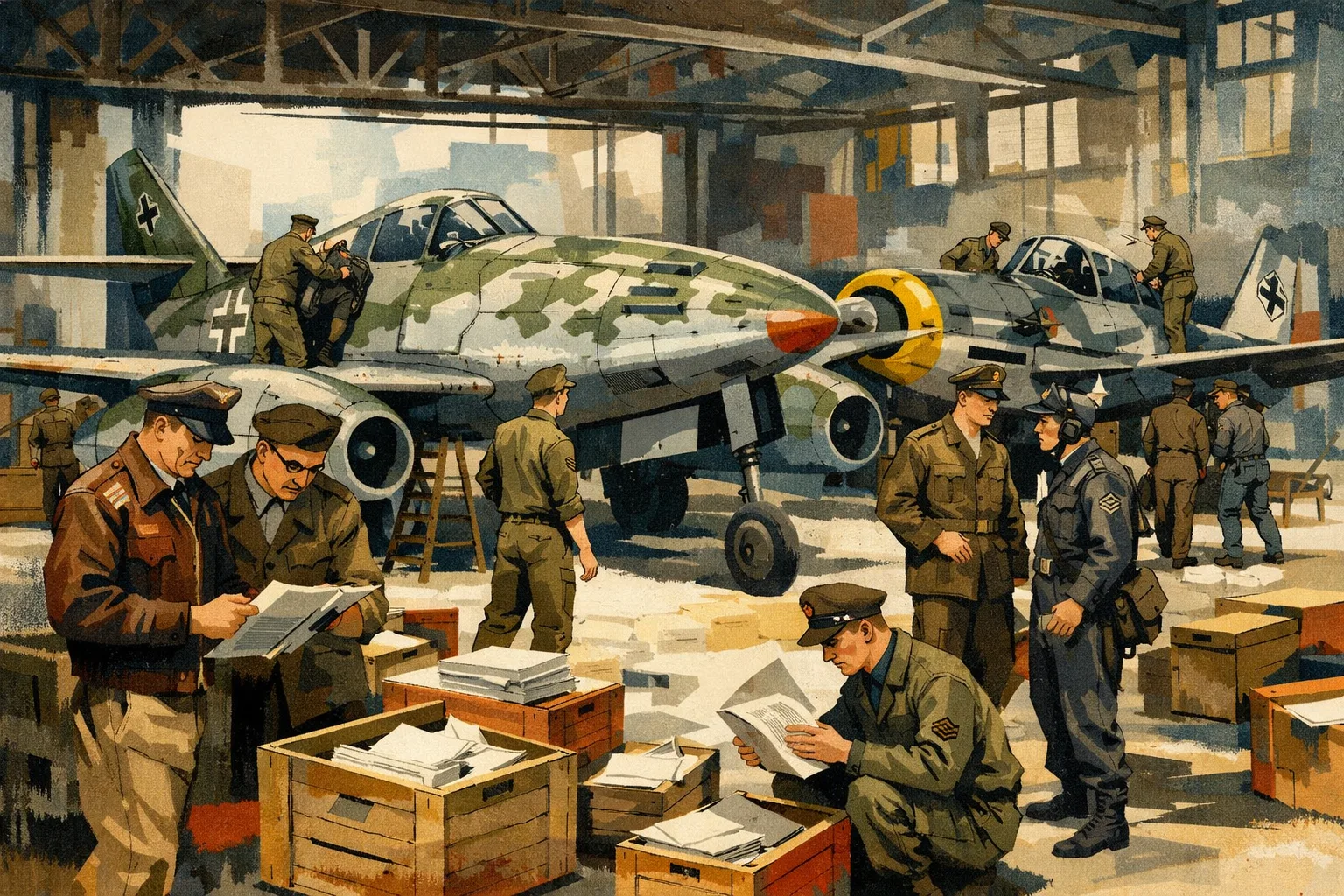
Operation LUSTY was the United States Army Air Forces’ late-war hunt for German aviation technology: aircraft, engines, weapons, research files, test data, laboratories and specialists. Its name came from “LUftwaffe Secret TechnologY”, but its importance was practical rather than theatrical. In spring and summer 1945, American teams tried to move from battlefield rumours to physical evidence: not just “Germany has jets”, but which jets, how they flew, how they were maintained, what documents explained them, and what could be tested in the United States.
The operation matters in the history of reverse engineering foreign military technology because it shows the full exploitation cycle in a compressed time window. Allied personnel identified target equipment, raced other collection teams, recruited captured German pilots and engineers, ferried unfamiliar aircraft across Europe, shipped them home, and turned wreckage, documents and airframes into technical intelligence. The result was not a simple copying programme. It was a bridge between wartime capture and Cold War aerospace intelligence, where captured hardware became evidence, training material, museum preservation and a spur to post-war research priorities.[Air Force Museum]nationalmuseum.af.milOperation LUSTY > National Museum of the United States Air Force > Display…
Aircraft and document recovery
By 1945, Allied air forces knew that Germany had produced advanced aircraft and weapons, but knowing that a system existed was not the same as understanding it. Operation LUSTY formalised the USAAF effort to exploit captured German scientific documents, research facilities and aircraft. The National Museum of the United States Air Force describes the operation as beginning on 22 April 1945, when USAAF technical and post-hostilities intelligence objectives were combined under the Exploitation Division. One team, led by Colonel Harold E. Watson, collected aircraft and weapons for examination in the United States; another recruited scientists, gathered documents and investigated facilities.[Air Force Museum]nationalmuseum.af.milOperation LUSTY > National Museum of the United States Air Force > Display…
The recovery effort was competitive. Air Technical Intelligence teams were not alone in Europe; the National Museum notes that they competed with 32 other Allied technical intelligence groups for information and equipment from crash sites and captured facilities. That rivalry explains the urgency and occasional improvisation. The point was to secure aircraft, papers and specialists before they were destroyed, looted, claimed by another Allied service, or reached by Soviet forces.[Air Force Museum]nationalmuseum.af.milOperation LUSTY > National Museum of the United States Air Force > Display…
Watson’s team became known as “Watson’s Whizzers”. It was not a normal combat unit. It was a mixed technical recovery group of pilots, engineers and maintenance personnel, working from lists of priority aircraft and equipment drawn up at Wright Field. Watson divided the work between jet aircraft and piston-engine aircraft, including non-flyable jet and rocket equipment. The most vivid part of the story is that many captured aircraft could not simply be loaded intact onto a lorry. If they were flyable, someone had to make them safe, understand their unfamiliar controls, find suitable fuel, and ferry them across a damaged continent.[Air Force Museum]nationalmuseum.af.milOperation LUSTY > National Museum of the United States Air Force > Display…
That meant using German expertise. The Whizzers brought in Luftwaffe and industry test pilots, including Messerschmitt personnel such as Karl Baur and Ludwig Hofmann, to help American crews operate aircraft such as the Messerschmitt Me 262. This was reverse engineering in a human as well as mechanical sense: the aircraft contained information, but so did the men who knew its starting procedures, failure modes and handling quirks. Air & Space Forces Magazine describes booby traps in some Me 262 cockpits, brief conversion training, improvised maintenance learning, and even the use of diesel fuel when the desired jet fuel was unavailable.[Air Force Museum]nationalmuseum.af.milOperation LUSTY > National Museum of the United States Air Force > Display…
The ferry route itself became part of the exploitation process. The National Museum records that the Whizzers flew Me 262s and other aircraft from Lechfeld to St Dizier, then to Melun, and finally to Cherbourg. There the British lent the escort carrier HMS Reaper for the transatlantic shipment. The aircraft were protected against salt air, loaded aboard, and brought to the United States for study by USAAF and US Navy intelligence groups.[Air Force Museum]nationalmuseum.af.milOperation LUSTY > National Museum of the United States Air Force > Display…
Documents mattered as much as aircraft. Captured technical papers could explain why a design looked the way it did, which alternatives had been tried, and which problems German engineers had failed to solve. Smithsonian archival records for captured German technical documents, compiled and microfilmed by the US Navy, list subjects including long-range bombers, aircraft propulsion, infrared research, optics, turbomachinery, flutter research, torpedoes and radar. That breadth shows why LUSTY was more than an aircraft-spotting expedition: it was an attempt to reconstruct an adversary’s research system from its machines, drawings and files.[sova.si.edu]sova.si.eduOpen source on si.edu.

Why jet technology mattered
The late-war German jet aircraft collected under LUSTY were not war-winning weapons by 1945, but they were proof that the next air war would be different. The Me 262 was the headline aircraft because it was the first operational jet fighter to see combat in significant numbers. The Smithsonian notes that 1,443 Me 262s were completed, though only about 300 are estimated to have seen combat; Allied air dominance, attacks on airfields, fuel shortages and Germany’s collapsing logistics prevented the aircraft from reaching its full potential. Still, the same Smithsonian account stresses that the Me 262 introduced features seen in later aircraft, including swept wings, wing slots, underslung engine nacelles and concentrated nose armament.[National Air and Space Museum]airandspace.si.eduOpen source on si.edu.
For American technical intelligence, the Me 262’s value lay in detail. Its reported top speed of about 870 km/h was not merely a performance statistic; it forced analysts to think about jet acceleration, throttle handling, compressor stalls, maintenance tolerances and pilot conversion. Air & Space Forces Magazine’s account of the Whizzers shows how unfamiliar this technology was to the recovery crews: a non-flyable Me 262 was used as a ground trainer, German personnel explained procedures, and American pilots received extremely short conversion flights before ferrying aircraft onward.[National Air and Space Museum]airandspace.si.eduOpen source on si.edu.
The Arado Ar 234 showed a different lesson. It was not a fighter, but the world’s first operational jet bomber and reconnaissance aircraft. The Smithsonian records that its first combat mission was a reconnaissance flight over the Normandy beachhead on 2 August 1944, and that its speed made it very difficult for Allied piston-engine fighters to intercept. The surviving Smithsonian Ar 234 had served with KG 76, was captured by British forces in Norway, turned over to the United States, and brought to Wright Field for testing.[National Air and Space Museum]airandspace.si.eduOpen source on si.edu.
The Ar 234 also illustrated why captured aircraft had to be studied as systems, not trophies. Its value was in the combination of turbojet propulsion, cameras, bombing equipment, autopilot-assisted bombing runs and the operational problem of using very fast reconnaissance aircraft when conventional interception was failing. Its design history also revealed bottlenecks: the Smithsonian notes that engine problems and competition for scarce flight-ready turbojets delayed the Ar 234, even though the airframe concept dated back to 1940. Reverse engineering therefore exposed not only German breakthroughs, but German production weaknesses.[National Air and Space Museum]airandspace.si.eduOpen source on si.edu.
Not every important captured aircraft was a jet. The Dornier Do 335, shipped to the United States aboard HMS Reaper after being ferried to Cherbourg, represented another category of advanced German aviation: an exceptionally fast piston-engined aircraft using a low-drag push-pull engine arrangement, with one engine in the nose and one in the tail. The Smithsonian describes it as one of the fastest propeller-driven aircraft ever flown, while also noting serious flaws such as rear-engine overheating and weak landing gear. For analysts, that combination was valuable: it showed both the promise and the practical compromises of a clever configuration.[National Air and Space Museum]airandspace.si.eduOpen source on si.edu.
The most useful lesson was not that German aircraft should be copied whole. By 1945, American and British jet programmes already existed. What LUSTY provided was comparative evidence: real engines, real airframes, real cockpit layouts, real maintenance problems and real flight-test data. It helped analysts distinguish between propaganda, battlefield rumours, promising research and mature operational technology.
The race was also against disorder
The phrase “race for German secret technology” can sound like a neat treasure hunt, but the actual situation was chaotic. Allied armies were moving, German units were surrendering unevenly, laboratories were scattered, airfields were damaged, and valuable documents could be hidden, removed or destroyed. Dik Alan Daso’s Airpower Journal study describes American scientists and technical teams entering Europe close behind the advancing armies, inspecting laboratories and boxing up data for shipment to Wright Field. It also records inter-service competition: in one case, Navy teams boxed up hardware and data, only for Army teams later to crate the Navy boxes inside larger boxes and relabel them.[indianamilitary.org]indianamilitary.orgOPERATION LUSTYOPERATION LUSTY
That anecdote is almost comic, but it reveals a serious point about foreign materiel exploitation. Physical possession shaped what could be studied later. A laboratory report, a wind-tunnel model, a jet engine or a nearly complete airframe was useful only if it was identified, secured, transported, catalogued and kept intact enough for analysis. Operation LUSTY therefore depended on logistics as much as intelligence judgement.
The scale was large. The National Museum of the United States Air Force states that LUSTY collectors acquired 16,280 items, amounting to 6,200 tons, from which intelligence personnel selected 2,398 separate items for technical analysis. Those numbers make the operation a collection-and-filtering problem: the first task was to gather broadly, but the lasting intelligence value came from deciding what deserved technical examination.[Air Force Museum]nationalmuseum.af.milOperation LUSTY > National Museum of the United States Air Force > Display…
The document haul was even broader than the aircraft story suggests. Daso’s study describes discoveries including rocket-propelled fighter aircraft, radio-controlled bombs, guided anti-aircraft missiles, swept-back wings in high-speed wind tunnels, hidden assembly sites and large quantities of technical data. Some findings confirmed lines of research already being pursued in the United States; others, such as particular rotor and propulsion experiments, came as surprises.[indianamilitary.org]indianamilitary.orgOPERATION LUSTYOPERATION LUSTY
That is one reason LUSTY is a strong case study in reverse engineering. It shows that exploitation is not only the disassembly of a captured object. It is also triage: separating what is operationally urgent from what is scientifically interesting, what is genuinely new from what is a dead end, and what can be learned from documents versus what must be measured in hardware.
Cold War intelligence legacy
Operation LUSTY’s immediate context was the end of the Second World War, but its legacy belongs to the early Cold War. American commanders were already thinking beyond Germany. General Henry “Hap” Arnold wanted the USAAF to preserve and exploit wartime technological gains, and Daso’s account places LUSTY alongside the work of Theodore von Kármán’s Scientific Advisory Group, which examined German aeronautical laboratories and data as part of a broader post-war research vision.[indianamilitary.org]indianamilitary.orgOPERATION LUSTYOPERATION LUSTY
The operation also helped establish habits that later became normal in military technology intelligence. Captured equipment was not merely displayed; it was assigned inventory numbers, divided between services, flight-tested, compared, stored, transferred and sometimes scrapped. The Smithsonian’s Me 262 record describes the aircraft being brought from Cherbourg on HMS Reaper, offloaded at Newark, flown to Freeman Field, assigned a foreign equipment number, sent for comparison work and later stored and restored. The Ar 234 record similarly traces capture, shipment, reassembly, flight testing at Freeman and Wright Field, and eventual transfer to the Smithsonian.[National Air and Space Museum]airandspace.si.eduOpen source on si.edu.
That administrative trail is part of the legacy. It turned enemy aircraft into data objects: numbered, inspected, tested and filed. The same pattern appears in later foreign materiel exploitation programmes, where the value of a captured system depends on disciplined custody and analysis as much as dramatic acquisition.
LUSTY also left a preservation legacy, though that was not its main purpose. Some of the world’s rarest surviving German aircraft passed through this exploitation pipeline. The Smithsonian identifies its Ar 234 as the sole surviving example of the type. It also displays the second Do 335 A-0 built, shipped to the United States after capture and later transferred to the museum. The National Museum of the United States Air Force notes that General Arnold ordered one example of every enemy aircraft type preserved, although storage pressures later led to many aircraft being moved, exposed or scrapped.[National Air and Space Museum]airandspace.si.eduOpen source on si.edu.
There is a tension here. LUSTY preserved some unique artefacts, but preservation was secondary to exploitation. Aircraft that now appear as museum treasures were first intelligence material. Others were lost when storage needs changed, especially after the Korean War increased pressure on depot space. That uneven survival is a reminder that reverse engineering programmes are built for military utility, not heritage.
What LUSTY shows about reverse engineering foreign military technology
Operation LUSTY is best understood as a case family rather than a single dramatic seizure. It included aircraft recovery, document exploitation, laboratory inspection, expert interrogation, ferry operations, sea shipment, flight testing, inter-service rivalry and long-term storage. Each part mattered because advanced military technology is never only a machine. It is a design record, a manufacturing system, an operating procedure, a maintenance burden and a set of tactical assumptions.
The captured German aviation programme also shows the limits of reverse engineering. The Allies did not need to copy every German aircraft, and some German designs were more impressive as concepts than as reliable weapons. The Me 262 had remarkable speed but suffered from operational constraints. The Ar 234 was difficult to intercept but appeared too late and in too few numbers to change the war. The Do 335 demonstrated an ingenious high-speed piston arrangement while also revealing overheating and landing-gear weaknesses.[National Air and Space Museum]airandspace.si.eduOpen source on si.edu.
The deeper value was comparative learning. By putting German hardware beside Allied assumptions, engineers and intelligence officers could see which adversary ideas were ahead, which were fragile, which were constrained by production, and which pointed towards the next generation of air warfare. That is why LUSTY belongs at the centre of any discussion of reverse engineering foreign military technology: it shows exploitation as a race, a technical discipline and a strategic habit formed at the boundary between one war ending and another security era beginning.
Amazon book picks
Further Reading
Books and field guides related to The Race for German Secret Technology. Use these as the next step if you want deeper reading beyond the article.
The Right Stuff
Rating: 4.5/5 from 8 Google Books ratings
Provides broader context for post-war flight testing and aerospace culture.
The Jet Race and the Second World War
Examines the strategic importance of German jet advances.
Germany's Secret Weapons in World War II
Covers many technologies targeted by Allied exploitation teams.
eBay marketplace picks
Marketplace Samples
Live-tested eBay searches with available results related to this page.

Endnotes
1.
Source: nationalmuseum.af.mil
Title: Air Force Museum
Link:https://www.nationalmuseum.af.mil/Visit/Museum-Exhibits/Fact-Sheets/Display/Article/196144/operation-lusty/
Source snippet
Operation LUSTY > National Museum of the United States Air Force > Display...
2.
Source: indianamilitary.org
Title: OPERATION LUSTY
Link:https://www.indianamilitary.org/FreemanAAF/OperationLusty/OPERATION-LUSTY.pdf
3.
Source: sova.si.edu
Link:https://sova.si.edu/record/NASM.XXXX.0409
4.
Source: indianamilitary.org
Title: Operation Lusty s
Link:https://www.indianamilitary.org/FreemanAAF/OperationLusty/OperationLusty-s.pdf
5.
Source: indianamilitary.org
Link:https://www.indianamilitary.org/FreemanAAF/Aircraft%20-%20German/FE%201012-Do335A/1012.htm
6.
Source: airandspace.si.edu
Link:https://airandspace.si.edu/collection-objects/messerschmitt-me-262-a-1a-schwalbe-swallow/nasm_A19600328000
7.
Source: airandspace.si.edu
Link:https://airandspace.si.edu/collection-objects/arado-ar-234-b-2-blitz-lightning/nasm_A19600312000
8.
Source: airandspace.si.edu
Link:https://airandspace.si.edu/collection-objects/dornier-do-335-0-pfeil-arrow/nasm_A19610129000
9.
Source: nationalmuseum.af.mil
Title: mil Fact Sheets
Link:https://www.nationalmuseum.af.mil/Visit/Museum-Exhibits/Fact-Sheets/?Page=141
10.
Source: nationalmuseum.af.mil
Title: mil American Raiders
Link:https://www.nationalmuseum.af.mil/Portals/7/documents/transcripts/american_raiders_transcript.pdf
11.
Source: Wikipedia
Title: Operation LUSTY
Link:https://en.wikipedia.org/wiki/Operation_LUSTY
12.
Source: Wikipedia
Title: Dornier Do 335
Link:https://en.wikipedia.org/wiki/Dornier_Do_335
13.
Source: facebook.com
Link:https://www.facebook.com/groups/617693038404313/posts/3157286647778260/
14.
Source: crouze.com
Title: Captured Aircraft
Link:https://www.crouze.com/baugher/captured_serials/capturedaircraft_00.html
15.
Source: vintageaviationnews.com
Title: dornier do 335
Link:https://vintageaviationnews.com/warbird-articles/grounded-dreams/dornier-do-335.html
Additional References
16.
Source: youtube.com
Link:https://www.youtube.com/watch?v=SgcYXApzK3s
Source snippet
Operation LUSTY captured German aircraft Operation LUSTY: The Secret U.S. Mission That Stole Nazi Jet Technology and Changed Aviation For...
17.
Source: youtube.com
Link:https://www.youtube.com/watch?v=QHs_u1iDg2s
Source snippet
Aviation Stuff: Operation Lusty and Watson's Whizzers...
18.
Source: youtube.com
Title: Why This Secret WWII Mission Stole Hitler’s Jet Engines — OPERATION LUSTY
Link:https://www.youtube.com/watch?v=CXz1EmW-NyA
Source snippet
Watson's Whizzers: The Secret Team That Hunted Nazi Aviation Tech...
19.
Source: youtube.com
Title: Watson’s Whizzers: The Secret Team That Hunted Nazi Aviation Tech
Link:https://www.youtube.com/watch?v=Y1YPnMq4ekI
Source snippet
Captured German Jet: When Americans Tested the Me 262 — 1945...
20.
Source: youtube.com
Title: Aviation Stuff: Operation Lusty and Watson’s Whizzers
Link:https://www.youtube.com/watch?v=A0y08v8Y5TY
Source snippet
Why This Secret WWII Mission Stole Hitler's Jet Engines — OPERATION LUSTY...
21.
Source: airandspaceforces.com
Link:https://www.airandspaceforces.com/PDF/MagazineArchive/Documents/1963/0663vonkarman.pdf
22.
Source: facebook.com
Link:https://www.facebook.com/planehistoria/posts/a-view-from-inside-the-cockpit-of-the-only-surviving-dornier-do-335-gives-a-rare/944913911382785/
23.
Source: reddit.com
Link:https://www.reddit.com/r/WeirdWings/comments/pue5rt/german_dornier_do_335_aircraft_from_world_war_ii/
24.
Source: facebook.com
Link:https://www.facebook.com/NavyGeneralBoard/posts/german-aircraft-loaded-aboard-the-aircraft-carrier-hms-reaper-for-shipment-back-/686756173854837/
25.
Source: amazon.com
Link:https://www.amazon.com/Operation-LUSTY-Hitlers-Secret-Technology/dp/1473847370?tag=searcht-20
Topic Tree