Within Foreign Materiel
Why the Cold War Prized Captured Machines
The Cold War made foreign hardware especially valuable because both blocs feared surprise and raced for advantage.
On this page
- Fear of technological surprise
- Aircraft and missile collection
- Lessons for arms competition
Page outline Jump by section
Introduction
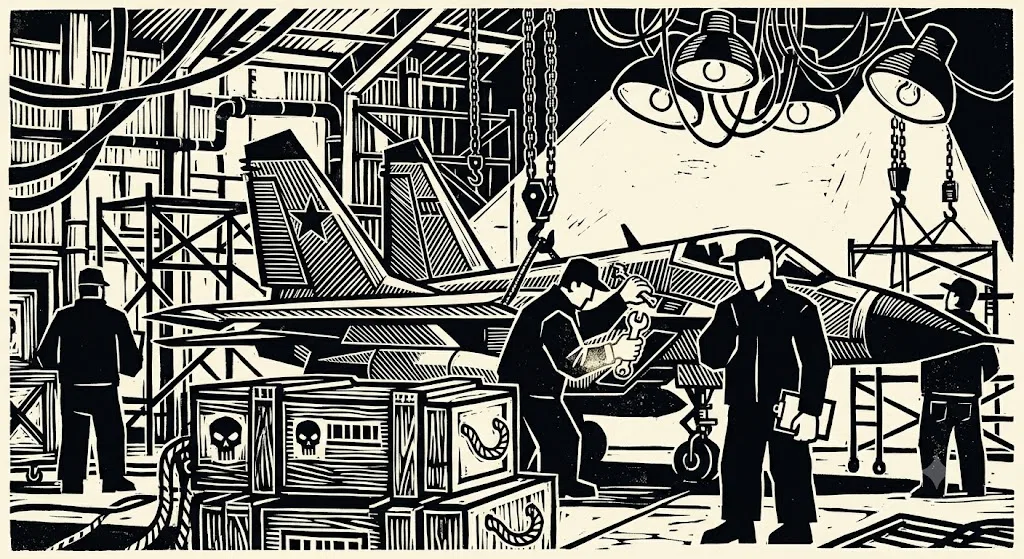
Cold War competition made captured military technology unusually valuable because each bloc feared being surprised by the other’s next aircraft, missile, radar or electronic system. Reverse engineering foreign military technology was therefore not only a matter of copying parts. It was a race to reduce uncertainty: to discover what an enemy machine could really do, how it had been manufactured, how it might fail, and how it could be countered in combat. A captured missile seeker, a defected fighter, a wrecked radar van or even space hardware could alter training, procurement and arms-control assumptions.
The clearest pattern is that both sides treated hardware as evidence. Intelligence estimates based on photographs, signals and rumours were useful, but a real machine could be measured, flown, dismantled and tested. In the United States, Cold War foreign materiel exploitation covered overt and covert acquisition of military and civilian equipment and became a major contributor to scientific and technical intelligence. Declassified records show efforts ranging from Korean War MiG-15 wreckage to Soviet equipment captured by Israel, SA-2 missile components, MiG evaluations, space debris and the attempted recovery of a sunken Soviet submarine.[National Security Archive]nsarchive.gwu.eduOpen source on gwu.edu.
Why captured machines mattered more in the Cold War
The Cold War compressed technical uncertainty and political danger into the same problem. If a rival’s fighter was faster than expected, if a missile radar was harder to jam, or if an air-defence system had a hidden weakness, the consequences could affect nuclear deterrence, air campaigns and alliance confidence. Captured equipment mattered because it turned fear into a testable object.
US intelligence definitions of scientific and technical intelligence included the characteristics, capabilities, limitations, research, development and production methods of foreign military systems. That definition is important: it shows that exploitation was not just about “what does this weapon do?” but also “how is it made, how mature is the industry behind it, and what does that imply for future weapons?”[National Security Archive]nsarchive.gwu.eduOpen source on gwu.edu.
The Cold War also created a global market of opportunity. Wars fought by allies and client states exposed equipment that the superpowers could not easily obtain directly. Korea yielded aircraft wreckage. The Middle East produced captured Soviet-supplied systems. Vietnam made the SA-2 surface-to-air missile an urgent target for countermeasure work. Defections and accidental landings produced aircraft that were otherwise inaccessible. Declassified National Security Archive material describes US military and intelligence operatives seeking everything from captured surface-to-air missiles to bits of spacecraft that had fallen to Earth, with an eye to learning something useful about adversaries.[National Security Archive]nsarchive.gwu.eduOpen source on gwu.edu.
That urgency was sharpened by the fear of technological surprise. The Cold War rewarded worst-case thinking: analysts had to assume that an unfamiliar Soviet system might be more capable than it looked. Physical exploitation could either confirm those fears or puncture them. A captured machine might reveal a genuine leap, but it might also show that an apparently revolutionary system was a specialised design with serious trade-offs.
Fear of technological surprise
The most important Cold War prize was not always a complete copy. Often it was confidence. A state wanted to know whether its aircraft could survive, whether its pilots needed new tactics, whether its jammers worked, or whether an expensive new weapons programme was justified.
The MiG-25 Foxbat case shows this clearly. Before 1976, Western observers had seen enough of the aircraft to worry about its speed, altitude and possible role against aircraft such as the SR-71 or against NATO air defences. When Soviet pilot Viktor Belenko landed a MiG-25 in Japan on 6 September 1976, Japanese and US specialists suddenly had access to one of the most feared Soviet aircraft of the period. A CIA museum account states that Western military and civilian experts welcomed the chance to inspect the aircraft directly and debrief its pilot. A Defense Intelligence Agency exploitation report from September 1976 described technical reporting on the MiG-25 as a continuing process based on Japanese Self-Defense Forces and US exploitation-team data.[CIA]cia.govOpen source on cia.gov.
The lesson was not simply that the aircraft was “good” or “bad”. The MiG-25 was extremely fast and powerful, but examination helped clarify the compromises behind that performance. It was not the all-purpose superfighter imagined by some Western speculation. Its construction, avionics and operating assumptions reflected a high-speed interceptor optimised for particular missions rather than a universal air-combat machine. The intelligence payoff lay in replacing myth with engineering detail.
The same logic applied to Soviet air defence. The SA-2 Guideline had already proved deadly: the National Museum of the US Air Force notes that the Soviet V-750 Dvina, known by NATO as SA-2, shot down Francis Gary Powers’ U-2 over the USSR in 1960 and Major Rudolf Anderson’s U-2 over Cuba in 1962, and was exported widely from 1960 onward.[Air Force Museum]nationalmuseum.af.milAir Force Museum SA-2 Surface-to-Air MissileAir Force Museum SA-2 Surface-to-Air Missile By the mid-1960s, US analysts urgently wanted more than general knowledge. National Security Archive summaries of CIA and DIA records show that information supplied by CIA to the Department of Defense had helped develop countermeasures that reduced US aircraft losses over North Vietnam, but major gaps remained, especially concerning the FAN SONG radars associated with the SA-2 system.[National Security Archive]nsarchive.gwu.eduOpen source on gwu.edu.
This is why captured technology could become strategically important even when incomplete. A guidance antenna, a radar van, a fuze, a tube, a missile fragment or a manual could narrow uncertainty. In an air war, that could mean the difference between flying blind against an unknown threat and designing tactics around measured weaknesses.
Aircraft and missile collection
Aircraft were among the most prized Cold War objects because they could be exploited at several levels at once: performance, radar signature, cockpit layout, weapons integration, maintenance quality and tactics. A fighter was not just a machine; it embodied doctrine.
The early Cold War pattern began in Korea. US forces salvaged parts from a crashed MiG-15 in April 1951, then participated with British and South Korean forces in recovering almost an entire MiG-15 from waters off North Korea in July 1951. The material was quickly shipped to the Air Technical Intelligence Center in Dayton, Ohio, for analysis. Declassified summaries note that analysts examined not only performance-related features but also materials, manufacturing methods, rubber and plastic components.[National Security Archive]nsarchive.gwu.eduOpen source on gwu.edu.
That kind of exploitation soon became entangled with diplomacy. In 1953, a Polish MiG-15 landed in Denmark; the Danish government allowed covert British and US examination but insisted the work be completed within five days. The episode illustrates a recurring Cold War problem: the hardware was valuable, but the host government had to manage legal risk, alliance pressure and fear of Soviet retaliation.[National Security Archive]nsarchive.gwu.eduOpen source on gwu.edu.
The best-known US aircraft exploitation programmes came later. Declassified National Security Archive material on Area 51 shows that a 300-page DIA report covered exploitation of the MiG-21 under HAVE DOUGHNUT, while HAVE DRILL and HAVE FERRY evaluated MiG-17s. The same source notes that the MiG-17 work in 1969 involved 172 sorties over 55 days for one aircraft and 52 sorties over 20 days for a backup aircraft.[National Security Archive]nsarchive.gwu.eduOpen source on gwu.edu.
The value of these programmes was practical. The National Museum of the US Air Force states that late-1960s testing of MiGs under HAVE DOUGHNUT and HAVE DRILL provided the first complete technical breakdowns of MiG-17 and MiG-21 aircraft. This knowledge later fed Constant Peg, a secret programme established in 1977 in which US Air Force, Navy and Marine Corps aircrews trained against Soviet-designed MiG-17, MiG-21 and later MiG-23 aircraft flown by the 4477th Test and Evaluation Squadron.[Air Force Museum]nationalmuseum.af.milCONSTANT PEG: Secret MiGs in the Desert > National Museum of the United States Air Force > Display…
Captured missiles could have an even more direct design impact. The Soviet K-13, known to NATO as the AA-2 Atoll, is a classic case of reverse engineering as replication. The Smithsonian National Air and Space Museum describes the Atoll as a copy of the US Sidewinder heat-seeking air-to-air missile. In 1958, a Sidewinder fired from a Taiwanese F-86 during the Taiwan Strait fighting lodged in a People’s Republic of China aircraft without detonating. China recovered it intact, turned it over to the Soviet Union, and the Soviet Union copied, mass-produced and exported the Atoll to client states.[National Air and Space Museum]airandspace.si.eduOpen source on si.edu.
The Atoll case captures the competitive logic of the era. A single unexploded weapon moved from a local air battle into the strategic technology race between blocs. Unlike aircraft exploitation that primarily produced tactics and countermeasures, this case produced a family of weapons that proliferated through Soviet-aligned forces. It also shows why the boundary between battlefield accident, intelligence coup and industrial policy was often thin.

The Middle East as a hardware crossroads
The Arab-Israeli wars made the Middle East one of the most important Cold War sources of Soviet-supplied equipment for Western exploitation. The equipment was not captured from Soviet forces directly, but it often represented Soviet doctrine, export technology and weapons likely to appear in other theatres.
After the 1967 Six-Day War, Israel captured a large quantity of Soviet equipment. US records summarised by the National Security Archive show that the Department of Defense wanted to exploit it, while CIA took the lead in negotiating access with the Israelis and DIA coordinated examination and analysis plans. The technical exploitation project was designated MEXPO.[National Security Archive]nsarchive.gwu.eduOpen source on gwu.edu.
The details show how valuable and difficult such access could be. By September 1967, US personnel working through CIA channels had gained access to lower-priority items in Israel but not yet to higher-priority material such as SA-2 components. Later, US personnel did gain access to SA-2 components, but the Israelis resisted moving them to the United States. The FAN SONG computer and radar vans were reportedly too badly damaged for exploitation, leaving a continued requirement to bring a complete SA-2 system or major electronics to the United States for analysis and testing.[National Security Archive]nsarchive.gwu.eduOpen source on gwu.edu.
This episode matters because it shows captured technology as alliance bargaining. The United States wanted the equipment for technical intelligence and countermeasures; Israel had its own security interests, bargaining position and concerns about releasing prized captures. The machine itself was only one part of the competition. Access, custody, transport, classification and diplomatic handling could determine whether exploitation produced a quick look, a partial report or a full technical programme.
It also shows why reverse engineering foreign military technology was rarely a neat laboratory exercise. Captured systems were often damaged, incomplete, politically sensitive or urgently needed for more than one purpose. A radar van might be wanted by engineers, intelligence analysts, electronic warfare specialists, trainers and diplomats at the same time.
Electronics, space hardware and the widening target list
Cold War competition over captured technology did not stop at aircraft and missiles. Electronics, computers, radio tubes and space hardware also became intelligence targets because they revealed industrial capacity and design philosophy.
National Security Archive summaries note a 1965 memorandum requesting funds for DIA acquisition of a Soviet Minsk-2 computer through CIA’s Sovmat Staff. They also identify a 1963 US Navy examination of East German subminiature tubes used in radio equipment. These were not glamorous objects, but they mattered because Cold War military power increasingly depended on electronics: radar, guidance, communications, computation and data links.[National Security Archive]nsarchive.gwu.eduOpen source on gwu.edu.
Space hardware extended the same logic beyond the atmosphere. The CIA’s “Lunik” operation, described in declassified material and summarised by the National Security Archive, involved examining a Soviet Lunik spacecraft while it was touring as part of an exhibition of Soviet industrial articles and space vehicles. The intelligence point was not to copy a lunar probe wholesale, but to extract clues about Soviet space technology at a moment when the space race had major military and political meaning.[National Security Archive]nsarchive.gwu.eduOpen source on gwu.edu.
Space debris created legal and bureaucratic complications. The National Security Archive notes that CIA and DoD disagreed over responsibility for foreign space fragments that returned to Earth, while the 1967 Outer Space Treaty provided that space debris landing on Earth remained the property of the launching nation and should be returned.[National Security Archive]nsarchive.gwu.eduOpen source on gwu.edu. In other words, the Cold War prized captured machines even when the “capture” involved a fallen fragment whose ownership was legally contested.
At the extreme end was Project AZORIAN, the CIA’s attempt to recover part of the sunken Soviet submarine K-129 from the Pacific Ocean floor. According to the CIA’s own museum account, K-129 was a Soviet Golf II-class submarine carrying three SS-N-4 nuclear-armed ballistic missiles when it was lost in 1968. After Soviet search efforts ended, the United States located it about 1,800 miles north-west of Hawaii, 16,500 feet below the surface, and pursued a secret recovery effort using the Hughes Glomar Explorer under a deep-sea mining cover story.[CIA]cia.govProject AZORIANProject AZORIAN
AZORIAN was not a straightforward reverse-engineering project in the aircraft-shop sense, but it belongs to the same Cold War competition over captured technology. The prize was access to an adversary strategic system: missiles, cryptographic material, equipment and design evidence. The extraordinary engineering required to attempt the recovery shows how much value intelligence agencies placed on physical access to enemy machines.
Lessons for the arms competition
Captured technology influenced the Cold War arms competition in three main ways: it corrected estimates, changed training, and accelerated countermeasures or copying.
First, exploitation corrected estimates. The MiG-25 case reduced uncertainty around a feared aircraft. The SA-2 effort refined understanding of a system already killing US and allied aircraft. The MiG-15, MiG-17 and MiG-21 programmes moved analysis from rumour and combat anecdote to measured performance, materials and tactics. In each case, physical access changed the quality of knowledge.
Second, exploitation changed training. Constant Peg is the clearest example. Rather than relying only on lectures about Soviet aircraft, US pilots flew against real MiGs operated by trained American pilots. The museum account emphasises that the first MiG exposure was designed partly to eliminate “buck fever” — the shock of seeing a MiG up close — and then to demonstrate strengths and weaknesses in one-versus-one manoeuvres.[Air Force Museum]nationalmuseum.af.milCONSTANT PEG: Secret MiGs in the Desert > National Museum of the United States Air Force > Display… That was reverse engineering translated into behaviour: pilots learned not just what the enemy aircraft looked like, but how it fought.
Third, exploitation shaped weapons development and countermeasures. The Soviet copying of the Sidewinder into the K-13/Atoll shows captured technology becoming an industrial shortcut. The SA-2 exploitation effort shows the opposite direction: not copying a Soviet missile, but trying to defeat it through electronic countermeasures and tactical knowledge.[National Air and Space Museum]airandspace.si.eduOpen source on si.edu.
The larger lesson is that the Cold War did not reward simple imitation alone. The most successful exploitation asked a sharper question: what decision does this machine help us make? Sometimes the answer was to copy. Sometimes it was to jam, avoid, redesign, train, negotiate or stop overestimating an adversary. Captured hardware mattered because it forced intelligence to become empirical.
What made the Cold War race distinctive
Earlier wars had also produced captured weapons, but the Cold War gave foreign materiel a distinctive strategic role. The conflict was global, technically intense, usually indirect, and shadowed by nuclear risk. Much of the most important competition happened below the threshold of open war. That made machines captured through proxy conflicts, defections, crashes and covert operations disproportionately valuable.
The competition also blurred categories. A MiG was a training aid, an intelligence source and a political embarrassment. A Sidewinder lodged in a MiG became a Soviet design template. An SA-2 radar component was a countermeasure target. A Lunik spacecraft was both propaganda exhibit and intelligence opportunity. A sunken submarine was both a grave and a potential source of strategic secrets.
That is why Cold War competition over captured technology remains central to understanding reverse engineering foreign military technology. The story is not only about clever engineers taking machines apart. It is about a geopolitical system in which every recovered object could change what one side believed about the other — and in an arms race, belief itself was part of the battlefield.
Amazon book picks
Further Reading
Books and field guides related to Why the Cold War Prized Captured Machines. Use these as the next step if you want deeper reading beyond the article.
The Puzzle Palace
Shows how technical intelligence reduced uncertainty during the Cold War.
Skunk Works
Explains how intelligence about rival technology influenced aircraft development.
eBay marketplace picks
Marketplace Samples
Live-tested eBay searches with available results related to this page.
Endnotes
1.
Source: cia.gov
Link:https://cia.gov/legacy/museum/artifact/former-soviet-pilot-viktor-belenkos-knee-pad-notebook-with-flight-data/
2.
Source: nationalmuseum.af.mil
Title: Air Force Museum
Link:https://www.nationalmuseum.af.mil/Visit/Museum-Exhibits/Fact-Sheets/Display/Article/1682967/constant-peg-secret-migs-in-the-desert/
Source snippet
CONSTANT PEG: Secret MiGs in the Desert > National Museum of the United States Air Force > Display...
3.
Source: cia.gov
Title: Project AZORIAN
Link:https://www.cia.gov/legacy/museum/exhibit/project-azorian/
4.
Source: cia.gov
Link:https://www.cia.gov/readingroom/historical-collections
5.
Source: cia.gov
Link:https://www.cia.gov/readingroom/docs/CIA-RDP84B00049R001403390009-8.pdf
6.
Source: cia.gov
Link:https://www.cia.gov/readingroom/document/cia-rdp84b00049r001403390009-8
7.
Source: cia.gov
Link:https://www.cia.gov/readingroom/docs/CIA-RDP82M00786R000104810001-5.pdf
8.
Source: cia.gov
Link:https://www.cia.gov/readingroom/document/cia-rdp85t00176r000900020001-5
9.
Source: cia.gov
Link:https://www.cia.gov/readingroom/docs/CIA-RDP84S00553R000300060004-7.pdf
10.
Source: cia.gov
Link:https://www.cia.gov/readingroom/collection/lunik-loan-space-age-spy-story
11.
Source: cia.gov
Link:https://www.cia.gov/readingroom/document/05835438
12.
Source: cia.gov
Title: THE EGYPTIAN ARMS INDUSTR[15872662]
Link:https://www.cia.gov/readingroom/docs/THE%20EGYPTIAN%20ARMS%20INDUSTR%5B15872662%5D.pdf
13.
Source: cia.gov
Link:https://www.cia.gov/readingroom/document/cia-rdp82-00850r000200040051-9
14.
Source: cia.gov
Link:https://www.cia.gov/readingroom/document/cia-rdp90b01390r000100050003-1
15.
Source: cia.gov
Link:https://www.cia.gov/readingroom/document/cia-rdp71b00364r000300150001-8
16.
Source: space.com
Title: lunik heist a real life cia rocket kidnapping goes to hollywood
Link:https://www.space.com/space-exploration/launches-spacecraft/lunik-heist-a-real-life-cia-rocket-kidnapping-goes-to-hollywood
17.
Source: time.com
Title: intelligence bonanza or bust
Link:https://time.com/archive/6848376/intelligence-bonanza-or-bust/
18.
Source: youtube.com
Title: HAVE DOUGHNUT
Link:https://www.youtube.com/watch?v=pG6n6aKC1bM
Source snippet
Declassified: America's MiG Squadron...
19.
Source: nsarchive.gwu.edu
Link:https://nsarchive.gwu.edu/briefing-book/intelligence/2018-01-31/scavenging-intelligence-us-governments-secret-search-foreign-objects-during-cold-war
20.
Source: nationalmuseum.af.mil
Title: Air Force Museum SA-2 Surface-to-Air Missile
Link:https://www.nationalmuseum.af.mil/Visit/Museum-Exhibits/Fact-Sheets/Display/Article/196037/sa-2-surface-to-air-missile/
21.
Source: nsarchive.gwu.edu
Link:https://nsarchive.gwu.edu/briefing-book/intelligence/2013-10-29/area-51-file-secret-aircraft-soviet-migs
22.
Source: airandspace.si.edu
Link:https://airandspace.si.edu/collection-objects/missile-air-air-atoll-also-designated-k-13-aa-2/nasm_A19930363000
23.
Source: Wikipedia
Title: Cold War
Link:https://en.wikipedia.org/wiki/Cold_War
24.
Source: Wikipedia
Title: Have Doughnut
Link:https://en.wikipedia.org/wiki/Have_Doughnut
25.
Source: Wikipedia
Title: Project Azorian
Link:https://en.wikipedia.org/wiki/Project_Azorian
26.
Source: nsarchive.gwu.edu
Link:https://nsarchive.gwu.edu/search?op=Search&page=285&s=The+Cold+War
27.
Source: nsarchive2.gwu.edu
Link:https://nsarchive2.gwu.edu/nukevault/ebb305/index.htm
28.
Source: fordlibrarymuseum.gov
Link:https://www.fordlibrarymuseum.gov/library/document/0324/1553702.pdf
29.
Source: nationalmuseum.af.mil
Link:https://www.nationalmuseum.af.mil/Visit/Museum-Exhibits/Fact-Sheets/Display/Article/195923/cold-war-in-space-top-secret-reconnaissance-satellites-revealed/
Additional References
30.
Source: youtube.com
Title: America’s Secret Mission To Steal A Soviet Submarine | Project Azorian Explained
Link:https://www.youtube.com/watch?v=xquZRHljqOA
Source snippet
Operation Diamond: How Mossad Stole Soviet Mig-21 Fighter Jet...
31.
Source: archives.gov
Link:https://www.archives.gov/research/foreign-policy/cold-war
32.
Source: youtube.com
Title: Declassified: America’s Mi G Squadron
Link:https://www.youtube.com/watch?v=VhPjl3rTza0
Source snippet
America's Secret Mission To Steal A Soviet Submarine | Project Azorian Explained...
33.
Source: sipri.org
Link:https://www.sipri.org/sites/default/files/files/books/SIPRI98An/SIPRI98An03.pdf
34.
Source: reddit.com
Link:https://www.reddit.com/r/WarCollege/comments/yamwfx/are_there_any_notable_or_suspected_examples_of/
35.
Source: facebook.com
Link:https://www.facebook.com/groups/380971065278407/posts/36490562923892431/
36.
Source: nationalww2museum.org
Link:https://www.nationalww2museum.org/war/articles/cold-conflict
37.
Source: usmcu.edu
Link:https://www.usmcu.edu/Outreach/Marine-Corps-University-Press/MCU-Journal/JAMS-vol-14-no-2/Cold-War-Computer-Arms-Race/
38.
Source: facebook.com
Link:https://www.facebook.com/CommemorativeAF/posts/the-age-of-the-sidewinder-began-on-september-24-1958-when-the-first-combat-engag/1219739800192234/
39.
Source: facebook.com
Link:https://www.facebook.com/groups/1378802532139295/posts/9449268578425943/
Topic Tree
Follow this branch
Parent topic
Foreign MaterielRelated pages 29
- Danish Mi G When a defected Mi G became a diplomatic problem
- Hardware Evidence Why real machines beat Cold War rumors
- Mi G 15 Recovery How a salvaged Mi G 15 became an intelligence prize
- Mi G 25 Myths Did the Mi G 25 deserve its terrifying reputation?
- Proxy War Finds How proxy wars fed the hardware chase
- +1 more in sidebar