Within Mi G 25
Why Returning the Mi G 25 Was So Complicated
Tokyo had to satisfy Soviet demands, enable allied inspection and avoid a larger diplomatic confrontation.
On this page
- Soviet Pressure
- US Access Negotiations
- Return in Crates
Page outline Jump by section
Introduction
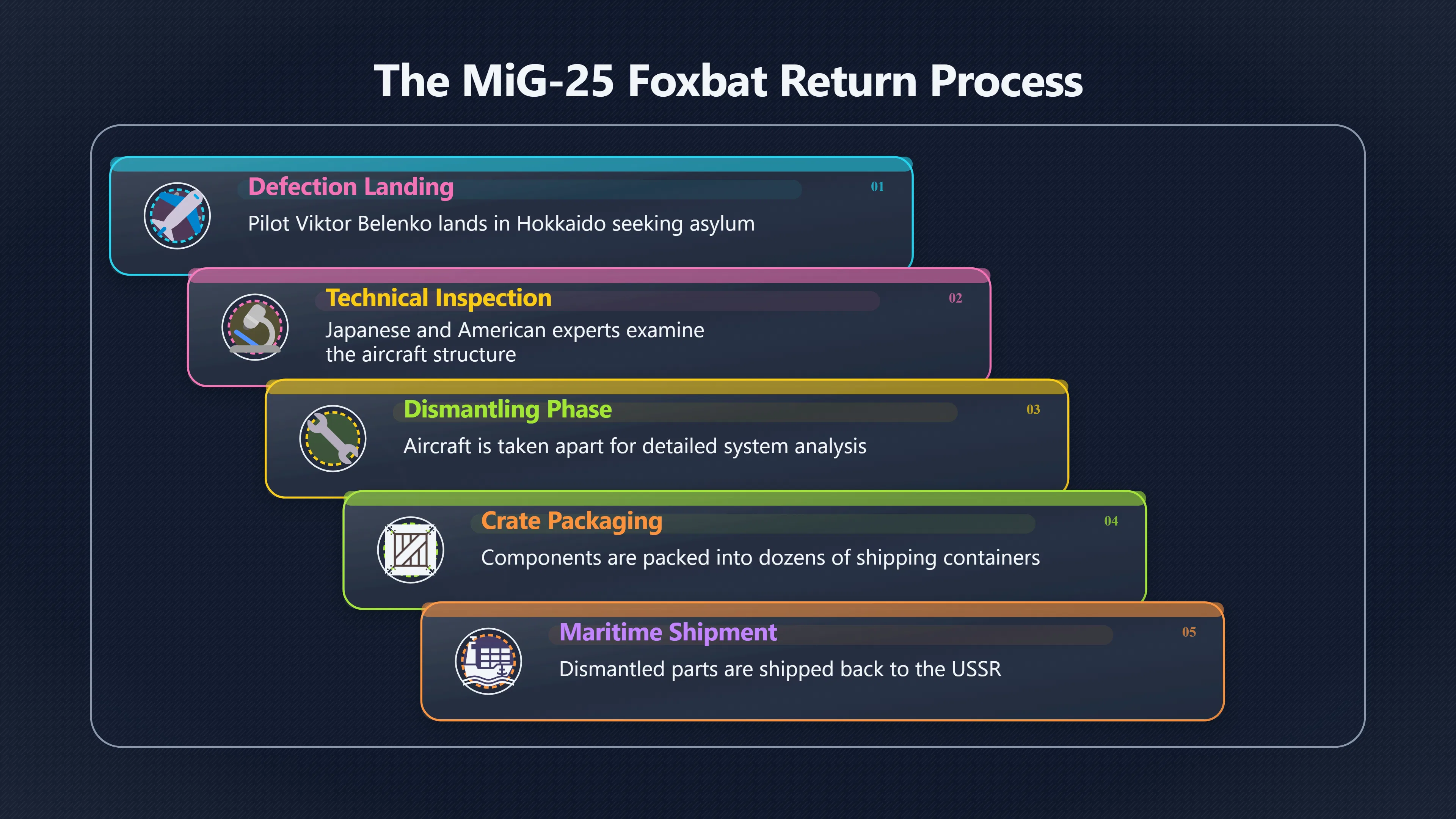
Japan’s handling of the 1976 MiG-25 defection was not simply an intelligence story. It was a diplomatic balancing act conducted under intense pressure from both superpowers. When Soviet pilot Viktor Belenko landed a MiG-25 Foxbat in Hokkaido and sought asylum, Tokyo suddenly found itself responsible for one of the Cold War’s most sensitive pieces of military technology. Japan needed to respect international obligations, manage relations with its powerful American ally, and avoid provoking a major confrontation with the Soviet Union. The result was a carefully managed compromise: the aircraft would be examined by Japanese and American specialists, but it would ultimately be returned to Moscow. That decision allowed valuable technical exploitation while limiting the political damage that might have followed an outright refusal to return the aircraft.[National Security Archive]nsarchive.gwu.eduNational Security Archive Mi G-25 in JapanExcerpt from The President's Daily Brief…28 Sept 1976 — The USSR demanded the immediate return of the aircraft, which the Japanese gov…

Soviet Pressure
The Soviet Union reacted immediately and forcefully. Moscow demanded the rapid return of both the aircraft and its pilot, viewing the defection as a serious political embarrassment and a major security breach. For Japan, ignoring those demands carried risks far beyond the fate of a single aircraft. The Soviet Union was a neighbouring power with unresolved territorial disputes and significant military forces stationed in the Far East.[National Security Archive]nsarchive.gwu.eduNational Security Archive Mi G-25 in JapanExcerpt from The President's Daily Brief…28 Sept 1976 — The USSR demanded the immediate return of the aircraft, which the Japanese gov…
Tokyo therefore faced a difficult legal and diplomatic question. Belenko’s asylum request could be handled under humanitarian and refugee principles, but the aircraft itself was Soviet state property. Returning the MiG too quickly would deny Japan and its allies an unprecedented intelligence opportunity. Holding it indefinitely, however, could trigger a prolonged crisis with Moscow.[National Security Archive]nsarchive.gwu.eduNational Security Archive Mi G-25 in JapanExcerpt from The President's Daily Brief…28 Sept 1976 — The USSR demanded the immediate return of the aircraft, which the Japanese gov…
Japanese leaders chose a middle course. They signalled that the aircraft would be returned, thereby acknowledging Soviet ownership, but delayed the handover long enough to conduct technical inspections. This approach gave Tokyo a defensible position: it was not seizing Soviet property, yet it was not surrendering it immediately under pressure.[National Security Archive]nsarchive.gwu.eduNational Security Archive Mi G-25 in JapanExcerpt from The President's Daily Brief…28 Sept 1976 — The USSR demanded the immediate return of the aircraft, which the Japanese gov…
US Access Negotiations
The United States viewed the Foxbat as one of the most valuable intelligence opportunities of the Cold War. Western analysts had spent years estimating the aircraft’s capabilities from photographs, radar observations and indirect evidence. An intact example offered a chance to replace speculation with direct examination.[ADST]adst.orgA “Very Japanese” Arrangement to Dismantle a Soviet MIG…On September 6, 1976 a MIG-25 (foxbat), the most advanced Soviet fighter j…
Yet Japan could not simply hand the aircraft over to Washington. Such a move would have confirmed Soviet accusations that the defection was being exploited by the United States and could have severely damaged Japan’s diplomatic position. Instead, Tokyo imposed limits and retained formal control over the process. According to later accounts, the Japanese government restricted American access and did not allow the United States to remove or fly the aircraft. Japanese authorities supervised the inspection while permitting American specialists to participate.[CIA]cia.govFormer Soviet Pilot Viktor Belenko's Knee Pad Notebook1976. Western… Soviet Union, the Japanese Government limited US access to the MiG before it was disassembled and returned to the USSR…
This arrangement reflected Japan’s broader Cold War strategy. The country depended heavily on the United States for security through the US–Japan alliance, yet it also sought stable relations with the Soviet Union. By insisting that the examination occur on Japanese soil and under Japanese authority, Tokyo demonstrated that it was neither acting as a passive intermediary for Washington nor yielding entirely to Soviet demands.[ADST]adst.orgA “Very Japanese” Arrangement to Dismantle a Soviet MIG…On September 6, 1976 a MIG-25 (foxbat), the most advanced Soviet fighter j…
The compromise succeeded in practical terms. American and Japanese teams obtained extensive technical information before the aircraft left Japanese custody. At the same time, Tokyo could point to its eventual decision to return the MiG as evidence that it had respected international norms.[National Security Archive]nsarchive.gwu.eduNational Security Archive Mi G-25 in JapanExcerpt from The President's Daily Brief…28 Sept 1976 — The USSR demanded the immediate return of the aircraft, which the Japanese gov…

Why Inspection Time Mattered
The value of the delay lay in what engineers and intelligence specialists could learn before the aircraft was returned. Japanese authorities authorised the MiG’s transfer to a military facility where it could be dismantled and examined in detail. Contemporary reports noted Japanese requests for American assistance in moving and handling the aircraft, reflecting both its importance and the complexity of the operation.[Ford Library Museum]fordlibrarymuseum.govFord Library Museum JapanON FRIDAY. THE AGENCY HAS REQUESTED ASSISTANCE FROM AMERICAN MILITARY. AUTHORITIES IN TRANSPORTING…Read more…
For intelligence agencies, every additional day mattered. The inspection allowed experts to analyse the aircraft’s structure, avionics and systems rather than relying on assumptions. The findings helped clarify that the MiG-25 was a specialised high-speed interceptor rather than the all-purpose “super fighter” that some Western observers had feared. This intelligence value explains why Japan resisted immediate Soviet demands while still avoiding an outright refusal to return the aircraft.[Wikipedia]WikipediaDefection of Viktor BelenkoDefection of Viktor Belenko
Return in Crates
The final stage of the crisis showed how carefully Japan managed the political optics. After the examination was completed, the aircraft was not flown back to the Soviet Union. Instead, it was dismantled, packed into crates and shipped home. Multiple contemporary and retrospective accounts describe the aircraft being returned in dozens of containers after inspection teams finished their work.[CIA]cia.govFormer Soviet Pilot Viktor Belenko's Knee Pad Notebook1976. Western… Soviet Union, the Japanese Government limited US access to the MiG before it was disassembled and returned to the USSR…
The method of return served several purposes. It ensured that the aircraft could be thoroughly inspected before departure, demonstrated that Japan intended to honour its commitment to return Soviet property, and avoided creating the appearance that the aircraft had become a permanent Western intelligence asset. At the same time, the dismantled return underscored the reality that the Soviets were receiving back an aircraft that had already revealed many of its secrets. Soviet complaints that parts were missing reflected lingering tensions surrounding the episode.[Wikipedia]WikipediaDefection of Viktor BelenkoDefection of Viktor Belenko
For Japan, the outcome represented a narrowly successful diplomatic compromise. Moscow recovered its aircraft, Washington gained access to critical intelligence, and Tokyo avoided becoming the centre of a prolonged superpower confrontation. The episode remains a notable example of how a middle power can manage a crisis involving highly sensitive foreign military technology: by controlling access, limiting escalation, and creating enough room for competing interests to be partially satisfied without allowing any single party to dictate the outcome.[gwu.edu]nsarchive.gwu.eduNational Security Archive Mi G-25 in JapanExcerpt from The President's Daily Brief…28 Sept 1976 — The USSR demanded the immediate return of the aircraft, which the Japanese gov…

eBay marketplace picks
Marketplace Samples
Live-tested eBay searches with available results related to this page.




Endnotes
1.
Source: cia.gov
Title: Former Soviet Pilot Viktor Belenko’s Knee Pad Notebook
Link:https://cia.gov/legacy/museum/artifact/former-soviet-pilot-viktor-belenkos-knee-pad-notebook-with-flight-data/
Source snippet
1976. Western... Soviet Union, the Japanese Government limited US access to the MiG before it was disassembled and returned to the USSR...
2.
Source: adst.org
Link:https://adst.org/2018/03/a-very-japanese-arrangement-to-dismantle-a-soviet-mig-25/
Source snippet
A “Very Japanese” Arrangement to Dismantle a Soviet MIG...On September 6, 1976 a MIG-25 (foxbat), the most advanced Soviet fighter j...
Published: September 6, 1976
3.
Source: Wikipedia
Title: Defection of Viktor Belenko
Link:https://en.wikipedia.org/wiki/Defection_of_Viktor_Belenko
4.
Source: cia.gov
Link:https://www.cia.gov/readingroom/docs/CIA-RDP90-00552R000100490007-2.pdf
Source snippet
CIA INDUCED RUSSIAN TO DEFECT: JAPAN PRESSThe plane was airlifted to an airport near Tokyo, where U.S. and Japanese experts examined it f...
5.
Source: Wikipedia
Link:https://en.wikipedia.org/wiki/Mikoyan
Source snippet
MikoyanRussian Aircraft Corporation "MiG commonly known as Mikoyan and MiG, is a Russian aerospace and defence company headquartered i...
6.
Source: nsarchive.gwu.edu
Title: National Security Archive Mi G-25 in Japan
Link:https://nsarchive.gwu.edu/document/16291-document-36-mig-25-japan-excerpt
Source snippet
Excerpt from The President's Daily Brief...28 Sept 1976 — The USSR demanded the immediate return of the aircraft, which the Japanese gov...
7.
Source: fordlibrarymuseum.gov
Title: Ford Library Museum Japan
Link:https://www.fordlibrarymuseum.gov/library/document/0324/1553701.pdf
Source snippet
ON FRIDAY. THE AGENCY HAS REQUESTED ASSISTANCE FROM AMERICAN MILITARY. AUTHORITIES IN TRANSPORTING...Read more...
8.
Source: fordlibrarymuseum.gov
Link:https://www.fordlibrarymuseum.gov/library/document/0324/1553706.pdf
Source snippet
MIG - Incident (7)THE JAPANESE GOVERNMENT IS EXPECTED TO REQUEST THE. SOVIETS TO PAY COMPENSATION FOR THE DAMAGE DONE TO HOKKAIDO:S. SAPP...
9.
Source: einvoice.nat.gov.tw
Link:https://www.einvoice.nat.gov.tw/ptl007w/1692324517106
Additional References
10.
Source: reddit.com
Link:https://www.reddit.com/r/aviation/comments/11ns6bp/mig25_foxbat_being_inspected_on_the_ground_at/
Source snippet
MiG-25 Foxbat being inspected on the ground at Japan's...MiG-25 Foxbat being inspected on the ground at Japan's Hakodate airport soon af...
11.
Source: facebook.com
Title: otd𝟭𝟵𝟳𝟲 soviet pilot lt victor belenko taking off from sakharovka ab near vladiv
Link:https://www.facebook.com/AirAndSpaceForcesAssociation/posts/otd%F0%9D%9F%AD%F0%9D%9F%B5%F0%9D%9F%B3%F0%9D%9F%B2-soviet-pilot-lt-victor-belenko-taking-off-from-sakharovka-ab-near-vladiv/1205458941609351/
Source snippet
Soviet pilot defects with Mig-25 in 1976After American engineers examined the plane Japan then sent it back,piece by piece and billed Rus...
12.
Source: facebook.com
Title: lt victor belenko landed his mikoyan gurevich mig 25 foxbat at hakodate airport
Link:https://www.facebook.com/100095585407183/posts/lt-victor-belenko-landed-his-mikoyan-gurevich-mig-25-foxbat-at-hakodate-airport-/629544630241712/
Source snippet
Victor Belenko, landed his Mikoyan-Gurevich MiG-25 “...On 2 October 1976, the Japanese Government announced that it would ship the aircr...
Published: October 1976
13.
Source: reddit.com
Title: til that in 1976 a soviet pilot viktor belenko
Link:https://www.reddit.com/r/todayilearned/comments/1uekzx0/til_that_in_1976_a_soviet_pilot_viktor_belenko/
Source snippet
TIL that in 1976 a Soviet pilot, Viktor Belenko, defected to...TIL that in 1976 a Soviet pilot, Viktor Belenko, defected to Japan by fly...
14.
Source: migflug.com
Title: the pilot who stole the foxbat
Link:https://migflug.com/jetflights/the-pilot-who-stole-the-foxbat/
Source snippet
BlogApr 10, 2026 — Viktor Ivanovich Belenko was a 29-year-old Soviet Air Defence Forces pilot who defected to Japan on September 6, 1976...
Published: September 6, 1976
15.
Source: docs.cloud.google.com
Link:https://docs.cloud.google.com/compute/docs/instance-groups/create-mig-with-gpu-vms?hl=zh-tw
Source snippet
google.com建立一次新增多個GPU VM 的MIG | Compute Engine本文說明如何建立代管執行個體群組(MIG),一次新增多個GPU 虛擬機器(VM) 執行個體。 MIG 會使用目標大小政策的大量模式,一次新增所有VM。...
16.
Source: rapiddirect.com
Title: mig vs tig welding
Link:https://www.rapiddirect.com/zh-TW/blog/mig-vs-tig-welding/
Source snippet
MIG 與TIG 焊接:選擇正確方法的完整指南Jan 17, 2025 — 與許多焊工認為焊接的縮影的TIG 焊接相比,MIG 焊接在處理之前不需要太多的技術專業知識。 MIG 焊工可以只用一隻手焊接鈑金零件,而TIG 焊工則需要一隻手和...Read more...
17.
Source: youtube.com
Title: Victor Belenko | The Pilot Who Stole the Soviet Union’s Greatest Secret
Link:https://www.youtube.com/watch?v=_sAvkr4LbWw
Source snippet
F-15 Eagle vs MiG-25 Foxbat: The Cold War Dogfight That Changed Everything...
18.
Source: youtube.com
Title: F-15 Eagle vs Mi G-25 Foxbat: The Cold War Dogfight That Changed Everything
Link:https://www.youtube.com/watch?v=Urczy9qBT8M
Source snippet
He Stole the MiG-25 to Escape the Soviet Union...
19.
Source: migjimenez.com
Link:https://www.migjimenez.com/en/
Source snippet
ing magazine and much more...
Topic Tree