Within Industrial Learning From Captured Weapon Design
What T 34 Wrecks Taught Factories
Captured T-34s showed how production-friendly tank design could matter as much as finish quality or crew comfort.
On this page
- Sloped armour as a production lesson
- Welds, sealing and uneven finishing
- When rough manufacture is still good enough
Page outline Jump by section
Introduction
Captured T-34 tanks taught foreign observers a lesson that went beyond armour thickness or gun calibre. The most important discovery was that a tank could be designed around factory realities rather than ideal engineering. When German, American and other analysts examined captured or supplied T-34s, they found a vehicle full of compromises: rough welds, inconsistent finishing, cramped crew conditions and quality-control problems. Yet they also found a machine that could be produced in extraordinary numbers while retaining enough combat effectiveness to remain dangerous on the battlefield. The central industrial lesson was that a successful wartime weapon did not have to be refined everywhere. It had to be good enough in the areas that mattered most and economical enough to build at scale.[Wikipedia]WikipediaOpen source on wikipedia.org.

Sloped Armour as a Production Lesson
The T-34’s most famous feature was its heavily sloped armour. Military engineers quickly recognised the tactical advantages: angled armour increased effective protection and improved the chance that incoming rounds would deflect. However, the design also carried an important manufacturing lesson. By relying on geometry rather than simply adding thicker plates, Soviet designers achieved substantial protection without a corresponding increase in weight or raw material consumption.[wikipedia.org]WikipediaOpen source on wikipedia.org.
For industrial planners studying captured examples, this was a reminder that clever shaping could substitute for additional steel. A tank did not necessarily need thicker armour if the armour could be arranged more efficiently. This principle influenced later armoured vehicle development across multiple countries, including designs that adopted stronger emphasis on sloped surfaces.[Discovery UK]discoveryuk.comDiscovery UKThe T-34 Tank: Soviet Armour That Changed WWII12 Jul 2024 — Unlike earlier tanks, which were essentially basic metal boxes, t…
The T-34 also demonstrated that protection should be viewed as a system rather than a collection of individual plate thicknesses. Foreign investigators often came away impressed by the concept even when they criticised details of Soviet manufacturing. In other words, the armour layout represented an industrial success even where workmanship did not.[Wikipedia]WikipediaOpen source on wikipedia.org.
Welds, Sealing and Uneven Finishing
Captured tanks revealed a less glamorous side of Soviet mass production. Testing at Aberdeen Proving Ground in the United States identified weaknesses in weld quality, armour joins and weather sealing. Examiners noted that water could enter through gaps and cracks, creating risks for electrical equipment and ammunition. They also criticised inconsistent armour quality and manufacturing standards.[Wikipedia]WikipediaOpen source on wikipedia.org.
These findings are often cited as evidence that the T-34 was poorly made, but that interpretation misses the industrial context. Soviet factories were operating under invasion, evacuation and severe resource pressures. Production facilities were relocated eastward, labour forces changed dramatically, and output requirements increased rather than decreased. Under such conditions, many finishing operations that would improve durability or crew comfort were treated as secondary concerns.[Wikipedia]WikipediaOpen source on wikipedia.org.
What foreign observers learned was that not every manufacturing defect had equal importance. A rough weld might reduce long-term durability, but if the vehicle could survive its expected combat life and remain operational in battle, Soviet planners often accepted the compromise. This was a very different philosophy from peacetime engineering, where appearance, finish and longevity usually receive greater emphasis.[Wikipedia]WikipediaOpen source on wikipedia.org.
The T-34 therefore became a case study in prioritisation. Captured examples showed where Soviet engineers spent their limited production effort and where they deliberately economised. The distinction mattered because some shortcuts represented intelligent simplification, while others represented unavoidable sacrifices imposed by wartime conditions.[Wikipedia]WikipediaOpen source on wikipedia.org.

How the Design Was Simplified for Mass Production
One of the most striking discoveries from studying T-34 production was the extent to which the vehicle was redesigned for manufacturing efficiency during the war. Soviet engineers repeatedly modified components not to improve battlefield performance directly but to reduce labour requirements, simplify tooling and accelerate assembly.[Wikipedia]WikipediaOpen source on wikipedia.org.
Examples included:
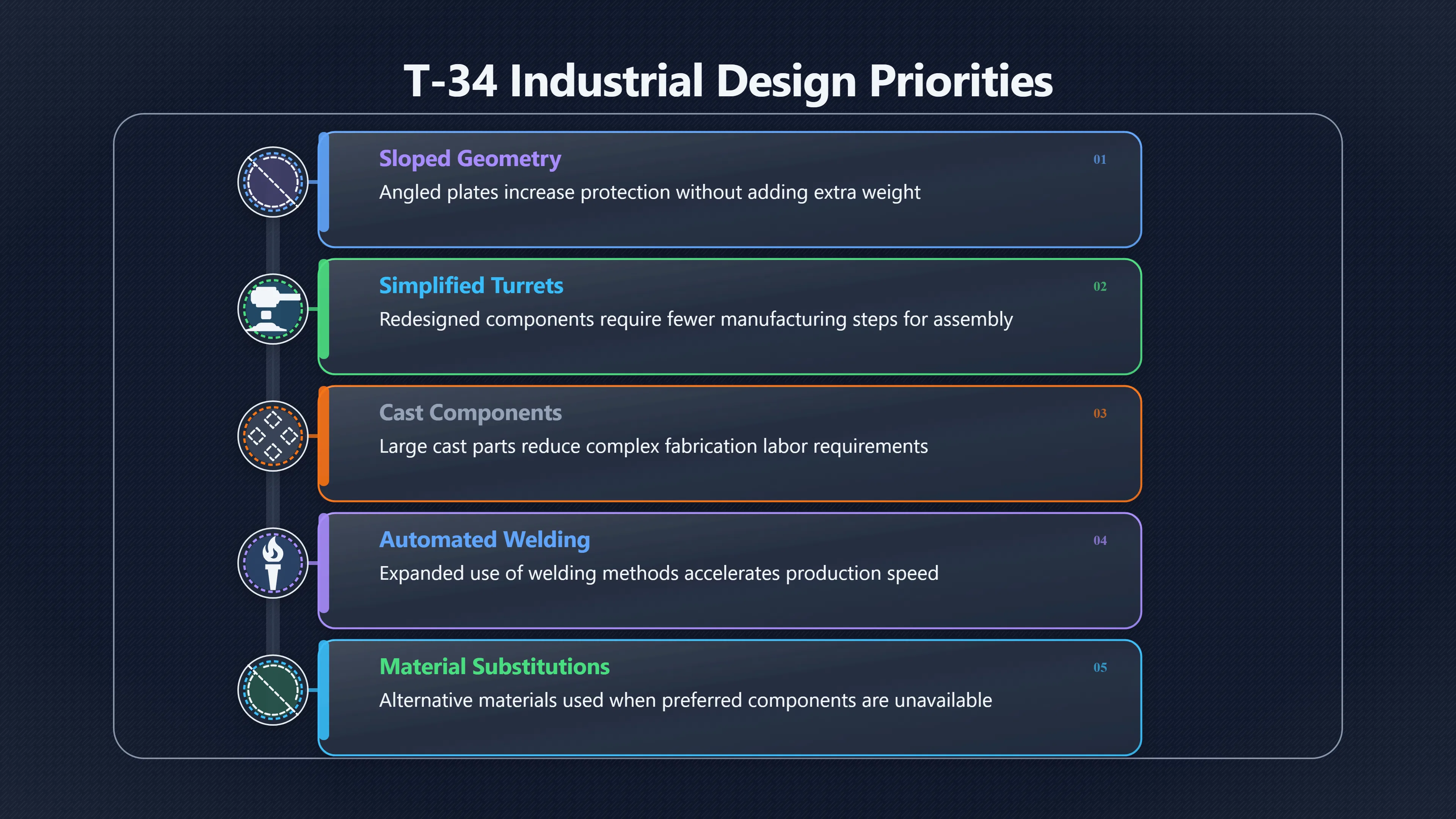
- Increased use of large cast components that reduced complex fabrication work.
- Simplified turret designs that required fewer manufacturing steps.
- Expanded use of automated welding methods.
- Reduction in the number of parts required for major assemblies, including the main gun.
- Material substitutions when shortages made preferred components unavailable.[wikipedia.org]WikipediaOpen source on wikipedia.org.
The results were dramatic. Production costs fell sharply during the war, while output increased to levels that few countries could match. Soviet industry reduced both manufacturing time and labour requirements even as factories were disrupted by combat and relocation.[wikipedia.org]WikipediaOpen source on wikipedia.org.
For foreign analysts, the lesson was not merely that the Soviet Union built many tanks. It was that production engineering itself could become a weapon. Simplifying a design after it entered service could yield strategic advantages every bit as important as introducing a new gun or thicker armour.[Wikipedia]WikipediaOpen source on wikipedia.org.
When Rough Manufacture Is Still Good Enough
The T-34 exposed a recurring tension in military production: whether perfection is worth the cost. Captured vehicles showed clear shortcomings in ergonomics, visibility, crew comfort, sealing and manufacturing consistency. Crews often operated in cramped conditions, and foreign observers frequently regarded Soviet optics and interior arrangements as inferior to contemporary Western or German standards.[Wikipedia]WikipediaOpen source on wikipedia.org.
Yet the same tank combined strong battlefield mobility, effective armour geometry and a capable gun with production volumes that opponents struggled to match. The Soviet leadership consciously delayed or rejected some desirable improvements because they would have slowed output. Changes that simplified production were frequently approved more readily than changes that improved comfort or refinement.[Wikipedia]WikipediaOpen source on wikipedia.org.
Captured T-34s therefore challenged a common engineering assumption: that the best-designed product is the one with the fewest flaws. Wartime experience suggested a different metric. A design could be crude in some respects yet strategically superior if it could be manufactured rapidly, repaired reasonably well and deployed in overwhelming numbers.[Wikipedia]WikipediaOpen source on wikipedia.org.
This was the deeper lesson extracted from T-34 wrecks and captured examples. The tank’s importance lay not only in its battlefield characteristics but also in what it revealed about industrial priorities. Foreign observers learned that manufacturability, labour savings and production speed could shape military effectiveness just as decisively as armour quality or technical sophistication.[Wikipedia]WikipediaOpen source on wikipedia.org.
Amazon book picks
Further Reading
Books and field guides related to What T 34 Wrecks Taught Factories. Use these as the next step if you want deeper reading beyond the article.
The Russian Way of War
Provides context for Soviet operational and production choices.
eBay marketplace picks
Marketplace Samples
Live-tested eBay searches with available results related to this page.

Endnotes
1.
Source: Wikipedia
Link:https://en.wikipedia.org/wiki/T-34
2.
Source: discoveryuk.com
Link:https://www.discoveryuk.com/military-history/the-t-34-tank-soviet-armour-that-changed-wwii/
Source snippet
Discovery UKThe T-34 Tank: Soviet Armour That Changed WWII12 Jul 2024 — Unlike earlier tanks, which were essentially basic metal boxes, t...
3.
Source: dlab.epfl.ch
Link:https://dlab.epfl.ch/wikispeedia/wpcd/wp/t/T-34.htm
Source snippet
dlab @ EPFLT-34Over two years, the production cost of the tank was reduced from 269,500 rubles in 1941, to 193,000, and then to 135,000 (...
4.
Source: o5m6.de
Link:https://www.o5m6.de/redarmy/t_34_76_uztm.php
Source snippet
T-34 Medium Tank w/UZTM Cast Turret28 Jan 2012 — A new slightly larger »stamped« cast turret out of 60mm hardened steel was developed wit...
5.
Source: o5m6.de
Title: t34 76 stz
Link:https://www.o5m6.de/redarmy/t34_76_stz.php
Source snippet
T-34/76 STZ20 Aug 2014 — To reinforce this and at the same time to simplify production, the lower corner was simply cut off and a single...
Additional References
6.
Source: reddit.com
Link:https://www.reddit.com/r/WarCollege/comments/jalkav/the_myth_of_the_disposable_t34/
Source snippet
The Myth of the Disposable T-34: r/WarCollegeWell if the expected service life of any individual tank in actual use is 600 hours, you've...
7.
Source: cia.gov
Link:https://www.cia.gov/readingroom/docs/CIA-RDP81-01044R000100070001-4.pdf
Source snippet
Russian Medium Tank T34 and KV-1" No. W.A.L. 640/91, 24 Nov. 1943. E. F. "Russian Radio and...Read more...
8.
Source: facebook.com
Title: it might not be the prettiest or the most reliable but it was cheap easy to make
Link:https://www.facebook.com/tankmuseum/posts/it-might-not-be-the-prettiest-or-the-most-reliable-but-it-was-cheap-easy-to-make/843822637929579/
Source snippet
The Tank MuseumThe T34 is a design classic. It was easily the best tank in the world in 1941, sloped armour, a powerful reliable engine a...
9.
Source: reddit.com
Link:https://www.reddit.com/r/AskHistorians/comments/dsxwyy/ama_tank_archives_and_designing_the_t34/
Source snippet
My name is Peter Samsonov, and my area of research is primarily in armoured warfare in World War II. You may have seen me answer...
10.
Source: dday.center
Link:https://www.dday.center/the-role-of-the-soviet-t-34-tank-in-european-battles/
Source snippet
They... The T-34's mass production methods shook up how countries built armored vehicles.Read more...
11.
Source: facebook.com
Link:https://www.facebook.com/SimpleHistoryCartoons/posts/soviet-engineers-tested-t-34-concrete-armor-prototypes-in-1943-due-to-steel-shor/1307638558057157/
Source snippet
ins and welds, as well as the use of soft steel combined with...Read more...
12.
Source: facebook.com
Link:https://www.facebook.com/TankArchivesBlog/posts/extensive-trials-of-the-t-34-tank-in-late-1940-revealed-a-number-of-shortcomings/627086956109829/
Source snippet
Extensive trials of the T-34 tank in late 1940 revealed...This new prototype had a new engine, gearbox and improved its transmission...
13.
Source: en.topwar.ru
Title: 169476 vojny tehnologij svarka sovetskoj broni
Link:https://en.topwar.ru/169476-vojny-tehnologij-svarka-sovetskoj-broni.html
Source snippet
Военное обозрениеTechnology Wars: Welding Soviet Armor30 Mar 2020 — Welding the commander's turret to the roof of the T-34-85 tank tower...
14.
Source: facebook.com
Title: Imitation is the highest form of flattery!
Link:https://www.facebook.com/tankmuseum/posts/imitation-is-the-highest-form-of-flattery-the-soviet-t-34-had-a-big-influence-on/1322160926762412/
Source snippet
/ The Soviet T-34...The T‑34's combination of sloped armour, wide tracks, and the 76.2 mm F‑34 gun represented a design philosophy the G...
15.
Source: reddit.com
Link:https://www.reddit.com/r/badhistory/comments/10o3tnr/the_t34_is_not_as_bad_as_you_think_it_is_part_25/
Source snippet
spot-welded using inferior [materials]({{ 'materials/' | relative_url }}) to make the joint.Read more...
Topic Tree