Within Tu 4 Copy
The paperwork needed to copy a bomber
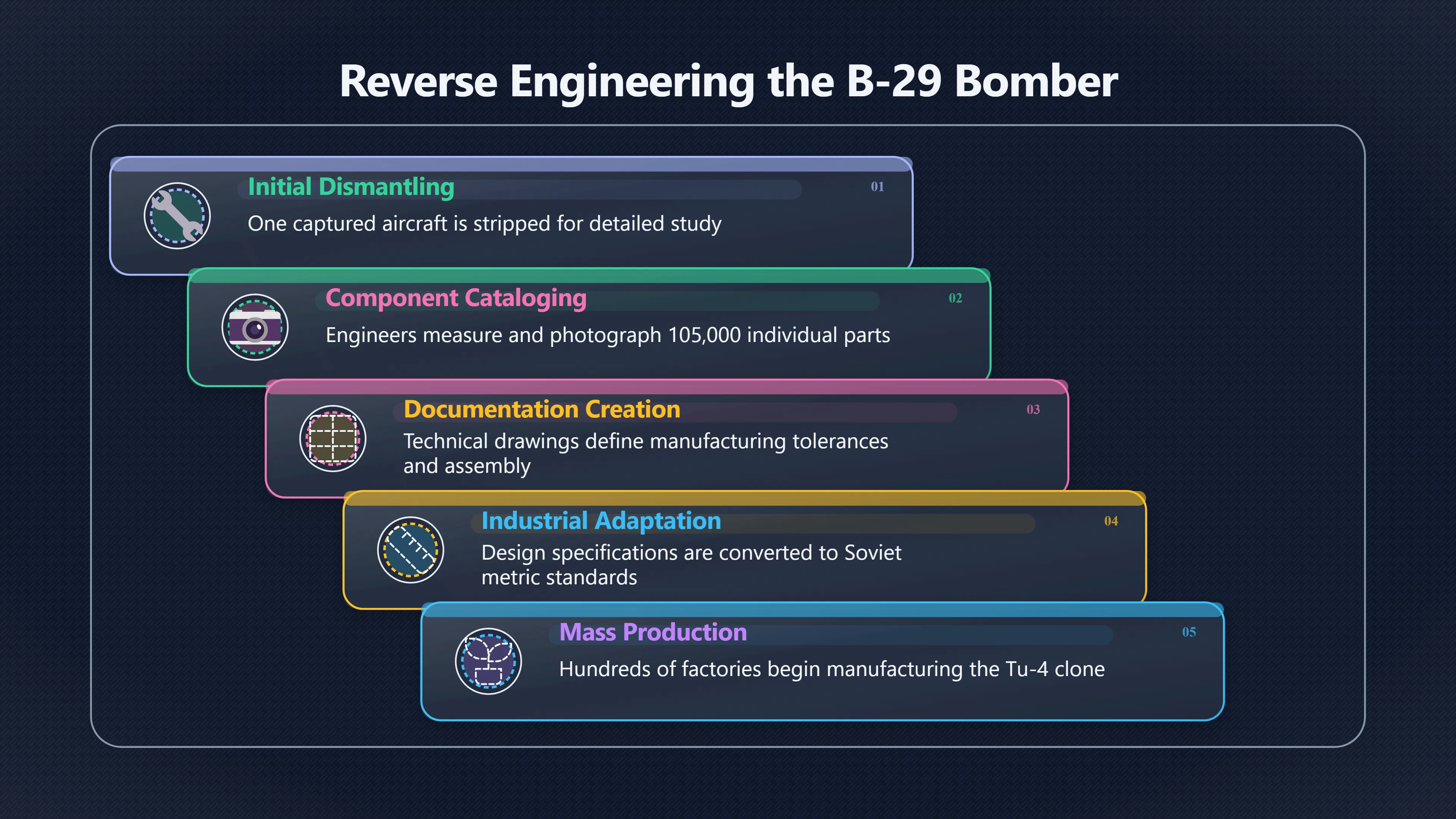
Reverse engineering the Tu-4 required thousands of drawings because a captured aircraft had to become a buildable factory package.
On this page
- Why dismantling was only the starting point
- How parts became drawings and production instructions
- What documentation reveals about reverse engineering scale
Page outline Jump by section
Introduction
The most revealing statistic from the Tu-4 programme is not the bomber’s range, speed, or bomb load. It is the paperwork. Soviet sources and later historical studies consistently report that the effort to reproduce the American B-29 required the creation of roughly 105,000 drawings and involved hundreds of factories and research institutes. That figure captures a central truth about reverse engineering military technology: possessing a physical aircraft is not the same thing as possessing the information needed to manufacture it repeatedly. The Tu-4 programme transformed a handful of captured bombers into a complete industrial package of measurements, specifications, tolerances, instructions, and production documents. The paperwork was not a by-product of copying. It was the copy.[Wikipedia]WikipediaTupolev Tu-4Tupolev Tu-4

Why Dismantling Was Only the Starting Point
When Soviet engineers received the interned B-29s, they did not acquire the engineering drawings, manufacturing plans, tooling specifications, or production standards that Boeing had accumulated during development and wartime manufacture. What they possessed was a finished aircraft. Turning that aircraft into a reproducible weapon required reconstructing the missing information from scratch.[Wikipedia]WikipediaTupolev Tu-4Tupolev Tu-4
One B-29 was dismantled in detail, another was retained as a reference aircraft, and another was used for flight testing and familiarisation. The goal was not merely to understand how the bomber worked but to determine exactly how every component could be manufactured inside Soviet industry.[Wikipedia]WikipediaTupolev Tu-4Tupolev Tu-4
Historical accounts describe the bomber as containing approximately 105,000 individual parts that had to be measured, catalogued, photographed, and analysed. Each component represented a separate engineering problem. A bracket, cable fitting, instrument housing, or structural rib might seem insignificant in isolation, but production could not proceed until every item existed on paper in a form that factories could reproduce.[coldwar.org]coldwar.orgCold War MuseumRussian B-29 Clone — The TU-4 StoryThe Russian plan was to organize the best pilots, technicians, engineers, and aviation…
The resulting challenge demonstrates a common misconception about reverse engineering. A captured machine reveals what was built. It does not automatically reveal the full chain of decisions, tolerances, inspection criteria, and manufacturing methods that produced it.
How Parts Became Drawings and Production Instructions
The frequently cited figure of 105,000 drawings can sound excessive until the process is examined more closely. Soviet engineers were not producing artistic sketches. They were creating the documentation required for industrial production.[wikipedia.org]WikipediaTupolev Tu-4Tupolev Tu-4
For each component, engineers had to:
- Measure dimensions and geometry.
- Determine material composition.
- Establish acceptable manufacturing tolerances.
- Define assembly relationships with adjoining parts.
- Produce shop-floor instructions.
- Create inspection and quality-control documentation.
- Integrate the component into larger assemblies and subassemblies.
Every one of these steps generated paperwork. A finished bomber could not be ordered from a factory merely by providing photographs and measurements. Production managers required drawings. Toolmakers required drawings. Inspectors required drawings. Suppliers required drawings. The reverse-engineering effort therefore became a documentation project on an extraordinary scale.[CBS News]cbsnews.compiece by pieceCBS NewsPiece By Piece25 Jan 2001 — New details of how Soviet engineers copied the B-29… They measured and photographed about 105,000…
Some accounts distinguish between approximately 105,000 parts that were measured and catalogued and roughly 40,000 detailed engineering drawings generated from that work. Other sources refer to 105,000 drawings as the overall documentation output. Regardless of the precise accounting method, all descriptions point to the same reality: tens of thousands of technical documents had to be created before serial production could begin.[CBS News]cbsnews.compiece by pieceCBS NewsPiece By Piece25 Jan 2001 — New details of how Soviet engineers copied the B-29… They measured and photographed about 105,000…
This explains why historians often describe the Tu-4 effort as a national industrial mobilisation rather than a simple aircraft-copying exercise.
The Hidden Problem: Translating an American Aircraft into Soviet Industry
The paperwork burden expanded because Soviet engineers could not merely trace American dimensions.
The B-29 had been designed using American measurement standards and American material specifications. Soviet factories worked in metric units and used different industrial standards. A direct one-to-one transfer was often impossible. Sheet aluminium thicknesses available to Boeing did not necessarily exist in Soviet production. Materials and alloys frequently had no exact Soviet equivalent.[Wikipedia]WikipediaTupolev Tu-4Tupolev Tu-4
As a result, engineers had to create documentation that did more than record what they found. They had to convert the aircraft into a form that Soviet factories could actually build.
That conversion process multiplied the paperwork. Every time a measurement was translated, a material substituted, or a manufacturing method adjusted, additional engineering documentation became necessary. The bomber therefore generated not only reverse-engineering records but also an enormous body of adaptation paperwork linking American design practice to Soviet production capability.[Wikipedia]WikipediaTupolev Tu-4Tupolev Tu-4
The paperwork became the bridge between the captured aircraft and the Soviet industrial system.
What the Documentation Reveals About Reverse Engineering Scale
The scale of the documentation effort provides one of the clearest quantitative measures of what reverse engineering actually requires.
The Tu-4 programme reportedly drew upon around 900 factories and research institutes. Design work was completed within roughly a year, after which industry moved into production. Such figures reveal that the challenge was not confined to Tupolev’s design bureau. It extended across an entire industrial network.[wikipedia.org]WikipediaTupolev Tu-4Tupolev Tu-4
The paperwork also exposes a broader principle often overlooked in discussions of technological copying. Reverse engineering is rarely about obtaining a physical object. It is about recreating the information ecosystem behind that object.
A bomber consists of metal, engines, and electronics. A production programme consists of drawings, specifications, inspection procedures, manufacturing instructions, tooling requirements, and supplier documentation. The captured B-29 supplied the first category. Soviet engineers had to reconstruct the second.[Smithsonian Magazine]smithsonianmag.comSmithsonian MagazineMade in the U.S.S.R.Of course they copied it. The two airplanes could have been twins. But was the Soviets' Tu-4 trul…
That distinction helps explain why technologically advanced military systems are difficult to duplicate even when examples are available. The visible machine is only the final expression of a much larger body of knowledge.

The Real Meaning of the 105,000-Figure
The famous 105,000 figure is often repeated because it is dramatic, but its significance is not the number itself. The number illustrates that copying an aircraft required converting physical evidence into institutional knowledge.[Wikipedia]WikipediaTupolev Tu-4Tupolev Tu-4
The Tu-4 demonstrates that reverse engineering succeeds only when a captured artefact can be transformed into documentation that factories understand and can use repeatedly. Thousands of engineers could examine a B-29 parked on an airfield, yet none of them could mass-produce it without drawings, standards, and production instructions. The vast paperwork burden behind the Tu-4 was therefore not an administrative side issue. It was the essential step that turned a captured bomber into a Soviet-built bomber.[cbsnews.com]cbsnews.compiece by pieceCBS NewsPiece By Piece25 Jan 2001 — New details of how Soviet engineers copied the B-29… They measured and photographed about 105,000…
Amazon book picks
Further Reading
Books and field guides related to The paperwork needed to copy a bomber. Use these as the next step if you want deeper reading beyond the article.
Skunk Works
Illustrates the enormous documentation burden behind aircraft development.
The Design of Everyday Things
Highlights how design information and documentation shape products.

Stalin's aviation gulag
Offers insight into the organizations producing the Tu-4 documentation.
eBay marketplace picks
Marketplace Samples
Live-tested eBay searches with available results related to this page.
Endnotes
1.
Source: Wikipedia
Title: Tupolev Tu-4
Link:https://en.wikipedia.org/wiki/Tupolev_Tu-4
2.
Source: b-29s-over-korea.com
Title: B-29’s Over Korea Russian B-29 Clone
Link:https://www.b-29s-over-korea.com/russian-b-29-clone-tupolev-tu-4/
Source snippet
105,000 parts of the B-29. They decided to completely disassemble the Hap...Read more...
3.
Source: warfarehistorynetwork.com
Link:https://warfarehistorynetwork.com/article/the-soviets-steal-the-b-29/
Source snippet
The Soviets steal the B-29.The reengineering project had required the full cooperation of 900 research facilities and factories across th...
4.
Source: smithsonianmag.com
Link:https://www.smithsonianmag.com/air-space-magazine/made-in-the-ussr-38442437/
Source snippet
Smithsonian MagazineMade in the U.S.S.R.Of course they copied it. The two airplanes could have been twins. But was the Soviets' Tu-4 trul...
5.
Source: coldwar.org
Link:https://coldwar.org/RB-29/HTML/03RelatedStories/03.03shortstories/03.03.10contss.htm
Source snippet
Cold War MuseumRussian B-29 Clone — The TU-4 StoryThe Russian plan was to organize the best pilots, technicians, engineers, and aviation...
6.
Source: cbsnews.com
Title: piece by piece
Link:https://www.cbsnews.com/news/piece-by-piece/
Source snippet
CBS NewsPiece By Piece25 Jan 2001 — New details of how Soviet engineers copied the B-29... They measured and photographed about 105,000...
7.
Source: reddit.com
Title: Tupolev Tu-4
Link:https://www.reddit.com/r/WeirdWings/comments/1cu7f2v/tupolev_tu4_when_the_soviets_reverse_engineered/
Source snippet
When The Soviets Reverse Engineered...The Tu-4 was slightly slower, slightly heavier, could fly substantially higher, had a three-ton hi...
8.
Source: facebook.com
Title: Tupolev Tu-4
Link:https://www.facebook.com/planehistoria/posts/tupolev-tu-4-when-the-soviets-reverse-engineered-the-boeing-b-29-superfortress-1/867976225743221/
Source snippet
When The Soviets Reverse Engineered...Stalin told the Tupolev Design Bureau that he wanted an exact copy of the B29. Fearing Stalin's Wr...
Additional References
9.
Source: airandspaceforces.com
Link:https://www.airandspaceforces.com/article/0609bomber/
Source snippet
Carbon Copy BomberThe Soviet Union had done the impossible: It had reverse engineered and produced flyable B-29 replicas in two short yea...
10.
Source: warthunder.fandom.com
Link:https://warthunder.fandom.com/wiki/Tu-4
Source snippet
War Thunder WikiTu-4 | War Thunder Wiki | FandomThe reverse-engineering effort involved 900 factories and research institutes, who finish...
11.
Source: reddit.com
Title: tupolev tu4 when the soviets reverse engineered
Link:https://www.reddit.com/r/aviation/comments/1cu7dry/tupolev_tu4_when_the_soviets_reverse_engineered/
Source snippet
Tupolev Tu-4. When The Soviets Reverse Engineered...The soviets got their first B29 on July 29 1944 when an intact B-29 —Ramp Tramp—was...
12.
Source: facebook.com
Link:https://www.facebook.com/planehistoria/posts/tupolev-tu-4-when-the-soviets-reverse-engineered-the-boeing-b-29-superfortress-1/1048012081072967/
Source snippet
e from combat damage built onto the planes and the control...Read more...
13.
Source: reddit.com
Link:https://www.reddit.com/r/WWIIplanes/comments/vmjf0g/tupolev_tu4_a_reversed_engineered_copy_of_4_us/
Source snippet
tory after bombing Japan. The Soviet model would not fly...Read more...
14.
Source: youtube.com
Link:https://www.youtube.com/watch?v=teE2SG2Di8g
Source snippet
Paper Skies · 1.2M views; When China flew the Superfortress -Tupolev Tu-4 and KJ-1...
15.
Source: warhistoryonline.com
Title: reverse engineering b29 soviet tu4
Link:https://www.warhistoryonline.com/world-war-ii/reverse-engineering-b29-soviet-tu4.html
Source snippet
Reverse-Engineering the B-29 Into the Soviet Tupolev TU-421 Jun 2018 — It took the USSR more than two years to get their version off the...
16.
Source: mikesresearch.com
Title: soviet tupolev tu 4 bomber
Link:https://mikesresearch.com/2023/05/28/soviet-tupolev-tu-4-bomber/
Source snippet
Soviet Tupolev Tu-4 Bomber28 May 2023 — The Soviet Tupolev Tu-4 strategic bomber was an unlicensed, reverse-engineered copy of the US WWI...
Published: May 2023
17.
Source: youtube.com
Link:https://www.youtube.com/watch?v=8BvcCbrW9so&vl=en
Source snippet
engineered Boeing B-29 Superfortress built during the early...
18.
Source: youtube.com
Title: Tupolev Tu-4 Bull (Soviet B-29 Superfortress clone)
Link:https://www.youtube.com/watch?v=5mXIRIurWHU
Source snippet
Tupolev Tu-4 Long Range Bomber Documentary - MADE in the USSR...
Topic Tree