Within Sidewinder
Why the Sidewinder Seeker Was Hard to Copy
The AIM-9B seeker revealed a simple layout, but its optics, detector behavior and lock-on limits made exact performance difficult to reproduce.
On this page
- What the early infrared seeker actually did
- Why rear aspect lock on limited combat use
- How small seeker differences changed operational performance
Page outline Jump by section
Introduction
The captured AIM-9B Sidewinder that reached Soviet engineers in the late 1950s seemed, at first glance, to offer an unusually favourable reverse-engineering opportunity. Unlike many advanced weapons, the missile was compact, mechanically elegant and designed around a relatively simple infrared seeker. Yet the seeker proved to be one of the hardest parts of the missile to reproduce with identical performance. The challenge was not understanding what the seeker did; it was reproducing how well it did it. Early heat-seeking missiles depended on a delicate interaction between optics, detector materials, rotating scanning systems, analogue electronics and aircraft employment tactics. A reverse engineer could measure the hardware, but matching the missile’s real-world sensitivity, tracking behaviour and reliability was far more difficult.[ausairpower.net]ausairpower.netAir Power AustraliaThe Sidewinder Story / The Evolution of the AIM-9 Missileby C Kopp · 1994 · Cited by 22 — The simplest strategy for de…
What the Early Infrared Seeker Actually Did
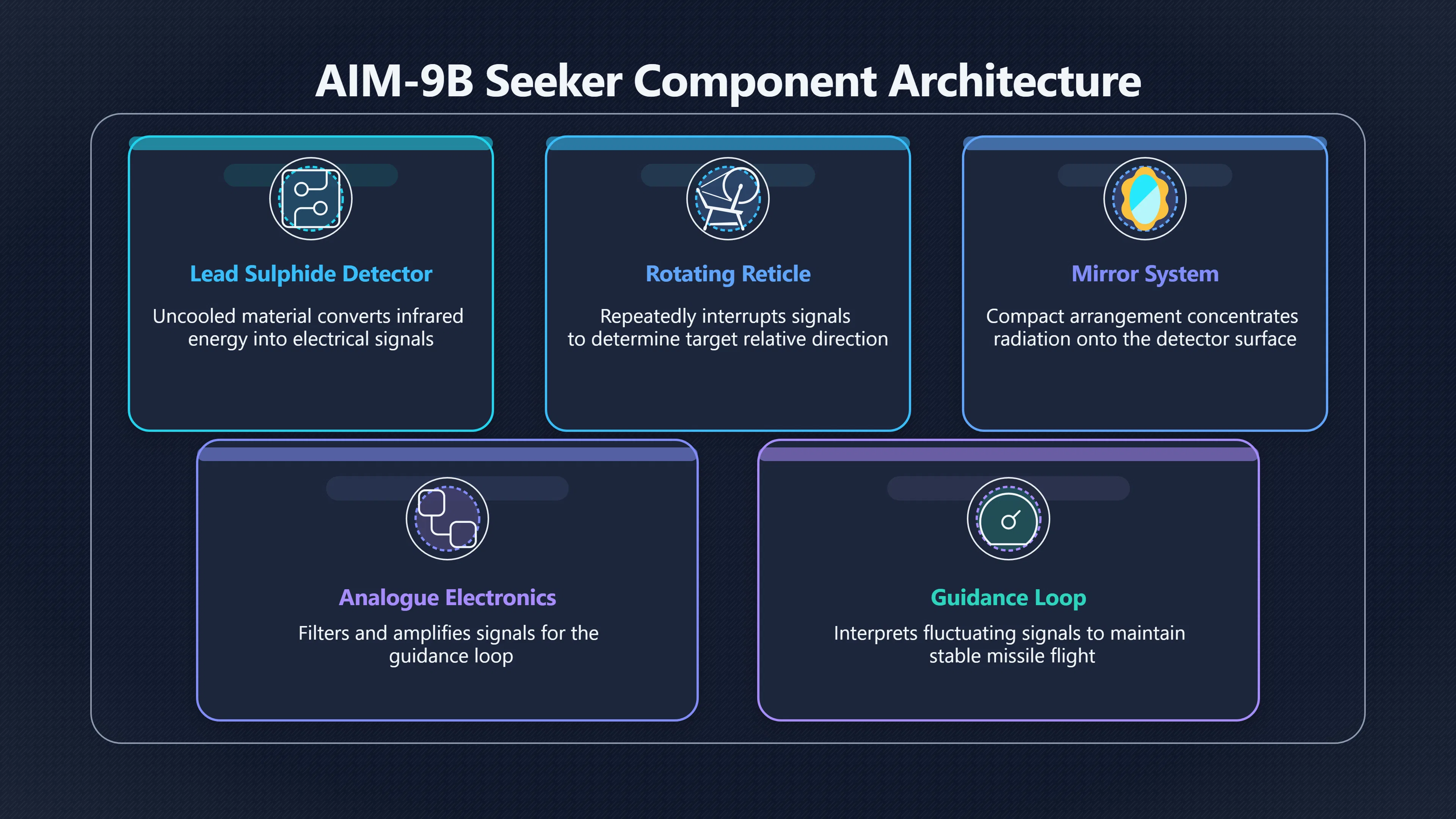
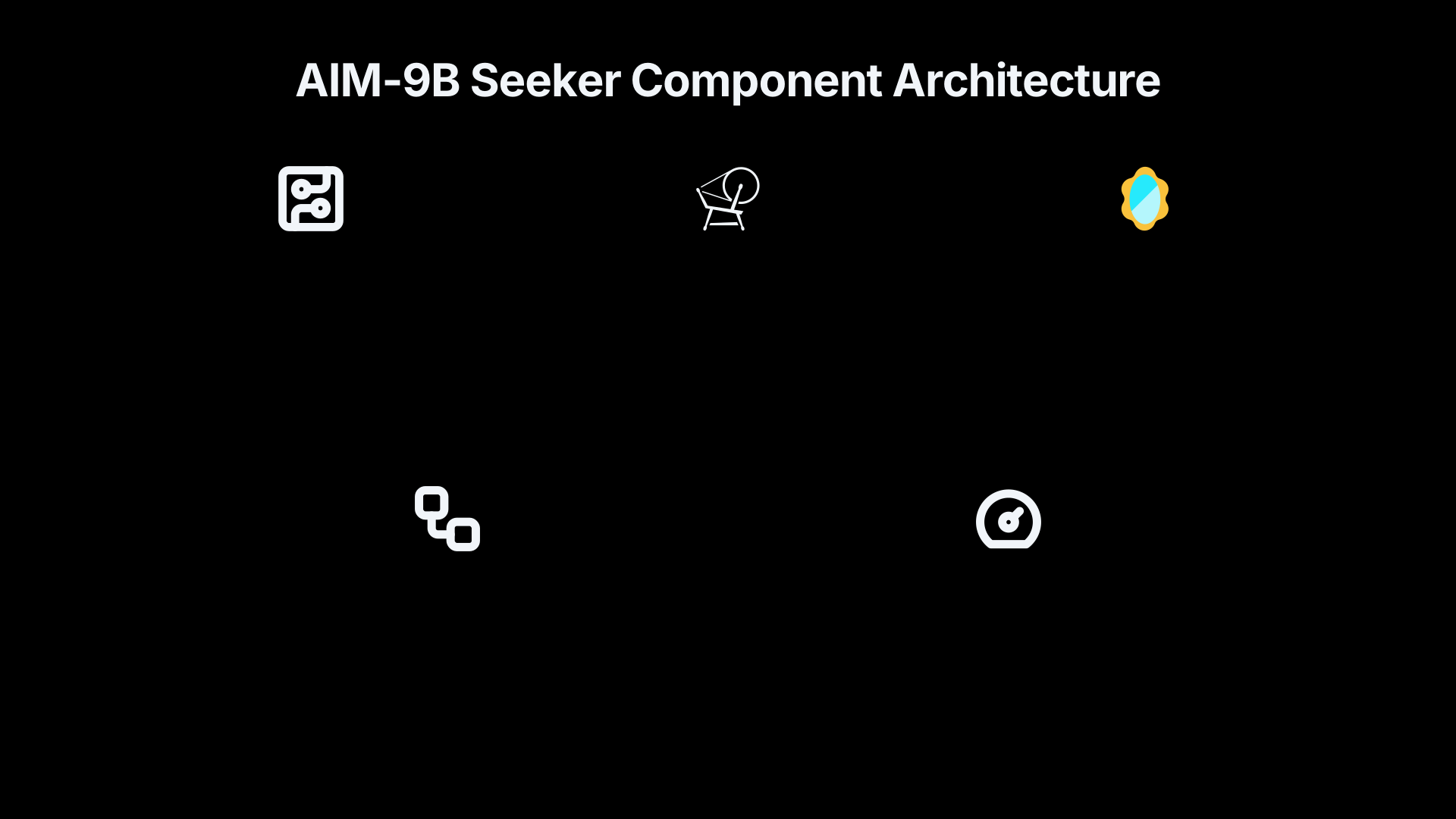
The AIM-9B seeker was built around an uncooled lead sulphide infrared detector, a rotating reticle and a compact mirror system. Rather than forming a detailed image of a target, the seeker converted changing infrared energy into electrical signals that told the missile whether a heat source was centred or off-centre in its field of view. The rotating reticle repeatedly interrupted the incoming infrared signal, allowing the guidance electronics to determine the direction of the target relative to the missile’s nose.[Air Power Australia]ausairpower.netAir Power AustraliaThe Sidewinder Story / The Evolution of the AIM-9 Missileby C Kopp · 1994 · Cited by 22 — The simplest strategy for de…
This sounds straightforward, but the seeker was really a complete sensing system rather than a collection of individual parts. Performance depended on several interacting factors:
- The optical quality and alignment of the mirrors.
- The sensitivity and consistency of the lead sulphide detector.
- The exact characteristics of the rotating reticle.
- The filtering and amplification performed by analogue electronics.
- The stability of the guidance loop interpreting the signals.[Air Power Australia]ausairpower.netAir Power AustraliaThe Sidewinder Story / The Evolution of the AIM-9 Missileby C Kopp · 1994 · Cited by 22 — The simplest strategy for de…
A reverse engineer could identify these components, but reproducing their combined behaviour required understanding manufacturing tolerances and operational tuning that were not obvious from physical inspection alone.
The difficulty is reflected in the history of the Soviet K-13 (AA-2 Atoll), which successfully copied the overall Sidewinder architecture but still displayed operational differences. Contemporary accounts note that early K-13 variants had significantly longer seeker settling times than the original AIM-9B, showing that matching appearance and matching behaviour were not the same thing.[Wikipedia]WikipediaK-13 (missileK-13 (missile
Why Rear-Aspect Lock-On Limited Combat Use
The AIM-9B’s seeker was not an all-purpose infrared sensor. It was a highly constrained rear-aspect seeker that could reliably track only the hottest parts of an aircraft, usually engine exhaust viewed from behind. Early versions had a very narrow effective acquisition envelope and were vulnerable to interference from the sun and other heat sources. Pilots often had to position their aircraft carefully before launch to achieve a usable lock.[Wikipedia]WikipediaAIM-9 SidewinderAIM-9 Sidewinder
This limitation matters because it reveals how much seeker performance depended on subtle sensitivity thresholds. If a copied detector was slightly less sensitive, the missile might lose lock at longer range. If it was slightly more susceptible to noise, it might chase false heat sources. If its scan pattern differed even modestly, target acquisition could become less reliable.[Air Power Australia]ausairpower.netAir Power AustraliaThe Sidewinder Story / The Evolution of the AIM-9 Missileby C Kopp · 1994 · Cited by 22 — The simplest strategy for de…
The AIM-9B’s combat usefulness therefore emerged from a narrow balance:
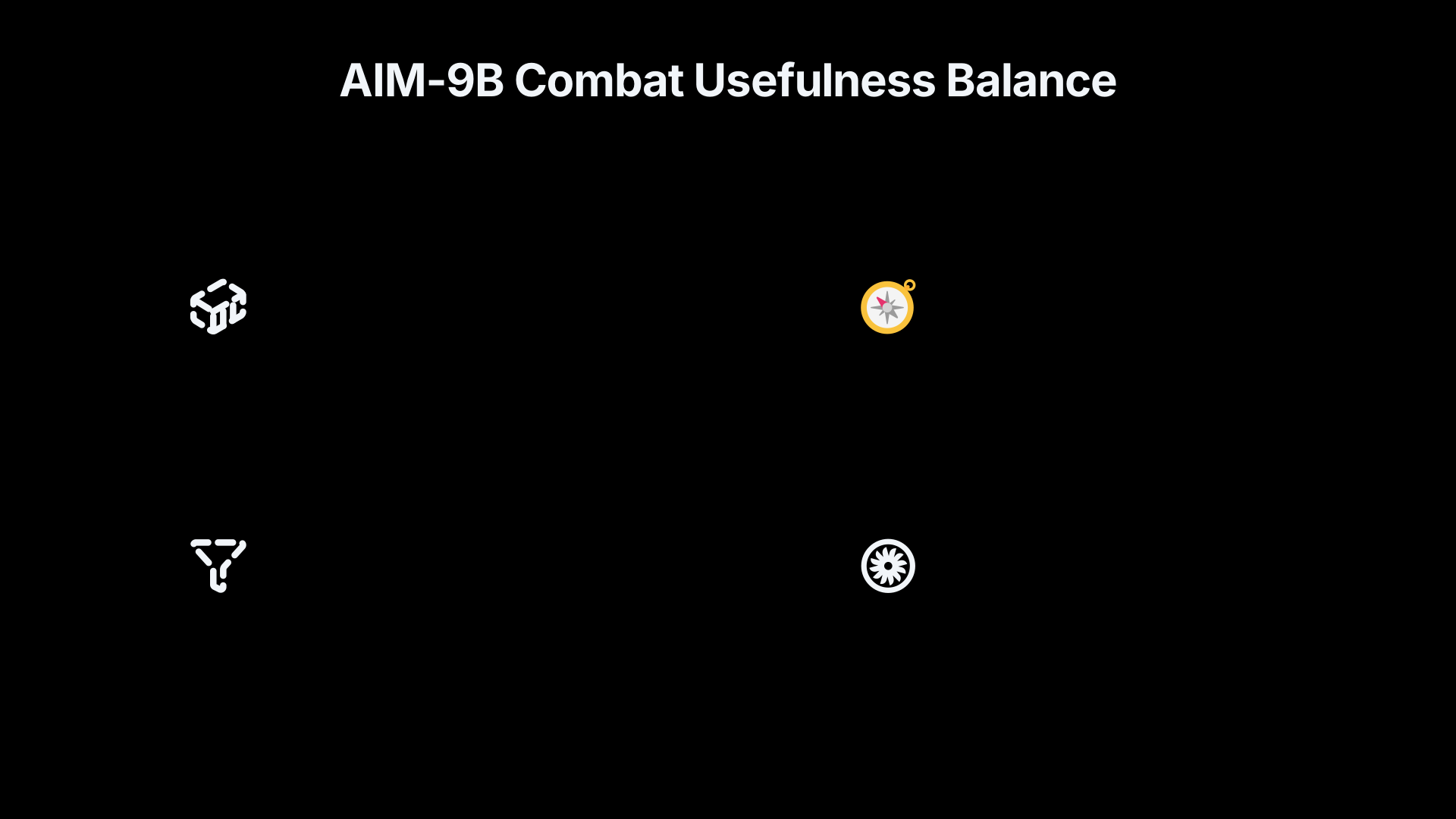
- Sensitive enough to detect engine exhaust.
- Selective enough to reject background radiation.
- Stable enough to guide accurately.
- Simple enough to be mass-produced.[Air Power Australia]ausairpower.netAir Power AustraliaThe Sidewinder Story / The Evolution of the AIM-9 Missileby C Kopp · 1994 · Cited by 22 — The simplest strategy for de…
Replicating that balance was harder than copying the visible hardware.

How Small Seeker Differences Changed Operational Performance
One of the most important lessons from the Sidewinder story is that tiny seeker differences could create major operational consequences.
The lead sulphide detector was particularly significant. Infrared detectors are not interchangeable components whose performance can be inferred simply by measuring dimensions. Their sensitivity depends on material purity, manufacturing processes and calibration. Two detectors that appear identical may respond differently to weak heat sources. In a rear-aspect missile already operating near the limits of available infrared energy, such differences mattered greatly.[Air Power Australia]ausairpower.netAir Power AustraliaThe Sidewinder Story / The Evolution of the AIM-9 Missileby C Kopp · 1994 · Cited by 22 — The simplest strategy for de…
The optics created similar challenges. The AIM-9B used a compact optical arrangement that concentrated infrared radiation onto a small detector. Small deviations in mirror alignment, surface quality or optical filtering could alter signal strength and tracking accuracy. These were not design secrets visible from a schematic; they were embedded in production quality and assembly practice.[Air Power Australia]ausairpower.netAir Power AustraliaThe Sidewinder Story / The Evolution of the AIM-9 Missileby C Kopp · 1994 · Cited by 22 — The simplest strategy for de…
The analogue guidance electronics added another layer of complexity. Early Sidewinders relied on continuous interpretation of fluctuating signals from the spinning reticle. Engineers copying the circuitry still had to reproduce gain settings, filtering characteristics and dynamic response closely enough that the missile would neither overreact nor respond too slowly. A seeker that oscillated excessively or tracked sluggishly could miss manoeuvring targets even if every major component appeared correct.[Air Power Australia]ausairpower.netAir Power AustraliaThe Sidewinder Story / The Evolution of the AIM-9 Missileby C Kopp · 1994 · Cited by 22 — The simplest strategy for de…
Why the Seeker Was a Reverse-Engineering Lesson
The Sidewinder is often cited as one of history’s most successful examples of military reverse engineering because the Soviet Union produced a functional equivalent remarkably quickly. Yet the seeker demonstrates the limits of what a captured weapon can reveal.
The missile exposed its architecture: engineers could examine the detector, the reticle, the optics and the guidance arrangement directly. What it did not automatically reveal was the accumulated manufacturing knowledge behind those parts. The difference between a missile that works occasionally and one that works consistently often lies in detector quality, calibration procedures, assembly tolerances and testing methods rather than in visible design features.[chinalakemuseum.org]chinalakemuseum.orgChina Lake Museum FoundationWeapons… Sidewinder development: simplicity, reliability, maintainability, producibility, improvability. Mi…
This is why the AIM-9B seeker remains an instructive case in reverse engineering foreign military technology. The physical design could be copied, and eventually was. The harder task was reproducing the subtle performance characteristics that allowed a seemingly simple heat-seeking missile to function reliably in combat. The seeker looked simple because its designers had already solved a series of difficult optical, electronic and manufacturing problems. Reverse engineers inherited the hardware, but they still had to rediscover many of those solutions for themselves.[ausairpower.net]ausairpower.netAir Power AustraliaThe Sidewinder Story / The Evolution of the AIM-9 Missileby C Kopp · 1994 · Cited by 22 — The simplest strategy for de…
Amazon book picks
Further Reading
Books and field guides related to Why the Sidewinder Seeker Was Hard to Copy. Use these as the next step if you want deeper reading beyond the article.
Missile Design and System Engineering
Explains seeker performance, guidance and integration.
Introduction to Infrared and Electro-Optical Systems, Third E...
Provides background on infrared detection and sensing.
eBay marketplace picks
Marketplace Samples
Live-tested eBay searches with available results related to this page.



Endnotes
1.
Source: Wikipedia
Title: AIM-9 Sidewinder
Link:https://en.wikipedia.org/wiki/AIM-9_Sidewinder
2.
Source: Wikipedia
Title: K-13 (missile)
Link:https://en.wikipedia.org/wiki/K-13_%28missile%29
3.
Source: onr.navy.mil
Link:https://www.onr.navy.mil/media/document/sidewinder-missile
Source snippet
Sidewinder missileSidewinder locked on and reimagined air combat. Sidewinder's simplicity, reliability and effectiveness made it a critic...
4.
Source: youtube.com
Title: The Genius Engineering of the AIM-9 Sidewinder
Link:https://www.youtube.com/watch?v=LuhyUP9PmfU
Source snippet
Sidewinder - The Weapon That Changed Air Combat...
5.
Source: youtube.com
Link:https://www.youtube.com/watch?v=TGTOVA3tWpQ
Source snippet
This video provides an excellent visual exploration of the engineering challenges and history behind reverse engineering the heat-seeking...
6.
Source: ausairpower.net
Link:https://www.ausairpower.net/TE-Sidewinder-94.html
Source snippet
Air Power AustraliaThe Sidewinder Story / The Evolution of the AIM-9 Missileby C Kopp · 1994 · Cited by 22 — The simplest strategy for de...
7.
Source: chinalakemuseum.org
Link:https://chinalakemuseum.org/weapons
Source snippet
China Lake Museum FoundationWeapons... Sidewinder development: simplicity, reliability, maintainability, producibility, improvability. Mi...
8.
Source: af.mil
Title: aim 9 sidewinder
Link:https://www.af.mil/About-Us/Fact-Sheets/Display/Article/104557/aim-9-sidewinder/
Source snippet
Air ForceAIM-9 Sidewinder > Air Force > Fact Sheet DisplayThe AIM-9 Sidewinder is a supersonic, heat-seeking, air-to-air missile carried...
Additional References
9.
Source: x.com
Link:https://x.com/RealAirPower1/status/2039010992009429101?lang=en
Source snippet
Air PowerAfter feverishly reverse-engineering every screw and circuit, their near-perfect clone, the Vympel K-13 (aka AA-2 Atoll), entere...
10.
Source: medium.com
Link:https://medium.com/%40OpenSeason/1946-germany-has-been-defeated-and-its-military-technology-put-under-the-microscope-the-west-e60b82926b40
Source snippet
Fox Two — Infrared Missile Target TrackingThe purpose of this article is to explore the techniques the missile uses to track and attack t...
11.
Source: reddit.com
Link:https://www.reddit.com/r/hoggit/comments/ai7n8o/til_that_the_soviet_aa2_atoll_missile_was_reverse/
Source snippet
TIL that the Soviet AA-2 Atoll missile was reverse...The Soviet AA-2 Atoll missile was reverse engineered from a US AIM-9 Sidewinder aft...
12.
Source: youtube.com
Link:https://www.youtube.com/watch?v=Vr1mCaBoDWk
Source snippet
EVERY SIDEWINDER COMPARED: AIM-9B to AIM-9LHow one missile changed air combat | The AIM-9 Sidewinder. Australian Military Aviation Histor...
13.
Source: youtube.com
Link:https://www.youtube.com/watch?v=_Uwk4eiJ07o
Source snippet
How Heat Seeking Missile Works I Aim 9 SidewinderThe heat source from this aircraft travels through a set of lenses into the reticle, whi...
14.
Source: si.edu
Link:https://www.si.edu/object/missile-air-air-atoll-also-designated-k-13-aa-2%3Anasm_A19930363000
Source snippet
dewinder air-to-air, heat-seeking missile. Atoll originated in 1958, when a Sidewinder...Read more...
15.
Source: strasam.org
Link:https://strasam.org/en/defense/aerospace-industry/how-the-soviets-were-able-to-copy-the-american-aim-9-sidewinder-airborne-missile-through-reverse-engineering-and-espionage-during-the-cold-war-3362
Source snippet
n the Soviet Union and the AIM-9 Sidewinder, designated PL-2 under licence in...Read more...
16.
Source: airuniversity.af.edu
Title: 2020 11 30 Air to Air Missiles and Guidance Systems
Link:https://www.airuniversity.af.edu/Portals/10/CASI/[documents
Source snippet
by TextOre, Inc. - Air UniversityChina's first semi-active radar-homing (SARH) AAM, the PL-4 was developed in the 1960s and was intended...
17.
Source: facebook.com
Link:https://www.facebook.com/officeofnavalresearch/posts/the-worlds-most-widely-used-air-to-air-missile-began-as-a-side-project-today-mor/1048334627463454/
Source snippet
day, more than 70 years later, the Sidewinder missile remains in...
18.
Source: odin.t2com.army.mil
Link:https://odin.t2com.army.mil/WEG/Asset/03939621dfbb69fcaf2fad181c1939aa
Source snippet
army.milK-13 (AA-2 Atoll) Russian Short-Range Infrared Homing Air...13 Jan 2025 — The Sidewinder was quickly reverse engineered as the K...
Topic Tree