Within Foreign Materiel
Paper Plans or Real Machines?
Documents explain design intent, but hardware shows what was actually built, maintained and fielded.
On this page
- What documents reveal
- What hardware corrects
- Best evidence together
Page outline Jump by section
Introduction
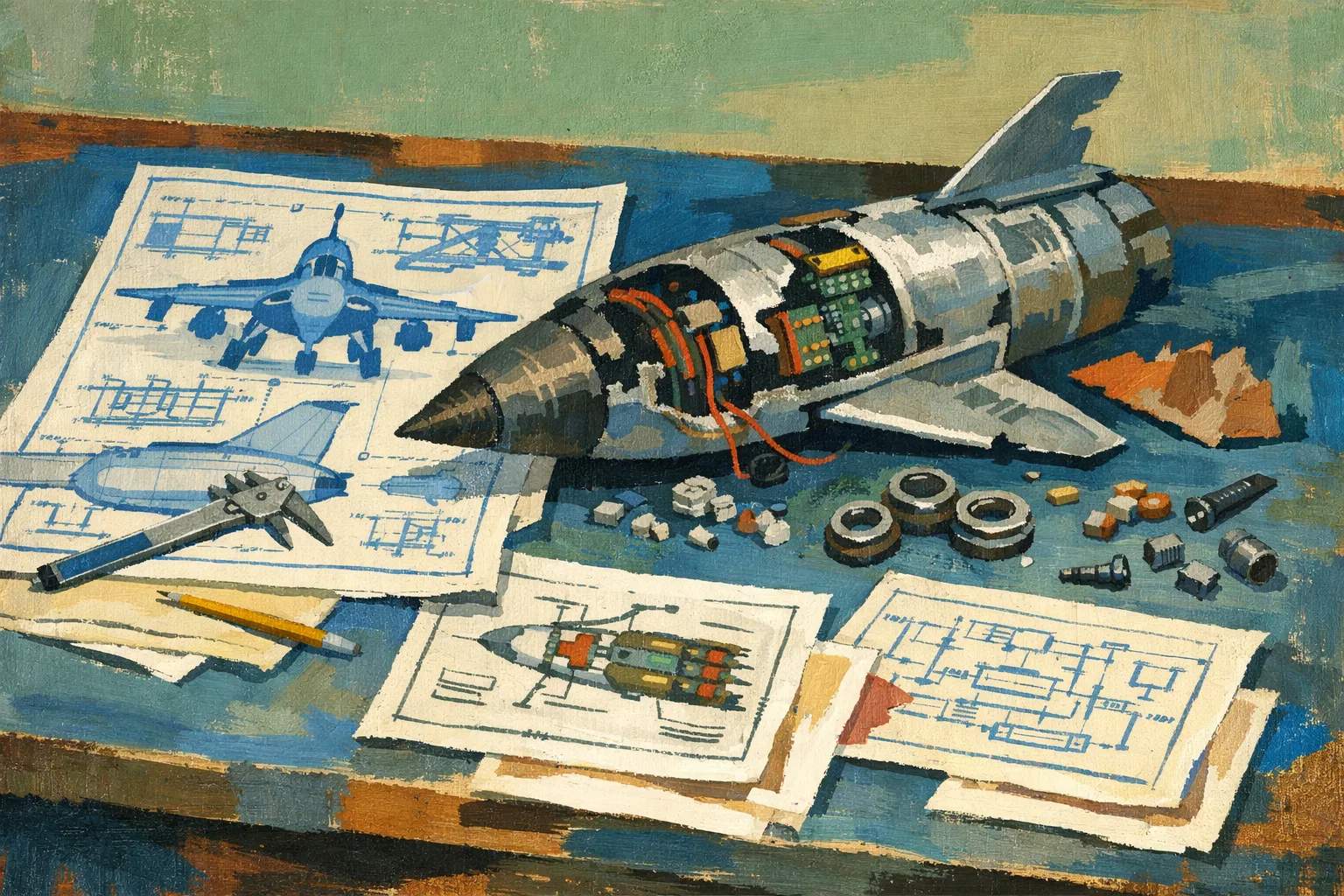
Captured documents and captured hardware answer different questions in reverse engineering foreign military technology. Documents can reveal design intent: what engineers hoped a radar, missile, aircraft or vehicle would do, how operators were trained to use it, what maintenance intervals were expected, and which variants were planned. Hardware shows the messier truth: what was actually manufactured, fielded, repaired, modified, degraded, improvised or substituted under wartime pressure. The strongest exploitation work uses both.
That distinction matters because a blueprint, manual or firing table can make a foreign system legible, but it can also mislead if it describes an ideal version rather than the object on the battlefield. A captured aircraft, missile fragment, circuit board or engine can correct the paper record by exposing tolerances, wear, counterfeit parts, production shortcuts, field modifications and real performance limits. Modern foreign materiel exploitation treats documents and machines as linked evidence, not rival evidence: one explains what the system was supposed to be; the other tests whether that story survived contact with production, maintenance and combat. US Army doctrine explicitly links captured technical documents such as firing tables, logbooks and equipment manuals with the evacuation or photographic documentation of equipment for captured materiel exploitation centres.[Public Intelligence |]info.publicintelligence.netPublic IntelligencePublic Intelligence
What Documents Reveal Before the Hardware Speaks
Captured documents are often the fastest way to understand an unfamiliar military system. A missile fragment may show a circuit board and actuator, but a technical manual can name assemblies, define test procedures, identify expected voltages, describe launch sequencing and explain which faults the operator was taught to recognise. In a wartime exploitation chain, this is not a minor convenience. It can turn a mysterious object into a structured problem.
The value of paper intelligence is clearest when the documents are technical rather than merely administrative. The Smithsonian’s National Air and Space Museum catalogue of captured German technical documents from 1941–1946 records microfilmed US Navy translations covering long-range bombers, propulsion, infrared research, optics, turbomachinery, flutter research, torpedoes, radar and other technical topics. That sort of material does not merely say that a weapon existed; it can show the research questions, engineering vocabulary and development path behind it.[SOVA]sova.si.eduOpen source on si.edu.
Documents are especially useful in four ways:
- They reveal design intent. Plans, specifications and research reports can show what a foreign engineering team valued: speed over endurance, simplicity over precision, mass production over maintainability, or modularity over tight integration.
- They explain operation and maintenance. Manuals, checklists, fault logs and firing tables can show what crews were meant to do, how often components were inspected, and which failures were common enough to be anticipated.
- They expose variants and future plans. A single captured vehicle may represent only one production batch, while documents can point to other marks, upgrades, experimental versions or planned countermeasures.
- They preserve context that hardware alone cannot. A recovered circuit board may identify a component; a packing slip, logbook or depot record may indicate how it moved through a supply chain.
Operation LUSTY, the US Army Air Forces effort to exploit German aeronautical technology after the Second World War, illustrates why documents were treated as a primary intelligence target rather than an afterthought. The National Museum of the US Air Force describes the operation as an effort to exploit captured German scientific documents, research facilities and aircraft, with one team collecting aircraft and weapons while another recruited scientists, collected documents and investigated facilities.[Air Force Museum]nationalmuseum.af.milOperation LUSTY > National Museum of the United States Air Force > Display…
That split of labour is revealing. The aircraft mattered, but so did the paper world around them: reports, drawings, test data, factory records and the people who could interpret them. A captured jet without documentation could still be measured and flown, but documents could explain why certain design choices had been made, which problems German engineers already knew about, and which projects were promising but not yet mature.

What Hardware Corrects
Hardware is the corrective to the document’s idealised version of reality. A manual can state a maintenance interval; the machine can show whether crews were actually replacing parts, improvising fixes or running systems beyond intended limits. A blueprint can define a clean design; a captured example can reveal cheaper substitute components, rough machining, unapproved field modifications, corrosion, heat damage, battle repairs or manufacturing variation between batches.
This is why foreign materiel exploitation is built around physical analysis, testing and evaluation, not just translation. A 1997 US Department of Defense Inspector General audit defined foreign materiel exploitation as the analysis, testing and evaluation of foreign materiel, including testing against US equipment, and noted that its results supported acquisition programmes, test and evaluation, threat simulator and target development, modelling, training and tactics.[U.S. Department of War]media.defense.govU.S. Department of War Use of Foreign Materiel Exploitation ResultsU.S. Department of War Use of Foreign Materiel Exploitation Results(https://media.defense.gov/1997/Oct/08/2001715489/-1/-1/1/98-005.pdf)
The difference is not abstract. In the Cold War, the US exploitation of captured or covertly acquired Soviet aircraft showed how a real machine could convert general intelligence into specific tactics. The National Security Archive describes the HAVE DOUGHNUT MiG-21 exploitation as including a 300-page Defense Intelligence Agency report and related briefing material focused on evaluating existing US Air Force and Navy tactical manoeuvres, exploiting the MiG-21’s tactical capabilities and limitations, and developing tactics to defeat it.[National Security Archive]nsarchive.gwu.eduOpen source on gwu.edu.
A manual might describe the MiG-21 as a high-performance interceptor. Flight testing against US aircraft showed what that meant in a fight: visibility limits, speed limits at low altitude, turn performance, acceleration, weapon employment and the situations in which US pilots should avoid or force particular engagements. The important intelligence was not simply “what is the MiG-21?” but “how does this exact aircraft behave when flown hard against our own aircraft?”
Hardware also reveals whether earlier assessments were right. NASIC’s account of the North Korean MiG-15 delivered by defector No Kum-Sok says US pilots conducted 11 test flights, engineers modified instrumentation, and the aircraft was later examined at Wright-Patterson Air Force Base. NASIC’s historian is quoted as saying the exploitation confirmed that prior US technical assessments had been “98 percent correct”, which is itself an important point: physical capture did not replace analysis, but validated and sharpened it.[NASIC]nasic.af.milAcquire, Assess, Exploit > National Air and Space Intelligence Center > Article Display…
Paper Plans and Real Machines Can Disagree
The most useful intelligence often comes from the disagreement between captured documents and captured hardware. A document may show the authorised design; the hardware may show what the factory could actually produce. A maintenance card may show scheduled servicing; the machine may show neglected lubrication, cannibalised parts or battle damage. A parts list may identify a domestic component; the physical board may reveal imported electronics or substitute suppliers.
This gap is particularly visible in modern missile and drone exploitation. Investigators do not only ask what a weapon was designed to do. They also examine the components it actually contains, their markings, production dates, serial numbers and supply-chain clues. Conflict Armament Research has reported that its investigators observed post-invasion components in Russian weapon systems in Ukraine, a finding that matters precisely because the physical components can expose acquisition patterns that official documentation or export-control declarations may not show.[Conflict Armament Research]conflictarm.comfield dispatchesfield dispatches
For sanctions and procurement analysis, hardware can be more probative than a captured manual. A manual might identify a system as Russian, Iranian or North Korean by design lineage; a recovered chip, inertial sensor, radio module or connector can point to commercial supply chains, diversion routes and recent production. Reuters reported in 2024 that debris from a North Korean missile used in Ukraine contained numerous components from US-based companies, with Conflict Armament Research finding that 75 per cent of the electronic components were linked to US companies.[Reuters]reuters.comDebris from North Korean missile in Ukraine could expose procurement networksDebris from North Korean missile in Ukraine could expose procurement networks
The same logic applies to battlefield adaptation. Documents may describe a standard configuration, but recovered equipment can show how quickly a system is being modified. If a drone’s navigation package changes, if a missile gains a different seeker, if a vehicle’s armour is patched in the field, or if an electronic warfare system uses different commercial modules from one batch to the next, the hardware becomes a running record of adaptation. A paper file may lag behind that reality.
Why the Best Evidence Is the Pairing
The best exploitation work treats documents and hardware as mutually checking evidence. Documents reduce ambiguity; hardware tests the document. Together, they answer three linked questions: what was intended, what was built, and what was actually fielded.
Operation LUSTY again provides a useful historical pattern. It did not simply collect aircraft. It collected aircraft, weapons, scientific documents, research facilities and personnel. In the end, US collectors acquired 16,280 items, amounting to 6,200 tons, from which 2,398 separate items were selected for technical analysis.[Air Force Museum]nationalmuseum.af.milOperation LUSTY > National Museum of the United States Air Force > Display… The scale matters because reverse engineering a foreign military technology is rarely a single-object exercise. It is a reconstruction of a technical ecosystem.
A captured aircraft, for example, is more valuable when analysts also have:
- maintenance tools and spare parts, because these show how the system was meant to be sustained;
- manuals and checklists, because these show normal operating assumptions;
- test reports, because these show what designers knew or claimed;
- logbooks, because these show usage, failure and repair history;
- comparable friendly equipment, because testing against one’s own systems turns measurement into tactics.
US Army foreign materiel exploitation rules make the same point institutionally. The Army’s FMEP regulation defines the programme as life-cycle management of foreign ground-force systems and related materiel for producing scientific and technical intelligence, assessing foreign technology for possible use in US development, supporting testing with adversary systems, and developing simulators.[Intelligence Resource Program]irp.fas.orgOpen source on fas.org. Those outputs require both the documentary description of a threat and the physical basis for validating it.
The 1997 DoD audit also shows why this pairing matters after the first analysis is complete. It found that foreign materiel exploitation results were disseminated to testing, simulator, target-development, training and tactics communities, but warned that simulated threat systems were not always validated against the latest exploitation data. In other words, the danger was not lack of documents alone or lack of hardware alone; it was allowing models and simulators to drift away from current evidence.[U.S. Department of War]media.defense.govU.S. Department of War Use of Foreign Materiel Exploitation ResultsU.S. Department of War Use of Foreign Materiel Exploitation Results(https://media.defense.gov/1997/Oct/08/2001715489/-1/-1/1/98-005.pdf)
The Modern Version: Shared Databases, Samples and Battlefield Debris
The documents-versus-hardware distinction has become more visible in the war in Ukraine because captured and recovered systems are being studied not only by national intelligence bodies but also by arms-control investigators, research organisations, defence companies and partner governments. Ukraine’s TrophyLab platform is a clear example of the combined-evidence model. Its official site says verified users can access a catalogue of captured Russian equipment samples and research results, study research online, or request samples for offline analysis. It lists more than 115 samples across 79 categories and says technical specifications, blueprints and research results are available.[TrophyLab]trophylab.mod.gov.uaOpen source on mod.gov.ua.
That design is significant because it treats data and objects as a package. A partner can read technical specifications and blueprints, but the option to request offline analysis recognises that some questions require touch, measurement, disassembly or independent testing. A blueprint may say where an antenna should be; a damaged drone can show whether the antenna survived impact, whether it was shielded, whether it was replaced, and whether it matches other recovered examples.
Recent reporting on TrophyLab emphasises the same combined model. The Jerusalem Post reported that Ukraine’s Defence Ministry launched the secure digital platform to provide authorised partners with technical information from captured Russian equipment, describing it as a structured environment for storing and distributing documentation and research from examined systems.[Jerusalem Post]jpost.comJerusalem Post Ukraine launches Trophy Lab to share data from capturedJerusalem Post Ukraine launches Trophy Lab to share data from captured Business Insider reported that the platform includes technical data on drones, missiles, armoured vehicles and electronic systems, and that Ukraine may provide physical samples for further study.[Business Insider]businessinsider.comThe initiative aims to facilitate collaboration among Ukraine’s defense manufacturers, NATO members, and foreign research labs by enablin…
This approach compresses what used to be a slower intelligence cycle. Instead of one laboratory receiving one object and producing one classified report months later, a controlled platform can distribute research findings, component data, imagery and requests for samples among multiple trusted users. That does not make the work simple or risk-free, but it reflects a modern reality: foreign technology exploitation is no longer just about copying a weapon. It is also about building countermeasures, closing procurement loopholes, updating training, identifying suppliers and warning allies quickly.
Common Misreadings of Captured Evidence
The first common error is to treat documents as more authoritative because they look complete. A neat manual or design drawing may be internally coherent, but it can describe a prototype, an export variant, an aspirational requirement or an outdated configuration. Without hardware, analysts may mistake intention for reality.
The second error is to treat a single captured object as representative. One missile, vehicle or aircraft can be unusually well maintained, unusually damaged, from an early batch, from a later emergency-production run, or modified by a particular unit. Hardware is concrete, but it is still a sample. Its value rises when compared with documents, multiple recovered examples, serial-number patterns and field reports.
The third error is to confuse identification with exploitation. Naming a system is only the beginning. The harder questions are about performance limits, reliability, supply chains, crew workload, maintainability, electronic signatures, software behaviour and battlefield adaptation. That is why formal exploitation systems route technical intelligence equipment to specialised centres and treat associated documents, photographs and descriptions as part of the same evidence chain.[Public Intelligence |]info.publicintelligence.netPublic IntelligencePublic Intelligence
The fourth error is to assume reverse engineering means copying. Sometimes it does produce direct imitation, but in foreign military technology it often produces countermeasures, simulators, tactics, export-control leads or vulnerability assessments. NASIC’s public description of foreign materiel exploitation stresses dissecting foreign hardware with multidisciplinary experts and using the information to understand adversary capabilities, weapons and tactics, rather than presenting the mission as simple replication.[NASIC]nasic.af.milAcquire, Assess, Exploit > National Air and Space Intelligence Center > Article Display…
The Practical Test: Which Evidence Changes Decisions?
The most useful way to compare captured documents and captured hardware is to ask what decision each can change.
Documents can quickly change interpretation. They may tell analysts that a radar mode exists, that a missile has a particular operating sequence, that a vehicle uses a known engine family, or that a maintenance routine is required every set number of hours. They are excellent for orientation, translation, naming, procedure and intent.
Hardware can change confidence. It can show that the radar mode is present but poorly implemented, that the missile uses a different supplier’s component, that the engine is worn beyond normal limits, that the wiring differs from the diagram, or that field crews have bypassed a subsystem. It is excellent for validation, measurement, failure analysis and discovering what no manual admits.
Together, they can change tactics and policy. The HAVE DOUGHNUT MiG-21 work was valuable because it translated a physical aircraft into tactical guidance for US aircraft and weapons. Modern component exploitation in Ukraine is valuable because physical debris and serial numbers can inform sanctions enforcement, supply-chain investigations and countermeasure design. TrophyLab’s value lies in combining technical documentation, research results and physical samples so that partners can move from reading about foreign systems to testing what was actually recovered.[gwu.edu]nsarchive.gwu.eduOpen source on gwu.edu.
Bottom Line
Documents explain the plan; hardware tests the plan. In reverse engineering foreign military technology, neither is enough on its own. Captured documents can reveal intent, procedures, design logic and variant history, but they can be incomplete, obsolete or aspirational. Captured hardware can reveal production reality, battlefield modifications, component sourcing, reliability and true performance, but one object may not represent the whole fleet.
The strongest evidence comes when the two are reconciled: manuals against wear marks, blueprints against circuit boards, firing tables against test shots, logbooks against broken parts, and factory specifications against battlefield debris. That is where foreign materiel exploitation becomes more than curiosity. It turns enemy technology into usable knowledge about what was designed, what was built, what was fielded, and what can be countered.
Amazon book picks
Further Reading
Books and field guides related to Paper Plans or Real Machines?. Use these as the next step if you want deeper reading beyond the article.
The Pentagon's Brain
Explains how intelligence, technology exploitation and defence research intersect.
Skunk Works
Shows the relationship between design intent, documentation, testing and real-world hardware.
Military Innovation in the Interwar Period
Demonstrates how doctrine, documents and equipment evolve together.
eBay marketplace picks
Marketplace Samples
Live-tested eBay searches with available results related to this page.
Endnotes
1.
Source: info.publicintelligence.net
Title: Public Intelligence
Link:https://info.publicintelligence.net/USArmy-DocumentMediaExploitation.pdf
2.
Source: sova.si.edu
Link:https://sova.si.edu/record/NASM.XXXX.0409
3.
Source: nationalmuseum.af.mil
Title: Air Force Museum
Link:https://www.nationalmuseum.af.mil/Visit/Museum-Exhibits/Fact-Sheets/Display/Article/196144/operation-lusty/
Source snippet
Operation LUSTY > National Museum of the United States Air Force > Display...
4.
Source: media.defense.gov
Title: U.S. Department of War Use of Foreign Materiel Exploitation Results
Link:https://media.defense.gov/1997/Oct/08/2001715489/-1/-1/1/98-005.pdf
5.
Source: nasic.af.mil
Link:https://www.nasic.af.mil/News/Article-Display/Article/1010245/acquire-assess-exploit/
Source snippet
Acquire, Assess, Exploit > National Air and Space Intelligence Center > Article Display...
6.
Source: reuters.com
Title: Debris from North Korean missile in Ukraine could expose procurement networks
Link:https://www.reuters.com/world/debris-north-korean-missile-ukraine-could-expose-procurement-networks-2024-02-22/
7.
Source: youtube.com
Title: Watson’s [Whizzers]({{ ‘whizzers/’ | relative_url }}): The Secret Team That Hunted Nazi Aviation
Link:https://www.youtube.com/watch?v=Y1YPnMq4ekI
Source snippet
Technical intelligence | Wikipedia audio article...
8.
Source: youtube.com
Title: Technical intelligence | Wikipedia audio article
Link:https://www.youtube.com/watch?v=0W0fncmgrlQ
Source snippet
This video provides a foundational breakdown of Technical Intelligence, explaining how military forces exploit captured enemy equipment...
9.
Source: nsarchive.gwu.edu
Link:https://nsarchive.gwu.edu/briefing-book/intelligence/2013-10-29/area-51-file-secret-aircraft-soviet-migs
10.
Source: conflictarm.com
Title: field dispatches
Link:https://www.conflictarm.com/field-dispatches/
11.
Source: irp.fas.org
Link:https://irp.fas.org/doddir/army/ar381-26.htm
12.
Source: trophylab.mod.gov.ua
Link:https://trophylab.mod.gov.ua/en/
13.
Source: jpost.com
Title: Jerusalem Post Ukraine launches [Trophy Lab]({{ ‘trophy-lab/’ | relative_url }}) to share data from captured
Link:https://www.jpost.com/defense-and-tech/article-900845
14.
Source: businessinsider.com
Link:https://www.businessinsider.com/inside-ukraine-move-to-spill-russian-north-korean-military-secrets
Source snippet
The initiative aims to facilitate collaboration among Ukraine’s defense manufacturers, NATO members, and foreign research labs by enablin...
Additional References
15.
Source: youtube.com
Title: Aviation Historian Peter Merlin talks about the Russian Mi Gs at AREA 51
Link:https://www.youtube.com/watch?v=t79ndKspdvQ
Source snippet
TECHINT on Russian T-80 Tank's Radio/Comms Electronics...
16.
Source: youtube.com
Title: National Ground Intelligence Center | Wikipedia audio article
Link:https://www.youtube.com/watch?v=7AaVn7szkMw
Source snippet
Watson's Whizzers: The Secret Team That Hunted Nazi Aviation...
17.
Source: youtube.com
Title: TECHINT on Russian T-80 Tank’s Radio/Comms Electronics
Link:https://www.youtube.com/watch?v=GSi-WX4nchU
Source snippet
National Ground Intelligence Center | Wikipedia audio article...
Topic Tree